
Why US Agencies Should Use Indian White-Label Web Development

White label web development agencies in India provide fully branded code, design, and deployment while staying invisible to the client, letting US agencies keep the margin and the relationship. They combine lower hourly rates, a deep pool of full-stack engineers, and a 9.5-12.5 hour time-zone offset that creates a reliable async workflow. The result is a repeatable, high-quality pipeline that lets agencies say yes to every custom build request.
Key takeaways
- Indian white-label teams charge 40-60% less per hour than US freelancers (Statista, 2023).
- The talent pool includes 1.5 million engineers with proven experience in AI, voice, and custom back-ends (NASSCOM, 2022).
- Overlap of 2-4 hours with US East Coast enables daily hand-offs without sacrificing speed.
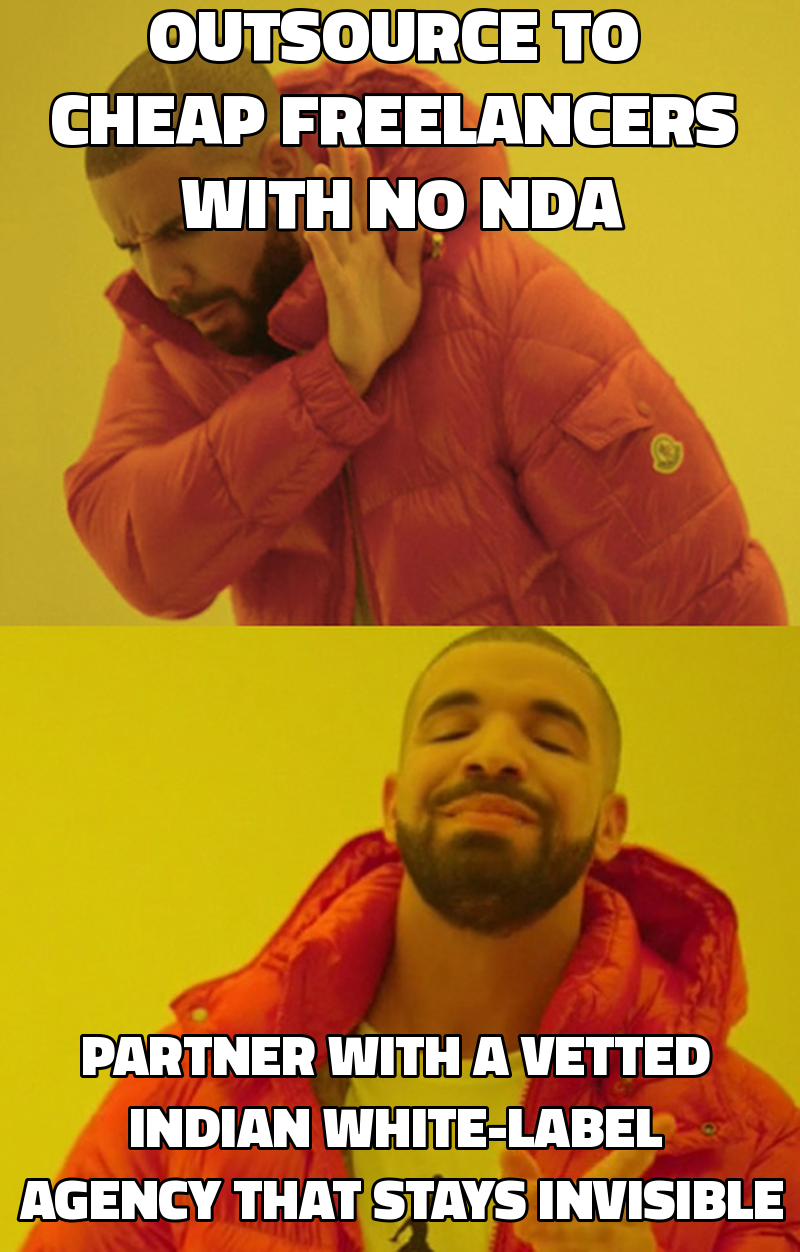
- Quality contracts, NDA, and a single point of contact protect the agency’s brand.
- A small paid pilot de-risky the partnership and unlocks a retainer for ongoing overflow.
What is white label web development in India?
White label web development means a third-party studio builds the product, but the agency presents it as its own work. In the Indian context, the partner typically operates from cities such as Bangalore, Hyderabad, or Pune, where a concentration of senior full-stack, AI, and voice engineers exists. The agency receives source code, design assets, and documentation under a non-disclosure agreement, and can brand the deliverable with its own logo and style guide. This model eliminates the need for the agency to hire a full-time developer while preserving the perception of a full-service offering.
How much can US agencies save with Indian partners?
A 2023 Deloitte Global Outsourcing Survey found that 62% of US agencies outsource development to offshore locations to improve margins. The same report notes an average hourly rate of $115 for US senior developers versus $25-$35 for comparable Indian engineers (Statista, 2023). For a typical $5,000 web-app project, an agency can save $3,000-$4,000 on labor alone. When you add lower overhead – no office space, no benefits, and no recruitment costs – the net margin improvement can exceed 50%.
| Metric | US Freelance/Agency Avg | Indian White-Label Avg | Savings |
|---|---|---|---|
| Hourly rate (senior) | $115 | $30 | 74% |
| Project management overhead | $1,200 per project | $300 per project | 75% |
| Total cost for $5k project | $6,200 | $2,300 | $3,900 |
Which Indian talent pools deliver agency-grade quality?
India’s tech education system produces roughly 2.5 million engineering graduates each year (NASSCOM, 2022). Within that, a subset of 150,000 engineers specialize in full-stack JavaScript, Python, and Go – the stacks most agencies request for SaaS and custom portals. Companies like Synthisia employ a vetting process that includes:
- Technical screening with live coding challenges.
- Portfolio review of production SaaS (e.g., RouteMate, a full-stack voice-automation platform).
- Soft-skill assessment for English fluency and client-facing communication. The result is a talent bench that can handle AI automation, voice-assistant integration, and complex back-end workflows that no-code tools cannot achieve.
How does the time zone difference become an advantage?
The 9.5-12.5 hour gap between IST and US Eastern Time creates a natural “follow-the-sun” pipeline. A typical workflow looks like this:
- Day 1 US morning: Agency provides brief, assets, and acceptance criteria.
- Day 1 India evening: Development team starts work, pushes daily builds to a shared GitHub repo.
- Day 2 US morning: Agency reviews, adds feedback, and the cycle repeats. Because the hand-off happens at the start of each day, turnaround times of 7-10 business days for a medium-complexity web app become realistic, even without “same-week” promises. The overlap of 2-4 hours (US West Coast with IST) also allows real-time video stand-ups when needed.
What quality safeguards protect agency reputation?
- NDA + non-circumvent clause – standard legal protection that prevents the partner from approaching the agency’s clients directly.
- Single point of contact (SPOC) – a dedicated delivery manager who owns the timeline, quality gates, and client communication.
- Automated testing suite – unit, integration, and UI tests run on every pull request, ensuring code quality before delivery.
- Design system compliance – the partner follows the agency’s brand kit, typography, and component library, guaranteeing visual consistency.
- Post-delivery warranty – a 30-day bug-fix window included in the pilot, demonstrating confidence in the output. These safeguards address the common fear that “outsourcing will expose the agency’s brand” and provide a concrete framework that agencies can audit.
How to choose the right Indian white-label partner
| Criteria | Why it matters | Typical red flag |
|---|---|---|
| Proven agency-grade portfolio | Shows ability to work under a brand umbrella | Only personal freelancer projects listed |
| Fixed-scope pilot option | De-risks the first engagement | Refuses any upfront cost or scope definition |
| Dedicated SPOC | Guarantees accountability | Multiple rotating contacts with no clear owner |
| NDA & non-circumvent clause | Protects client relationships | No legal contract offered |
| Capacity limits | Prevents the “flaky freelancer” scenario | Claims unlimited bandwidth without references |
When evaluating a partner, ask for a recent case study that matches your niche (e.g., a custom chatbot for a local retailer). Verify that the partner’s development stack aligns with your typical tech stack, and request a short 2-week pilot that costs a fraction of the full project.
Case study: Synthisia’s Silent Dev Arm delivering AI automation for a US agency
Client: A US-based growth agency with 12 staff, serving SMB retailers. The agency needed a voice-enabled inventory assistant but had no in-house devs. Challenge: The agency feared brand exposure and needed a quick proof of concept to win the client’s $8,000 budget. Solution: Synthisia offered a $1,500 fixed-scope pilot to build a prototype using Google Dialogflow and a Node.js backend. A single SPOC coordinated daily stand-ups across the time-zone gap. Outcome: The prototype shipped in 9 calendar days, passed the agency’s QA, and the client approved a full build worth $12,000. The agency retained 65% margin, and Synthisia entered a $1,500 monthly retainer for ongoing feature upgrades. Key takeaways: A low-cost pilot built trust, the time-zone overlap delivered rapid feedback, and the NDA kept the agency’s brand front-and-center.
Cost vs quality matrix for offshore options
| Option | Avg hourly rate | Typical quality rating (1-5) | Brand exposure risk | Ideal use case |
|---|---|---|---|---|
| Indian white-label agency (vetted) | $30 | 4.5 | Low (NDA, SPOC) | Ongoing custom SaaS, AI, voice |
| Individual Indian freelancer (platform) | $20 | 3.0 | Medium (no brand guard) | Small one-off fixes |
| US boutique dev shop | $110 | 4.8 | Low (same country) | High-security or regulated apps |
| Low-cost offshore (Philippines, Vietnam) | $25 | 3.5 | Medium-high (no brand focus) | Simple landing pages |
Implementation checklist for agencies
- Step 1 – Qualification: Run the 10-second site test, confirm no development service listed, and verify recent client case studies.
- Step 2 – Pilot definition: Scope a 2-4 week pilot with clear deliverables, fixed price, and a 30-day warranty.
- Step 3 – Legal safeguards: Sign NDA and non-circumvent agreement before any code exchange.
- Step 4 – Communication plan: Set daily async updates via Slack or Teams, and schedule a 2-hour overlap video call twice a week.
- Step 5 – Quality gate: Require automated test coverage >80% and a design-system checklist before each release.
- Step 6 – Review & scale: After pilot success, negotiate a retainer (e.g., $1,500/month for 15-20 dev hours) and lock in capacity limits.
Frequently asked questions
How do I protect my agency’s brand when the work is done offshore?
By using a robust NDA, a non-circumvent clause, and a single point of contact who handles all client-facing communication, the offshore team never appears in invoices or presentations. The deliverable arrives as a zip file or repository that the agency can brand before delivery, keeping the client’s perception intact.
What is the typical turnaround for a medium-complexity web app?
With a 2-4 hour overlap, most Indian white-label teams can deliver a functional MVP in 7-10 business days. The key is a well-defined scope and daily async feedback loops. Larger projects that exceed $10k may take 3-4 weeks, but the same pipeline applies.
Can I rely on Indian developers for AI and voice integration?
Yes. India’s top engineering schools produce specialists in machine learning, NLP, and cloud-based voice platforms. Companies like Synthisia have shipped production-grade AI automation for US agencies, using TensorFlow, Dialogflow, and AWS Lambda.
How do I handle time-zone differences without causing delays?
Treat the time-zone gap as a hand-off system. Provide clear acceptance criteria each US morning, let the Indian team work overnight, and review the build first thing US morning. Use shared project boards (e.g., ClickUp) to keep visibility.
What if the offshore partner misses a deadline?
A vetted white-label partner includes a penalty clause in the pilot contract and offers a 30-day warranty. The dedicated SPOC escalates any risk early, and the agency can request additional resources from the partner’s bench if needed.
Is the cost advantage real after accounting for management overhead?
Studies from McKinsey show that effective offshore management adds roughly 15% overhead, still leaving a 40-50% net savings compared to hiring a US senior developer. The pilot model further reduces risk by front-loading management effort.
Should I also consider local freelancers for small tasks?
For very small, one-off UI tweaks, a local freelancer may be cheaper. However, for any project that requires brand consistency, security, or integration with AI services, a vetted white-label partner provides far higher reliability and protects the agency’s reputation.
How many partners should I work with at once?
Synthisia recommends capping active white-label partners at 3-5 to maintain capacity and avoid the “flaky freelancer” perception. This ensures each partner receives dedicated bandwidth and high-quality delivery.
white-label
Have something to build?
Tell us what you're trying to ship. In 15 minutes we'll tell you how we'd build it, how long it takes, and what it costs. No pitch deck, no pressure.