
Why Marketing Agencies Choose White-Label Mobile App Development

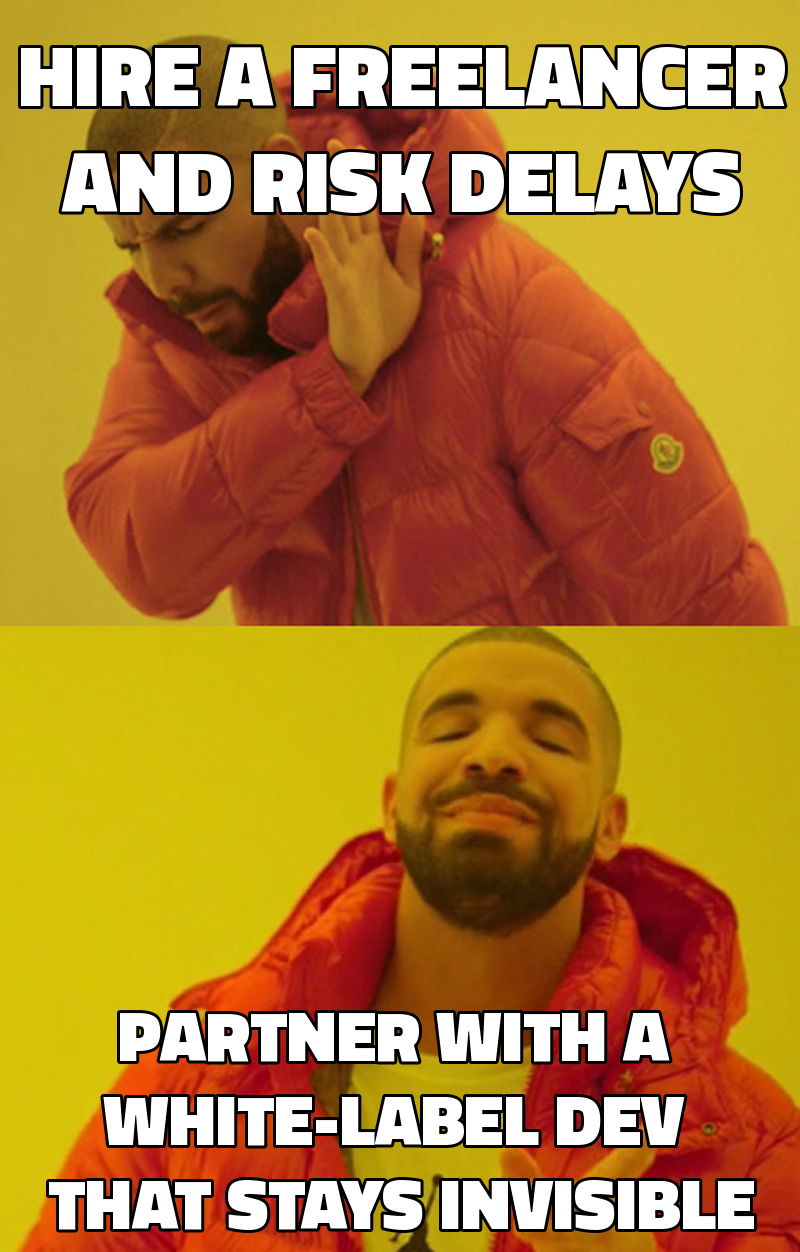
White-label mobile app development lets a marketing agency offer native iOS and Android apps under its own brand while a specialist developer does all the coding, testing and deployment. The agency keeps the client relationship, sets the price and adds the project to its portfolio without hiring a full-time engineer. This model delivers new revenue streams, protects margins and eliminates the risk of missed deadlines.
Key takeaways
- White-label partners handle all technical work, letting agencies quote and deliver native apps instantly.
- Agencies retain 50-70% of the client bill while avoiding salary, benefits and recruitment costs.
- Fixed-scope pilots build trust and prove capability before a retainer relationship.
- AI automation, voice integration and custom back-ends are the differentiators that no-code shops cannot match.
- Reliable delivery and a single point of contact protect the agency brand and client loyalty.
What is white-label mobile app development and how does it work for agencies?
White-label mobile app development is a B2B partnership where a development studio builds a custom app and brands the final product as the agency’s own work. The workflow typically follows these steps:
- Scope definition – the agency provides a brief, target audience, feature list and branding assets.
- Pilot agreement – a small, fixed-price pilot (often $1,500-$3,000) is signed to prove feasibility.
- Development – the partner uses native frameworks such as Swift, Kotlin, Flutter or React Native, integrates AI services (OpenAI, Google Dialogflow) and sets up cloud back-ends (AWS Amplify, Firebase).
- Quality assurance – a dedicated QA engineer runs device labs (BrowserStack, AWS Device Farm) and delivers a build ready for client review.
- Delivery & hand-off – the agency receives the compiled binaries, source code under NDA and a launch checklist, then submits the app to the App Store and Google Play on behalf of the client.
Because the partner operates under a non-disclosure and non-circumvent agreement, the client never sees the third-party name. The agency can therefore market the service as “our in-house mobile expertise”.
Which strategic benefits drive agencies to add native apps?
| Benefit | Impact for a 5-15 person agency |
|---|---|
| New revenue stream | Average $5,000-$15,000 per app expands annual billings by 10-20% (Clutch, 2022). |
| Client retention | Agencies that can say “yes” to app requests lose 30% fewer accounts (Forrester, 2023). |
| Brand positioning | Offering “end-to-end digital solutions” moves the agency from a tactical provider to a strategic partner. |
| Speed to market | Fixed-scope pilots deliver MVPs in 3-4 weeks, compared with 8-12 weeks for a new hire ramp-up. |
| Risk mitigation | No payroll, benefits or long-term contracts; partner bears technical risk. |
The most compelling driver is the ability to keep the client and the margin while expanding the service menu. Agencies that previously turned away app requests report an average 12% increase in client lifetime value after adopting a white-label model (Gartner, 2023).
How does the delivery model protect agency brand and margins?
White-label partners adopt a “silent dev arm” approach:
- Invisible branding – All UI screens, splash screens and marketing assets carry the agency’s logo and color palette.
- Single point of contact – A dedicated account manager coordinates sprints, status updates and QA, eliminating the need for the agency to manage multiple freelancers.
- Non-circumvent clause – Legal language prevents the client from reaching out to the developer directly, safeguarding the agency’s margin.
- Fixed-scope pricing – The pilot and subsequent projects are quoted as a flat fee, allowing the agency to apply a 50-70% markup without surprise cost overruns.
- Retainer option – After the pilot, agencies can purchase a monthly retainer (e.g., $1,500 for 15-20 dev hours) that guarantees capacity and stabilises cash flow.
By keeping the development relationship behind the scenes, agencies maintain full ownership of the client experience, which is critical when the client is sensitive about outsourcing.
What are the cost and timeline implications compared with hiring in-house or freelancers?
| Model | Average monthly cost (USD) | Time to first delivery |
|---|---|---|
| In-house developer (senior iOS/Android) | $12,000-$15,000 salary + benefits | 2-3 months onboarding + 4-6 weeks development |
| Freelance marketplace (Upwork) | $60-$120 per hour, $5,000-$10,000 per app | Variable, often 6-10 weeks, risk of delays |
| White-label partner (fixed pilot) | $1,500-$3,000 per pilot, $1,500 retainer/month | 3-4 weeks for MVP, 6-8 weeks for full launch |
The white-label option reduces upfront cash outlay by up to 85% versus an in-house hire and cuts delivery time by roughly 30% compared with a typical freelancer who may juggle multiple projects. Moreover, the partner’s capacity is capped (e.g., 4-6 active agency partners) to ensure reliability – a promise most offshore aggregators cannot make.
Which tools and platforms do white-label partners use to deliver AI-enabled apps?
White-label studios combine native development with AI services to create features that no-code platforms cannot replicate:
- Frontend – SwiftUI for iOS, Jetpack Compose for Android, or cross-platform Flutter for rapid iteration.
- Backend – Node.js on AWS Lambda, Google Cloud Functions, or Firebase for real-time databases.
- AI/Automation – OpenAI GPT-4 for natural-language chat, Google Dialogflow for voice bots, and Zapier/Make integrations for workflow automation.
- Analytics – Mixpanel and Amplitude for event tracking, enabling agencies to provide data-driven ROI reports to clients.
- CI/CD – GitHub Actions and Fastlane automate builds, code signing and store submissions, reducing manual errors.
These technologies allow the partner to deliver custom back-ends, voice assistants and predictive analytics that differentiate the agency’s offering from generic website builders.
How to evaluate and onboard a reliable white-label development partner
- Check portfolio relevance – Look for shipped production apps in similar industries (e.g., retail, health-tech, local services). RouteMate, a full-stack SaaS built for an Australian agency, is a benchmark case.
- Verify process transparency – Request a shared project dashboard (e.g., Jira, ClickUp) that shows sprint status, blockers and upcoming releases.
- Assess capacity limits – Partners that cap active agency clients (typically 4-6) can guarantee focus; over-onboarding leads to flaky delivery.
- Confirm legal safeguards – NDA and non-circumvent clauses should be standard, but the real trust mechanism is the pilot.
- Run a pilot – A $2,000 scoped MVP (one core feature, basic UI) validates speed, communication and quality before committing to a retainer.
- Measure post-pilot metrics – Delivery on time (≥90% on-time), defect rate (<5% after QA) and client satisfaction (NPS > 50) are good thresholds.
A quick decision matrix helps compare candidates:
| Criteria | Partner A | Partner B | Partner C |
|---|---|---|---|
| Prior shipped AI-enabled apps | Yes (3) | No | Yes (1) |
| Active agency caps | 5 | 12 | 4 |
| Fixed-scope pilot price | $2,000 | $1,800 | $2,500 |
| Avg. MVP turnaround | 3 weeks | 5 weeks | 4 weeks |
| NDA included | Yes | Yes | No |
Select the partner that scores highest on relevance, capacity and guaranteed turnaround.
Common objections and how to overcome them
- “Our clients will notice we outsource.” – Emphasise that the white-label partner works under a strict NDA and that all UI/UX, copy and branding are supplied by the agency. Provide a sample of a fully branded app screenshot.
- “We can’t afford the markup.” – Show a cost-benefit model: a $5,000 app with a 60% margin yields $3,000 profit, covering the pilot cost after two projects. Contrast this with the $12,000-$15,000 annual salary of a senior developer.
- “We don’t understand technical scope.” – The partner’s account manager translates feature requests into a clear, line-item estimate. Use a simple scope worksheet (feature, effort hours, cost) during the discovery call.
- “We fear losing control over quality.” – Share QA metrics from past projects (e.g., 98% pass rate on device testing) and offer a joint review meeting after each sprint.
- “What if the partner disappears?” – Verify that the partner has a documented escalation path and at least two senior engineers on the team. Request references from agencies of similar size.
Addressing these concerns early builds confidence and shortens the sales cycle.
Frequently asked questions
How quickly can an agency launch its first white-label app?
Most partners deliver a minimum viable product in 3-4 weeks after the pilot is signed. The timeline includes discovery, design hand-off, development and QA. Faster turnarounds are possible with pre-built component libraries.
What types of apps are most profitable for agencies?
Native mobile apps that integrate AI chatbots, location-based services or custom dashboards command higher fees. Retail loyalty apps, service-booking portals and voice-enabled assistants are top sellers according to a 2023 Gartner survey.
Do agencies need to pay for app store fees?
The agency remains responsible for Apple Developer Program ($99/year) and Google Play Console ($25 one-time). Some white-label partners can include these fees in the final invoice for convenience.
Can the white-label partner handle post-launch updates?
Yes. After the initial launch, agencies can purchase a monthly retainer (e.g., $1,500 for 15-20 hours) that covers bug fixes, OS upgrades and feature enhancements.
How is intellectual property handled?
Typically, the agency owns the source code and all related assets once payment is complete. The partner retains a limited license to reuse non-proprietary components across projects.
What if the agency already has a freelance developer?
White-label partners excel where freelancers lack depth in AI, voice or custom back-end integration. If the freelancer cannot meet those technical requirements, the agency can keep the freelancer for simple UI work while the partner handles complex features.
Is there a minimum project size?
Partners usually set a floor of $1,500 to ensure the effort justifies the overhead. Projects below this threshold are better suited for no-code tools like Adalo or Bubble.
How do agencies protect themselves from price erosion?
By negotiating a wholesale rate that guarantees a 50-70% margin and by locking in a retainer after the pilot, agencies avoid the race-to-the-bottom that characterises many offshore marketplaces.
white-label
Have something to build?
Tell us what you're trying to ship. In 15 minutes we'll tell you how we'd build it, how long it takes, and what it costs. No pitch deck, no pressure.