
White-Label WordPress Development Agency: End-to-End Workflow Blueprint for Small Marketing Shops

A white-label WordPress development agency partners with your marketing firm to build custom sites under your brand, handling everything from brief to launch while you keep the client relationship. The model lets you say yes to high-margin projects without hiring a full-time engineer, and you stay invisible to the client.
Key takeaways
- White-label dev teams deliver under your brand, so you retain the client and the margin.
- Start with a fixed-scope pilot (typically $2,000-$5,000) to prove reliability before moving to larger builds or a retainer.
- Use a shared project dashboard and a single point of contact to avoid the "multiple vendor" nightmare.
- Define a clear turnaround band (e.g., 2-3 weeks for a standard WordPress site) to set realistic expectations.
- Include a quality-gate checklist for brief, scope, QA, and launch to keep projects on track.
- Protect your brand with NDA and non-circumvent clauses, but rely on performance, not legal threats, to build trust.
What is a white-label WordPress development agency?
A white-label WordPress development agency is a specialist partner that builds WordPress sites, plugins, and custom integrations on behalf of another agency. The work is delivered under the hiring agency’s brand, with all client-facing communication routed through the agency. This arrangement solves three core pain points for 5-15 person marketing shops:
- Capacity – they can accept more projects than their internal bandwidth allows.
- Expertise – they gain access to AI automation, voice assistants, and custom back-end work that no-code tools cannot handle.
- Margin protection – they keep the full client fee while paying a wholesale rate to the dev partner.
According to Clutch’s 2023 survey, 42% of small agencies outsource web development because they lack the technical staff. The same study shows that agencies that outsource see a 15% higher average profit margin on development projects.
How does the briefing process work?
The brief is the foundation of a successful white-label engagement. Follow this five-step checklist:
| Step | Owner | Deliverable | Typical Time |
|---|---|---|---|
| 1 | Agency Account Lead | Client questionnaire (goals, branding, functionality) | 1-2 days |
| 2 | Agency Project Manager | Internal brief template (scope, timeline, budget range) | 1 day |
| 3 | White-label PM | Technical discovery (plugins, custom API needs, AI/voice scope) | 1-2 days |
| 4 | Joint Review | Signed brief and NDA | 1 day |
| 5 | Agency Lead | Client-approved brief (no dev brand mention) | 1-2 days |
Key points:
- Use a standard questionnaire that captures SEO goals, target audience, required integrations (e.g., HubSpot, Zapier, or custom REST APIs), and any AI or voice features.
- Keep the client-facing brief free of any mention of the development partner. Phrase it as “Our internal team will handle the build.”
- Attach an NDA that covers confidentiality and a non-circumvent clause; this is table-stakes, not a selling point.
How to scope and price the project?
Accurate scoping prevents surprise costs and protects your margin. Use the Fixed-Scope Pilot model for the first three projects:
- Define deliverables – e.g., 5-page site, custom theme, SEO-ready, one AI-driven chatbot.
- Break down tasks – design handoff, theme development, plugin configuration, QA, launch.
- Assign hours – a typical 5-page site averages 30-40 dev hours (Synthisia data, 2024).
- Apply a markup – your wholesale rate is 55% of the client fee; for a $4,000 project you pay $1,800-$2,200 to the dev partner.
- Add a buffer – 10% contingency for unexpected integrations.
"Scope creep is the number-one reason agencies lose profit on outsourced builds," notes Forrester (2022).
Pricing example:
- Base dev cost: 35 hrs × $50/hr = $1,750
- Markup (55%): $962
- Client price: $2,712 (rounded to $2,700)
- Contingency (10%): $270 added to client price → $2,970 total.
Present the quote as a flat fee with a clear list of deliverables. Avoid hourly rates; they invite endless negotiations.
What does the development workflow look like?
Once the brief is signed, the dev partner follows a repeatable workflow that mirrors an in-house sprint but stays invisible to the client.
1. Project kickoff (Day 0-1)
- White-label PM schedules a 30-minute call with the agency’s Project Manager.
- Review brief, confirm timelines, and set communication cadence (Slack channel, weekly status email).
2. Environment setup (Day 1-2)
- Create a staging WordPress install on a secure AWS or DigitalOcean droplet.
- Install base theme (e.g., Genesis) and required plugins (Yoast SEO, WP Rocket, Advanced Custom Fields).
- Configure version control with a private GitHub repo (access limited to dev team).
3. Design handoff (Day 2-5)
- Agency provides Figma or Sketch files.
- Dev team translates layouts into a custom child theme, respecting brand guidelines.
- For AI or voice components, set up a sandbox (Dialogflow, OpenAI API keys) and document endpoints.
4. Core development (Day 5-12)
| Phase | Tasks | Owner |
|---|---|---|
| Theme coding | HTML, CSS, PHP templates, responsive breakpoints | Front-end dev |
| Plugin config | Install, configure, custom code for SEO, caching, forms | WordPress dev |
| Custom integration | API calls, webhook setup, AI prompt engineering | Backend dev |
| QA prep | Unit tests, accessibility audit (WCAG 2.1 AA) | QA lead |
- Follow a 2-day sprint model: code, review, commit, test.
- Use Pull Request reviews to maintain quality and provide a clear audit trail.
5. Internal QA (Day 12-14)
- Run automated Lighthouse scores; aim for >90 on performance, accessibility, SEO.
- Conduct functional testing on the staging site (form submissions, chatbot flows, voice triggers).
- Document any bugs in a shared Asana board; assign owners and due dates.
6. Client preview (Day 14-15)
- Provide the agency with a password-protected preview link.
- Agency shares the link with the client for feedback; all comments are routed back to the dev PM.
- Limit revisions to two rounds; additional rounds are billed as change orders.
7. Final QA and launch prep (Day 15-17)
- Apply final SEO settings (meta tags, schema markup).
- Migrate from staging to production using a one-click WP-CLI script.
- Set up CDN (Cloudflare) and SSL (Let’s Encrypt).
- Create a post-launch checklist (backup, monitoring, 30-day support).
8. Launch (Day 18)
- Switch DNS, verify SSL, run a live Lighthouse audit.
- Send a launch email to the agency with login credentials and a short “how-to” guide.
- Archive the project in the shared dashboard for future reference.
How to manage QA, client approvals, and revisions?
A transparent QA process reduces back-and-forth and protects your timeline.
- Define acceptance criteria in the brief (e.g., page load < 2 seconds, chatbot responds within 1 second).
- Use a shared status board (e.g., Trello or ClickUp) where each task has columns: To Do, In Progress, Review, Approved.
- Limit revision cycles – two rounds of client feedback are standard; a third triggers a change-order fee (usually 20% of the original dev cost).
- Document every change in the board with a timestamp; this creates an audit trail that discourages scope creep.
- Post-launch support – offer a 30-day “bug-fix window” included in the price; after that, move to a retainer or hourly support.
How to launch and hand over the site?
The hand-over is the moment the client sees the final product, so it must be smooth and brand-consistent.
- Create a launch kit: a PDF with login details, a short video walkthrough, and a maintenance checklist.
- Transfer ownership: change WordPress admin email to the agency’s designated contact, then hand over the admin account.
- Set up monitoring: enable UptimeRobot alerts and Google Search Console verification.
- Schedule a debrief: a 30-minute call with the agency to review performance metrics and discuss next steps (e.g., SEO campaigns, ongoing AI chatbot training).
How to maintain the partnership and scale the flow?
Long-term success hinges on reliability, clear communication, and predictable pricing.
| Metric | Target | Measurement Tool |
|---|---|---|
| On-time delivery | ≥ 95% of projects | Project dashboard timestamps |
| First-time quality | ≤ 2 bugs per launch | QA bug log |
| Client satisfaction | ≥ 4.5/5 rating | Post-launch survey |
| Revenue share | 55-70% of client fee | Invoice reconciliation |
- Cap the number of active partners – Synthisia limits active white-label agencies to 12 to keep capacity low and avoid the “flaky freelancer” perception.
- Introduce a retainer after the pilot – $1,500-$2,000 per month for 15-20 dev hours gives the agency a predictable escalation path and guarantees you steady revenue.
- Quarterly business reviews – discuss upcoming pipeline, success stories, and any new AI or voice features that could unlock higher-margin work.
- Continuous improvement – collect feedback on the briefing template, dashboard UI, and turnaround times; iterate every 6 months.
- Showcase case studies – with permission, publish anonymized success stories (e.g., RouteMate SaaS launch) to demonstrate reliability to prospects.
Comparison: In-house vs Freelance vs White-label
| Option | Typical Cost per Project | Turn-around | Control | Risk |
|---|---|---|---|---|
| In-house dev | $8,000-$12,000 (salary + overhead) | 6-8 weeks | High (direct management) | High (hiring, turnover) |
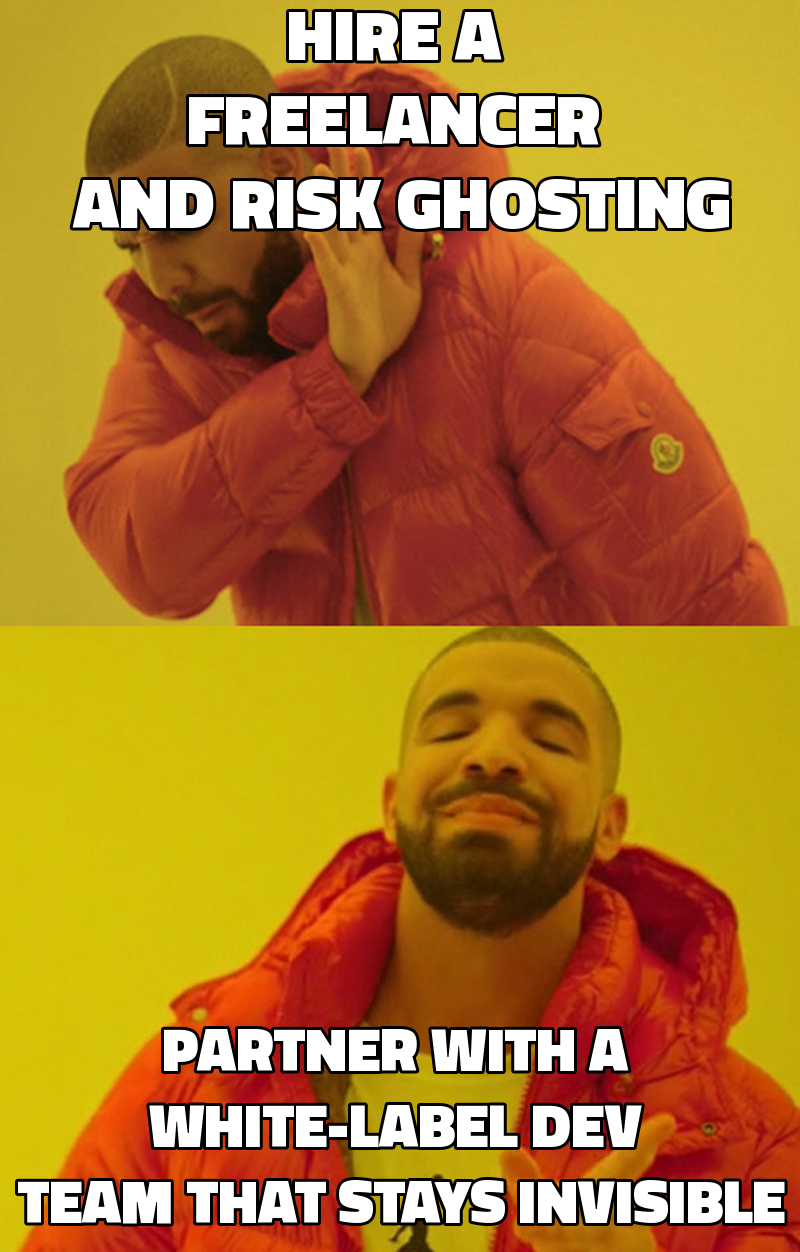
| Freelance marketplace | $2,500-$5,000 (hourly) | 3-6 weeks | Medium (communication gaps) | Medium (ghosting, quality variance) |
| White-label partner | $2,000-$5,000 (fixed) | 2-3 weeks | High (single PM, dashboard) | Low (contractual SLA, proven track record) |
Quick checklist for each project phase
| Phase | Checklist |
|---|---|
| Brief | Client questionnaire completed, NDA signed, internal brief approved |
| Scope | Deliverables listed, hour estimate, contingency added, client price set |
| Development | Staging env ready, Git repo created, sprint plan defined |
| QA | Automated Lighthouse >90, functional tests passed, bugs logged |
| Client Review | Preview link shared, two revision rounds documented |
| Launch | DNS switched, SSL active, monitoring enabled, launch kit delivered |
| Post-launch | 30-day bug-fix window, hand-over docs, debrief call |
Real-world example: RouteMate SaaS launch
Synthisia delivered a custom WordPress-based portal for RouteMate, a logistics SaaS, in 19 days. The agency kept the client relationship, billed $12,000, and paid Synthisia $5,400 (45% wholesale). The project included:
- A custom theme with dynamic pricing tables.
- Integration with Stripe and a voice-enabled chatbot (Dialogflow).
- Automated CI/CD pipeline using GitHub Actions. The client praised the speed and quality, leading to a $1,500 monthly retainer for ongoing feature work.
Final thoughts
White-label WordPress development is not a “cheap outsourcing” trick; it is a strategic partnership that lets boutique agencies punch above their weight. By following a disciplined end-to-end workflow, brief, scope, fixed-price pilot, transparent dashboard, strict QA, and a clean launch, you protect your brand, keep margins healthy, and open the door to high-value AI and voice projects that no-code tools cannot handle. The key is to treat the dev partner as an extension of your team, not a hidden cost center.
Frequently asked questions
How do I ensure the white-label partner stays invisible to my client?
All client-facing communication passes through your agency’s email or Slack channel. The partner signs an NDA and a non-circumvent clause, and you control the branding on all deliverables (e.g., custom theme header, PDF reports). The partner never appears in invoices or on the live site footer.
What if the project scope expands after work has started?
Include a change-order clause in the contract that defines an hourly rate (usually 20% above the original dev rate) for any out-of-scope items. Require written approval before additional work begins to protect both parties.
Can I use this workflow for non-WordPress projects?
The core steps, brief, scoped pilot, shared dashboard, fixed-turnaround, apply to any web development work. For non-WordPress tech stacks (e.g., React, Laravel), adjust the environment setup and plugin list, but keep the same governance model.
How do I handle AI or voice integrations that require third-party API keys?
Collect API credentials during the discovery phase and store them in a secure vault (e.g., 1Password Teams). The dev partner configures the integration on staging, and you verify functionality before the client sees it.
What level of support is expected after launch?
A 30-day bug-fix window is standard and included in the project price. After that, offer a retainer (e.g., $1,500/month) for ongoing updates, security patches, and new AI features. Clearly separate what is covered under the retainer versus ad-hoc change orders.
How do I measure the ROI of using a white-label partner?
Track three metrics: (1) additional project win rate (e.g., +20% after pilot), (2) average margin per project (client fee minus wholesale cost), and (3) time saved in sales cycles (average 5-day reduction). Compare these against baseline figures from before the partnership.
Is it safe to share my client’s proprietary data with the partner?
Yes, provided you have a robust NDA that includes data protection clauses and you use encrypted transfer methods (SFTP, VPN). Limit access to only the files needed for the build and revoke credentials after launch.
How many partners should I work with at once?
Synthisia recommends capping active white-label partners at 12 to maintain high reliability. Too many partners dilute focus and increase the risk of missed deadlines, which defeats the purpose of the model.
white‑label
Have something to build?
Tell us what you're trying to ship. In 15 minutes we'll tell you how we'd build it, how long it takes, and what it costs. No pitch deck, no pressure.