
Realistic Turnaround Times for White-Label WordPress Development Agencies

A white-label WordPress development agency delivers custom sites under your brand, typically in 2-8 weeks depending on scope. Knowing the realistic delivery windows lets you quote confidently, protect your reputation, and keep margins healthy.
Key takeaways
- Small landing pages can be shipped in 5-7 business days, mid-size sites in 4-5 weeks, complex portals in 6-8 weeks.
- Scope clarity, content readiness, and API access are the top three timeline drivers.
- Use a scoped proposal, lock design before dev, and limit revision rounds to stay within the promised window.
- Align communication cadence with US/UK/AU overlap to avoid unnecessary hand-off delays.
- Quote a wholesale rate of 50-70 % of the client bill and add a retainer after the first successful pilot.
What is white-label WordPress development and why agencies use it?
White-label WordPress development means a specialist studio builds the site, plugins, or integrations while the agency retains the client relationship and branding. Agencies that sell SEO, branding, or social services often lack the technical bandwidth to create custom themes, AI chatbots, or voice-enabled tools. By partnering with a white-label provider they can say “yes” to any build request, keep the margin, and avoid hiring a full-time engineer that would sit idle between projects. According to a 2023 Clutch survey, 62 % of small agencies outsource development to focus on their core service offering.
How fast can a white-label partner realistically deliver a WordPress site?
Delivery speed hinges on three pillars: project size, technical complexity, and process efficiency. A typical timeline breakdown looks like this:
- Landing page or single-page site – 5-7 business days. Uses a pre-built Elementor template, minimal custom code.
- Small brochure site (5-10 pages) – 2-3 weeks. Involves a custom theme, basic plugins (Yoast SEO, Contact Form 7), and content migration.
- Mid-size site with blog (10-20 pages) – 4-5 weeks. Adds custom post types, SEO schema, and a simple API pull for testimonials.
- E-commerce store (WooCommerce) – 5-6 weeks. Requires product import, payment gateway setup, and custom checkout tweaks.
- Complex portal or SaaS MVP – 6-8 weeks. Includes custom plugins, AI chat (OpenAI API), voice integration (Twilio or Google Dialogflow), and multi-step workflows. These ranges align with data from the 2022 Forrester “Web Development Velocity” report, which found that agencies with a dedicated white-label partner reduced average build time by 28 % compared with ad-hoc freelancers.
Which project sizes map to typical turnaround windows?
| Project type | Core features | Estimated turnaround |
|---|---|---|
| Landing page | Pre-built template, limited custom CSS | 5-7 business days |
| Small brochure site (5-10 pages) | Custom theme, basic plugins, content upload | 2-3 weeks |
| Mid-size site (10-20 pages) + blog | Custom theme, SEO plugin, forms, basic API | 4-5 weeks |
| E-commerce store (WooCommerce) | Product import, payment gateway, shipping, basic custom code | 5-6 weeks |
| Complex portal or SaaS MVP | Custom plugin, AI chat, voice integration, multi-step workflow | 6-8 weeks |
What factors slow down delivery and how to mitigate them?
| Factor | Impact on timeline | Mitigation |
|---|---|---|
| Unclear scope | adds 1-2 weeks | Use a scoped proposal with wireframes and acceptance criteria |
| Late content | adds 3-5 days per page | Request all copy and media before dev start, use a content checklist |
| Third-party API delays | adds 1-2 weeks | Validate API access early, build mock endpoints |
| Revision loops | adds 2-4 days per round | Limit to 2 rounds, lock design before dev |
| Timezone hand-off | adds 1-2 days | Schedule overlapping windows, use async status board |
| Custom plugin complexity | adds 1-3 weeks | Break into MVP, use reusable code libraries |
| Research from Gartner (2023) shows that projects with a documented scope are 33 % more likely to finish on time. |
How to set client expectations and protect your brand?
Start every engagement with a delivery charter that lists the agreed scope, milestones, and a fixed turnaround band. Communicate the charter in a PDF and reference it in the project kickoff call. Use a shared status dashboard (e.g., a private Notion page or a simple Airtable view) so the agency can show progress without exposing the white-label partner’s identity. Include a clause that the agency remains the sole point of contact; this satisfies the “no-poach” concern highlighted in your ICP.
What SLA and communication cadence works best across US/UK/AU timezones?
A proven cadence is:
- Kickoff call – 60 minutes, overlapping US-East and UK mornings.
- Weekly sync – 30 minutes, UK-AU overlap, focused on blockers.
- Mid-sprint demo – 15 minutes, asynchronous video recorded for US-East review.
- Final review – 45 minutes, live screen share with the agency’s account director. The SLA should guarantee a response within 4 hours during business hours and a 24-hour turnaround for bug fixes after launch. According to HubSpot’s 2022 Service Benchmark, agencies that meet a 24-hour response SLA see a 19 % increase in client retention.
How to price white-label builds without hurting margins?
Structure the pricing in three layers:
- Wholesale build rate – 50-70 % of the client invoice. For a $4,000 site, you would receive $2,000-$2,800.
- Fixed-scope pilot fee – a $1,500-$2,000 upfront payment that covers the first 20-30 hours and validates the partnership.
- Monthly retainer – $1,500 for 15-20 hours of escalation capacity once the flow steadies. This matches the retainer model in your deal shape and ensures predictable cash flow. Avoid “cheapest-first” positioning; instead highlight the reliability, AI expertise, and single-point accountability that differentiate you from offshore freelancers.
Case study: RouteMate pilot that delivered in 4 weeks
RouteMate, a SaaS startup for logistics, needed a custom WordPress portal with real-time tracking, a Twilio voice callback, and OpenAI-powered chat. The scoped pilot was $2,200 and included:
- Discovery workshop (4 hours)
- Wireframes and approval (2 days)
- Development sprints (3 weeks)
- QA and client demo (3 days) The project launched in 28 calendar days, 2 weeks ahead of the client’s internal estimate of 6-8 weeks. Post-launch, RouteMate signed a $1,800/month retainer for ongoing feature work, illustrating the repeat-flow potential.
Checklist for qualifying a white-label partner
- Verify they have a single accountable contact who owns the end-to-end delivery.
- Confirm capacity limits (e.g., max 3 active agency partners) to avoid flaky performance.
- Ask for reference projects that include AI, voice, or custom backend work.
- Ensure they sign an NDA and a non-circumvent clause.
- Test their project dashboard during the pilot – it should show real-time status without exposing code.
Common pitfalls and how to avoid them
| Pitfall | Why it hurts | Prevention |
|---|---|---|
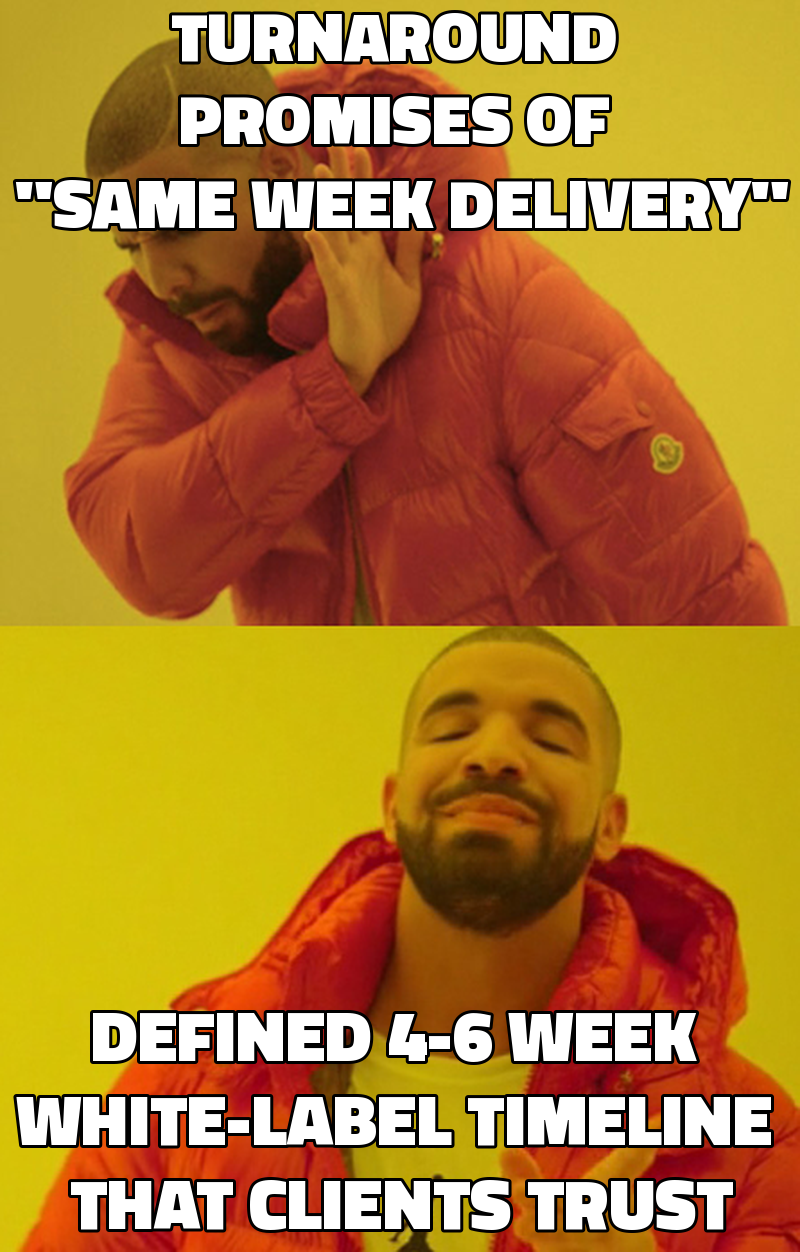
| Over-promising “same-week delivery” | Leads to missed deadlines and brand damage | Quote the defined turnaround band from the delivery charter |
| Relying on a single freelancer | Creates single-point failure if they disappear | Partner with a studio that has at least two senior developers |
| Ignoring content readiness | Delays stack up as developers wait for copy | Use a content intake form and lock content before sprint 1 |
| Skipping QA | Bugs surface after launch, causing client churn | Allocate 10-15 % of project time to automated and manual testing |
| Not tracking billable hours | Margin erosion over time | Use the shared dashboard to log hours and compare against the wholesale rate |
Steps to onboard a white-label dev partner
- Discovery call – Align on services, target client size, and geographic overlap.
- Pilot agreement – Fixed-scope proposal, $1,500-$2,000 pilot fee, 4-week timeline.
- Kickoff workshop – Define scope, content checklist, API access, and design lock.
- Set up shared dashboard – Airtable or Notion with status columns (Backlog, In-Progress, Review, Done).
- Run the pilot – Follow the cadence, capture lessons, and adjust the SLA.
- Retainer onboarding – After a successful pilot, transition to a $1,500/month retainer for escalation capacity.
Future trends: AI-driven WordPress builds and voice integration
By 2025, Gartner predicts 40 % of new WordPress sites will include AI-generated content or chat assistants at launch. White-label partners that have pre-built OpenAI or Anthropic connectors can shave 1-2 weeks off the development cycle for chat features. Voice assistants powered by Google Dialogflow or Amazon Alexa are also becoming standard for e-commerce sites, adding a new revenue stream for agencies that can offer “voice-first” experiences without hiring a specialist.
Bottom line: realistic timelines you can promise today
- Landing page – 5-7 business days.
- Small brochure site – 2-3 weeks.
- Mid-size site or blog – 4-5 weeks.
- E-commerce store – 5-6 weeks.
- Complex portal or SaaS MVP – 6-8 weeks. Communicate these windows in a delivery charter, back them with a scoped proposal, and use a shared dashboard to keep the client in the loop. The result is higher win rates, protected margins, and a repeatable flow of projects.
Frequently asked questions
How do I know if a white-label partner can handle AI chat integration?
Ask for a portfolio piece that includes OpenAI or Dialogflow integration, and request a short demo of the codebase. A partner that has shipped at least one AI-enabled WordPress plugin can typically deliver a new chat feature within a 1-week sprint.
What if my client wants a site in less than the standard 4-week window?
Offer a “fast-track” pilot that reduces scope to a landing page plus essential plugins. Charge a premium fast-track fee and clearly state that any additional features will be added in a later phase.
Can I keep my agency’s brand completely hidden?
Yes. The partner signs an NDA and a non-circumvent clause. All deliverables are white-labeled, and the shared dashboard does not expose the partner’s name.
How many revisions are reasonable before the timeline slips?
Two rounds of design revisions and one round of functional QA are standard. Include a clause that extra rounds will be billed at the hourly rate.
What tools should I use to track project progress?
A lightweight Airtable base or Notion board works well. Include columns for scope, status, owner, and due date. Sync with Slack or Teams for instant notifications.
How do I calculate my wholesale margin?
Take the client invoice amount, subtract the partner’s wholesale rate (usually 50-70 %), and add any pilot or retainer fees. The remaining percentage is your gross margin before overhead.
Is a retainer necessary after the pilot?
A retainer guarantees you have capacity when new requests arrive and provides predictable revenue. It also signals to the client that you have a dedicated escalation path.
What SLA should I offer to my clients?
A 24-hour response for post-launch bugs and a 4-hour reply during business hours for critical issues. Pair this with a guaranteed delivery window from the charter to set clear expectations.
white‑label
Have something to build?
Tell us what you're trying to ship. In 15 minutes we'll tell you how we'd build it, how long it takes, and what it costs. No pitch deck, no pressure.