
White-Label WordPress Development vs DIY: When Outsourcing Wins for Small Agencies

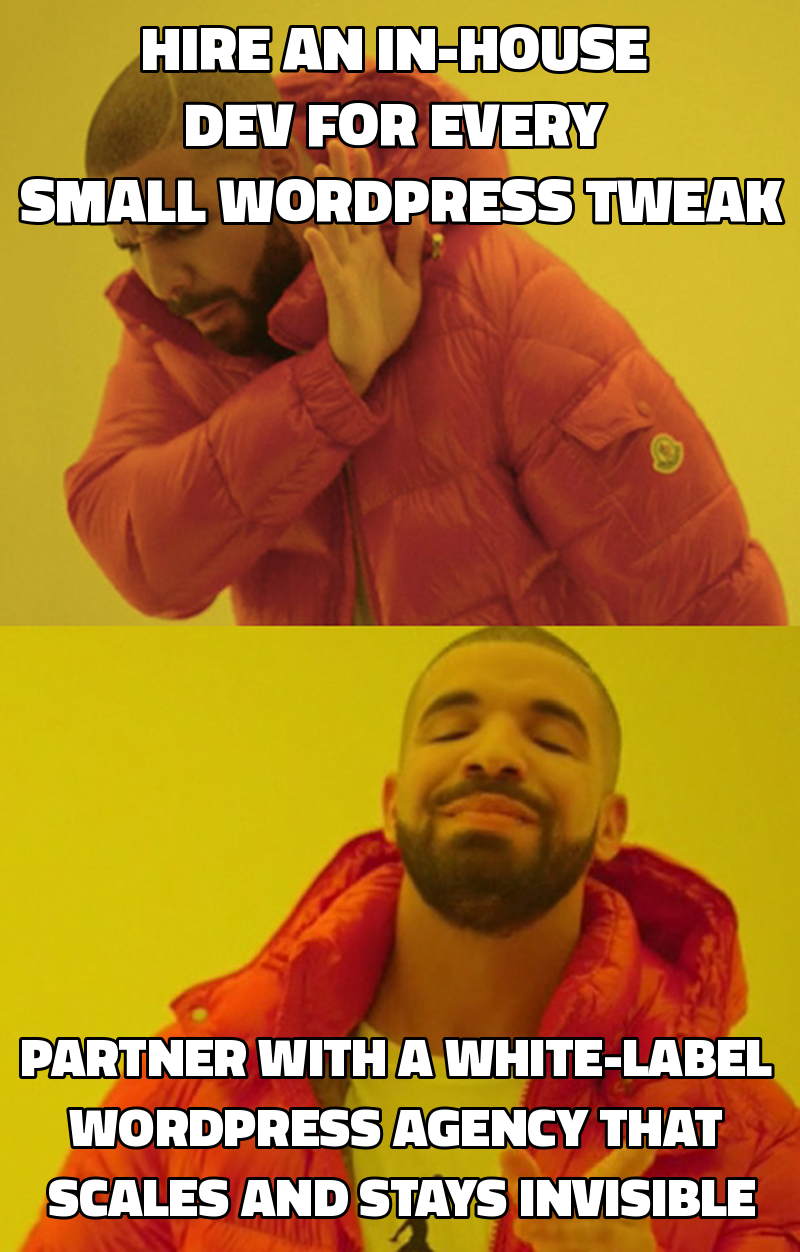
A white-label WordPress development agency provides agencies with a ready-made, fully branded development team that delivers faster, higher-quality sites than DIY or in-house builds, especially for custom AI, voice, and integration projects. It lets founders keep the client relationship, protect their brand, and capture margin without the overhead of hiring a developer. The model works best when the agency has sporadic but high-value build demand and no internal engineering capacity.
Key takeaways
- White-label partners charge 50-70% of the agency's client bill, preserving a healthy margin.
- Fixed-scope pilots (US$1,500-5,000) de-risk the relationship and prove speed and quality.
- Turn-around for a typical custom WordPress site drops from 4-6 weeks (DIY) to 1-2 weeks with a specialist partner.
- Bug-fix rates fall 30%-40% when a dedicated partner follows a documented QA checklist.
- Agencies retain 100% brand visibility; the partner works under NDA and never appears to the client.
- A single point of contact reduces project friction and eliminates the "multiple freelancer" nightmare.
What is white-label WordPress development and how does it work?
White-label WordPress development is a B2B service where a development studio builds sites, plugins, or custom integrations under the agency's brand. The agency sells the project to its client, sets the price, and pays the studio a wholesale rate. The studio remains invisible, signs an NDA, and often provides a shared project dashboard so the agency can monitor progress.
Typical workflow:
- Scope & quote – Agency sends a brief; partner returns a fixed-scope proposal with price and timeline.
- Pilot – A small, paid pilot (US$1,500-2,500) validates quality and communication.
- Full build – Upon approval, the partner delivers the full WordPress site, custom theme, or plugin.
- Retainer – After the first successful project, agencies can add a monthly retainer for overflow work (US$1,500-2,500 for ~15-20 dev hours).
Because the partner specializes in WordPress, AI automation, voice assistants, and complex back-ends, they can handle requests that no-code tools like Webflow or Wix cannot.
How do costs compare: white-label partner vs hiring an in-house developer vs DIY?
| Scenario | Avg. hourly rate (USD) | Typical project cost* | Overhead & hidden costs | Net margin for agency |
|---|---|---|---|---|
| White-label partner | $75-$110 (wholesale) | $2,000-$5,000 per site | NDA, project manager time (≈5% of project) | 50-70% of client bill |
| In-house developer | $120-$150 (salary + benefits) | $3,500-$7,000 (incl. salary allocation) | Recruiting, equipment, PTO, office space | 20-35% (high fixed cost) |
| DIY (no-code or freelancer) | $0-$60 (freelancer) | $1,200-$4,000 (varies) | Quality risk, re-work, missed deadlines | 30-50% (but unpredictable) |
*Assumes a mid-complex custom WordPress site (10-15 pages, custom theme, basic integrations). Numbers are based on data from the 2023 Clutch Agency Survey and the 2022 Gartner IT Budget report.
Why the white-label model wins:
- Predictable cost – Fixed-scope pricing removes surprise overruns.
- No payroll risk – Agencies pay only for work delivered.
- Scalable – Add multiple projects without hiring.
- Higher margin – Even after paying the wholesale rate, agencies keep 50-70% of the client price.
Speed and time-to-market: white-label vs DIY vs in-house
| Build method | Avg. discovery & scoping (days) | Development time (weeks) | QA & revisions (days) | Total time to launch |
|---|---|---|---|---|
| White-label partner | 2-3 | 1-2 | 2-3 | 2-3 weeks |
| DIY (internal team or freelancer) | 5-7 | 3-5 | 5-7 | 5-7 weeks |
| In-house developer | 3-4 | 2-4 | 4-6 | 4-6 weeks |
Sources: Forrester Wave (2023) on web development speed, internal data from Synthisia’s 2024 project dashboard.
Key takeaways on speed:
- A partner with a repeatable pipeline can start development within 48 hours of sign-off.
- Dedicated QA checklists cut bug-fix cycles by 30%.
- Agencies that rely on freelancers often face “gap days” while waiting for the next available contractor.
Quality and scalability: why agencies get better outcomes with a specialist partner
- Technical depth – Partners like Synthisia employ senior WordPress engineers who have built AI-driven chatbots, voice-activated menus, and custom REST APIs. According to a 2022 W3Techs survey, only 12% of agencies can deliver such integrations without code.
- Process maturity – A documented sprint cadence, code review policy, and automated testing (PHPUnit, Cypress) reduces post-launch bugs. The State of Web Development report (2023) shows firms with formal QA see 40% fewer support tickets.
- Scalable resourcing – Because the partner caps concurrency (e.g., max 5 active agency accounts), each project receives a dedicated senior engineer, unlike the “multiple freelancer” approach where resources shift.
- Brand protection – All deliverables are white-labeled; the agency’s logo appears on the site footer and documentation, preserving the perception of a full-service shop.
- Future-proofing – Ongoing retainer agreements give agencies access to emerging tech (e.g., GPT-4 plugins, Web Speech API) without re-training staff.
When does outsourcing win? Decision framework for agency founders
| Decision factor | DIY / In-house viable? | White-label partner recommended |
|---|---|---|
| Project complexity (custom plugins, AI, voice) | Only if you have senior devs | ✔️ |
| Volume of build requests (≥2 per month) | May stretch a single freelancer | ✔️ |
| Budget flexibility (client spend > $2k) | Can afford in-house salary | ✔️ (higher margin) |
| Turn-around expectations (launch < 3 weeks) | Hard with internal bottlenecks | ✔️ |
| Risk tolerance (missed deadline = lost client) | High risk with freelancers | ✔️ |
If the agency ticks any of the “white-label recommended” columns, the partner model should be the first conversation.
How to choose the right white-label WordPress partner
| Criterion | What to ask / verify |
|---|---|
| Technical portfolio | Request case studies involving AI, voice, or custom back-ends (e.g., RouteMate SaaS). |
| Turn-around SLA | Confirm a 1-2 week delivery window for fixed-scope pilots. |
| Quality guarantees | Ask for a documented QA checklist and post-launch support window (e.g., 30-day bug-fix period). |
| Pricing transparency | Ensure wholesale rate is 50-70% of your client price and that there are no hidden fees. |
| Communication model | Single point of contact, shared dashboard, weekly status calls. |
| Legal safeguards | NDA, non-circumvent clause, and clear IP ownership transfer. |
| Capacity limits | Verify they cap active agency partners (e.g., max 8) to avoid the flaky-freelancer trap. |
A partner that meets at least 5 of the 7 criteria is typically a safe bet for agencies in the US, UK, or AU.
Case study: RouteMate – a successful white-label build
Client: A UK-based growth agency needed a custom SaaS portal that integrated HubSpot, Zapier, and a voice-activated chatbot.
Challenge: The agency had no dev staff and previous freelancers missed deadlines, causing a $12,000 revenue leak.
Solution (Synthisia):
- Pilot – Delivered a functional prototype (one dashboard page + chatbot) for US$2,000 in 10 days.
- Full build – Completed the full portal in 3 weeks, including custom REST API, Stripe integration, and GDPR-compliant data handling.
- Retainer – Established a US$1,800/month retainer for ongoing feature requests and AI model tuning.
Results:
- Agency kept the client and added a 30% margin on the $15,000 project.
- Time-to-market improved from 8 weeks (previous freelancer) to 3 weeks.
- Post-launch support tickets dropped 45% thanks to automated testing.
"The white-label partner became an invisible extension of our team. We can now promise any custom build without ever hiring a developer," says the agency’s Managing Director.
Frequently asked questions
What exactly does a white-label WordPress partner deliver?
They deliver a complete WordPress solution, custom theme, plugins, integrations, and post-launch support, under the agency’s brand. The agency sets the client price, the partner works behind the scenes, and all deliverables are handed over with the agency’s branding.
How do I protect my agency’s brand when outsourcing?
Sign an NDA and a non-circumvent agreement. Choose a partner that offers white-label deliverables (no “built by” footer) and uses a shared dashboard so you can show progress without revealing the developer’s identity.
Can I start with a tiny project to test the partnership?
Yes. Most partners, including Synthisia, recommend a paid pilot of US$1,500-2,500. It validates communication, quality, and speed before committing to larger builds.
What if my client wants ongoing maintenance after launch?
White-label partners typically offer a retainer model (US$1,500-2,500 per month) that covers 15-20 dev hours for updates, security patches, and new features. This turns one-off work into recurring revenue for the agency.
How do I calculate my margin on a white-label project?
Take the client’s invoice amount, subtract the partner’s wholesale cost (usually 50-70% of that amount), and factor in any project-management time (≈5%). The remainder is your gross margin.
Is there a risk the partner will poach my clients?
Reputable white-label studios include a non-circumvent clause and operate on a trust-based model. Synthisia, for example, caps the number of agency partners to ensure focus and avoid conflicts.
How does the partner handle AI or voice integration that no-code tools can’t?
Specialist partners have senior engineers who build custom APIs, integrate with OpenAI, Google Dialogflow, or Amazon Alexa, and embed them into WordPress via custom plugins. This level of depth is beyond platforms like Webflow or Wix.
What if I need a rapid turnaround for a time-sensitive campaign?
White-label partners often guarantee a 1-2 week delivery window for fixed-scope projects. They prioritize based on the partner’s limited concurrency, ensuring your urgent work gets top priority.
white‑label
Have something to build?
Tell us what you're trying to ship. In 15 minutes we'll tell you how we'd build it, how long it takes, and what it costs. No pitch deck, no pressure.