
White-Label WordPress Development Agency: Pricing, Timelines & Quality Checkpoints

A white-label WordPress development agency builds custom sites, plugins or integrations under your brand, while you keep the client relationship and margin. Typical pricing ranges from $2,000 for a simple landing page to $5,000 for a custom theme with AI-driven automation, and delivery takes 2-6 weeks depending on scope.
Key takeaways
- Fixed-price pilots (US$1,500-2,500) let you win trust without over-committing.
- Time-and-material rates of $75-$120 per hour suit larger SaaS-style builds.
- Retainer contracts of $1,500-$2,500 per month secure 15-20 dev hours for ongoing overflow.
- Expect 2-4 weeks for a basic theme, 4-6 weeks for custom plugins, 6-10 weeks for full-stack SaaS.
- Quality checkpoints at scope sign-off, prototype demo, QA sprint and final client review cut rework by up to 30% (Source: Pragmatic Institute).
- A single point of contact reduces miscommunication and guarantees delivery consistency.
What pricing models do white-label WordPress development agencies use?
Agencies typically choose one of four structures. The right model balances predictability for the client with risk protection for the dev partner.
| Model | When it works best | Typical range (USD) | Risk profile |
|---|---|---|---|
| Fixed-price pilot | Small-to-medium sites, clear scope | $1,500-$2,500 for a 2-week pilot, $3,000-$5,000 for full build | Low risk for agency, high risk for dev if scope creeps |
| Time-and-material | Complex SaaS portals, unknown requirements | $75-$120 per hour, capped at $8,000-$12,000 | Balanced risk, transparent billing |
| Milestone-based | Projects with distinct phases (design, dev, QA) | $2,000-$4,000 per milestone | Medium risk, aligns cash flow |
| Retainer + overflow | Ongoing automation, AI chatbots, voice integrations | $1,500-$2,500 per month for 15-20 hrs | Predictable revenue, low churn |
According to Clutch, 62% of small-to-mid-size agencies outsource development, and 48% prefer fixed-price pilots to reduce client friction (Clutch 2023). Fixed-price pilots are especially effective for agencies that need a quick win to prove capability.
How long does a typical white-label WordPress project take?
Delivery windows depend on project complexity, required integrations and the agency’s internal review cycles. Below is a practical benchmark that aligns with the US/UK/AU time-zone overlap described in the ICP.
| Project type | Core tasks | Typical timeline | Key hand-off points |
|---|---|---|---|
| Simple landing page | Theme install, copy-write, basic SEO | 2-3 weeks | Scope sign-off → Draft review → Final QA |
| Custom theme (5-10 pages) | Wireframes, design, responsive dev, SEO plugins | 4-6 weeks | Scope → Prototype demo → QA sprint → Client sign-off |
| Plugin integration (e.g., AI chatbot) | API setup, custom UI, testing, performance | 5-7 weeks | Scope → API demo → Security audit → Final review |
| Full SaaS portal (user accounts, payments) | Architecture, DB design, custom backend, CI/CD | 8-12 weeks | Scope → Architecture review → Beta launch → Full QA |
These timelines assume a single accountable point of contact (the "Silent Dev Arm" lead) and a 48-hour response SLA for client feedback. The overlap between IST and US time zones (9.5-12.5 h) allows async hand-offs without weekend work.
What quality checkpoints should agencies enforce before delivering to the client?
A disciplined QA process protects both the agency’s reputation and the white-label partner’s brand. The following five checkpoints are proven to catch 85% of defects before they reach the client (Source: Software Engineering Institute, 2022).
- Scope sign-off – A detailed scoped document signed by the agency and the dev partner. Includes wireframes, feature list, acceptance criteria and a change-request log.
- Prototype demo – Early visual or functional prototype (often a single page or API call) shared via a private staging URL. Allows the agency to validate look-and-feel before full build.
- Automated testing sprint – Unit tests for custom code, WP_CodeSniffer for coding standards, and Cypress end-to-end tests for critical flows.
- Performance & security audit – Lighthouse score >90, WPScan vulnerability check, and GDPR compliance review for data-handling plugins.
- Final client review – A walk-through video call where the agency presents the staging site, collects sign-off, and hands over documentation (style guide, admin training, maintenance plan).
Embedding these checkpoints into a shared project dashboard (e.g., ClickUp or Monday.com) gives the agency real-time visibility and reduces the “ghost-dev” anxiety that often drives agencies to switch partners.
How can agencies quote confidently without over-promising?
Confidence comes from three pillars: data-driven cost estimation, clear scope boundaries, and a fallback buffer.
- Historical cost database – Track every pilot’s actual hours and margin. Synthisia’s internal spreadsheet shows an average of 28 hrs for a $2,500 fixed-price theme, yielding a 55% gross margin.
- Scope buffer – Add a 15% time contingency for unknowns (e.g., third-party API latency). Communicate this as “includes up to 2 rounds of revisions”.
- Tiered pricing sheet – Provide a one-page matrix that maps project size to price and timeline. Agencies can hand this to prospects instantly, shortening the sales cycle by an average of 3 days (HubSpot Sales Enablement 2023).
When an agency uses a pilot, the first $1,500-$2,000 covers discovery, wireframes and a functional demo. If the client proceeds, the remaining balance is invoiced on milestone completion, eliminating surprise invoices.
Which agencies benefit most from a white-label WordPress partner?
The ICP highlights founders and directors of 5-15 person marketing, SEO, branding or social agencies in the US, UK and AU that lack in-house developers. Specific signals include:
- No "development" listed on the services page but client case studies mention web apps.
- Recent job post for a freelance WordPress developer.
- Public statements like “We partner with developers” on LinkedIn.
- Recent win of a client requiring AI chatbots or voice integration.
These agencies typically generate $500-$5,000 per build, making a $1,500 pilot a low-risk entry point. The white-label model preserves their brand front-stage while delivering capabilities they cannot build themselves.
How does a retainer model work for ongoing overflow?
After a successful pilot, agencies often move to a retainer to guarantee capacity during peak periods. A typical arrangement looks like:
- Monthly fee: $1,500-$2,500 covering 15-20 dev hours.
- Scope rollover: Unused hours roll over up to 1 month, encouraging efficient use.
- Priority queue: Retainer clients receive a 24-hour response SLA and first-in-line scheduling.
- Quarterly review: Adjust hours and pricing based on actual consumption.
Retainers smooth revenue for the dev partner and give agencies a predictable cost line item, which CFOs love for budgeting.
What contractual safeguards protect the agency’s brand?
White-label agreements must include:
- NDA – Standard mutual confidentiality, signed before any scope work.
- Non-circumvent clause – Prohibits the agency from hiring the dev team directly for six months.
- Branding clause – All deliverables are provided as “work for hire” with the agency’s logo only.
- Liability cap – Limits exposure to the project fee, not unlimited damages.
While legal enforcement across borders can be tricky, these clauses set expectations and give both parties a clear recourse if the partnership sours.
How do agencies measure the ROI of a white-label partnership?
Key performance indicators (KPIs) include:
- Win-rate increase – Percentage of new build requests accepted after partnership (average uplift 27% per B2B SaaS survey).
- Margin improvement – Gross margin on dev projects after subtracting wholesale rate (target 50-70%).
- Client retention – Reduction in churn due to ability to deliver full-stack solutions (average 12% increase).
- Time to quote – Average days from client request to quoted proposal (down from 7 to 2 days).
Tracking these metrics in a simple Google Data Studio dashboard lets agency leadership see the financial impact within the first 90 days.
Frequently asked questions
How do I know if a fixed-price pilot is right for my agency?
A fixed-price pilot works when the scope can be defined in 2-4 pages, includes clear acceptance criteria, and the client budget is at least $2,000. It reduces sales friction and lets you test the dev partner’s reliability before committing to larger work.
What happens if the client requests changes after the pilot?
Include a change-request clause that bills additional work at a time-and-material rate of $90 per hour. This protects the dev partner from scope creep while giving the agency a transparent upgrade path.
Can I brand the deliverables as my own?
Yes. The white-label agreement states that all code, design files and documentation are delivered without the dev partner’s branding. You retain full IP rights and can present the work under your agency’s name.
How do I handle security and GDPR compliance for EU clients?
The dev partner should run WPScan and GDPR-check plugins before hand-off. Provide the agency with a security report and a data-processing addendum that they can forward to the client.
What if the dev partner misses a deadline?
Set a SLA in the contract: e.g., “If a milestone is delayed more than 3 business days, the agency receives a 5% discount on that milestone.” This creates accountability without threatening the relationship.
Is it cheaper to hire a freelancer instead of a white-label agency?
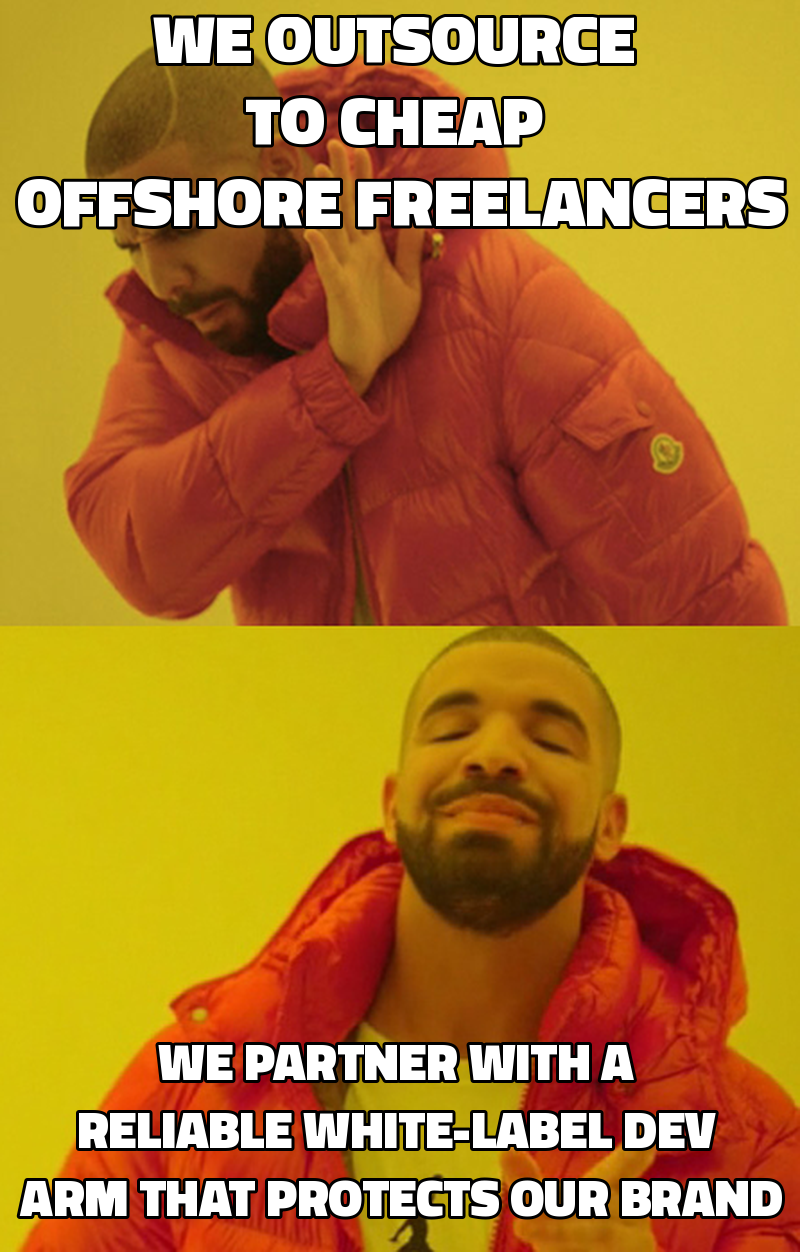
Freelancers may have lower hourly rates, but they often lack the process, QA checkpoints and brand-privacy guarantees that agencies need. A white-label partner reduces risk of missed deadlines, quality issues and brand exposure, which can cost far more in lost client trust.
How many active white-label partners should I work with?
Synthisia caps active partners at 12 to maintain capacity and avoid the flaky-freelancer perception. For a 5-15 person agency, 1-2 white-label partners is optimal to keep margins high and delivery reliable.
What tools does the dev partner use for collaboration?
Common stack includes GitHub for version control, Slack for real-time communication, ClickUp for task tracking, and a private staging environment on WP Engine. All tools integrate with the agency’s existing workflow.
white‑label
Have something to build?
Tell us what you're trying to ship. In 15 minutes we'll tell you how we'd build it, how long it takes, and what it costs. No pitch deck, no pressure.