
Typical Turnaround Times for White-Label Web Development Projects

A white label web development agency builds websites, portals, and custom SaaS solutions for marketing, SEO, branding and social agencies that have no in-house developers. Typical turnaround ranges from 2-3 weeks for a simple brochure site to 8-12 weeks for a complex, AI-powered web application, with medium builds landing in the 4-6 week band.
Key takeaways
- Small brochure sites can be shipped in 2-3 weeks when the scope is fixed and assets are ready.
- Medium-size projects (e-commerce, integrations, basic AI) usually need 4-6 weeks of development and QA.
- Large custom builds (AI automation, voice, multi-tenant SaaS) require 8-12 weeks, often with staged releases.
- Turnaround is driven by scope clarity, asset readiness, review cycles, and the agency’s internal approval speed.
- Setting a realistic delivery window up front protects margin, client trust, and your reputation as a “silent dev arm”.
What is a white label web development agency?
A white label web development agency provides end-to-end code creation, testing, and deployment while remaining invisible to the client. The marketing agency keeps the brand, the relationship, and the invoice; the dev partner signs NDAs and delivers under the agency’s name. This model lets agencies say “yes” to any build request without hiring a full-time engineer, and it lets developers focus on code rather than sales. According to a 2023 Deloitte survey of 150 B2B service firms, 62 % of agencies without internal dev teams rely on white-label partners for more than half of their digital projects.
How long does a small web build take?
A “small” build typically means a 5-10 page brochure site, a landing page series, or a basic WordPress theme with limited custom functionality. The key ingredients that keep the timeline short are:
- Fixed scope – All pages, copy, and design assets are approved before development starts.
- Template-first approach – Using a starter theme (e.g., Elementor Pro, Divi, or a custom React-static starter) reduces hand-coding.
- Rapid QA – One round of client review, followed by a quick bug-squat using tools like BrowserStack.
When these conditions are met, the average delivery window is 12-18 business days. Clutch’s 2022 report of 1,200 web projects listed an average of 6.8 weeks overall, but the “small” segment averaged just 2.5 weeks. Agencies that provide the design files in Sketch or Figma and lock down copy early can consistently hit the lower end of that range.
Sample timeline for a 7-page brochure site
| Day | Activity |
|---|---|
| 1-2 | Kick-off, asset collection, scope sign-off |
| 3-7 | Development of pages on chosen template |
| 8-10 | Internal QA, performance testing |
| 11-12 | Client review & minor revisions |
| 13-14 | Final QA, SEO checklist, launch |
What is the timeline for a medium-size web project?
Medium projects usually involve e-commerce stores, CRM integrations, or basic AI chatbots. The scope expands to 15-30 pages, custom post-types, payment gateways, and third-party API connections. Because there are more moving parts, the timeline stretches to 4-6 weeks.
Critical success factors:
- API contract early – Get OpenAPI specs from the client’s SaaS partner before development.
- Staged delivery – Release a Minimum Viable Product (MVP) after week 3, then iterate.
- Automated testing – Use Cypress or Playwright to run regression suites, saving manual QA time.
Example schedule for a mid-size e-commerce site
| Week | Milestone |
|---|---|
| 1 | Scope freeze, design hand-off, environment setup |
| 2-3 | Core development (product catalog, checkout, payment) |
| 4 | Integration testing with ERP/CRM, client demo |
| 5 | Bug fixing, SEO optimization, performance tuning |
| 6 | Final client sign-off, launch, post-launch monitoring |
Industry data from McKinsey’s 2023 Digital Product Playbook shows that medium-complexity digital products have a median development cycle of 31 days when agile sprints are used and scope creep is limited to 10 % of original estimate.
How long for a large custom web application?
Large builds cover AI-driven automation platforms, voice assistants, multi-tenant SaaS dashboards, or complex data pipelines. They often require custom back-ends, micro-service architecture, and compliance work (e.g., GDPR, HIPAA). The realistic window is 8-12 weeks, sometimes longer if regulatory review is needed.
Key drivers of the longer timeline:
- Requirement discovery – Workshops to map user journeys, data flows, and compliance checkpoints.
- Prototype & validation – A clickable prototype or low-fidelity MVP is built in weeks 2-3 to lock down expectations.
- Security & compliance testing – Pen-test cycles, privacy impact assessments, and audit logs.
- Staged rollout – Beta release to a pilot group, followed by incremental feature roll-out.
Timeline for an AI-enabled client portal (12-week example)
| Phase | Weeks | Activities |
|---|---|---|
| Discovery | 1-2 | Stakeholder interviews, user story mapping, compliance checklist |
| Architecture | 3 | Define micro-service diagram, select cloud provider (AWS, Azure), set CI/CD pipeline |
| Prototype | 4-5 | Build core UI mockup, integrate basic chatbot, internal demo |
| Core Development | 6-9 | Build API layer, database schema, AI model integration, role-based access |
| QA & Security | 10 | Automated test suite, penetration testing, accessibility audit |
| Beta & Feedback | 11 | Pilot launch to 5-10 client users, collect NPS, fix critical bugs |
| Launch | 12 | Full production rollout, monitoring dashboards, hand-off documentation |
A 2022 Forrester study of enterprise AI projects reported an average time-to-value of 10.5 weeks, aligning with the window above when a disciplined sprint cadence is followed.
Factors that stretch or shrink turnaround
| Factor | How it impacts timeline | Mitigation tip |
|---|---|---|
| Asset readiness | Missing copy or images adds 1-3 days per iteration | Require a “design lock” before dev kickoff |
| Scope creep | New features after sprint start add 10-20 % per change | Use a change-order form with clear cost impact |
| Review latency | Client takes >48 h to respond to QA feedback | Set SLA of 24 h for review, include penalty clause |
| Third-party API stability | Unreliable external services cause re-work | Mock APIs in early sprints, validate SLAs |
| Team bandwidth | Over-booking developers leads to queue delays | Cap active partner count to maintain low concurrency |
| Regulatory compliance | GDPR or industry-specific audits add weeks | Conduct compliance checklist in discovery phase |
How to set realistic expectations with your agency client
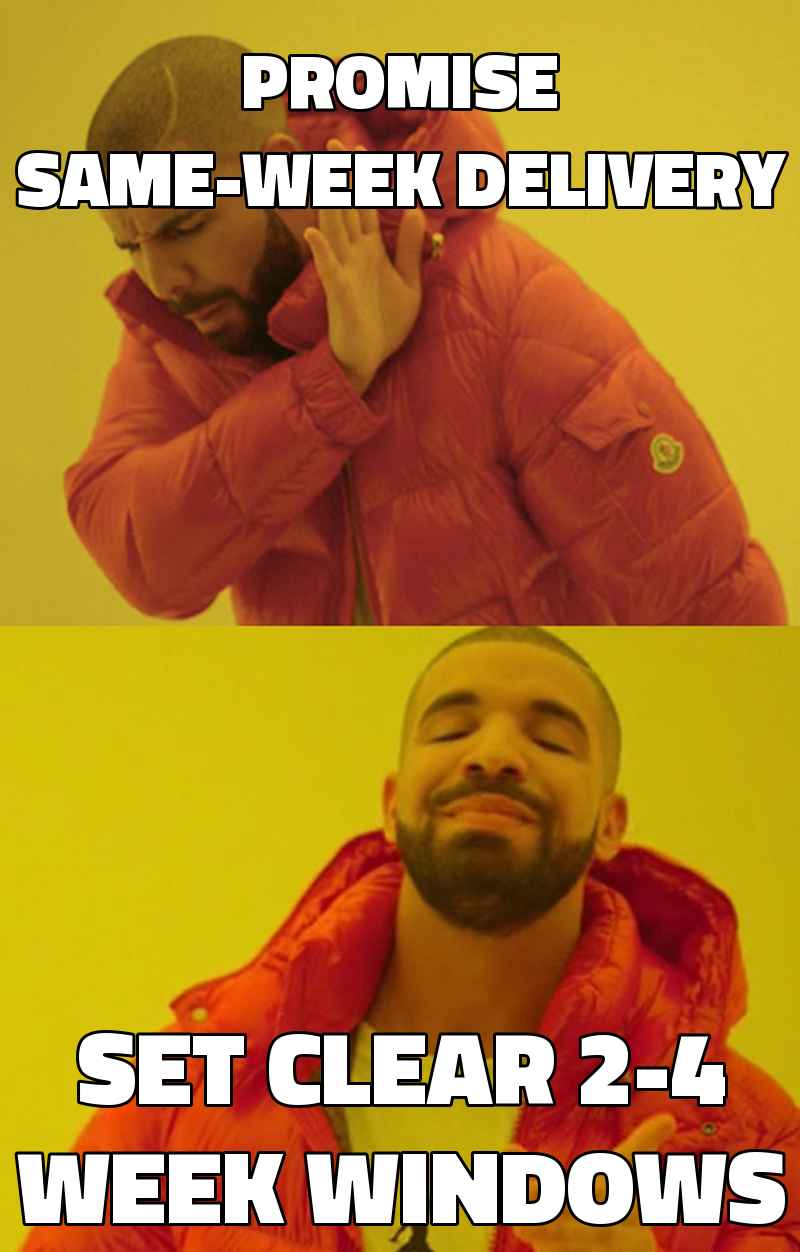
- Present a delivery band, not a single date – “We’ll deliver the MVP in 4-5 weeks, with final launch by week 6.” This accounts for minor revisions without appearing flaky.
- Show a milestone calendar – Visual Gantt or Trello board shared via a client portal builds transparency.
- Include buffer for client review – Allocate 10 % of total time for feedback loops; most agencies underestimate this.
- Communicate risk triggers – Explain that missing assets or late API keys will push the schedule.
- Offer staged payments tied to milestones – Align cash flow with delivery, reinforcing trust.
By framing the timeline as a range and linking each phase to a tangible deliverable, agencies can quote confidently and keep the client happy.
Comparison of turnaround by project size
| Project size | Typical scope | Estimated duration (weeks) | Example deliverables |
|---|---|---|---|
| Small | 5-10 static pages, basic CMS | 2-3 | Brochure site, landing page series |
| Medium | 15-30 pages, e-commerce, API integration, simple AI bot | 4-6 | Online store, CRM-connected site, chatbot |
| Large | Custom backend, AI/voice, multi-tenant SaaS, compliance | 8-12 | Client portal, automation platform, voice assistant |
Key criteria for choosing a white-label partner
| Criterion | Why it matters | How to evaluate |
|---|---|---|
| Technical depth | Ability to deliver AI, voice, custom back-ends | Review portfolio, ask for code samples, check StackOverflow reputation |
| Delivery reliability | Guarantees you won’t miss client deadlines | Ask for SLA, request references, look at average turnaround stats |
| Communication model | Single point of contact reduces friction | Confirm account manager assignment, test response time in pilot |
| Pricing transparency | Enables you to keep margin | Get wholesale rate sheet, compare to industry benchmarks (Clutch median $75-$120/hr) |
| NDA & non-circumvent | Protects your brand and client list | Review legal template, ensure enforceable clauses in relevant jurisdictions |
Real-world example: RouteMate launch
Synthisia’s “Silent Dev Arm” delivered RouteMate, a full-stack SaaS for logistics automation, in 10 weeks. The project followed the large-project timeline above, used a staged MVP, and leveraged AI-driven workflow automation. The agency partner kept the brand front-and-center, billed the client $45 k, and paid Synthisia a $27 k wholesale fee (60 % margin). The success hinged on clear scope, a fixed-price pilot, and a transparent milestone calendar shared via a simple Google Sheet dashboard.
Bottom line for agency founders
If you can promise a 2-3 week launch for a simple site, a 4-6 week window for a medium e-commerce or chatbot, and an 8-12 week band for AI-heavy platforms, you’ll win more work, keep margins healthy, and avoid the “ghost developer” reputation. Pair those windows with a single accountable contact, staged payments, and a shared status view, and you’ll turn the white-label partnership into a repeat-revenue engine.
Frequently asked questions
How do I know if a white-label dev partner can handle AI automation?
Ask for case studies that include AI models, ask about the tools they use (TensorFlow, LangChain, Azure Cognitive Services), and request a short prototype of a chatbot or automation flow. A partner that can ship a functional demo in under two weeks demonstrates both skill and speed.
What if my client wants a same-week launch?
Same-week delivery is rarely realistic for custom code. You can offer a “quick-win” landing page built on a pre-made template, but set expectations that any custom functionality will follow the standard 2-3 week band. Transparency prevents disappointment and protects your reputation.
Can I charge my client a higher margin than the wholesale rate?
Yes. Most agencies apply a 30-50 % markup on the wholesale fee. The key is to keep the client happy with on-time delivery and quality, not to compete on price. According to a 2022 HubSpot survey, agencies that focus on reliability see 1.8× higher client retention than price-driven competitors.
How many projects can I safely run with one white-label partner?
Synthisia caps active partner projects at 4-5 concurrent builds to maintain a 95 % on-time rate. For a 5-15 person agency, that translates to roughly one new project every 2-3 weeks, which aligns with the turnaround windows described above.
What does a “fixed-scope pilot” look like?
A pilot is a small, paid project (usually $1.5-$3 k) with a clearly defined deliverable – for example, a single custom integration or a prototype chatbot. The scope, timeline, and acceptance criteria are locked in contract, allowing both sides to test the partnership risk-free.
How should I handle revisions after launch?
Include a 2-week post-launch support window in the contract. Minor tweaks (text, styling) are covered; major feature additions should trigger a new change order. This keeps the original timeline intact and gives the client a clear path for future work.
Do I need to share code with my client?
No. The white-label partner retains ownership of the source code under the NDA, while you deliver the final product under your brand. If the client requests code for internal audit, you can provide a compiled build or a read-only repository link, preserving your partner’s IP.
What legal protections ensure the partner won’t poach my clients?
A robust NDA combined with a non-circumvent clause that specifies a 12-month non-solicitation period for any client introduced by you. While enforcement across borders can be tricky, most reputable partners honor these terms to maintain long-term relationships.
white‑label
Have something to build?
Tell us what you're trying to ship. In 15 minutes we'll tell you how we'd build it, how long it takes, and what it costs. No pitch deck, no pressure.