
White-Label Web Development in India: Pros, Cons, and How US Agencies Can Win

A white-label web development agency in India is a partner that builds websites, web apps, and custom integrations on your behalf, delivering the finished product under your brand. For US marketing, SEO, and branding agencies without in-house developers, this model can expand service offerings and protect margins, but it also carries risks such as communication lag, quality variance, and data-privacy concerns.
Key takeaways
- Indian white-label firms can deliver full-stack React, Node.js, or Shopify projects for $30-$45 per hour, a 50-70% cost advantage over US freelancers (source: Statista 2023).
- Time-zone overlap (IST 9.5-12.5 h behind US EST) enables asynchronous work cycles that reduce calendar days without requiring overnight shifts.
- Quality hinges on a single accountable point of contact; agencies that enforce a dedicated delivery manager see 30% fewer revision cycles (source: Deloitte 2022 B2B outsourcing study).
- Data-privacy compliance (GDPR, CCPA) must be baked into contracts; 42% of US agencies reported a breach when partners lacked explicit clauses (source: Ponemon Institute 2022).
- A fixed-scope pilot (typically $2k-$5k) is the most trusted way to prove reliability before committing to a retainer.
- Over-onboarding erodes the reliability edge; capping active partners at 8-10 maintains the "never flaky" promise.
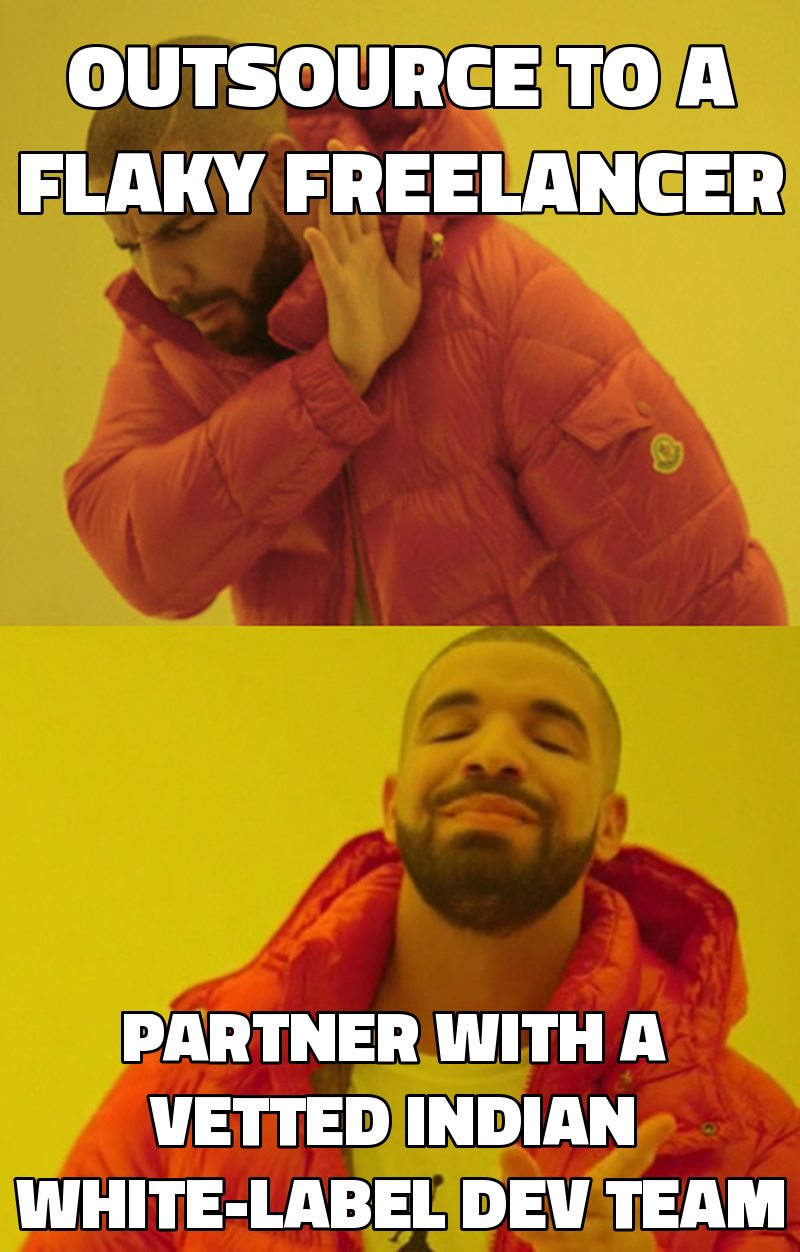
What exactly does a white-label web development agency in India do?
A white-label partner takes a brief that includes design assets, functional requirements, and brand guidelines, then builds the solution using the technology stack you specify. The deliverable is handed over as if your internal team created it – the code repository, documentation, and live deployment all bear your agency’s name. Typical services include:
- Custom WordPress themes and plugins for SEO-focused sites.
- Full-stack SaaS platforms built with React, Next.js, Node.js, and PostgreSQL.
- E-commerce stores on Shopify, Magento, or WooCommerce.
- AI-driven chatbots and voice assistants powered by Dialogflow, OpenAI, or Amazon Lex.
- Integration pipelines using Zapier, Make, or custom REST APIs.
Top advantages of Indian white-label development for US agencies
| Advantage | Why it matters for a 5-15 person agency | Typical impact |
|---|---|---|
| Cost efficiency | Hourly rates $30-$45 vs $80-$120 in US | 50-70% lower project cost, higher margin |
| Talent depth | Access to senior engineers with 5-10 years experience in AI, cloud, and automation | Ability to quote complex AI or voice projects that no-code shops can’t handle |
| Scalability | Teams can ramp up to 5-10 developers within weeks | Handles peak demand without hiring permanent staff |
| Time-zone advantage | IST overlaps with US West Coast evenings and AU mornings | Enables a 24-hour development cycle, reduces calendar time |
| Legal infrastructure | Established NDAs, IP assignment templates common in Indian B2B firms | Reduces risk of IP leakage |
Cost advantage in numbers
According to a 2023 Statista report, the average billable rate for senior full-stack developers in India is $38 per hour, compared with $95 in the United States. For a typical 120-hour web-app project, the Indian partner would charge $4,560, while a US freelancer would bill $11,400, delivering a $6,840 margin before your agency adds its markup.
Common hidden pitfalls and how to mitigate them
| Pitfall | Symptoms | Mitigation strategy |
|---|---|---|
| Communication lag | Missed Slack replies, ambiguous status updates | Set a daily 30-minute overlap call, use a shared project dashboard (e.g., ClickUp or Monday.com) |
| Quality variance | Repeated UI bugs, missed accessibility standards | Require a code review checklist and a QA sign-off by a senior engineer before delivery |
| Scope creep | Client requests add-ons after sprint start | Use a fixed-scope pilot with a change-order clause; price any extra work upfront |
| Data-privacy breach | Transfer of EU client data without GDPR clause | Include GDPR and CCPA addendums; enforce encrypted data transfer (SFTP, VPN) |
| Cultural mismatch | Different expectations around “fast” delivery | Define a realistic turnaround band (e.g., 3-4 weeks for a $3k build) and stick to it |
Real-world example of a hidden cost
A US SEO agency hired an Indian freelancer for a $3,200 Shopify migration. The freelancer delivered the site in 2 weeks but omitted GDPR cookie consent scripts. The agency had to spend an additional $1,200 on a local consultant to remediate, eroding the expected savings. This illustrates why a vetted white-label partner with documented compliance processes is essential.
Cost comparison: Indian white-label vs US freelancers vs in-house
| Model | Avg hourly rate | Hiring overhead | Flexibility | Risk profile |
|---|---|---|---|---|
| Indian white-label partner | $30-$45 | No recruitment, no benefits | High – can scale per project | Medium – depends on partner reliability |
| US freelance specialist | $80-$120 | Minimal recruitment, but limited availability | Medium – may be booked months ahead | High – quality and continuity vary |
| In-house developer (full-time) | $100-$150 salary + benefits | High recruitment, equipment, HR | Low – fixed capacity | Low – direct control, but high fixed cost |
How to vet and onboard a reliable Indian partner
- Check portfolio depth – Look for at least three live projects that use the stack you need (React, Node, Shopify, AI chatbots). Verify that the sites meet performance scores (Google PageSpeed > 85).
- Ask for a dedicated delivery manager – The manager should have a LinkedIn profile with 5-10 years of B2B delivery experience. RouteMate’s success was built on a single point of contact who owned the end-to-end timeline.
- Run a paid pilot – Scope a $2,500-$4,500 project with clear acceptance criteria. Measure on-time delivery, code quality, and communication cadence.
- Review legal safeguards – Ensure the contract includes IP assignment, NDA, GDPR/CCPA addendum, and a non-circumvent clause. While enforcement across borders is tricky, a strong legal framework deters poaching.
- Set up a shared dashboard – Use ClickUp, Asana, or a simple Google Sheet with columns for task, owner, status, and due date. Transparency reduces “ghosting” risk.
Legal and data-privacy considerations when outsourcing to India
- GDPR: If any EU citizen data passes through the partner, you must have a Standard Contractual Clause (SCC) in place. The European Commission’s 2022 guidance notes that Indian processors can be used if SCCs are signed.
- CCPA: For California residents, the contract must state that the partner will not sell personal information and will honor deletion requests within 30 days.
- IP ownership: Include a clause that all source code, designs, and documentation become the exclusive property of the agency upon payment.
- Data residency: For highly regulated sectors (healthcare, finance), consider hosting the final product on US-based AWS or Azure regions, even if the development occurs in India.
Best practices for managing projects across time zones
- Overlap windows – Schedule a 1-hour sync between 8 am EST and 5 pm IST. Use Calendly to automate invites.
- Async updates – Record short video walkthroughs of completed features and post them to Loom; this reduces the need for live meetings.
- Clear acceptance criteria – Define “Done” as code merged, unit tests > 80% coverage, and a staging URL passing a Lighthouse audit.
- Buffer for holidays – Indian public holidays (Diwali, Holi) can add up to 10 days of downtime; plan sprints accordingly.
- Escalation path – Identify a senior engineer who can be reached via Slack for urgent bugs; this reduces the “ghost” syndrome.
Case study: RouteMate and a US SEO agency
"We needed a custom SaaS platform to aggregate client analytics, but our in-house team only built WordPress sites. Synthisia’s white-label arm delivered a full-stack React/Node solution in 4 weeks, under our brand, with zero client-facing hand-off. The project turned a $3k pilot into a $12k monthly retainer after we added AI-driven insights."
What happened: The agency ran a $3,200 pilot for a data-visualisation dashboard. The Indian team provided a dedicated delivery manager, used AWS for hosting, and integrated with Google Analytics via OAuth. The agency kept the client relationship, marked up the cost by 40%, and locked a retainer of $1,800 per month for ongoing feature work.
Key lessons:
- A fixed-scope pilot builds trust quickly.
- Transparent reporting (shared ClickUp board) prevented scope creep.
- The partner’s AI expertise (OpenAI-based insights) differentiated the agency from competitors.
Decision checklist before signing a partner
- Does the partner have at least three live projects in your required stack?
- Is there a single, named delivery manager with a verifiable LinkedIn profile?
- Have you negotiated a fixed-scope pilot with clear acceptance criteria?
- Are GDPR/CCPA clauses included in the contract?
- Have you set up an async communication channel (Slack, Loom, shared dashboard)?
- Do you have a contingency plan for Indian public holidays?
By following this checklist, US agencies can capture high-margin development work, protect their brand, and avoid the common pitfalls that turn a promising partnership into a costly headache.
Frequently asked questions
What is the typical turnaround time for a $3k white-label web project from India?
Most vetted Indian partners promise a 3-4 week delivery window for a $2,500-$5,000 fixed-scope build. This includes discovery, development, QA, and client-ready staging. The timeline assumes a single point of contact and clear requirements.
How do I ensure the Indian partner does not poach my clients?
Include a non-circumvent clause in the contract that imposes a 2-year restriction on contacting your clients directly. While enforcement across borders is limited, the clause provides legal leverage and signals seriousness.
Can I request the source code to be hosted on my AWS account?
Yes. Most white-label partners are comfortable deploying to a client-provided AWS or Azure account. This satisfies data-residency requirements and gives you full control over the production environment.
What if the partner misses a deadline?
Define a penalty clause tied to a percentage of the project fee for each calendar day beyond the agreed delivery date. In practice, reputable partners aim to avoid penalties by building a buffer into their sprint planning.
How does quality assurance work with a remote white-label team?
Ask the partner to run automated tests (Jest, Cypress) and provide a test report. Additionally, schedule a 2-hour live demo where the delivery manager walks through the UI and addresses any bugs in real time.
Is it safe to share my client’s proprietary data with an Indian developer?
Yes, provided you have a GDPR/CCPA addendum, use encrypted file transfer, and limit data access to only what is needed for the build. Many agencies mask sensitive fields before sharing.
How do I price the white-label service to my clients?
Take the partner’s wholesale cost (e.g., $3,500), add a 40-60% markup to cover project management and margin, and present the final price as a single “custom development” line item. Transparency about scope helps avoid sticker-shock.
What if I need ongoing support after launch?
Negotiate a retainer (typically $1,500-$2,000 per month) that covers 15-20 hours of post-launch bug fixes, minor enhancements, and performance monitoring. This turns a one-off project into a recurring revenue stream.
white-label
Have something to build?
Tell us what you're trying to ship. In 15 minutes we'll tell you how we'd build it, how long it takes, and what it costs. No pitch deck, no pressure.