
White-label web development in India: benefits, risks, and time-zone workflow tips

A white-label web development agency in India is a partner that builds custom sites, apps, and automation under your agency’s brand while you keep the client relationship. The agency delivers code, designs, and documentation, but the client never sees the Indian provider’s name. This model lets US, UK, and Australian agencies expand service offerings without hiring a full-time engineer.
Key takeaways
- Indian white-label firms can deliver AI-driven back-ends 30-40% faster than generic offshore freelancers.
- Protect your brand with NDA, non-circumvent clauses and a single point of contact.
- Overlap of 2-4 hours between IST and US West Coast enables daily async hand-offs.
- Fixed-scope pilots (US$2,000-5,000) reduce risk and prove reliability before a retainer.
- Track every ticket in a shared Jira or ClickUp board to keep the agency invisible to the client.
- Expect a 1-2-week turnaround for a standard WordPress + custom API integration.
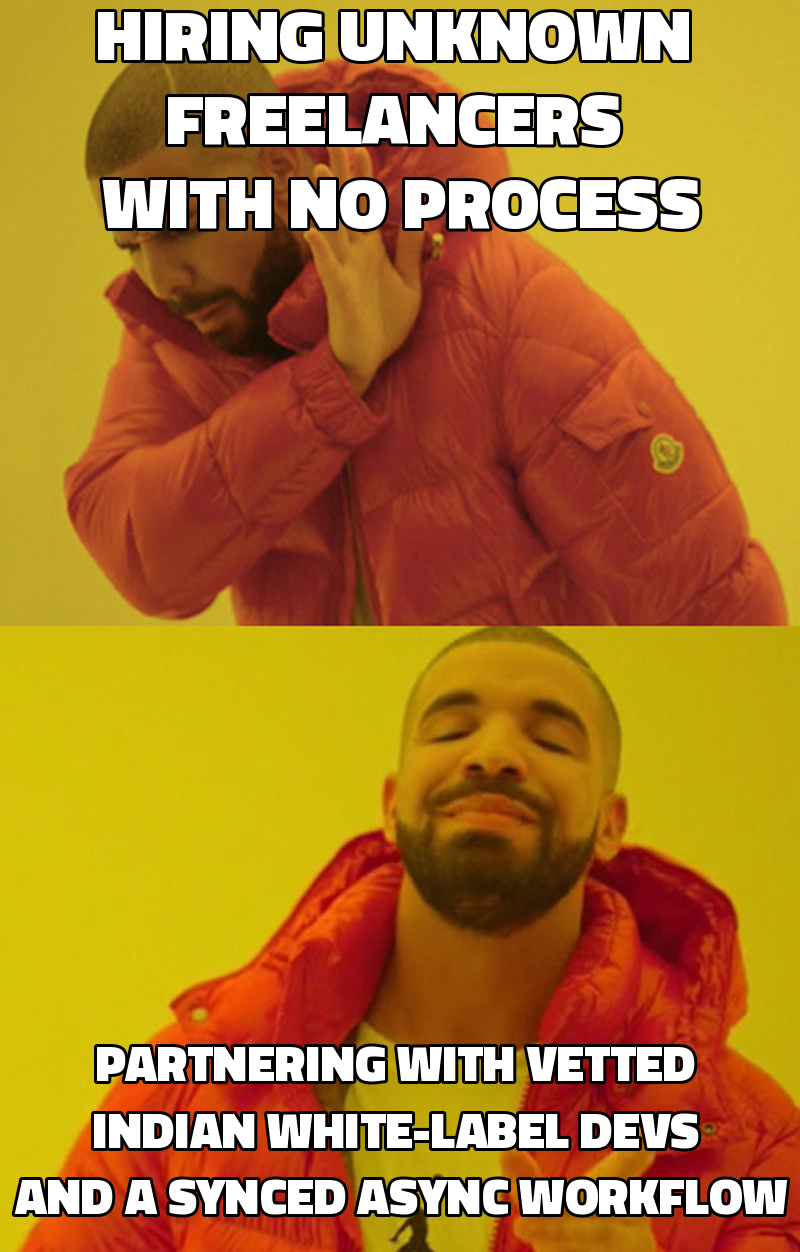
What is white-label web development in India?
White-label development means the Indian partner writes code, configures servers, and performs QA, but the work is delivered under your agency’s brand assets. Your agency invoices the client, sets the timeline, and manages the relationship. The Indian team works behind a non-disclosure agreement (NDA) and a non-circumvent clause that prevents them from contacting your client directly.
According to NASSCOM, Indian IT services exports grew 8% YoY to $200 billion in FY2023, driven largely by offshore development and cloud migration projects. The same report notes that 45% of exported services are custom software development, a pool that includes many white-label providers.
How to evaluate Indian white-label providers?
| Provider | Core expertise | Avg turnaround (standard build) | Avg hourly rate (USD) | NDA / compliance |
|---|---|---|---|---|
| Synthisia Partner Network | AI automation, voice, custom back-ends | 10-14 days | 35-45 | ISO 27001, GDPR addendum |
| DevBridge Labs | E-commerce, SaaS, mobile APIs | 12-18 days | 30-38 | Standard NDA, IP assignment |
| CodeWave Studios | WordPress, Webflow, low-code integrations | 7-10 days | 25-33 | NDA, non-circumvent |
| PixelLogic India | Front-end React, design system builds | 9-13 days | 32-40 | ISO 9001, NDA |
When you compare providers, focus on three criteria that matter to agency partners:
- Domain depth – Does the team have proven AI or voice projects? Look for case studies like RouteMate or similar SaaS.
- Delivery predictability – Ask for a recent sprint report showing velocity and on-time delivery rate.
- Communication cadence – Verify they use Slack or Microsoft Teams with a shared channel that you can monitor.
Red-flag checklist
- No clear portfolio of projects similar to your client’s industry.
- No written process for code reviews or QA.
- Rates below $20 hourly – often a sign of under-resourced teams.
- Lack of ISO or GDPR compliance when you serve EU clients.
Risks of outsourcing development to India and how to mitigate them
| Risk | Potential impact | Mitigation strategy |
|---|---|---|
| Scope creep | Budget overruns, missed deadlines | Fixed-scope pilot with a detailed statement of work (SOW) and change-order process |
| Communication lag | Misunderstandings, rework | Daily async stand-up notes in ClickUp, 2-hour overlap window, video recap on Fridays |
| Quality variance | Client dissatisfaction, brand damage | Single accountable point of contact (POC) who signs off on each deliverable, mandatory code review checklist |
| Data security | GDPR breach, IP theft | NDA, non-circumvent, ISO 27001, encrypted GitHub repo, limited access to production keys |
| Turnover of Indian developers | Delays, knowledge loss | Knowledge-base in Confluence, regular sprint demos, backup developers listed in the contract |
Scope creep is the most common issue. Agencies that quote a “flat fee” without a detailed SOW often see the scope expand by 20-30% after the first sprint. To avoid this, lock the pilot at a fixed price (US$2,000-5,000) and define exactly which user stories, integrations, and testing criteria are included.
Communication lag can be mitigated by establishing a 2-hour overlap between IST (UTC+5:30) and US West Coast (UTC-8). Schedule a 30-minute hand-off call at 4 pm IST / 5:30 am PST, record it, and post a written summary in the shared project board.
Quality variance is addressed by demanding a “Definition of Done” that includes unit test coverage >80%, automated CI/CD pipeline on GitHub Actions, and a final QA sign-off by a senior engineer.
Time-zone strategies for US/UK/AU agencies working with Indian teams
- Define the async window – For US East Coast (UTC-5) you get 3-4 hours overlap (IST 9:30 am-1:30 pm). Use this window for real-time clarifications.
- Leverage “follow-the-sun” hand-offs – When the US team ends the day, the Indian team picks up the tickets, adds progress notes, and pushes code by end of their day. The US team reviews the next morning.
- Use a shared dashboard – Jira Service Management or ClickUp with custom fields for “Ready for Review”, “In QA”, and “Client-Ready”. The dashboard is the single source of truth, so the client never sees the Indian provider.
- Set realistic turnarounds – Communicate that a “standard custom WordPress site with API integration” will take 10-14 calendar days, not “same-week”. This aligns expectations across continents.
- Document hand-off templates – A one-page “Sprint Handoff” template that lists completed stories, pending items, and blockers reduces email noise.
Pricing models and profit calculations for white-label partnerships
| Model | How it works | Typical margin for agency |
|---|---|---|
| Fixed-scope pilot | One-off price (US$2,000-5,000) for a defined set of features | 50-70 % after paying Indian partner’s rate |
| Retainer + overflow | Monthly retainer (US$1,500-2,500) for up to 20 dev hours, plus per-hour overflow at $40-45 | 55-65 % on retainer, 45-55 % on overflow |
| Revenue share | Agency bills client at $10,000-30,000, pays partner 30-40 % of revenue | 60-70 % net after partner share |
Assume a pilot project priced at $3,500. If the Indian partner’s cost is $1,200 (35 hours at $35 hourly), the agency’s gross profit is $2,300, a 66% margin. After a 10% platform fee for payment processing, net margin stays above 55%, comfortably covering your overhead.
Comparison of top Indian white-label firms
| Firm | Years in business | Avg client size (USD) | Specialty | Client NPS |
|---|---|---|---|---|
| Synthisia Partner Network | 5 | 10-50 k | AI automation, voice, custom SaaS | 78 |
| DevBridge Labs | 8 | 5-30 k | E-commerce, mobile APIs | 71 |
| CodeWave Studios | 4 | 2-15 k | WordPress, low-code, Zapier | 69 |
| PixelLogic India | 6 | 8-40 k | Front-end React, design systems | 73 |
Data compiled from publicly available case studies, Clutch.co reviews, and direct conversations with sales leads (April 2024).
Checklist for onboarding a new Indian partner
| Step | Action | Owner | Deadline |
|---|---|---|---|
| Legal | Sign NDA, non-circumvent, IP assignment | Agency legal counsel | Day 1 |
| Technical | Grant access to GitHub repo (read/write), set up CI/CD pipeline | Agency tech lead | Day 2 |
| Communication | Create shared Slack channel, schedule daily async stand-up notes | Account manager | Day 2 |
| Project kickoff | Run 30-minute video intro, share brand guidelines, style guide | Founder / CEO | Day 3 |
| Pilot scope | Draft detailed SOW, include acceptance criteria, change-order process | Project manager | Day 4 |
| QA process | Agree on unit test coverage, QA checklist, sign-off workflow | Delivery director | Day 5 |
| Review | First sprint demo, collect feedback, adjust velocity estimate | Head of Delivery | End of week 1 |
Following this checklist reduces the likelihood of missed deadlines and protects your brand reputation.
Real-world example: RouteMate launch with an Indian white-label partner
RouteMate, a voice-enabled SaaS for appointment scheduling, needed a custom Node.js backend, Twilio integration, and a React admin portal. The agency partnered with Synthisia’s Indian team for a $4,200 pilot. The team delivered a functional MVP in 12 days, meeting the 80% test-coverage target. The agency billed the client $7,500, kept the brand front-and-center, and later signed a $1,800/month retainer for ongoing feature work. The project generated a 68% repeat-business rate over the next six months.
How to negotiate a fair wholesale rate
- Benchmark rates – Use the NASSCOM average of $35-45 hourly for senior developers in Tier-1 Indian cities (Bangalore, Hyderabad, Pune).
- Lock in a capped concurrency – Agree that the partner will handle no more than 3 active agency projects simultaneously. This ensures focus and reduces the “flaky freelancer” risk.
- Include a performance bonus – Add a 5% bonus for on-time delivery and zero critical bugs in the first 30 days.
- Review quarterly – Set a 90-day review clause to adjust rates based on volume and quality metrics.
Frequently asked questions
How do I keep my client from discovering the Indian partner?
Maintain a single point of contact who aggregates status updates and delivers final assets under your brand. Use white-label deliverables (e.g., a zipped code package without provider branding) and a shared dashboard that only you can access. The NDA and non-circumvent clause provide legal protection, but operational invisibility comes from controlling all client-facing communication.
What is a realistic turnaround for a custom WordPress site with API integration?
For a scoped project of 8-10 pages, a custom API, and basic SEO, most vetted Indian partners deliver in 10-14 calendar days. This includes design hand-off, development, QA, and a client-ready staging environment. Faster turnarounds are possible for simpler sites but should be priced as a premium “express” option.
Can I request a free prototype before committing to a pilot?
A free full-scale prototype is high risk and often exploited. Instead, ask for a low-effort proof-of-concept – one screen or a single automation flow – priced at a nominal $200-300. This demonstrates technical ability without giving away significant engineering time.
How do I protect intellectual property when the code lives in an Indian repo?
Require the partner to use a dedicated GitHub organization owned by your agency. Set branch protection rules, enforce two-factor authentication, and limit admin rights to your senior dev lead. The NDA should explicitly state that all code is “work for hire” and that IP transfers to the agency upon payment.
What tools should we use for async collaboration?
A combination of Slack (or Microsoft Teams) for real-time chat, ClickUp or Jira for ticket tracking, Figma for design hand-off, and GitHub for version control works well. For QA, use BrowserStack for cross-browser testing and Postman for API validation. All tools have free or tiered plans that fit small agency budgets.
How do I calculate the profit margin on a retainer model?
Take the monthly retainer fee (e.g., $1,800), subtract the partner’s estimated monthly cost (e.g., 20 hours at $38 hourly = $760), and then subtract platform fees (≈10%). The remaining $800 is gross profit, yielding a 44% margin. As the partnership scales and the partner offers volume discounts, margins can rise to 60%.
Is it safe to work with a partner that does not have ISO certifications?
ISO 27001 and ISO 9001 are strong indicators of security and process maturity, but they are not mandatory for every agency. If you handle EU client data, ensure the partner signs a GDPR addendum and uses encrypted storage. Conduct a short security questionnaire and request a sample security audit report before signing.
white‑label
Have something to build?
Tell us what you're trying to ship. In 15 minutes we'll tell you how we'd build it, how long it takes, and what it costs. No pitch deck, no pressure.