
White-Label Web Development Agencies in India: Cost, Communication, and Delivery Compared for US/UK Agencies

White label web development agencies in India provide fully branded development services for agencies that lack in-house engineers. They typically charge $25-45 per hour, offer English-speaking project managers, and deliver on a fixed-scope pilot before scaling to a retainer model.
Key takeaways
- Indian white-label shops cost 60-80% less than US boutique firms while maintaining comparable quality for custom web and SaaS builds.
- Overlap of 4-6 hours with the UK and 1-3 hours with US East Coast enables daily async updates without sacrificing responsiveness.
- Fixed-scope pilots (often $1,500-$3,000) de-risk the partnership and prove delivery speed before a retainer is added.
- GDPR-ready Indian partners can sign EU Data Processing Agreements, protecting UK and EU client data.
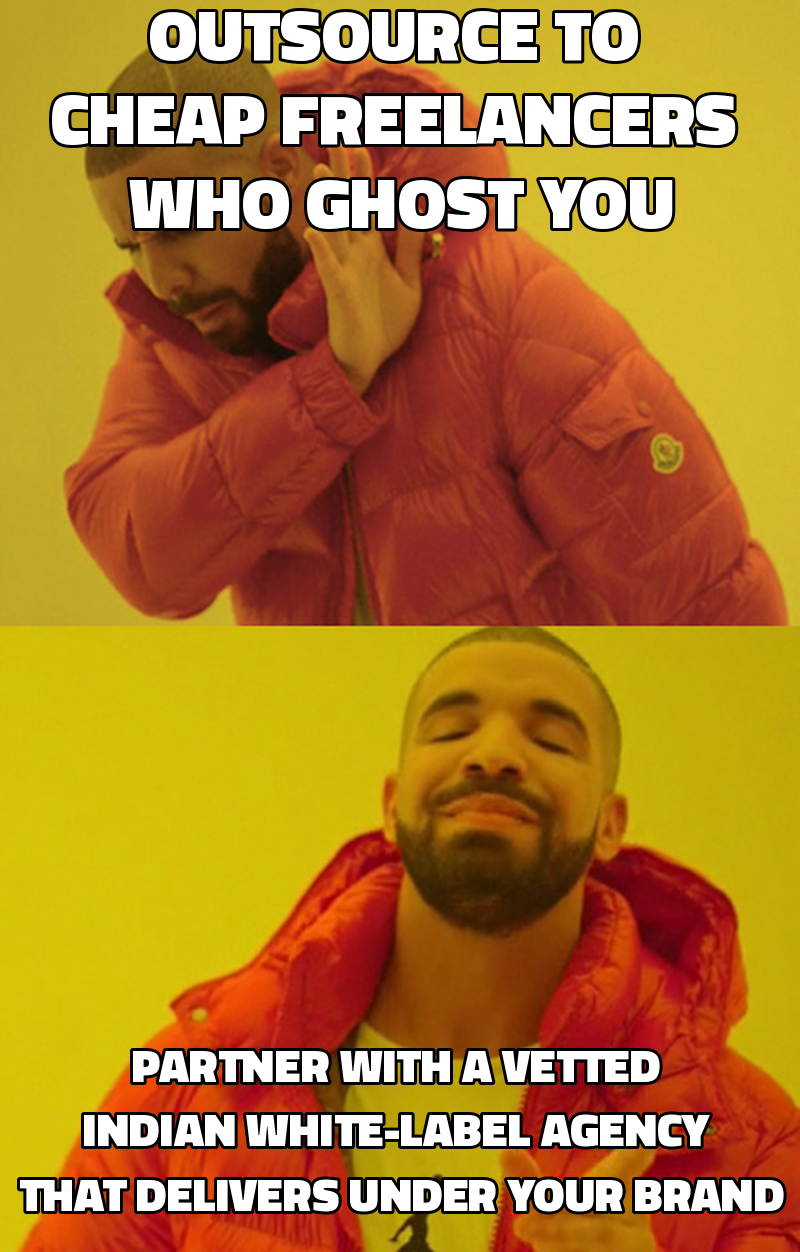
- A single accountable point of contact reduces the "multiple vendor" headache common with freelancers.
- Choose agencies that use transparent tools like Jira, Slack, and GitHub to keep you in the loop.
What is a white-label web development agency in India?
A white-label web development agency builds digital products, websites, portals, SaaS platforms, under your agency’s brand. The client never sees the developer; you keep the relationship, the margin, and the credit. Indian firms such as Synthisia, PixelCrayons, and Tata Consultancy Services (TCS) Digital specialize in this model, offering a dedicated project manager, NDA protection, and a non-circumvent clause as standard.
How do Indian rates compare to other offshore options?
| Region | Typical hourly rate (USD) | Typical project size (USD) | Common tech stack |
|---|---|---|---|
| India (white-label) | 25-45 | 1,500-5,000 for fixed-scope pilots | React, Node.js, Laravel, WordPress, Webflow |
| Eastern Europe (Poland, Ukraine) | 45-70 | 3,000-8,000 | Angular,.NET, Django |
| US boutique agencies | 100-150 | 5,000-15,000 | React, Ruby on Rails, Shopify Plus |
Source: Clutch 2023 for Indian rates, GoodFirms 2022 for Eastern Europe, and McKinsey 2021 for US boutique pricing.
The cost gap is significant, but price alone should not drive the decision. Indian agencies often have larger talent pools, allowing them to assign senior engineers to complex AI automation or voice integration projects that a typical US boutique might outsource to a specialist.
Communication models: What to expect from Indian partners
| Model | Time-zone overlap | Primary tools | Typical response time |
|---|---|---|---|
| Dedicated Project Manager (PM) | 4-6 hours with UK, 1-3 hours with US EST | Slack, Jira, Google Meet | Within 2 hours during overlap |
| Shared Slack channel + weekly demo | 2-3 hours with UK, minimal with US | Slack, Asana, Zoom | Within 4 hours during overlap |
| Email-only + bi-weekly status | 0-1 hour overlap | Email, Trello | Within 24 hours |
Agencies that assign a single PM (often titled Delivery Lead or Account Manager) reduce the “multiple point of contact” risk that plagues freelance arrangements. The PM consolidates updates from developers, runs daily stand-ups, and shares a live dashboard (e.g., a simple Airtable view or a private Jira board) so you can see progress in real time.
Delivery models: Fixed-scope pilot vs retainer vs full-project
- Fixed-scope pilot – A small, clearly defined deliverable (e.g., a landing-page with custom form automation) priced between $1,500-$3,000. The pilot lasts 2-4 weeks and includes a signed NDA and a non-circumvent clause. Successful pilots unlock a larger engagement.
- Retainer model – After trust is built, agencies often move to a monthly retainer of $1,500-$2,500 covering 15-20 development hours. This model is ideal for agencies with a steady flow of micro-SaaS features, chatbot tweaks, or integration work.
- Full-project – For larger builds ($5,000-$15,000) the Indian partner provides a full-stack team (frontend, backend, QA) on a milestone-based payment schedule (e.g., 30% upfront, 40% after MVP, 30% on launch).
Pros of partnering with an Indian white-label agency
- Cost efficiency – The hourly gap translates into higher margin on each client invoice.
- Scalable talent – Large talent pools mean you can quickly staff a React-Native mobile app or a voice-assistant integration without hiring locally.
- English proficiency – According to the British Council 2022, 70% of Indian IT professionals rate their English as business-level, which eases requirement gathering.
- Compliance ready – Many Indian firms have ISO 27001 certification and can sign GDPR Data Processing Agreements, satisfying UK and EU client requirements.
- Focused partnership – Agencies that limit active partners (often 5-7) keep concurrency low, ensuring they are not the flaky freelancer you are trying to replace.
Cons and risk factors to watch
- Time-zone lag – While there is overlap, real-time collaboration can be delayed. Critical bugs discovered late in the US day may wait until the next Indian workday.
- Cultural differences – Requirement phrasing may need extra clarification; using detailed user stories in Jira mitigates misunderstandings.
- Legal enforceability – NDAs are table-stakes, but cross-border non-circumvent clauses are hard to enforce; rely on relationship trust and pilot success instead.
- Variable quality – Not all Indian firms are equal. Look for partners with proven case studies (e.g., RouteMate, a full-stack SaaS built for an Australian agency) and client references.
How to vet an Indian white-label partner for your agency
- Check the portfolio – Look for projects that match your client base (SMBs needing chatbots, custom dashboards, or voice-enabled sites). Absence of similar work is a red flag.
- Ask for a pilot – A $2,000 pilot with clear acceptance criteria demonstrates delivery speed and communication style.
- Confirm tooling – Ensure they use Jira or ClickUp for task tracking, GitHub for version control, and a shared Slack channel for daily syncs.
- Validate compliance – Request ISO 27001 or SOC 2 reports and a GDPR DPA template.
- Test responsiveness – Send a technical question at 9 AM EST; a reply within 2 hours indicates good overlap.
Pricing structure you can quote to your clients
| Service | Indian partner cost (USD) | Your markup (30-50%) | Client price range |
|---|---|---|---|
| Simple landing page with automation | 1,200-1,800 | 360-900 | 1,600-2,800 |
| Custom WordPress site with integrations | 2,500-3,500 | 750-1,750 | 3,500-5,250 |
| SaaS MVP (React + Node) | 4,500-6,500 | 1,350-2,600 | 6,000-9,500 |
| Voice-assistant integration (Google, Alexa) | 2,000-3,000 | 600-1,500 | 2,600-4,500 |
When you present these numbers, frame the markup as “project management and quality assurance” – a service you own, not a hidden profit.
Real-world example: RouteMate partnership
An Australian growth agency needed a custom dashboard to aggregate ad spend data from three platforms. They engaged Synthisia on a $2,400 pilot. Within three weeks, the dashboard was live, the agency kept the client’s brand, and a $1,800 monthly retainer was signed for ongoing feature work. The agency reported a 20% increase in client retention because they could now say “We build that for you.”
Frequently asked questions
How quickly can an Indian white-label agency deliver a typical web app?
Most Indian partners promise a 2-4 week turnaround for a fixed-scope pilot of up to 30 development hours. Larger projects follow a milestone schedule, with the first MVP often delivered in 6-8 weeks. The exact timeline depends on the clarity of the requirements and the agreed-upon sprint cadence.
What safeguards protect my agency’s brand and client data?
All reputable Indian white-label shops sign a mutual NDA and a non-circumvent agreement. Additionally, they provide GDPR-compliant data processing agreements and ISO 27001 certification, ensuring that client data is stored securely and never transferred outside the agreed jurisdiction without consent.
Do I need to pay for the pilot if the client decides not to continue?
The pilot is a paid, fixed-scope engagement. It is priced low enough to be a low-risk test for both parties. If the client declines further work, you retain the deliverable and can repurpose the code for another client, provided the licensing terms allow it.
How do I handle time-zone differences in practice?
Set a daily stand-up at 9 AM IST (which is 11 PM EST). Record the meeting and share the video in Slack. Use asynchronous tools like Jira comments and GitHub PR reviews. This workflow ensures that US and UK stakeholders can review updates the next morning.
What level of technical expertise can I expect from the Indian team?
Top-tier Indian white-label agencies employ senior engineers with 5-10 years of experience in React, Node.js, Laravel, and AI automation platforms such as Dialogflow and Rasa. They also have QA engineers who run automated test suites using Cypress or Selenium.
Can I scale the partnership beyond the initial pilot?
Yes. After a successful pilot, most partners offer a retainer model that guarantees 15-20 hours of development per month. If demand grows, you can negotiate a dedicated squad (e.g., 2-3 developers) with a capped monthly rate, preserving the low concurrency advantage.
How do I ensure the Indian partner does not poach my clients?
Include a non-circumvent clause that penalizes direct outreach to your clients for a period of 12 months. While enforcement across borders is challenging, the clause protects the relationship and signals professionalism.
What tools should I require for project transparency?
Insist on a shared Jira board for issue tracking, a Slack channel for daily communication, and a GitHub repository with branch protection rules. A simple Airtable dashboard can aggregate sprint velocity and burn-down charts for quick executive view.
white‑label
Have something to build?
Tell us what you're trying to ship. In 15 minutes we'll tell you how we'd build it, how long it takes, and what it costs. No pitch deck, no pressure.