
White-Label vs Private-Label Software: What Agencies Need to Know

White label and private label are two distinct partnership models. In a white-label deal the development partner builds the product and the agency sells it under its own brand, while in a private-label arrangement the agency owns the IP and can re-sell or license the software as its own. Both affect branding, margin and long-term control, and the right choice depends on your agency’s client mix, cash flow and strategic goals.
Key takeaways
- White-label lets you keep the client relationship and brand front and centre, but you pay a wholesale margin on each project.
- Private-label gives you full IP ownership and higher upside, but requires upfront investment and ongoing maintenance.
- Revenue predictability is higher with white-label pilots; private-label scales with productised SaaS or licensing.
- Choose white-label if you need quick cash flow and low risk; choose private-label if you want to build a recurring revenue engine.
- Legal safeguards (NDA, non-circumvent) are essential for both models, but private-label contracts must also cover IP transfer.
- Agencies with 5-15 staff in the US, UK or AU typically see 30-45 % higher gross margin on private-label SaaS after the first year (source: B2B SaaS Benchmarks 2023).
How white-label software works for agencies
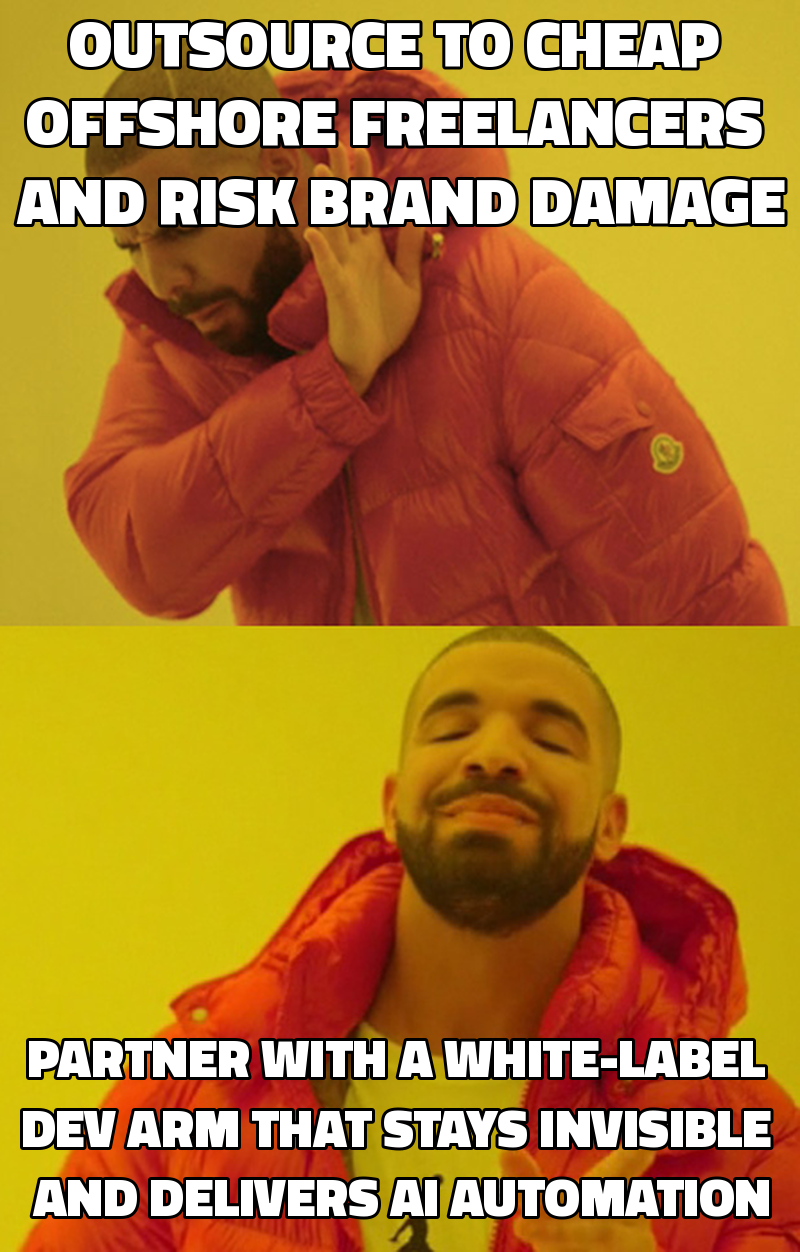
When you partner with a development studio like Synthisia, the studio delivers a custom solution, AI automation, voice bot, or bespoke backend, under your agency’s brand. The client never sees the developer’s name. You invoice the client at a rate that covers the studio’s wholesale price plus your margin. The studio remains invisible, protected by NDA and non-circumvent clauses.
Typical workflow
- Discovery call – you capture client requirements and scope.
- Fixed-scope pilot – a paid pilot (usually $1,500-$3,000) proves feasibility and builds trust.
- Full build – the studio executes the project, you manage client communication.
- Retainer option – after delivery, you can add a monthly dev retainer for ongoing tweaks (average $1,500-$2,000 per month for 15-20 hrs).
Benefits for the agency
- Brand consistency – the client sees only your agency’s logo and messaging.
- Speed to market – you can quote and start projects within days because the studio has pre-built frameworks.
- Margin control – wholesale rates typically range from 50-70 % of the client invoice, leaving a healthy 30-50 % gross margin.
- Risk reduction – you pay only for completed milestones; no upfront hiring costs.
Real-world example
RouteMate, a full-stack SaaS built for a UK marketing agency, was delivered entirely white-label. The agency kept the client relationship, billed $12,000 for the project, paid Synthisia $7,200 (60 % wholesale), and retained $4,800 profit. The client never knew a third-party developer was involved, preserving the agency’s full-service image.
How private-label software works for agencies
In a private-label arrangement the agency commissions the development of a product that it will own outright. Once the code is handed over, the agency can brand, market, license or sell the software to any client without additional royalty payments. This model turns a one-off build into a product line.
Typical workflow
- Product definition – you outline the core features, target market and pricing model.
- IP transfer agreement – a contract specifies that all source code, documentation and assets become your property.
- Development phase – the studio builds the product, often using a shared project dashboard for transparency.
- Launch & scaling – you host, market and support the software, collecting 100 % of revenue.
Benefits for the agency
- Full ownership – you can license the software to multiple clients, creating recurring revenue.
- Higher long-term margin – after the initial build cost (often $5,000-$10,000), each additional sale is pure profit.
- Strategic differentiation – a proprietary tool can become a unique selling point in proposals.
- Asset building – the software becomes a sellable asset that can increase the agency’s valuation.
Real-world example
A US-based SEO agency commissioned a private-label keyword-research SaaS. The initial development cost was $8,000. After launch, the agency sold 30 licenses at $200 per month, generating $6,000 monthly recurring revenue. Within six months the product paid for itself and now contributes a 20 % lift to the agency’s overall revenue.
White-label vs private-label: side-by-side comparison
| Feature | White-label | Private-label |
|---|---|---|
| Brand exposure | Agency brand only, developer invisible | Agency brand only, but you own the product |
| IP ownership | Studio retains IP, you get a usage license | Full transfer of IP to agency |
| Upfront cost | Low (pilot fee $1-3k) | Higher (full build $5-10k) |
| Margin | 30-50 % per project | 70-90 % after break-even |
| Scalability | Project by project, limited by studio capacity | Unlimited licensing, productised revenue |
| Risk | Minimal, pay per milestone | Higher, you bear maintenance and support |
| Time to launch | 2-4 weeks for typical pilot | 6-12 weeks for full product |
| Typical agency fit | Agencies needing occasional custom builds, cash-flow focused | Agencies looking to create a SaaS line or recurring revenue |
| Pricing model comparison | White-label (wholesale) | Private-label (IP purchase) |
|---|---|---|
| Project value range | $500-$5,000 per build | $5,000-$20,000 for full product |
| Your share of bill | 50-70 % | 100 % after cost recovery |
| Minimum floor | $1,500 (to cover dev overhead) | $5,000 (to justify IP transfer) |
| Retainer option | $1,500-$2,000/month for ongoing tweaks | $0 after launch, optional support contracts $500-$1,000/month |
| Revenue predictability | Medium – depends on pipeline | High – subscription or license fees |
Decision framework for agency founders
- Assess client demand – Do you receive 2-3 requests per month for custom AI or voice solutions? If yes, white-label can fill the gap quickly.
- Calculate cash flow – If you need immediate profit, white-label’s pilot model brings cash in 30-45 days. Private-label requires capital but yields higher ROI after 6-12 months.
- Evaluate strategic goals – Want to become a product-led agency? Private-label aligns with that vision. Want to stay service-focused? White-label keeps you agile.
- Consider capacity – Your studio partner caps at 3 active white-label projects to avoid flakiness. If you anticipate more than that, a private-label product can scale without extra dev bandwidth.
- Legal and compliance – Ensure NDAs cover confidentiality and non-circumvent. For private-label, add IP assignment clauses and warranty provisions.
Quick checklist for a go/no-go decision
- At least one client requesting a build you cannot deliver in-house.
- Ability to allocate $1,500-$3,000 for a pilot (white-label) or $5,000-$10,000 for a full product (private-label).
- Clear branding strategy: do you want to market a proprietary tool?
- Internal resource for ongoing support (even if outsourced).
- Legal counsel to review IP transfer agreements.
How Synthisia supports both models
- Single point of contact – you work with one delivery manager who coordinates all milestones.
- Shared project dashboard – real-time status updates keep you and the client in the loop.
- AI-first expertise – we specialize in automation, voice assistants and custom back-ends that no-code platforms cannot replicate.
- Fixed-scope pilots – start with a $2,000 pilot, then scale to full builds or product hand-off.
- Retainer flexibility – after a successful pilot, add a $1,500/month retainer for rapid iteration.
- IP transfer option – if you decide to go private-label, we provide a clean IP assignment and documentation package.
Real-world signals that you need a partner now
| Signal | What it means for you |
|---|---|
| Case study shows a web app deliverable but no engineer listed | You are already outsourcing; a reliable white-label partner can replace flaky freelancers. |
| Public statement: “we partner with developers” | You have an explicit gap; negotiate better terms and higher reliability. |
| Job post for a contract developer | Your current demand exceeds internal capacity; a white-label pilot can test fit before a long-term retainer. |
| Recent win of a larger client needing a platform | Immediate revenue opportunity; a private-label product could be reused for future clients. |
Frequently asked questions
What is the main branding difference between white-label and private-label?
White-label keeps the developer invisible; the agency’s brand is the only one the client sees. Private-label also uses the agency’s brand, but the agency owns the software, so it can market the product independently of any client project.
How does margin compare for a $3,000 project?
In a white-label scenario you might pay the studio $1,800 (60 % wholesale) and keep $1,200 profit, a 40 % margin. In a private-label case you would pay $3,000 upfront, then each subsequent sale of the same product adds 100 % margin.
Can I switch from white-label to private-label later?
Yes. Many agencies start with white-label pilots, then request full IP transfer once the product proves market fit. The transition involves a new contract and a one-time IP purchase fee.
What legal protections do I need?
At minimum an NDA and non-circumvent agreement for white-label. For private-label add an IP assignment clause, warranty language and a support SLA. Consulting a tech-savvy attorney is recommended.
How long does a typical white-label pilot take?
Most pilots are delivered in 2-4 weeks, depending on scope. The fixed-scope nature allows us to allocate dedicated resources and give you a firm delivery date.
Is there a risk of the developer poaching my clients?
Our partnership model includes a strict non-circumvent clause and a confidentiality agreement. Synthisia’s business relies on long-term agency relationships, so we have no incentive to poach.
What ongoing costs should I expect after launch?
For white-label you may keep a retainer of $1,500-$2,000 per month for updates. For private-label you might sell support contracts at $500-$1,000 per month per client, or handle support internally if you have the capacity.
How do I price a private-label SaaS to my clients?
Start with a cost-plus model: calculate total development cost, add a 30-40 % margin, then factor in hosting, support and future enhancements. Benchmark against similar SaaS tools; according to G2, mid-market SaaS pricing averages $150-$250 per month per seat.
Conclusion
Choosing between white-label and private-label hinges on your agency’s cash-flow needs, growth strategy and appetite for risk. White-label offers quick revenue, low upfront cost and brand protection, making it ideal for agencies that need to say “yes” to client build requests today. Private-label requires more capital but unlocks recurring revenue, product differentiation and higher long-term margins. Evaluate your client demand, financial runway and strategic vision using the framework above, and partner with a reliable development studio that can execute both models flawlessly.
white‑label
Have something to build?
Tell us what you're trying to ship. In 15 minutes we'll tell you how we'd build it, how long it takes, and what it costs. No pitch deck, no pressure.