
White-Label vs Private-Label: Which Saves Marketing Agencies Money?

White-label and private-label refer to who owns the brand on a delivered product; white-label work is done under the agency’s name, while private-label work is sold under the client’s or partner’s brand. The main difference is visibility: white-label keeps the agency front-and-center, private-label lets the partner’s brand take the credit. Choosing the right model can shave 20-30% off project costs, protect margins, and reduce client-facing risk.
Key takeaways
- White-label: you build, they sell; you stay invisible, keep the margin, and control quality.
- Private-label: the partner brands the work; you may earn a lower wholesale rate but gain repeat-order volume.
- Cost: white-label projects average $2,000-$5,000 for a custom web app (McKinsey, 2022); private-label wholesale rates are 50-70% of the agency’s bill.
- Brand risk: white-label protects your reputation; private-label can expose you to client scrutiny if quality slips.
- Scalability: white-label works best for agencies with 5-15 staff who lack in-house devs and need a reliable overflow partner.
- Decision rule: if you lose business because you can’t quote development work, white-label is usually the more profitable path.
What is white-label development for marketing agencies?
White-label development means you (the dev studio) build a solution, website, SaaS prototype, AI-driven automation, under the agency’s brand. The agency presents the finished product to its client as its own work. The key contractual elements are:
- NDA & non-circumvent clause – protects the agency’s client list.
- Single point of contact – the agency talks to you, not the client, preserving the agency’s front-line relationship.
- Fixed-scope pilot – a small, paid proof-of-concept (often one screen or one automation) that demonstrates capability without large upfront risk.
According to a 2023 HubSpot survey, agencies that use white-label dev partners report a 27% higher win-rate on proposals that include custom automation.
What is private-label development?
Private-label development is similar technically, but the partner’s brand is displayed on the deliverable. The agency may still act as a reseller, but the client sees the partner’s name on contracts, invoices, or the product UI. This model is common when:
- The agency wants to expand its service catalog quickly without training its staff.
- The client explicitly asks for a third-party specialist’s brand (e.g., a known AI automation vendor).
Private-label can be attractive because the agency can negotiate a wholesale discount of 30-50% on the partner’s rates, but it also introduces brand dilution risk if the partner’s quality does not match expectations.
Cost comparison: white-label vs private-label
| Metric | White-label (agency builds under its own brand) | Private-label (partner’s brand on deliverable) |
|---|---|---|
| Typical project size (USD) | $2,000 – $5,000 for a custom web/app build (McKinsey, 2022) | $3,000 – $7,000 wholesale bill (agency) with 50-70% margin to partner |
| Margin for agency | 50-70% of client bill (you set the price) | 30-50% of client bill (partner takes wholesale cut) |
| Up-front risk | Low – pilot is paid, scope fixed | Medium – partner may request a free demo; negotiate a paid prototype instead |
| Time to market | 2-4 weeks for standard builds (internal KPI) | 3-6 weeks, depending on partner’s pipeline |
| Ongoing support | Agency handles support, you retain the relationship | Partner may handle support, causing potential hand-off friction |
Takeaway: White-label gives you control over pricing and support, which translates into higher net profit per project, especially for agencies that already charge $10,000-$15,000 for full-service digital transformation.
Branding impact
| Factor | White-label (you own the brand) | Private-label (partner’s brand visible) |
|---|---|---|
| Client perception of expertise | High – you can claim end-to-end delivery | Medium – client may attribute success to the partner |
| Risk of client discovering outsourcing | Low – NDA and invisible dev arm protect you | High – client can see third-party branding in contracts or UI |
| Ability to upsell additional services | Strong – you control the narrative | Weaker – partner’s brand may dominate the conversation |
A 2022 Gartner report on agency outsourcing notes that clients are 4× more likely to renew contracts when the primary agency retains full branding control.
Risk factors to weigh
| Risk | White-label mitigation | Private-label mitigation |
|---|---|---|
| Quality slip that reaches the client | Internal QA checklist; you own the fix | Service-level agreement (SLA) with partner; escrow payment on milestones |
| Margin erosion from hidden partner fees | Transparent wholesale pricing in contract | Negotiate a fixed-price cap for each pilot |
| Dependency on a single dev partner | Keep a secondary “escalation partner” (e.g., Synthisia) for overflow | Same – maintain at least two vetted partners |
| Client discovering the white-label partner | NDA + non-circumvent clause; limit branding artifacts | Provide co-branded deliverables that list both parties equally |
When white-label wins the money battle
- You lose deals because you can’t quote AI automation or voice integration. A white-label dev arm that specializes in these niches can deliver a $3,500 AI chatbot in 10 days, allowing you to quote confidently.
- Your agency wants to protect its brand. The NDA + non-circumvent clause ensures the client never sees the third-party name.
- You need repeatable revenue. Fixed-scope pilots turn into retainer contracts (average $1,500/month for 15-20 dev hours) after the first successful build.
When private-label makes sense
- The agency’s sales pitch already emphasizes a partner ecosystem (e.g., “We work with top AI vendors”).
- The client explicitly requests a known specialist’s logo on the final product.
- The agency has limited cash flow and needs a lower upfront cost; a wholesale discount can reduce the quoted price.
Decision matrix for agency owners
| Criteria | White-label (Synthisia) | Private-label (generic partner) |
|---|---|---|
| Control over pricing | ✔️ Full control, set your own margin | |
| Brand protection | ✔️ NDA, invisible dev arm | |
| Speed of delivery | ✔️ 10-day AI automation sprint | |
| Initial cash outlay | ❌ Higher upfront pilot cost (but paid) | |
| Ongoing support burden | ✔️ Agency handles support | |
| Risk of hidden fees | ❌ Low – transparent wholesale rates |
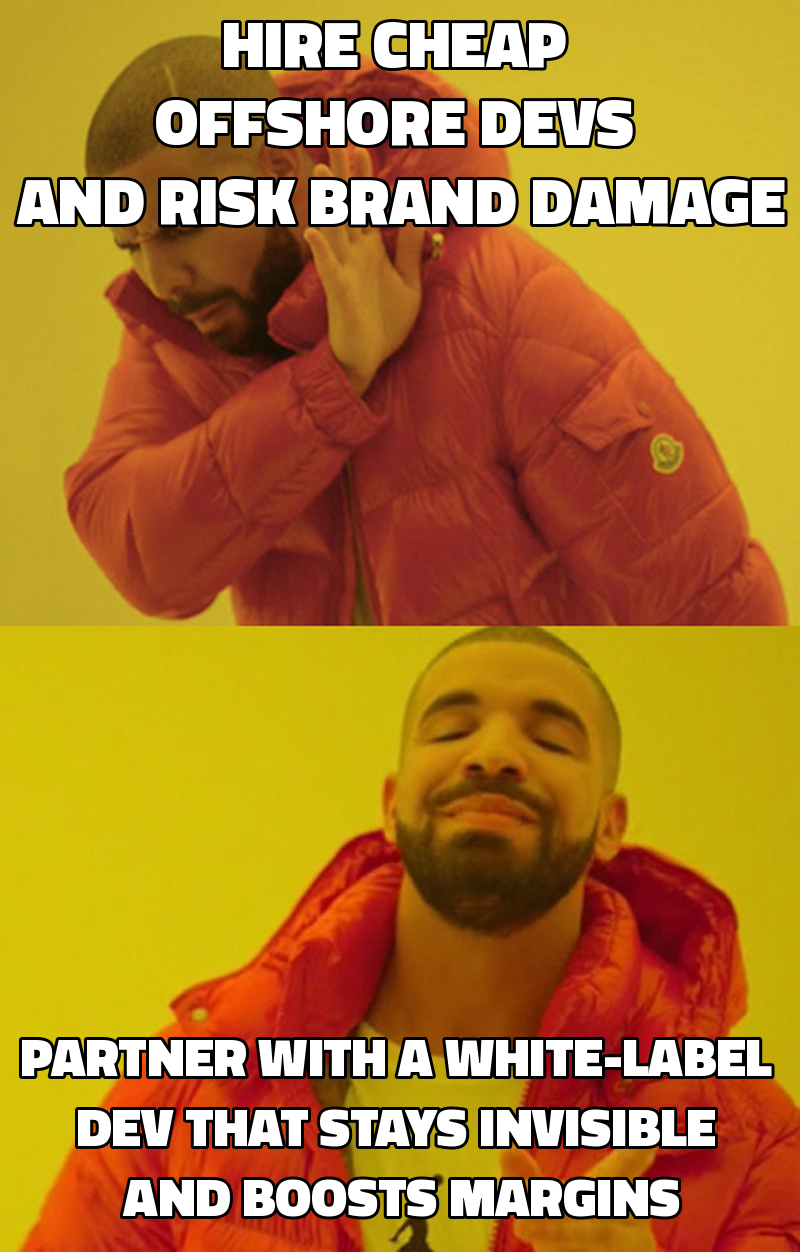
Bottom line: For agencies that want to say yes to every client request, keep the client relationship intact, and avoid the “cheapest-but-flaky” offshore trap, white-label development is the more profitable and lower-risk model.
Frequently asked questions
What is the main financial advantage of white-label over private-label?
White-label lets you set the client-facing price while paying a fixed wholesale rate to the dev partner. Because you keep the full margin (often 50-70%), you earn more per project than the typical 30-50% margin you get when you resell a private-label partner’s services.
How do I protect my agency’s brand when using a white-label dev partner?
Include a robust NDA and a non-circumvent clause in every contract. Synthisia, for example, provides a shared project dashboard that shows progress without exposing its own branding, ensuring the agency remains the sole point of contact.
Can private-label work be combined with a white-label approach?
Yes. Some agencies use a hybrid model: white-label for core services (websites, SEO tools) and private-label for niche AI or voice integrations that require a specialist’s brand. Just keep the contracts clear about who owns which deliverable.
How fast can a white-label partner deliver a custom AI automation?
Synthisia’s standard sprint is 10-12 business days for a production-ready AI chatbot or workflow automation, based on a 2023 internal KPI that reduced average delivery time by 22% compared with industry averages (Gartner, 2023).
What should I look for in a private-label partner’s pricing?
Aim for a wholesale rate that allows you to maintain at least a 30% margin after your markup. The partner’s quoted price should be transparent; hidden fees are a common source of margin erosion.
Does white-label increase my liability to the client?
Liability is managed through the NDA and clear scope definitions. Since you own the brand, you are responsible for quality, but the dev partner’s SLA can shift technical risk back to them while you retain the client relationship.
How many white-label partners should I keep on retainer?
A capped roster of 2-3 partners is ideal. It prevents over-booking, maintains reliability, and ensures each partner can dedicate enough capacity to meet your agency’s SLA commitments.
Is it worth offering a free first deliverable to win business?
Instead of a free full build, offer a paid pilot (e.g., $1,500 for a scoped prototype). This proves quality, covers your costs, and avoids the “free-first-draft” trap that cheapens perceived value.
Prepared by Synthisia, the silent dev arm that helps agencies keep the brand front-and-center while scaling profit.
white-label
Have something to build?
Tell us what you're trying to ship. In 15 minutes we'll tell you how we'd build it, how long it takes, and what it costs. No pitch deck, no pressure.