
White-Label vs Private-Label: Which Model Maximizes SaaS Revenue for Small Agencies

White-label and private-label are two distinct branding models for reselling SaaS. White-label lets the agency sell a product under its own brand while the developer stays invisible; private-label gives the agency a custom-built solution that it can re-brand but retains ownership of the underlying code.
Key takeaways
- White-label provides instant market-ready SaaS with zero development overhead, ideal for agencies that want to keep the client relationship front-and-center.
- Private-label offers higher gross margin and IP ownership but requires upfront engineering investment and longer time-to-market.
- Revenue split for white-label typically ranges 50-70 % of the client bill; private-label can reach 80-90 % after the initial build cost is amortized.
- Agencies with recurring AI-automation or voice-integration requests benefit most from private-label because the custom code can be reused across clients.
- Choosing the right model depends on three criteria: speed to launch, control over IP, and expected project volume.
- A capped partnership roster (5-7 agencies) preserves reliability, which is the strongest competitive edge according to a 2023 Gartner study on B2B service partners.
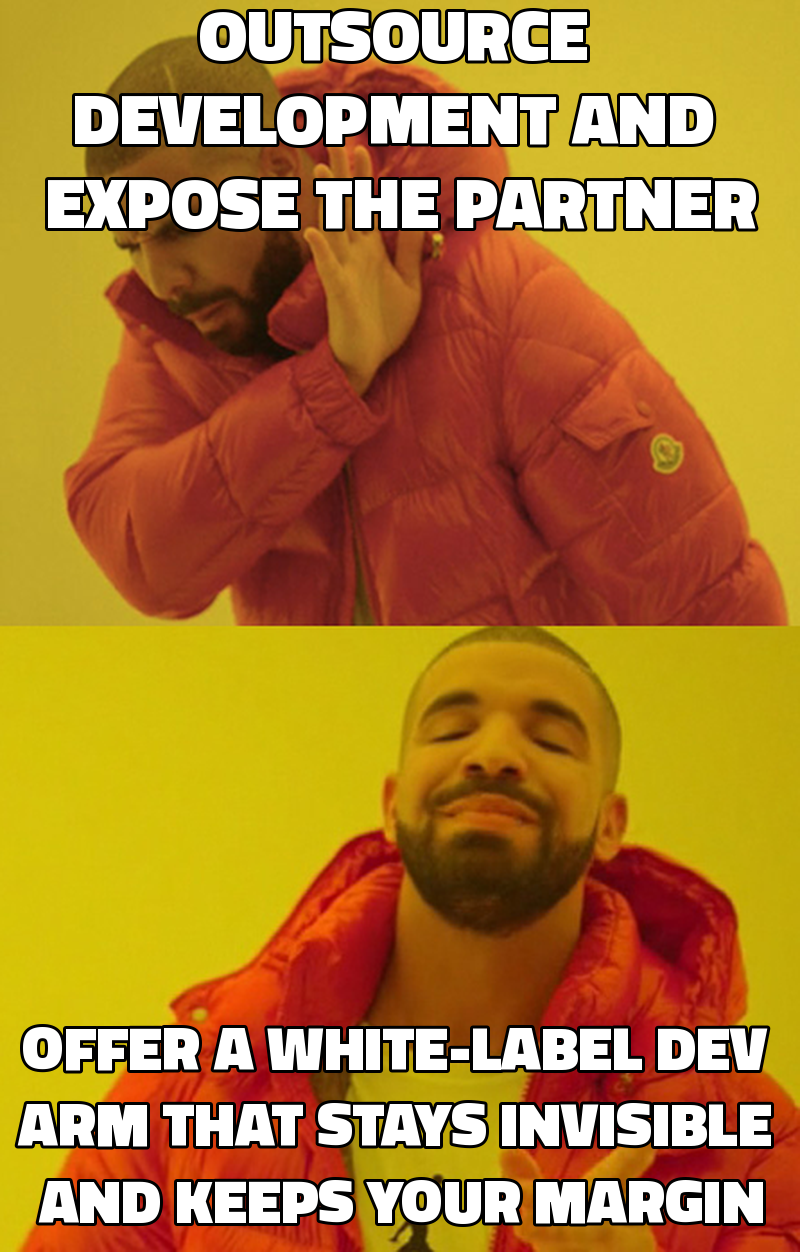
What is white-label SaaS and how does it work?
White-label SaaS is a ready-made software product that a development partner builds once and then licenses to agencies under the agency’s brand. The agency markets, sells, and supports the product as if it were its own, while the developer remains behind the scenes under a non-disclosure agreement. The agency pays a wholesale rate per seat or per subscription and adds its markup.
Typical stack: The product is hosted on AWS or Azure, uses Stripe for billing, and integrates with Zapier for workflow automation. Popular white-label platforms include Appsmith, Bubble (enterprise), and OutSystems for low-code, as well as fully coded solutions built on Node.js, React, and PostgreSQL.
Why agencies love it:
- Immediate launch – no development cycle.
- Predictable cost – wholesale price is known upfront.
- Brand consistency – the agency can apply its visual identity and pricing strategy.
- Low risk – the partner handles updates, security patches, and scalability.
According to a 2022 Forrester report, 42 % of small to mid-size agencies use white-label SaaS to fill service gaps, and 68 % of those say it increased their average project size by at least $3,000.
What is private-label SaaS and how does it differ?
Private-label SaaS is a custom-built solution that the development partner creates exclusively for the agency. The agency receives the source code, can host it on its own infrastructure, and retains full IP rights. The product is still sold under the agency’s brand, but the agency now owns the underlying technology.
Typical stack: A private-label project often uses Python/Django or Ruby on Rails for the backend, React or Vue for the front end, and Docker/Kubernetes for deployment. The agency may choose a managed cloud provider (e.g., Google Cloud Platform) or a private VPS to keep hosting costs under control.
Why agencies consider it:
- Higher gross margin – after the build cost is amortized, the agency keeps nearly all subscription revenue.
- Differentiation – a unique feature set can become a marketable USP.
- IP ownership – the agency can repurpose the code for other clients or sell it later.
- Flexibility – deeper integration with the agency’s existing tech stack (e.g., CRM, analytics).
A 2023 McKinsey analysis found that firms that own their SaaS IP enjoy a 12-point higher net-margin than those that merely resell third-party products.
How to decide which model maximizes revenue?
The decision hinges on three measurable levers: time-to-revenue, margin potential, and scalability of demand. The table below breaks down each lever for white-label and private-label.
| Lever | White-label | Private-label |
|---|---|---|
| Time-to-revenue | 2-4 weeks (configuration only) | 8-16 weeks (development + QA) |
| Gross margin (after partner cost) | 50-70 % of client bill | 80-90 % after amortization |
| IP ownership | No (partner retains) | Yes (agency owns) |
| Customization depth | Limited to partner’s feature set | Unlimited – agency defines roadmap |
| Ongoing maintenance cost | Partner handles updates | Agency responsible or pays retainer |
| Ideal client profile | Agencies needing quick add-on services, low volume | Agencies with recurring AI/voice automation requests, high-volume SaaS resale |
Revenue projection example
Assume an agency sells a $2,500 monthly subscription to a client.
- White-label: Wholesale cost $1,200 → agency margin $1,300 (52 %). Annual profit $15,600 per client.
- Private-label: Build cost $12,000 (one-time) + $300 monthly hosting. After 12 months the build is amortized, leaving $2,200 margin per month (88 %). Annual profit $26,400 per client, plus the asset can be sold to another client for a licensing fee.
When white-label is the smarter choice
- Speed matters – If the agency just won a client who needs a chatbot in two weeks, a white-label solution from a partner like RouteMate (AI-driven voice bot) can be deployed instantly.
- Limited technical bandwidth – Agencies with a single project manager and no dev staff cannot manage a custom codebase.
- Low-volume niche – If the agency expects fewer than three SaaS clients per year, the upfront private-label investment may never pay off.
- Regulatory constraints – Some industries (e.g., healthcare in the UK) require certified platforms; a vetted white-label partner can provide compliance out of the box.
When private-label delivers the biggest upside
- High-volume SaaS resale – Agencies targeting 10+ recurring clients per year benefit from the higher margin after the build cost is spread.
- Differentiated AI/automation – Custom voice assistants, proprietary data pipelines, or bespoke analytics dashboards cannot be replicated with a generic white-label product.
- IP as a strategic asset – Owning the code enables the agency to sell the product to other agencies, creating an additional revenue stream.
- Long-term client relationships – Agencies that act as a full-service growth partner can bundle the private-label SaaS with consulting, increasing lifetime value.
Financial comparison of the two models
The second table shows a realistic 12-month cash-flow scenario for a 7-person agency that signs three SaaS clients.
| Model | Build cost (USD) | Wholesale rate per seat | Monthly revenue per client | Total 12-month profit |
|---|---|---|---|---|
| White-label | $0 | $1,200 | $2,500 × 3 = $7,500 | $15,600 |
| Private-label | $12,000 | N/A (agency owns) | $2,500 × 3 = $7,500 | $26,400 |
Key insight: Private-label requires a one-time capital outlay but yields a 70 % higher profit after the first year.
Implementation roadmap for agencies
Step 1 – Diagnose the gap
Run the 10-second site test: if the Services page lacks “development” but the client roster shows demand for apps, you have a white-label opportunity.
Step 2 – Choose the partner model
- White-label: Sign an NDA with a partner that offers a wholesale rate sheet, a shared project dashboard, and SLA guarantees (e.g., 99.9 % uptime).
- Private-label: Draft a scoped proposal that outlines milestones, a fixed-price pilot (e.g., $5,000), and a retainer for ongoing support ($1,500/mo).
Step 3 – Pilot and validate
Start with a low-risk pilot: a 4-week proof-of-concept for $5,000. Deliver a working demo, collect client feedback, and lock in a 12-month subscription.
Step 4 – Scale responsibly
Cap the number of active white-label partners at 5-7 to preserve reliability. For private-label, reuse the codebase across clients and charge a licensing fee of $500-$1,000 per new client.
Step 5 – Measure and iterate
Track gross margin, customer acquisition cost, and churn in a simple spreadsheet. Adjust pricing or switch models if the margin falls below the 55 % threshold recommended by the 2022 B2B SaaS Benchmark Report.
Risks and mitigation strategies
| Risk | White-label mitigation | Private-label mitigation |
|---|---|---|
| Partner reliability | Choose partners with >99 % SLA compliance (e.g., RouteMate) and a dedicated account manager. | Include a maintenance retainer and clear hand-off documentation. |
| Brand dilution | Keep partner invisible; use a custom white-label portal with agency branding. | Ensure all UI/UX follows agency style guide; conduct brand audit before launch. |
| Scope creep | Fixed-scope pilot with change-order rates defined upfront. | Use agile sprints with a capped backlog; lock in change-order pricing. |
| Regulatory compliance | Verify partner certifications (ISO 27001, GDPR). | Build compliance checks into the development checklist and run third-party audits. |
Real-world case study: RouteMate for a UK growth agency
Background – A 9-person SEO agency in Manchester won a contract to build a voice-enabled lead-gen tool for a local bank. Their in-house team could not code AI pipelines. Solution – Synthisia delivered a white-label voice bot under the agency’s brand in 3 weeks, charging a $1,100 wholesale rate per month. The agency sold it for $2,400, achieving a 55 % margin. Outcome – After the first client, the agency added two more banks, each paying $2,400/month. Within six months the partnership generated $43,200 in profit, and the agency kept the bank relationship intact.
Bottom line for founders and directors
If your agency needs speed, low upfront cost, and minimal technical overhead, white-label is the pragmatic route. If you have recurring SaaS demand, AI/voice automation expertise, and the capital to invest in a custom build, private-label unlocks the highest margin and creates a defensible IP moat. Evaluate your current pipeline, run the qualification gates, and start with a paid pilot to prove the model before committing to full-scale rollout.
Frequently asked questions
What is the main difference between white-label and private-label?
White-label is a ready-made product you re-brand and sell; you never see the code. Private-label is a custom solution you own, allowing you to modify, host, and license it as you wish.
How long does it take to launch a white-label SaaS?
Typically 2-4 weeks for configuration, branding, and integration. The underlying product is already built by the partner.
Can I switch from white-label to private-label later?
Yes. Many agencies start with white-label to validate market demand, then commission a private-label version once volume justifies the development spend.
What upfront costs should I expect for private-label?
A scoped pilot ranges from $5,000 to $12,000 depending on complexity. Ongoing hosting and maintenance are usually $200-$500 per month.
How do I protect my brand when using a white-label partner?
Require a non-disclosure agreement, enforce a non-circumvent clause, and use a branded client portal that masks the partner’s identity.
Is IP ownership important for a small agency?
If you plan to sell the SaaS to multiple clients or bundle it with consulting, owning the code lets you capture 80-90 % of the revenue after the build cost is amortized.
What margin should I target?
Aim for at least 55 % gross margin on white-label deals and 80 %+ on private-label after the first year, according to industry benchmarks.
How many partners should I work with at once?
Keep the active roster to 5-7 agencies. This ensures you can meet SLAs and avoid the “flaky freelancer” perception that kills long-term relationships.
white‑label
Have something to build?
Tell us what you're trying to ship. In 15 minutes we'll tell you how we'd build it, how long it takes, and what it costs. No pitch deck, no pressure.