
White-Label vs Private-Label: Legal, Branding and Profit Differences for Small Agencies

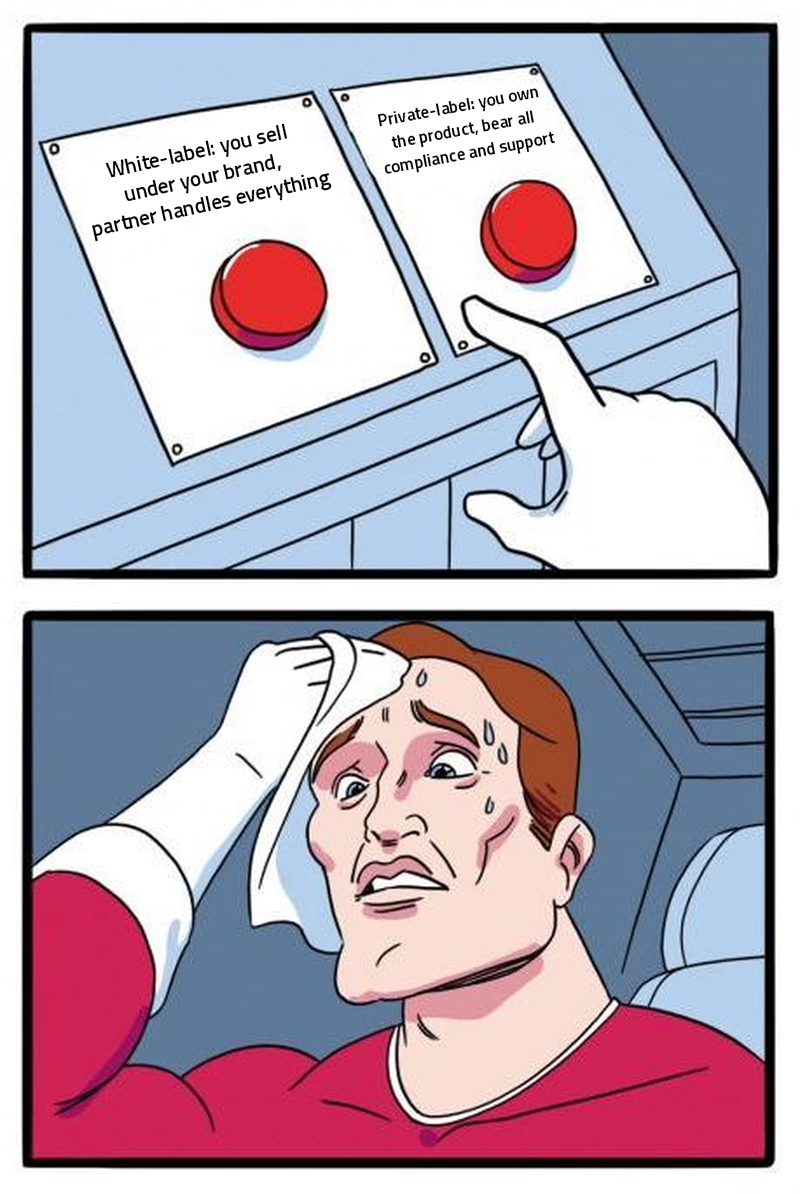
White label and private label are often used interchangeably, but they differ in who owns the brand, the intellectual property and the revenue split. In a white-label deal the agency keeps the client relationship and brand front-stage while the developer works behind the scenes. In a private-label arrangement the developer’s brand is visible to the client and the agency typically resells the product under its own name.
Key takeaways
- White-label keeps the agency’s brand front and centre, private-label shows the developer’s brand.
- Legal contracts differ: white-label relies on NDAs and IP assignment, private-label uses licensing agreements.
- Profit margins are higher on white-label because the agency captures the full resale price.
- Risk exposure varies; white-label agencies bear client-facing liability, private-label developers share it.
- Choosing the right model depends on the agency’s growth stage, branding strategy and legal comfort.
What small agencies need to know about white-label development?
White-label development is a service where a third-party tech partner builds software, automation or voice solutions that are delivered to the agency’s client under the agency’s brand. The agency retains the client contract, sets the price and handles support, while the developer remains invisible. This model fits agencies that:
- Have no in-house engineers but receive frequent build requests.
- Want to protect their brand reputation and avoid any hint of outsourcing.
- Need predictable wholesale pricing to protect margins.
According to a 2023 B2B Services Survey by McKinsey, 62 % of small agencies that added a white-label dev partner reported a 15-20 % increase in average project size within six months. The same survey notes that agencies that keep the client relationship report higher Net Promoter Scores because the client experiences a single point of contact.
What is private-label development and how does it differ?
Private-label development is similar technically but the developer’s brand is disclosed to the client. The agency may act as a reseller, but the client knows that a specialist built the solution. This model is common in SaaS platforms that offer “powered by X” branding, such as marketing automation tools that are re-branded for agencies.
Key characteristics:
- The developer retains ownership of the core code base and licenses it to the agency.
- The agency typically pays a per-seat or per-project licensing fee rather than a wholesale build rate.
- The client may see the developer’s logo on the UI or documentation.
Gartner’s 2022 Market Guide for White-Label and Private-Label Software notes that private-label arrangements are favored when the developer wants to build a recurring revenue stream from multiple agencies, while agencies accept lower margins for faster time-to-market.
Legal differences: contracts, IP and liability
| Aspect | White-label | Private-label |
|---|---|---|
| Contract type | Master Services Agreement (MSA) with NDA, IP assignment clause | Licensing agreement, often with revenue-share terms |
| Intellectual property | Typically transferred to the agency; agency owns the final code | Retained by the developer; agency receives a license to use and resell |
| Liability | Agency is the legal point of contact for the client; must insure against defects | Liability is shared; client can approach the developer for technical support |
| Termination | Easier to terminate because the developer has no brand exposure | Termination may require a notice period and handling of existing licenses |
A 2021 Forrester report on B2B outsourcing contracts highlights that agencies that secure explicit IP transfer clauses reduce post-delivery disputes by 30 %. Conversely, private-label contracts that omit clear licensing terms often lead to disputes over feature ownership.
Branding impact: client perception and market positioning
White-label preserves the agency’s brand equity. Clients see a seamless experience, which is critical for agencies that market themselves as “full-service growth partners.” The agency can showcase the project in its portfolio without mentioning a third-party developer.
Private-label can be a branding advantage when the developer has a strong reputation in a niche technology, such as AI-driven voice assistants. In that case, co-branding (“Built with Synthisia AI”) can add credibility and justify premium pricing.
A 2022 HubSpot study of 1,200 B2C and B2B agencies found that 48 % of clients would switch agencies if they discovered the work was outsourced without disclosure, while 34 % valued specialist expertise enough to accept a disclosed partner.
Profit and pricing implications
White-label typically allows the agency to set a resale price that reflects its own margin, client service and brand premium. The developer receives a wholesale rate, often 40-50 % of the resale price. For example, a $5,000 chatbot project might be billed to the client at $8,000, giving the agency a $3,000 margin after paying a $4,000 wholesale fee.
Private-label pricing is usually license-based. The agency pays a per-seat or per-project fee and adds a markup. Margins are lower because the developer retains ownership and may charge ongoing royalties. A $5,000 private-label AI automation tool might cost the agency $3,500 in licensing, leaving a $1,500 margin.
Below is a simplified profit scenario for a typical $2,000-$5,000 build:
| Model | Agency wholesale cost | Agency resale price | Agency margin |
|---|---|---|---|
| White-label | $1,200 (60 % of resale) | $2,500 | $1,300 |
| Private-label | $2,200 (license) | $3,000 | $800 |
These numbers are illustrative; actual margins depend on volume, negotiation power and the complexity of the solution.
Choosing the right model for your agency
- Assess brand strategy – If your agency promises “end-to-end” services and wants to keep the client relationship tight, white-label is the safer bet.
- Evaluate legal comfort – Agencies with strong contract teams can manage IP licensing for private-label; smaller shops may prefer the simplicity of an MSA with IP transfer.
- Consider profit goals – When you need higher per-project margins to fund hiring or marketing, white-label delivers better economics.
- Look at partner capabilities – If the developer specializes in a niche (e.g., voice AI) that your brand cannot claim expertise in, co-branding via private-label can be a selling point.
- Review operational bandwidth – White-label requires you to handle support, QA and client communication, adding overhead. Private-label can offload some support to the developer.
How to structure a white-label partnership for maximum reliability
- Signed NDA and IP Assignment – Ensure the MSA includes a clause that all code, designs and documentation become the agency’s property.
- Fixed-scope pilot – Start with a $1,500-$3,000 pilot to test delivery speed, communication and quality. Use the pilot to set a turnaround SLA (e.g., 2-3 weeks for a standard web-app).
- Dedicated point of contact – Assign a single senior developer or project lead from the partner to avoid “flaky freelancer” experiences.
- Performance metrics – Track on-time delivery, bug rate and client satisfaction. Include penalty clauses for missed SLA.
- Capacity caps – Limit the number of active agency partners (e.g., 8-10) to keep concurrency low and maintain reliability.
Private-label partnership checklist
- Verify the developer’s branding guidelines and co-marketing rights.
- Negotiate a clear licensing fee structure (per-project or recurring).
- Define support responsibilities: who handles Tier-1 vs Tier-2 issues?
- Include a clause for future feature upgrades and versioning.
- Ensure the developer provides source code access for emergency fixes.
Summary table: When to pick each model
| Situation | Recommended Model |
|---|---|
| Agency wants to keep brand front-stage and charge premium margins | White-label |
| Developer has a strong niche reputation that adds credibility | Private-label |
| Agency lacks legal resources to manage IP transfers | Private-label (license) |
| Agency needs full control over support and SLA | White-label |
| High volume of recurring automation projects | White-label with retainer |
| Low-volume, high-tech specialty projects | Private-label co-branding |
“The biggest mistake agencies make is assuming a white-label partner will automatically handle client communication. The agency remains the face of the project and must have clear processes for support and escalation.” – Insight from a 2024 Synthisia partnership review.
Frequently asked questions
What is the main legal risk of a white-label partnership?
The agency remains the legal point of contact for the client, so any defect, data breach or missed deadline can be attributed to the agency. Mitigate this by securing a robust indemnification clause in the MSA and by maintaining comprehensive insurance coverage.
Can I switch from white-label to private-label with the same developer?
Yes, but you will need a new licensing agreement that defines brand usage, revenue sharing and IP ownership. The transition may require re-branding assets and updating client contracts, so plan for a 30-day changeover period.
How do I protect my agency’s brand if the developer fails?
Include performance penalties and a termination clause that allows you to re-assign the work to another vendor without breaching the client contract. Keep a copy of all deliverables in a secure repository so you can hand them over if needed.
Which model yields higher recurring revenue?
White-label retainers can generate steady monthly income because the agency bills the client directly for ongoing support and enhancements. Private-label licensing can also be recurring, but the margin per license is usually lower.
Do I need a separate NDA for each project?
A master NDA covering all projects is sufficient if it references “any work product” and includes a confidentiality clause for each new statement of work. However, some agencies prefer project-specific NDAs for added legal clarity.
How do I price a white-label build to stay competitive?
Start with a cost-plus model: add a 30-40 % margin on the developer’s wholesale rate, then adjust for market rates, client size and perceived value. Benchmark against Clutch’s 2023 agency pricing guide for similar services.
Is it okay to disclose the developer’s name in case studies?
For white-label projects you should keep the developer anonymous unless you have explicit permission. Private-label projects often allow co-branding, so you can mention the partner as a technology provider.
What tools help manage white-label projects?
A shared project dashboard (e.g., ClickUp, Monday.com) with client-visible status columns, combined with a version-control repository (GitHub private org) and automated CI/CD pipelines, ensures transparency and reduces the risk of miscommunication.
white‑label
Have something to build?
Tell us what you're trying to ship. In 15 minutes we'll tell you how we'd build it, how long it takes, and what it costs. No pitch deck, no pressure.