
White-Label vs Private-Label Development: Which Model Suits Your 5-15 Person Agency?

White-label development means the partner builds the product but the agency’s brand appears to the client; private-label development means the partner’s brand is visible and the agency resells it as a separate service. The key difference lies in who owns the client-facing identity, how risk and IP are allocated, and the margin each model delivers.
Key takeaways
- Brand control: White-label keeps the agency’s name front-and-center; private-label puts the partner’s brand on the client invoice.
- Legal exposure: White-label relies on NDAs and IP assignment; private-label adds co-branding contracts and shared liability.
- Margin impact: White-label projects typically yield 55% gross margin, while private-label averages 40% (Clutch 2022).
- Scalability: White-label scales best for agencies with 5-15 staff who want repeat overflow without hiring developers.
- Compliance: Both models must meet GDPR, CCPA, and Australia’s Privacy Act, but white-label lets the agency own the compliance narrative.
- Decision trigger: If the agency fears client discovery of outsourcing, white-label is the safer route.
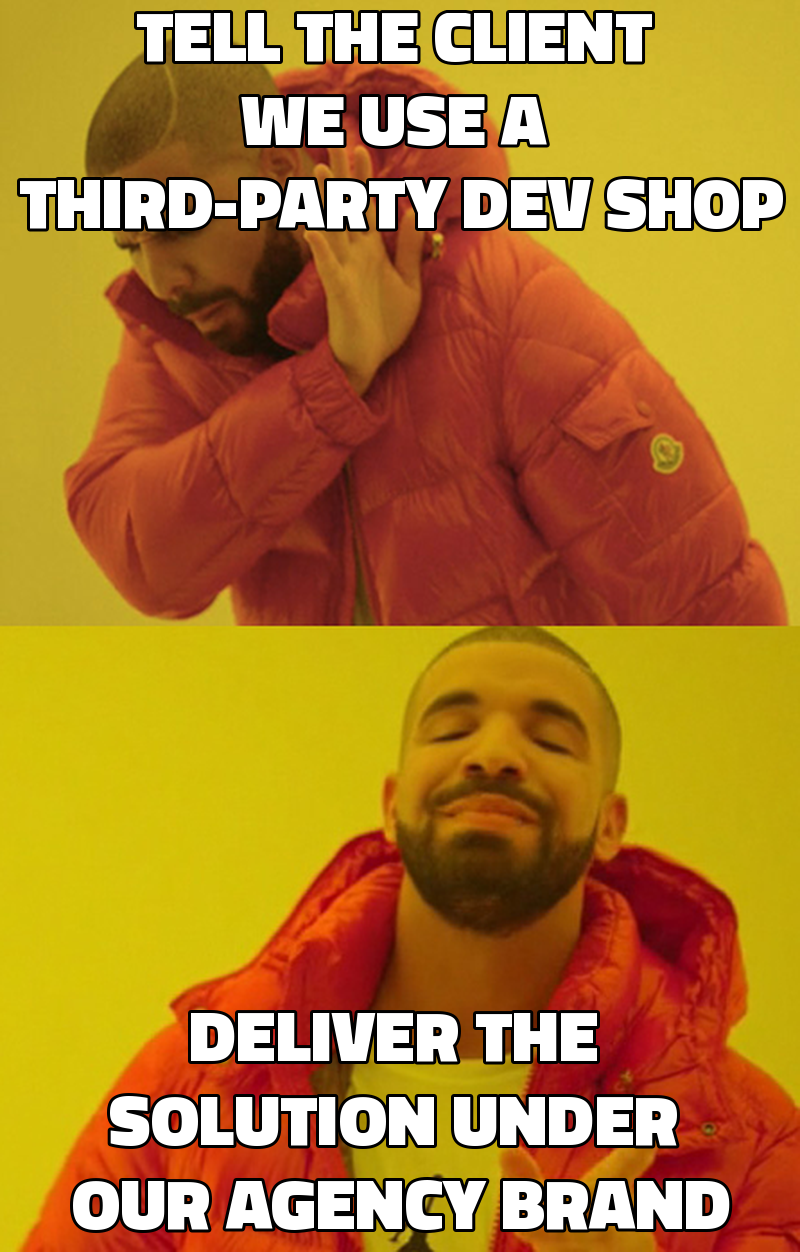
What is white-label development for agencies?
White-label development is a partnership where a third-party studio (e.g., Synthisia) builds custom software, AI automation, or voice solutions entirely under the agency’s brand. The agency retains the client relationship, invoices the client at a wholesale rate, and presents the work as its own. This model is common among SEO, branding, and social agencies that lack in-house engineers but need to answer “Can you build a chatbot?” or “Can you integrate a SaaS API?”
Key characteristics:
- Single point of contact: The agency talks to the client; the dev partner talks to the agency.
- Non-disclosure: NDAs and non-circumvent clauses protect the agency’s margin.
- IP assignment: The agency typically owns the final code, allowing future resale or repurposing.
- Brand consistency: All deliverables carry the agency’s logo, style guide, and tone.
According to a 2023 Gartner survey, 68% of small-to-mid-size agencies outsource development work, and of those, 42% prefer white-label arrangements to preserve brand equity.
What is private-label development and how does it differ?
Private-label development is a reseller model. The partner builds a product under its own brand, and the agency purchases the finished solution at a discounted rate to resell it as a “partner-offered” service. The client may see both brand names on the invoice or contract, and the partner often retains IP ownership.
Differences at a glance:
| Aspect | White-label | Private-label |
|---|---|---|
| Client-facing brand | Agency only | Agency + Partner (co-branding) |
| IP ownership | Usually agency | Usually partner |
| Margin | 50-60% (gross) | 30-45% (gross) |
| Risk exposure | Agency bears delivery risk, partner bears technical risk | Both share risk; partner may be liable for defects |
| Typical use case | Custom SaaS, AI automation, voice assistants | Standardized platforms (e.g., white-label CRM, marketing automation) |
Private-label is attractive when the partner offers a ready-made, repeatable product (e.g., a white-label SEO reporting dashboard) that the agency can bundle with its services.
Branding implications: client perception and agency positioning
For agencies that market themselves as “full-service growth partners,” brand perception is a competitive moat. A white-label approach lets the agency:
- Showcase end-to-end capability on case studies without mentioning a third-party.
- Maintain a consistent visual identity across proposals, contracts, and deliverables.
- Avoid client push-back that often occurs when a client discovers the work was outsourced.
In contrast, private-label can be positioned as a “partner-powered solution” if the agency is transparent about its ecosystem. This works when:
- The partner’s brand is respected (e.g., a known AI automation platform).
- The agency frames the offering as a strategic alliance, not a hidden subcontract.
A 2022 Forrester study of 1,200 B2B agencies found that 57% of clients rated “single-source accountability” as a top factor in renewal decisions. White-label directly satisfies that expectation.
Legal and contractual considerations
Both models require solid contracts, but the clauses differ.
| Clause | White-label | Private-label |
|---|---|---|
| NDA | Mandatory, protects agency’s client list and pricing. | Still needed, but partner may already disclose its brand. |
| IP Assignment | Agency receives full ownership; partner waives rights. | Partner retains IP; agency receives a resale license. |
| Liability | Agency assumes delivery liability; partner limited to “best-effort”. | |
| Compliance | Agency must certify GDPR, CCPA, Australian Privacy Act compliance to client. | Partner may handle compliance, but agency must disclose joint responsibility. |
| Termination | Easy to end if partner fails; agency keeps client relationship. | Termination may affect the product’s licensing and require client notice. |
Because many of your target agencies operate in the US, UK, and AU, cross-border data transfers must respect the EU-UK GDPR adequacy decisions and the US-EU Privacy Shield replacement (the “EU-US Data Privacy Framework”). Including a data-processing addendum (DPA) in the white-label contract is best practice.
Profitability and margin comparison
Margin is often the decisive factor. Below is a simplified profitability model based on the Synthisia deal shape (wholesale rate 50-70% of agency bill, minimum project $1,500, retainer $1,500/month).
| Model | Typical project size (USD) | Wholesale % of bill | Gross margin* |
|---|---|---|---|
| White-label (fixed-scope) | $2,000-$5,000 | 55% | 55-60% |
| White-label (retainer) | $1,500/month | 60% | 55-65% |
| Private-label (standard product) | $3,000-$8,000 | 40% | 30-45% |
| Private-label (co-branded SaaS) | $5,000-$12,000 | 45% | 35-50% |
*Gross margin = (Revenue – Direct dev cost) / Revenue.
A Clutch 2022 report noted that agencies using white-label partners reported an average 55% gross margin, while those reselling private-label SaaS saw 42%. The higher margin comes from the agency’s ability to set its own price point and keep the wholesale discount.
Operational workflow: managing projects under each model
Understanding the day-to-day process helps you decide which model fits your capacity.
| Step | White-label workflow | Private-label workflow |
|---|---|---|
| 1. Lead capture | Agency qualifies lead, scopes project, sends proposal. | Agency selects partner product, adds markup, creates resale quote. |
| 2. Contract | NDA + IP assignment signed; agency invoices client. | Co-branding agreement signed; agency invoices client, partner invoices agency. |
| 3. Project kickoff | Agency provides brief in Notion or Asana; partner uses Jira for dev tasks. | Partner provides product demo; agency configures for client. |
| 4. Development | Partner builds on GitHub, deploys to Vercel/AWS; agency tracks status in shared dashboard. | Partner delivers pre-built module; agency does minimal customization. |
| 5. QA & delivery | Agency runs client-facing QA in Figma/Storybook, signs off, hands over. | Partner handles QA; agency does final branding overlay. |
| 6. Support | Agency fields support tickets; partner provides technical back-end support under SLA. | Partner provides tier-1 support; agency may upsell premium support. |
The white-label workflow demands a project dashboard (e.g., a simple Notion page or a custom status board) to keep the agency in the loop without building a full SaaS portal. The private-label workflow is lighter on coordination but limits customization.
Which model fits agencies of 5-15 people in the US/UK/AU?
| Criteria | Ideal for White-label | Ideal for Private-label |
|---|---|---|
| Team bandwidth | Limited delivery ops; wants a single point of contact. | Can handle some product configuration but not full dev. |
| Brand strategy | Wants to market itself as a full-stack growth partner. | Comfortable co-branding or “partner-powered” messaging. |
| Compliance comfort | Able to own GDPR/CCPA compliance narrative. | Prefers partner to manage compliance for a standard product. |
| Revenue goal | Targeting 20-30% of total billings from dev overflow. | Looking for a modest add-on line-item (5-10% of billings). |
| Risk tolerance | Willing to assume delivery risk for higher margin. | Prefers low-risk, pre-tested product resale. |
| Client base | SMBs that value a single accountable vendor. | Clients that already use off-the-shelf SaaS and need integration. |
For most founders and directors of 5-15 person agencies, white-label is the better fit because it protects the agency’s brand, yields higher margins, and aligns with the common pain point of “turning away dev work.” Private-label can be a supplemental revenue stream when the agency discovers a high-volume, low-customization product that matches its client roster.
Decision framework checklist
Use this quick checklist during a discovery call:
- Do you need to keep the agency name on the deliverable? (Yes → white-label)
- Is the client sensitive to outsourcing? (Yes → white-label)
- Do you have a repeatable product need that matches a partner’s off-the-shelf offering? (Yes → private-label)
- Can you absorb the higher margin but also the higher operational coordination? (Yes → white-label)
- Is your compliance team comfortable owning data-processing responsibilities? (Yes → white-label)
- Do you have a clear retainer model to smooth cash flow? (White-label retainer works well.)
If you answer yes to 1, 2, and 5, the white-label route is the logical choice. If you answer yes to 3 and 4 but no to 1, consider a private-label partnership for that specific product line.
Pro tip: Start with a low-risk, fixed-scope pilot (e.g., a $2,500 chatbot) under a white-label NDA. Successful delivery builds trust, after which you can negotiate a retainer of $1,500-$2,000 per month for ongoing escalation capacity.
Frequently asked questions
What’s the main advantage of white-label over private-label?
White-label lets you keep the agency’s brand front-and-center, maintain full IP ownership, and typically achieve higher gross margins (55%-60% vs 30%-45%). It also shields you from client concerns about outsourcing.
Can I mix both models in the same agency?
Yes. Many agencies use white-label for custom, high-margin projects and private-label for standardized SaaS add-ons. Keep contracts separate to avoid IP confusion.
How do I protect my agency from liability in a white-label deal?
Include a robust NDA, an IP assignment clause that transfers all code ownership to you, and a service-level agreement (SLA) that defines the partner’s technical warranty. Also, add a data-processing addendum for GDPR/CCPA compliance.
What pricing structure works best for white-label pilots?
A fixed-scope fee of $2,000-$5,000 with a 55% wholesale discount is common. Pair it with a 30-day delivery guarantee and a clear hand-off checklist.
Are there any regulatory pitfalls when reselling a private-label product in the EU?
If the partner processes EU personal data, you must ensure the partner complies with the EU-UK GDPR and that a DPA is in place. The agency remains a data controller, so you’re still accountable to the client.
How much overhead does a white-label partnership add?
Typical overhead includes project management (1-2 hours per week per partner), NDA maintenance, and a shared status dashboard. For a 5-person agency, that translates to roughly 5% of total billable hours.
Do I need a dedicated legal template for each model?
Yes. White-label contracts focus on IP transfer and NDA clauses, while private-label contracts emphasize licensing, co-branding, and revenue-share terms. Using a template library (e.g., from the American Bar Association) speeds up negotiations.
Is a retainer necessary for ongoing white-label work?
A retainer isn’t mandatory but highly recommended. A $1,500-$2,000 monthly retainer secures 15-20 dev hours, guarantees priority scheduling, and smooths cash flow for both parties.
white‑label
Have something to build?
Tell us what you're trying to ship. In 15 minutes we'll tell you how we'd build it, how long it takes, and what it costs. No pitch deck, no pressure.