
White-Label vs Private-Label: What Marketing Agencies Must Know

White-label and private-label are two ways a marketing agency can deliver development work it cannot build in-house. In a white-label partnership the agency sells the work under its own brand while a silent development partner does the heavy lifting. In a private-label model the agency creates a sub-brand or product line that it owns and markets directly, often keeping the development partner invisible but also retaining more control over pricing and IP. Both models let agencies say yes to client requests, but they differ sharply in branding exposure, legal obligations, and profit potential.
Key takeaways
- Brand control: White-label keeps the agency’s brand front-and-center; private-label builds a new brand that can dilute the original.
- Legal exposure: White-label relies on NDAs and non-circumvent clauses; private-label adds IP ownership contracts and trademark considerations.
- Profit margin: White-label typically yields 50-70% of the client bill after the partner’s wholesale rate; private-label can capture 70-85% but requires upfront product costs.
- Scalability: White-label offers repeatable project flow with low overhead; private-label needs productization and ongoing support.
- Risk profile: White-label limits liability to the partner’s delivery; private-label places full liability on the agency.
- Best fit: Agencies with sporadic dev demand should start with white-label; those aiming to build a proprietary SaaS or recurring service should consider private-label.
What is white-label development?
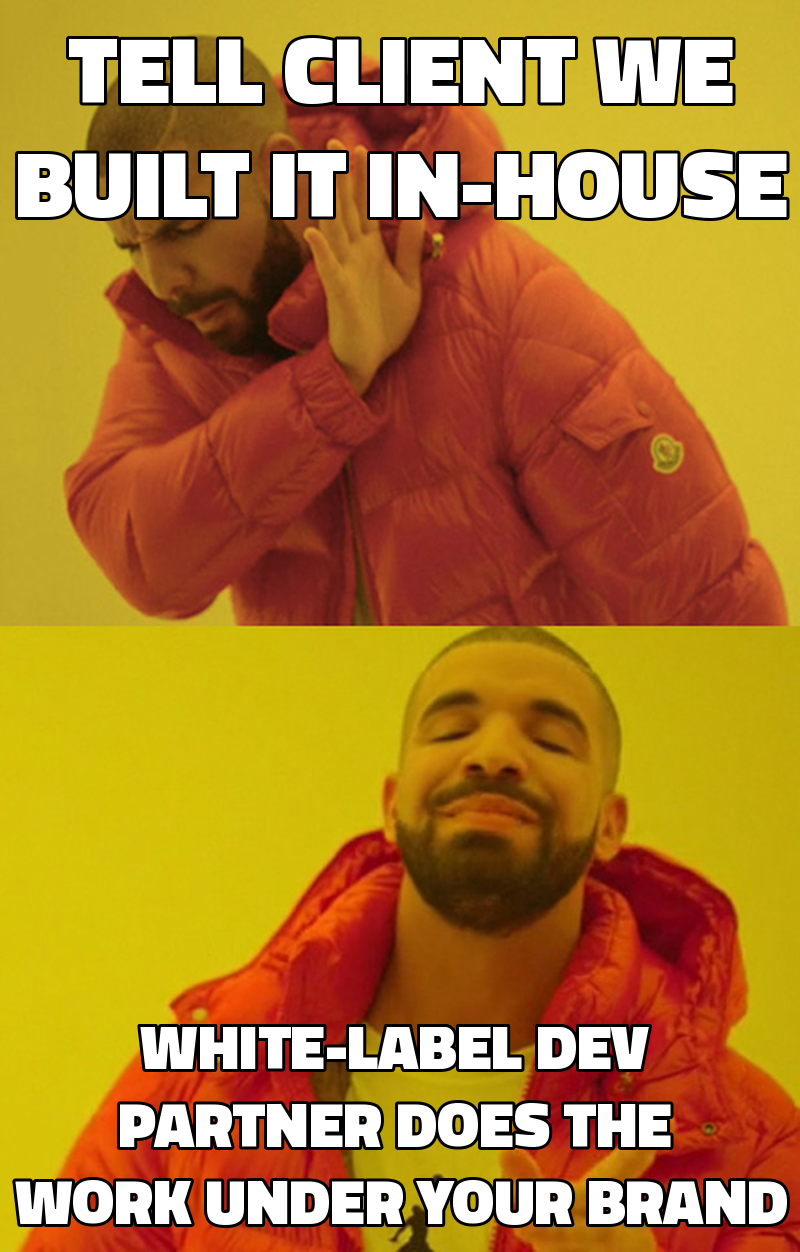
White-label development is a B2B partnership where a silent technical provider builds custom solutions, websites, SaaS platforms, AI automations, voice bots, under the agency’s brand name. The agency retains the client relationship, invoices the client, and pays the developer a wholesale rate. The client never sees the developer’s name.
Why agencies love it
- Immediate ability to quote projects without hiring staff.
- Predictable cost structure (e.g., $1,500-$5,000 per project, 50-70% margin).
- Low operational risk; the partner handles delivery, quality, and post-launch bugs.
- NDA and non-circumvent clauses protect the agency’s client list.
According to a 2023 Deloitte survey, 62% of mid-size agencies outsource development work, and 48% of those use white-label partners to preserve brand consistency.
What is private-label development?
Private-label development goes a step further: the agency creates a distinct product or service line that it owns and markets directly. The development partner may still be invisible to the end client, but the agency registers trademarks, owns the IP, and often bundles the offering with its own support and pricing.
Typical use cases
- Building a SaaS tool that the agency sells to multiple clients (e.g., a custom analytics dashboard).
- Launching a recurring automation platform that becomes a revenue stream separate from project work.
- Offering a “white-label” version of a product to other agencies, effectively becoming a developer yourself.
A 2022 McKinsey report on productized services notes that agencies that successfully productize can increase EBITDA by 15-25% compared with pure project-based models.
Branding implications
| Aspect | White-label | Private-label |
|---|---|---|
| Client-facing name | Agency’s existing brand (e.g., BrightWave) | New sub-brand or product name (e.g., BrightWave AI Hub) |
| Marketing assets | Agency reuses its own case studies, logos, and style guide | Requires separate landing pages, branding guidelines, and possibly a new logo |
| Brand dilution risk | Low – the agency’s reputation stays intact | Medium – if the product fails, it can tarnish the parent brand |
| Upsell potential | Easier to bundle with existing services | Can create a standalone revenue stream that upsells across the client base |
Practical tip: For agencies that market themselves as “full-service growth partners,” white-label preserves that promise. If you want to launch a proprietary AI automation platform, private-label lets you position the product as a distinct innovation.
Legal considerations
White-label contracts
- NDA – protects client confidentiality and the agency’s client list.
- Non-circumvent clause – prevents the developer from contacting the agency’s clients directly.
- Scope of work – clearly defines deliverables, timelines, and acceptance criteria.
- Liability – agency remains liable to the client for any breach; the developer is liable only to the agency.
Private-label contracts
- IP assignment – agency must own all code, designs, and data generated.
- Trademark registration – for the new product name and logo.
- Compliance – GDPR, CCPA, and industry-specific regulations (e.g., HIPAA for health-tech) apply directly to the agency.
- Warranty and support – agency must provide SLA terms, which can increase overhead.
A 2021 Gartner legal-tech survey found that 54% of agencies using private-label models experienced at least one IP dispute in the first two years, usually due to ambiguous ownership clauses.
Profit and margin implications
| Model | Typical wholesale rate | Agency margin range | Fixed-cost considerations |
|---|---|---|---|
| White-label | $1,500-$5,000 per project | 50-70% of client bill | Low – only partner cost and project management overhead |
| Private-label | Development cost varies; often $10-$30 per hour for partner | 70-85% of subscription or license revenue | High – product development, hosting, support, and marketing expenses |
Example profit scenario
- An agency wins a $8,000 chatbot project. The white-label partner charges $3,200 (40%). The agency nets $4,800 before internal labor – a 60% margin.
- The same agency builds a private-label SaaS subscription at $200/mo per client. After $30/mo hosting and $20/mo support, the gross margin is $150/mo (75%). Over 20 clients, monthly profit is $3,000, surpassing a single project but requiring ongoing ops.
Choosing the right model for your agency
- Assess demand volume – If you have 1-3 dev requests per month, white-label is cost-effective. If you see a steady pipeline of similar requests, productizing into a private-label SaaS may be worthwhile.
- Evaluate brand strategy – Do you want to stay a pure “full-service agency” or become known for a flagship product?
- Consider legal capacity – Private-label demands stronger IP and compliance frameworks; ensure you have legal counsel.
- Calculate ROI – Use the tables above to model cash flow for 12-month horizons.
- Pilot first – Start with a low-risk white-label pilot (e.g., a $2,500 automation) to test partner reliability before committing to private-label development.
Implementation checklist
- Partner vetting – Verify portfolio (AI, voice, custom back-ends), ask for NDA, and confirm non-circumvent terms.
- Contract template – Include scope, milestones, acceptance criteria, IP clause, and liability limits.
- Brand assets – Prepare agency-branded proposal decks, case studies, and a shared project dashboard (simple spreadsheet or Trello board).
- Pricing model – Set a wholesale rate (e.g., 40% of client bill) and define a margin target (55-65%).
- Support plan – Decide who handles post-launch bugs (agency or partner) and document SLA.
- Product roadmap (private-label only) – Outline MVP features, hosting costs, and pricing tiers.
- Compliance checklist – GDPR, CCPA, and any industry-specific rules must be addressed before launch.
Real-world example: RouteMate
Synthisia’s “Silent Dev Arm” helped a UK-based SEO agency launch RouteMate, a custom SaaS that automates client reporting. The agency kept the RouteMate brand, while Synthisia delivered the backend under an NDA. The agency retained 68% of the subscription revenue after a $30/mo hosting cost. Within six months, RouteMate generated $12,000 in recurring revenue, illustrating how a private-label approach can turn a one-off dev request into a scalable product.
Frequently asked questions
What is the biggest risk of white-label development?
The agency remains liable to the client for any delivery failure, even though the partner does the work. Mitigate this by using a partner with proven SLA performance and by having clear acceptance criteria in the contract.
Can I switch from white-label to private-label later?
Yes. Start with white-label to validate demand, then package repeatable projects into a private-label product. Ensure the original partner agrees to transfer IP or that you have a clause allowing code hand-off.
How do I protect my client list when using a white-label partner?
Include a robust non-circumvent clause and require the partner to sign an NDA that covers both client identities and project details. Regularly audit the partner’s compliance.
Do I need a separate legal entity for a private-label product?
Not always, but creating a subsidiary can isolate liability and simplify accounting. Consult a corporate attorney to decide based on revenue projections and risk exposure.
Which model yields higher long-term profit?
Private-label can generate higher long-term profit if the product scales to many clients, but it requires upfront investment and ongoing support. White-label offers higher short-term margins with less risk.
How should I price a white-label project?
Charge 2-3× the partner’s wholesale rate. For example, if the partner bills $2,000, price the client at $5,000-$6,000 to cover project management, QA, and margin.
What legal documents are essential for private-label?
You need an IP assignment agreement, trademark registration, SaaS terms of service, privacy policy, and a data processing addendum if you handle personal data.
Is it worth building my own dev team instead of partnering?
Only if you have a consistent pipeline of >$50k/month in dev work. Hiring full-time engineers adds fixed salary costs, benefits, and management overhead that most 5-15 person agencies cannot sustain.
white-label
Have something to build?
Tell us what you're trying to ship. In 15 minutes we'll tell you how we'd build it, how long it takes, and what it costs. No pitch deck, no pressure.