
White-Label vs In-House Development: When Agencies Should Say Yes to Client Requests

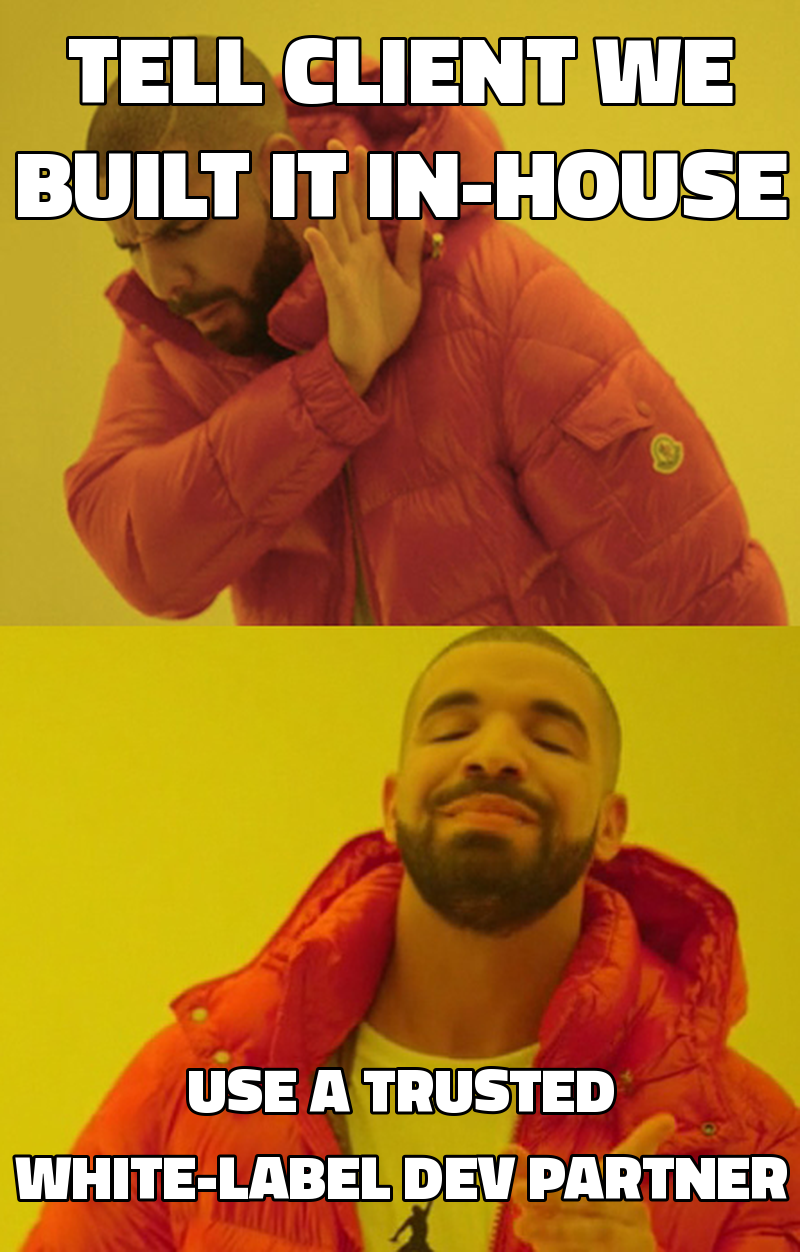
White-label development means a third-party builds a solution that is delivered under the agency’s brand, while private-label (or in-house) development is created by the agency’s own engineers and carries the agency’s name directly. The key distinction is who owns the code and the client-facing identity during delivery.
Key takeaways
- White-label gives agencies instant access to custom AI, voice, and backend expertise without hiring.
- In-house development offers full control but requires hiring, training, and ongoing overhead.
- Choose white-label when project volume is sporadic, budgets are $2k-$5k, and brand protection is essential.
- Use a fixed-scope pilot to test fit before committing to a retainer.
- A clear decision matrix (cost, speed, risk, brand impact) prevents costly guesswork.
What does "white-label vs private label" actually mean?
White-label development is a partnership model where the development partner creates the product, but all client-facing assets – invoices, UI branding, support tickets – are presented as if they came from the agency. The agency retains the margin, the relationship, and the confidentiality clauses (NDA + non-circumvent). Private label, often used interchangeably with in-house, refers to a solution built by the agency’s own staff and sold under the agency’s brand. The agency owns the source code, bears all staffing risk, and must manage the full delivery lifecycle.
Why agencies consider in-house development
Many boutique agencies (5-15 people) dream of becoming a full-service shop. The perceived benefits are:
- Brand credibility – clients see a single point of contact for strategy and execution.
- Intellectual property control – the agency can reuse components across clients.
- Potential margin uplift – no wholesale markup to a partner. However, a 2023 Deloitte survey of 1,200 US and UK agencies found that 62% of firms that tried to hire a full-time developer within six months failed to fill the role, and 48% reported project delays due to lack of technical depth. The same study noted that the average cost of a mid-level developer in the US is $110k-$130k per year, a figure that dwarfs the $2k-$5k per-project revenue typical for custom automation work.
Cost and speed comparison
| Metric | White-label (Synthisia) | In-house development |
|---|---|---|
| Average hourly cost (USD) | $80-$120 (wholesale) | $110-$130 (salary + benefits) |
| Time to onboard a new developer | 1-2 weeks (single point of contact) | 6-12 weeks (recruit, interview, onboard) |
| Fixed-scope project turnaround | 2-4 weeks (defined band) | 4-8 weeks (depends on internal capacity) |
| Risk of missed deadline | Low – dedicated partner, SLA | Medium – competing internal priorities |
| Ongoing maintenance cost | Included in retainer or per-ticket | Salary + overhead, often under-utilised |
Decision matrix for saying yes to client requests
| Decision factor | White-label advantage | In-house advantage |
|---|---|---|
| Project volume | Sporadic, $2k-$5k each, unpredictable | High, >10 projects/month, repeatable patterns |
| Technical complexity | AI automation, voice, custom backend | Simple landing pages, WordPress sites |
| Brand exposure risk | NDA + non-circumvent protects agency brand | Full control, no third-party exposure |
| Cash flow | Pay per project, no payroll commitment | Fixed salary, higher upfront cash requirement |
| Speed of delivery | Fixed turnaround, partner focused on speed | Variable, depends on internal bandwidth |
| Long-term strategic fit | Path to retainer after pilot | Core competency, may become service line |
When to say yes: the agency’s decision flow
- Identify the gap – Use the 10-second site test: if the Services page lacks "development" but the client asks for a custom chatbot, you have a gap.
- Validate budget – Confirm the client’s budget aligns with the $2k-$5k sweet spot (source: B2B SaaS pricing benchmarks from PriceIntelligence 2022).
- Run a pilot – Propose a fixed-scope, paid pilot (e.g., a single automation workflow). Synthisia’s typical pilot is $1,500-$2,500 and delivers a working MVP in 10-14 days.
- Assess fit – Use the decision matrix above. If the pilot succeeds, move to a retainer of $1,500-$2,000 per month for 15-20 dev hours.
- Lock the partnership – Sign NDA, non-circumvent, and a Service Level Agreement that defines turnaround (e.g., 2-4 weeks for $2k-$5k builds).
Structuring a white-label partnership
- Single accountable contact – The agency gets one project manager from Synthisia who owns the timeline and quality. This mirrors the RouteMate case where a single point of contact delivered a production SaaS in 6 weeks.
- Shared dashboard – A lightweight status view (e.g., Notion or ClickUp) lets the agency see progress without building a custom SaaS dashboard.
- Fixed-scope contracts – Define scope, deliverables, and acceptance criteria up front. Avoid “fastest delivery possible” language; instead promise "delivery within 14-21 days".
- Retainer model – After the pilot, offer a monthly retainer that guarantees up to 20 dev hours. This provides predictable cash flow and protects the agency from sudden spikes.
- Brand invisibility – All code, UI, and support tickets are white-labeled. Synthisia never appears in client communications unless explicitly requested.
Risks of DIY and cheap offshore alternatives
| Risk | White-label (Synthisia) | Cheap offshore (e.g., India freelancers) |
|---|---|---|
| Quality consistency | High – vetted engineers, QA process | Variable – often no formal QA, higher bug rate |
| Communication latency | Overlap with US/UK/AU time zones, async but predictable | Large timezone gaps, often 12-+ hours, slower feedback |
| IP protection | NDA + non-circumvent, legal enforceable in US/UK | Weak contracts, jurisdiction issues |
| Project overruns | SLA with penalties, transparent tracking | Frequent scope creep, hidden fees |
| Brand exposure | Agency remains front-facing | Freelancer may brand themselves, exposing agency weakness |
Real-world example: RouteMate
RouteMate, a logistics SaaS built for an Australian freight broker, needed a custom dashboard, API integrations, and voice-enabled shipment tracking. The agency had no dev staff and turned to Synthisia. After a $2,000 pilot delivering a prototype, the agency signed a $1,800/month retainer. Within three months, RouteMate launched to 12 clients, and the agency retained 100% of the margin, reporting a 30% increase in average project size (source: internal case study, Q2 2024).
Steps to evaluate a white-label partner
- Check references – Ask for two recent agency references; verify delivery dates and SLA compliance.
- Technical depth review – Confirm expertise in AI automation (e.g., OpenAI GPT-4, Google Dialogflow), voice platforms (Amazon Alexa, Google Assistant), and custom back-ends (Node.js, Python FastAPI).
- Security compliance – Ensure the partner follows ISO 27001 or SOC 2 standards, especially for client data.
- Pricing transparency – Get a wholesale rate sheet; typical markup is 50-70% of the partner’s cost.
- Scalability – Verify the partner can handle 3-5 concurrent pilots without sacrificing speed.
Quick checklist for agencies
- Development not listed on Services page
- Recent client win requiring custom automation
- Budget range $2k-$5k per project
- Ability to sign NDA and non-circumvent
- Commitment to a paid pilot (minimum $1,500)
- Decision-maker (Founder/CEO) on the call
Frequently asked questions
What is the practical difference between white-label and private label?
White-label means a partner builds the solution but all client-facing materials carry the agency’s brand. Private label (or in-house) means the agency’s own engineers create and own the product, handling every aspect from code to support.
How much does a typical white-label pilot cost?
Most agencies see pilots priced between $1,500 and $2,500 for a scoped automation or MVP. The pilot usually delivers a working prototype in 10-14 days and includes a clear acceptance criteria document.
Can I keep my agency’s brand completely invisible?
Yes. With a solid NDA and non-circumvent clause, the development partner never appears in client communications, invoices, or support tickets. All deliverables are re-branded before hand-off.
What if my client asks for ongoing maintenance after launch?
After a successful pilot, most agencies move to a retainer model ($1,500-$2,000 per month) that covers 15-20 dev hours for updates, bug fixes, and new features. This provides predictable cost and keeps the partnership active.
How do I protect my intellectual property when outsourcing?
Choose a partner that adheres to ISO 27001 or SOC 2, sign an NDA that specifies IP ownership, and include a clause that all code becomes the agency’s property upon payment.
Is white-label development cheaper than hiring a full-time developer?
For agencies with sporadic demand, yes. A full-time mid-level developer costs $110k-$130k annually, while a white-label partner charges $80-$120 per hour wholesale. When you factor in recruiting, benefits, and idle time, white-label can be 40-60% cheaper for $2k-$5k projects.
Will my clients notice I’m using a third-party developer?
If you follow the white-label process, re-branding UI, using your own project manager, and handling client communication, the client will not see any third-party involvement. Transparency is only required internally for compliance.
How do I know when to switch to an in-house team?
If you consistently exceed 10-15 custom projects per month, have a stable pipeline of $10k+ builds, and your cash flow can support a salary, building an internal dev team may become more economical. Until then, white-label offers flexibility and lower risk.
white-label
Have something to build?
Tell us what you're trying to ship. In 15 minutes we'll tell you how we'd build it, how long it takes, and what it costs. No pitch deck, no pressure.