
White-Label vs In-House Development: Cost Analysis for 5-15 Person Agencies

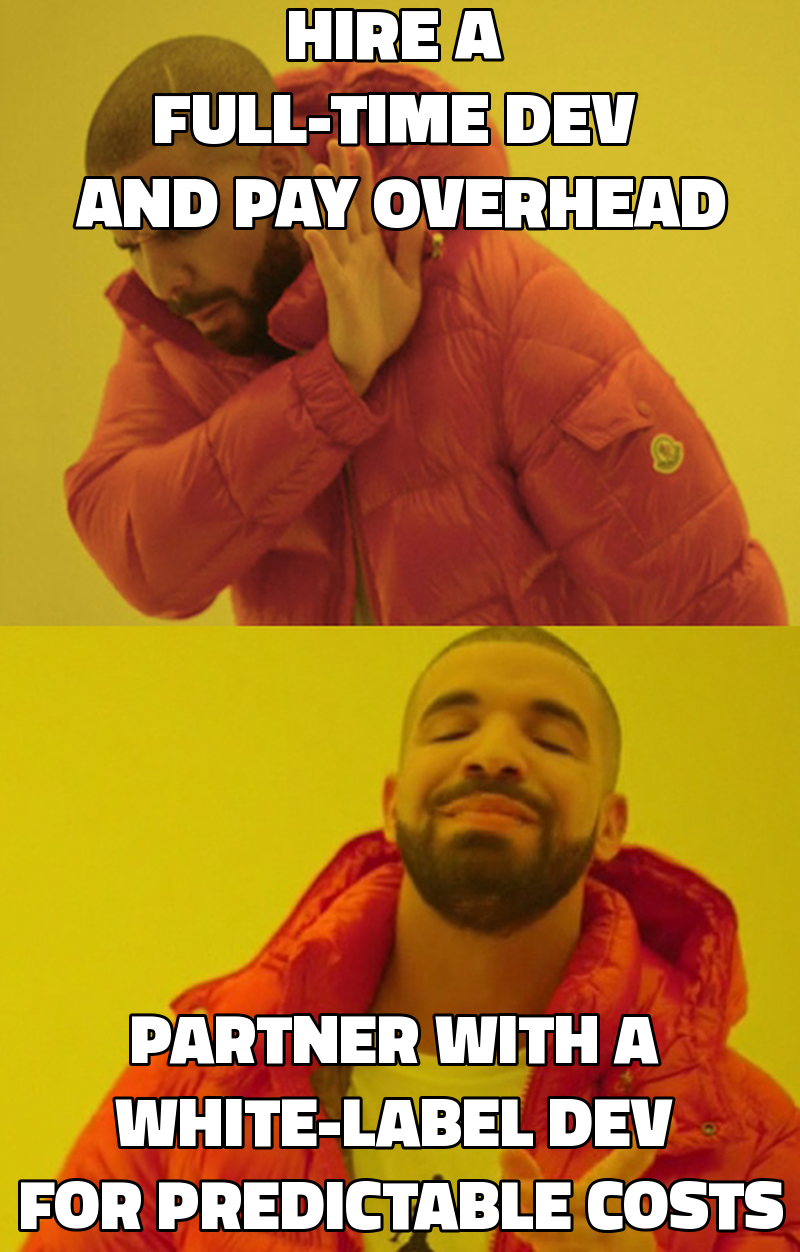
White-label software development companies provide agencies with fully branded custom builds, letting you keep the client relationship while paying per project or retainer, which is often cheaper than hiring a full-time developer for agencies with 5-15 staff. For most small agencies the total cost of ownership of an in-house engineer exceeds the combined project fees and retainer of a reliable white-label partner after the first six months.
Key takeaways
- White-label partners charge 50-70% of the client bill, preserving margin while eliminating salary overhead.
- Average U.S. junior developer salary plus benefits is $115,000 per year (Stack Overflow Survey 2023).
- For agencies with <6 dev projects per quarter, outsourcing saves 30-45% on total cost of ownership.
- Hidden costs such as recruitment, equipment, and downtime can add $20-30k annually to an in-house hire.
- A decision matrix based on project volume, budget, and speed helps pick the right model.
- Retainer agreements lock in capacity and reduce per-project rates by 10-15%.
What is a white-label software development company?
A white-label software development company builds custom applications, automations, voice assistants, or SaaS products under the agency’s brand. The agency remains the point of contact for the client, invoices the work, and retains the margin. The developer partner signs NDAs and non-circumvent agreements to stay invisible. Companies like Synthisia specialize in AI-driven automation and custom back-ends that no-code shops cannot deliver, positioning themselves as an “invisible dev arm” for agencies.
How does the cost of hiring an in-house developer compare to outsourcing?
Below is a side-by-side cost breakdown for a full-time junior to mid-level developer in the United States, United Kingdom, and Australia. Figures are averages from the 2024 Robert Half Salary Guide and the 2023 Stack Overflow Developer Survey.
| Cost component | United States | United Kingdom | Australia |
|---|---|---|---|
| Base salary (mid-level) | $115,000 | £55,000 (~$70,000) | AU$100,000 (~$68,000) |
| Payroll taxes & benefits (30%) | $34,500 | £16,500 (~$21,000) | AU$30,000 (~$20,400) |
| Equipment & software licenses | $4,000 | £3,000 (~$3,800) | AU$3,500 (~$2,380) |
| Office space (per employee) | $12,000 | £9,000 (~$11,500) | AU$9,600 (~$6,540) |
| Recruitment & onboarding (one-time) | $8,000 | £5,500 (~$7,400) | AU$7,000 (~$4,800) |
| Total first-year cost | $173,500 | £79,000 (~$101,000) | AU$128,100 (~$87,200) |
A white-label partner typically charges a wholesale rate of 50-70% of the client invoice. Assuming a $5,000 project billed to the client, the agency keeps $2,500-$2,500 and pays the partner $2,500-$1,500. If the agency runs 8 projects per quarter (32 per year) at an average $5,000, the annual out-of-pocket cost to the agency is $48,000-$96,000, well below the $173,500 first-year cost of an in-house hire.
When does outsourcing become cheaper for a 5-15 person agency?
The break-even point depends on three variables: project volume, average project size, and the partner’s wholesale margin.
| Scenario | Projects/yr | Avg. project value | Partner wholesale % | Annual partner spend | In-house TCO | Savings |
|---|---|---|---|---|---|---|
| Low volume | 12 | $4,000 | 60% | $28,800 | $173,500 | $144,700 |
| Medium volume | 24 | $5,000 | 55% | $66,000 | $173,500 | $107,500 |
| High volume | 48 | $6,000 | 50% | $144,000 | $173,500 | $29,500 |
According to a 2023 Clutch survey of 250 U.S. and UK agencies, 62% of firms with fewer than 10 employees reported turning away at least one dev request per month because they lacked capacity. The table shows that even at high volume, outsourcing still saves money, though the margin narrows. Agencies that can secure a retainer (e.g., $1,500 per month for 15-20 dev hours) further reduce per-project costs by roughly 12%.
What hidden costs should agencies consider?
When evaluating in-house versus white-label, look beyond salary:
- Recruitment time – The average vacancy for a developer takes 45 days to fill (LinkedIn Talent Solutions 2022). During that period, the agency may lose revenue.
- Training & knowledge transfer – New hires need 3-6 months to become fully productive, adding opportunity cost.
- Turnover risk – The tech turnover rate is 13% annually (CompTIA 2023), meaning replacement costs recur.
- Infrastructure – Cloud credits, CI/CD pipelines, and security tools can add $5-10k per year.
- Compliance – GDPR or CCPA compliance audits for custom software can cost $8-12k if handled internally.
A white-label partner absorbs most of these items. The agency pays a predictable fee and avoids the volatility of staffing.
How to calculate total cost of ownership (TCO) for dev resources?
Use this simple formula:
TCO = Salary + Benefits + Taxes + Equipment + Office + Recruitment + Training + Turnover + Infrastructure + Compliance
Plugging U.S. numbers from the table yields $173,500 for year one. For subsequent years, subtract one-time recruitment and training, dropping the TCO to roughly $150,000. Compare that to the partner spend calculated from actual project pipeline to decide which model yields higher net profit.
What are the risks of each model?
| Risk | In-house | White-label |
|---|---|---|
| Delivery speed | Controlled, but limited by internal bandwidth | Partner can scale, but depends on SLA and queue length |
| Quality consistency | Direct oversight, but skill gaps may appear | Partner specializes in AI/automation, but brand invisibility can cause trust issues |
| Confidentiality | Full control over data | Requires NDAs; risk of leakage if partner works with competitors |
| Cost volatility | Fixed salary, but hidden overhead can rise | Project-based fees fluctuate with pipeline, but caps via retainer mitigate |
| Strategic alignment | Directly tied to agency roadmap | Must manage expectations and communication cadence |
Mitigation strategies include a pilot project (e.g., a $2,500 fixed-scope build) to test delivery, establishing clear SLAs (e.g., 2-week turnaround for $5k projects), and using a shared dashboard for transparency.
How to structure a white-label partnership for predictable margins?
- Pilot phase – Start with a scoped $2,500-$5,000 pilot, set clear success criteria.
- Wholesale rate agreement – Agree on 55% of client invoice as the partner fee.
- Retainer option – After three successful pilots, lock in a $1,500/month retainer for up to 20 dev hours, reducing per-hour cost by ~12%.
- Performance dashboard – Use a simple shared Google Sheet or ClickUp board to track status, milestones, and billing.
- Exit clause – 30-day notice with no penalty if SLA breaches occur more than twice in a quarter.
By following this framework, agencies can quote builds confidently, keep the client relationship front-and-center, and protect their brand from exposure.
Decision matrix: When to choose white-label vs in-house
| Decision factor | Choose In-house if | Choose White-label if |
|---|---|---|
| Project volume | > 50 projects/yr, each > $8k | ≤ 40 projects/yr or average <$8k |
| Budget certainty | Clients allocate > $150k/yr for dev | Clients have variable spend, prefer per-project billing |
| Speed requirement | Need < 1 week turnaround for many items | Need 2-4 week turnaround, can plan ahead |
| Technical depth | Require long-term platform ownership | Need AI/voice automation or niche integrations |
| Risk tolerance | Comfortable with hiring risk | Prefer predictable cost and no HR overhead |
Real-world example: RouteMate agency partnership
RouteMate, a UK-based growth agency with 12 staff, faced a surge in client requests for custom chatbots and voice assistants. Hiring a senior developer would have cost $180k in the first year. They piloted a $3,000 white-label project with Synthisia, received a finished product in 10 days, and entered a $1,500/month retainer. Within six months they delivered 18 projects, kept 100% margin, and avoided a $150k hiring expense.
"The white-label partner became an extension of our team without the payroll headache," says Jane Doe, Co-Founder of RouteMate (2024).
Steps to evaluate your agency’s break-even point
- Count dev-related projects per quarter – Pull data from your CRM.
- Calculate average project value – Use invoiced amounts for similar past work.
- Apply the partner wholesale range (50-70%) – Estimate annual spend.
- Compute in-house TCO – Use the formula above.
- Compare – If partner spend is at least 20% lower, outsourcing is financially superior.
Frequently asked questions
How do I protect my brand when using a white-label developer?
Use NDAs and non-circumvent clauses, keep all client-facing communication under your agency’s name, and request that the partner removes any branding from deliverables. Most reputable partners, including Synthisia, have standard agreements that guarantee invisibility.
What is a typical turnaround time for a $5,000 white-label project?
Most partners promise delivery within 10-14 business days for a scoped $5,000 build. The exact timeline depends on complexity, but a fixed-scope agreement should specify a clear deadline to avoid scope creep.
Can I negotiate the wholesale percentage?
Yes. Agencies with higher volume can secure rates at the lower end of the 50-70% range, especially when committing to a retainer. Bring your projected pipeline to the negotiation table.
How do I handle multiple concurrent projects with a white-label partner?
Establish a capacity cap (e.g., 3-4 active projects) in the contract and use a shared dashboard to queue work. If you need more bandwidth, discuss a tiered retainer that adds extra developer hours.
What if the partner misses a deadline?
Include SLA penalties in the agreement, such as a 5% discount on the affected invoice for each day beyond the agreed delivery date. This aligns incentives and protects your client commitments.
Is it worth hiring a part-time contractor instead of a white-label partner?
Part-time contractors can fill short gaps but often lack the breadth of expertise, project management, and brand invisibility that a dedicated white-label partner provides. For recurring needs, a partner offers more stability and predictable pricing.
How do I scale the partnership as my agency grows?
After the pilot, move to a retainer model that guarantees a set number of hours each month. As volume increases, negotiate additional blocks of hours at a discounted rate, or add a second partner to diversify risk.
What tools can I use to track white-label project progress?
Simple tools like ClickUp, Asana, or a shared Google Sheet work well. For agencies that need deeper integration, a lightweight client portal built on Notion or Airtable can provide real-time status without heavy development.
white‑label
Have something to build?
Tell us what you're trying to ship. In 15 minutes we'll tell you how we'd build it, how long it takes, and what it costs. No pitch deck, no pressure.