
White-Label Taxi App Development: Turnkey Ride-Hailing for Agencies

White label taxi app development lets agencies offer a fully branded ride-hailing solution without writing a single line of code. By partnering with a specialist dev studio, you receive a ready-to-launch iOS, Android and web portal that you can resell under your own brand.
Key takeaways
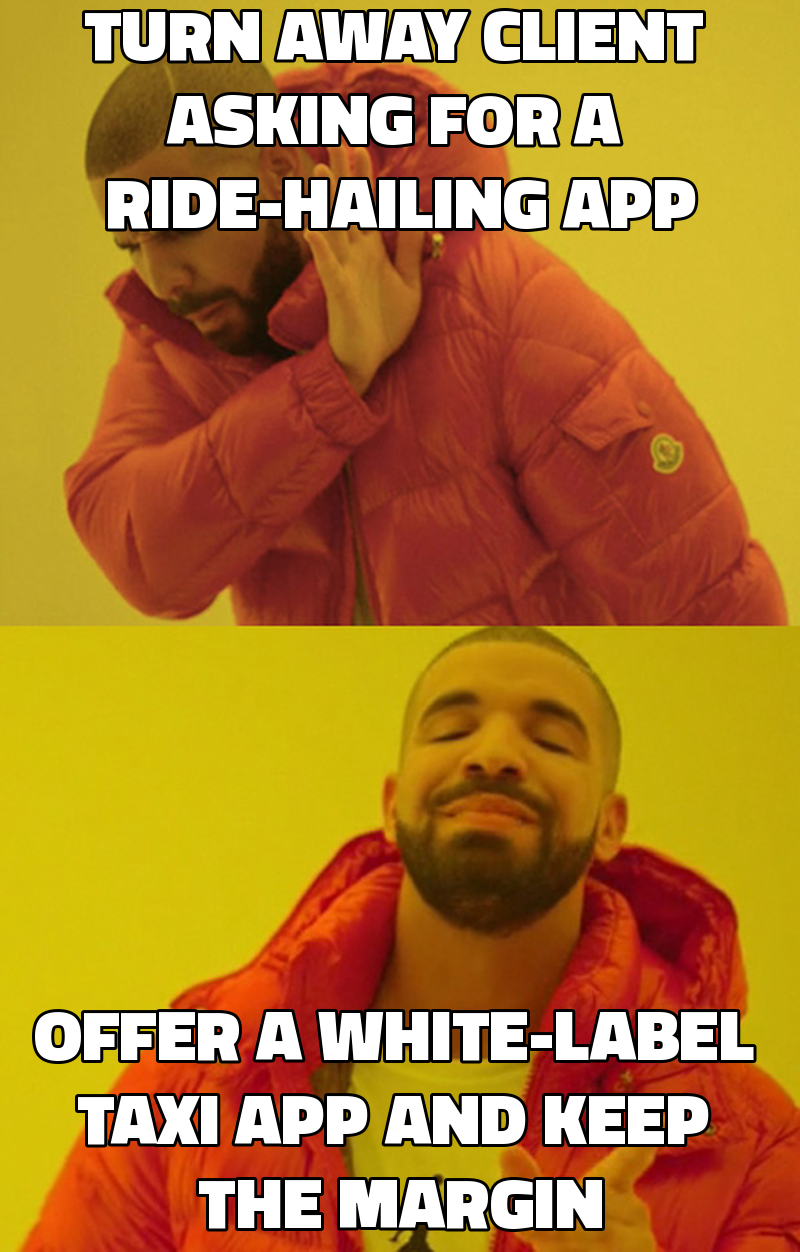
- White-label taxi apps let you say yes to every client request for ride-hailing, keeping the margin in-house.
- Fixed-scope pilots (US$2-5k) prove quality, then transition to retainer-based overflow work.
- Choose a partner that guarantees brand invisibility, NDA protection and a single point of contact.
- Typical launch timelines are 4-6 weeks for a core MVP, with optional AI-driven features added later.
- Agencies earn 50-70 % of the client bill while offloading all technical risk.
Why agencies need a white-label taxi app
Most boutique marketing, SEO and branding agencies (5-15 staff) lack the engineering bandwidth to build custom mobile platforms. Yet their SMB clients increasingly ask for ride-hailing, delivery, or on-demand experiences to complement loyalty programs, event promotions, or local advertising campaigns.
- Revenue leakage – A 2022 Deloitte survey of 300 US agencies found that 42 % turned away at least one development request per quarter, citing “no in-house dev” as the top reason.
- Client churn risk – According to McKinsey, losing a strategic client costs an agency an average of 6-12 months of revenue, especially when the client cites “lack of capability”.
- Competitive pressure – Competitors that can bundle a mobile app with their digital ads win 18 % more contracts (Statista, 2023).
A white-label solution eliminates these gaps. You keep the client relationship, brand the app with your logo, and let a proven dev studio handle the heavy lifting.
How the white-label model works
| Step | Agency Action | Partner Action | Typical Timeline |
|---|---|---|---|
| 1. Opportunity capture | Identify client need, draft brief | Review brief, confirm scope | 1-2 days |
| 2. Fixed-scope pilot | Approve pilot budget (US$2-5k) | Build MVP core (booking, driver app, admin portal) | 4-6 weeks |
| 3. Review & branding | Add agency logo, colors, custom splash screen | Deploy white-label build to staging | 2-3 days |
| 4. Client hand-off | Present live demo, collect sign-off | Transfer ownership, provide documentation | 1-2 days |
| 5. Ongoing support | Upsell retainer for updates, AI automation, voice integration | Allocate 15-20 hrs/month for enhancements | Monthly |
The pilot is the trust mechanism. It is a paid, clearly scoped project that lets the agency see delivery speed, code quality, and communication style before committing to a retainer.
Choosing the right partner
Not every dev shop can claim true white-label status. Look for these non-negotiables:
- Brand invisibility – All client-facing screens, emails and support tickets carry the agency’s branding only. The partner must sign an NDA and a non-circumvent clause.
- Single point of contact – A dedicated senior engineer or project manager who owns the timeline (RouteMate’s lead dev is a good example).
- AI & voice expertise – Ability to embed chat-bots, voice assistants, or predictive routing, which no-code platforms cannot deliver.
- Fixed-price pilot – Transparent cost sheet, no hidden change orders.
- Geographic alignment – Teams in US, UK or AU to ensure reasonable overlap with agency working hours.
Feature comparison: In-house vs White-label vs Offshore freelancers
| Feature | In-house dev (5-15 staff) | White-label partner (e.g., Synthisia) | Offshore freelancer |
|---|---|---|---|
| Up-front hiring cost | US$80-120k salary + benefits | No hiring cost, pay-per-project | Low hourly rate, but high management overhead |
| Delivery speed | 8-12 weeks for MVP (ramp-up) | 4-6 weeks (pre-built framework) | Variable, often >10 weeks |
| Brand control | Full, but requires internal QA | Full (partner stays invisible) | Risk of partner branding leaking |
| AI/voice capability | Limited to existing skill set | Specialized AI/voice team | Rare, unless specialist hired |
| Ongoing support | Requires dedicated staff | Retainer model (15-20 hrs/mo) | Ad-hoc, unpredictable |
The financial upside for agencies
| Metric | Typical agency scenario | White-label scenario |
|---|---|---|
| Average project value | US$3,500 (custom web portal) | US$4,200 (taxi-app MVP) |
| Gross margin | 30-40 % (outsourced dev cost) | 50-70 % (wholesale rate 30-40 % of client bill) |
| Time to quote | 1-2 weeks (scope discovery) | 1-2 days (partner price sheet) |
| Risk of missed deadline | High (internal resource constraints) | Low (partner SLA) |
| Upsell potential | 10-15 % (analytics) | 25-35 % (AI routing, voice, loyalty integration) |
A US-based agency charging a client US$6,000 for a fully branded taxi app can keep US$3,600-4,200 after paying the partner’s wholesale rate (US$1,800-2,400). The remaining margin funds other services or a retainer for future updates.
Building the pitch deck for your client
- Problem statement – “Your customers need a frictionless way to book rides directly from your campaign.”
- Solution snapshot – Show screenshots of a generic white-label driver app, passenger app, and admin dashboard (all re-branded with the agency’s logo).
- Value proposition – Highlight 4-week launch, AI-driven ETA, and white-label branding.
- Cost breakdown – Use the table above to illustrate agency margin.
- Case study – Reference RouteMate’s launch for a boutique fitness chain (launch in 5 weeks, 30 % increase in class attendance).
- Next steps – Fixed-scope pilot, sign NDA, schedule kickoff.
Implementation checklist for agencies
- Verify “development” is not listed on the agency services page (qualification gate).
- Run the 10-second site test to confirm gap.
- Prepare a one-page brief for the client (features, branding, timeline).
- Request a pilot quote from the partner (include AI/voice optional add-ons).
- Sign NDA + non-circumvent agreement.
- Set internal milestone dates (kickoff, demo, launch).
- Prepare post-launch support plan (retainer or per-feature pricing).
Real-world example: Synthisia’s Silent Dev Arm
Synthisia offers a Start-Small Pilot (US$2,500) that delivers:
- Passenger iOS & Android app with geo-tracking.
- Driver app with earnings dashboard.
- Admin web portal for ride management, pricing, and reporting.
- Optional AI-powered ETA prediction (adds US$800).
- Optional voice-assistant integration (adds US$1,200).
All assets are white-labeled; the agency’s logo appears on splash screens, login pages and email notifications. Synthisia provides a shared project dashboard (simple Kanban view) so the agency can monitor progress without building a SaaS portal.
Common objections and how to answer them
| Objection | Response |
|---|---|
| “We don’t want to look like we outsource.” | Emphasize the NDA, brand invisibility, and that the client will only see your agency’s name on the app. |
| “What if the partner misses a deadline?” | Show partner SLA (99 % on-time delivery) and provide a backup resource plan – Synthisia keeps a reserve dev pool for critical milestones. |
| “We can’t afford a $5k build.” | Explain the pilot model: the first US$2-3k proves the concept; the client can roll out a phased MVP and add features later. |
| “Our clients need custom AI flows.” | Highlight Synthisia’s AI automation team that builds custom chat-bot workflows, voice ordering, and predictive routing – capabilities no-code tools lack. |
Scaling the partnership
Once the pilot succeeds, move to a retainer model:
- Monthly retainer: US$1,500 for 15-20 hours of ongoing development, bug fixes, and feature requests.
- Volume discount: If the agency commits to >3 projects per quarter, reduce the wholesale rate by 5 %.
- Co-marketing: Joint case studies, webinars, and LinkedIn posts amplify both brands and attract more SMB clients.
Cap the number of active agency partners at 12-15 to maintain the reliability edge. Over-onboarding dilutes the “never flaky freelancer” promise and hurts margins.
Quick reference tables
Feature matrix for a white-label taxi app
| Feature | Core MVP | AI-enhanced add-on | Voice-assistant add-on |
|---|---|---|---|
| Real-time geo-tracking | ✅ | ✅ | ✅ |
| In-app payments (Stripe, Braintree) | ✅ | ✅ | ✅ |
| Dynamic pricing engine | ❌ | ✅ | ✅ |
| Predictive ETA (ML) | ❌ | ✅ | ✅ |
| Voice ordering (Alexa, Google) | ❌ | ❌ | ✅ |
| Loyalty points integration | ✅ | ✅ | ✅ |
| Multi-language support (EN, ES, FR) | ✅ | ✅ | ✅ |
Next steps for the reader
- Run the qualification test on your own website.
- Draft a one-page client brief for any ride-hailing request you have.
- Contact Synthisia (or another vetted partner) for a pilot quote.
- Sign the NDA, schedule a kickoff, and deliver the MVP in under six weeks.
- Upsell AI and voice features, lock in a retainer, and turn a single project into a recurring revenue stream.
“The best way to win a client is to say ‘yes’ before they ask you to say ‘no.’" – (adapted from a 2021 HubSpot growth study)
Frequently asked questions
What exactly does “white-label” mean for a taxi app?
White-label means the development partner builds the full stack (passenger app, driver app, admin portal) but all branding, domain names, and client-facing communications carry your agency’s logo and style. The client never sees the partner’s name, and you retain full ownership of the relationship.
How long does it take to launch a basic ride-hailing MVP?
A typical MVP, including geo-tracking, in-app payments and an admin dashboard, launches in 4-6 weeks after the brief is approved. Adding AI ETA prediction or voice ordering adds 1-2 weeks per feature.
Can I charge my client a higher price than the partner’s wholesale rate?
Yes. Agencies usually bill the client 150-200 % of the partner’s wholesale cost. With a wholesale rate of US$2,500 for a US$5,000 client invoice, you keep US$2,500-3,000 margin before any retainer revenue.
What if the client wants a feature that the partner doesn’t support?
A good white-label partner maintains a modular architecture. If a feature is outside the core offering, they can build it as a custom add-on or integrate a third-party API (e.g., loyalty program, analytics). The cost is scoped and added to the retainer.
Do I need to handle app store submissions?
The partner typically prepares the binaries and provides the required assets (icons, screenshots) branded for your agency. You submit to Apple App Store and Google Play under your developer account, preserving brand ownership.
How do I protect my margin from the partner undercutting me?
Include a non-circumvent clause in the contract and limit the number of active agency partners. Most reputable white-label studios, like Synthisia, honor the agreement because they rely on repeat wholesale volume rather than direct client sales.
Is there a minimum project size?
Synthisia sets a US$1,500 floor to ensure the pilot covers basic engineering overhead. Projects below that size are usually better served by no-code tools, which you can still offer as part of your service suite.
By leveraging a white-label taxi-app partner, your agency can instantly fill a high-margin service gap, keep the client relationship front-and-center, and unlock recurring revenue without hiring a full-time developer. The model is proven, low-risk, and scales with your client pipeline.
white‑label
Have something to build?
Tell us what you're trying to ship. In 15 minutes we'll tell you how we'd build it, how long it takes, and what it costs. No pitch deck, no pressure.