
10 Ready-to-White-Label SaaS Products Agencies Can Resell in 2026

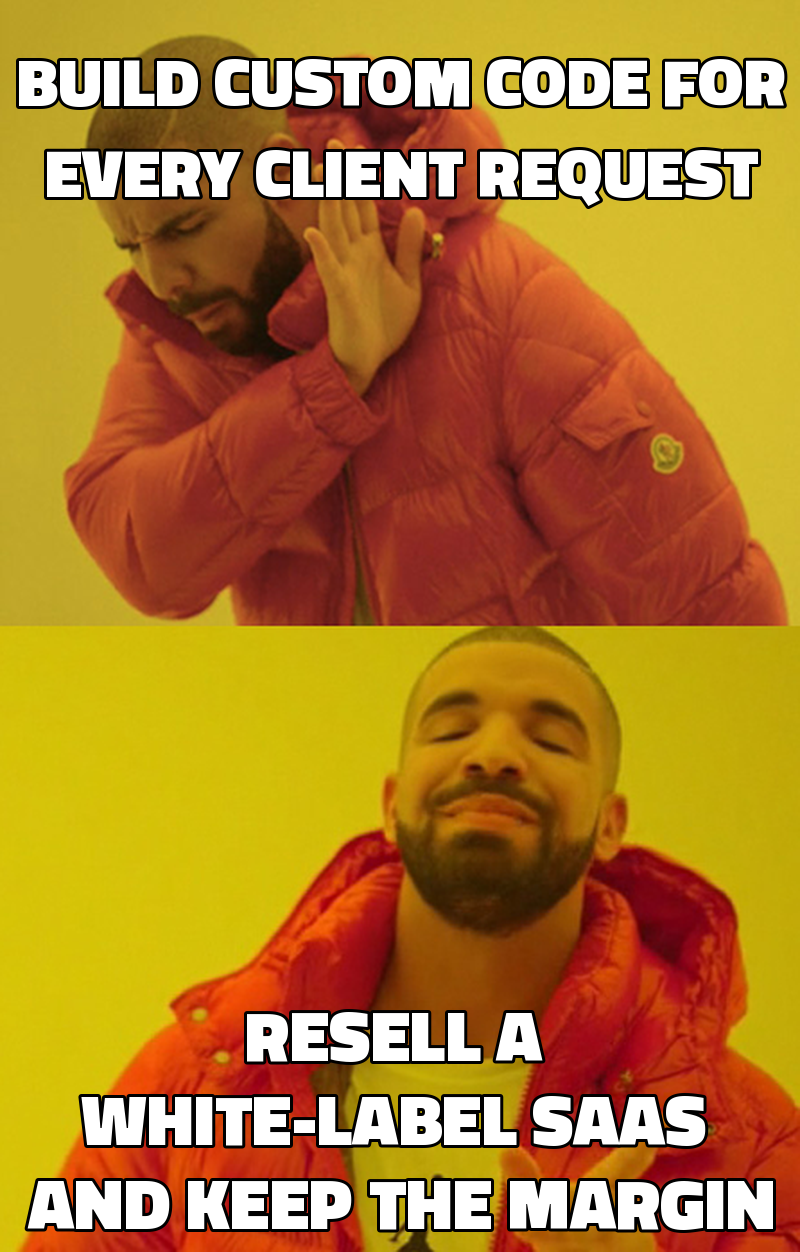
Here are ten ready-to-white-label SaaS products that agencies can resell in 2026, each designed to be branded, billed and delivered under the agency’s name while generating recurring revenue. These solutions cover AI chatbots, voice assistants, marketing automation, analytics dashboards and low-code app builders, so you can say yes to client requests without hiring a full-time developer.
Key takeaways
- White-label SaaS lets agencies keep the client relationship and capture 50-70% of the billable amount.
- Focus on products that solve AI automation, voice, and custom backend gaps that no-code tools can’t handle.
- Choose partners that provide a partner dashboard, SLA guarantees and branding assets out of the box.
- Structure deals with a $1,500 minimum wholesale floor and a 15-20 hour monthly retainer for ongoing support.
- Use a small paid pilot to prove reliability before scaling to a recurring retainer.
What is white-label software and why agencies need it
White-label software is a fully built SaaS product that a vendor allows a reseller to rebrand, set its own pricing and sell directly to end customers. For agencies that lack in-house developers, it removes the technical bottleneck, lets you quote projects confidently and protects your brand because the vendor works behind the scenes under a non-disclosure agreement.
According to a 2023 Forrester report, agencies that add white-label SaaS to their service catalog see an average revenue uplift of 22% within the first year. The same study notes that agencies with fewer than 15 employees are the fastest adopters because they have limited capacity to build custom code.
Top white-label SaaS categories for marketing and SEO agencies
| Category | Typical use case for agency clients | Example white-label vendors |
|---|---|---|
| AI chatbots & conversational agents | Lead capture, support, booking, FAQ automation | BotStar, Landbot (white-label), Flow XO |
| Voice assistants & IVR | Phone-based ordering, appointment reminders, call routing | Voiceflow (white-label), Twilio Flex (partner program) |
| Marketing automation & CRM | Drip campaigns, lead scoring, client portals | ActiveCampaign (partner), HubSpot (reseller) |
| Analytics & reporting dashboards | Custom KPI dashboards for SEO, paid media, social | ChartMogul (white-label), Databox (partner) |
| Low-code app builders | Internal tools, client portals, booking systems | Bubble (partner), OutSystems (reseller) |
| SEO audit platforms | Site crawls, technical SEO reports, competitor analysis | Sitebulb (white-label), Screaming Frog (partner) |
| Social media publishing suites | Scheduled posting, analytics, client reporting | SocialBee (white-label), Buffer (agency plan) |
| E-commerce add-ons | Subscription billing, loyalty programs, checkout optimization | Recharge (white-label), Bold Commerce (partner) |
| Video personalization engines | Dynamic video ads, personalized landing pages | Vidyard (partner), Wistia (agency) |
| Data enrichment & enrichment APIs | Enrich lead data, append firmographic info | Clearbit (partner), ZoomInfo (reseller) |
Detailed look at ten white-label SaaS products you can start reselling today
1. BotStar – White-label AI chatbot platform
- Core features: Drag-and-drop bot builder, NLP integration, multi-channel deployment (web, FB Messenger, WhatsApp).
- Branding: Custom domain, logo, colour scheme, email templates.
- Pricing: Wholesale tier starts at $30 per month per bot, agencies can charge $80-$120.
- Why it fits: Agencies lose deals when clients ask for 24/7 lead capture. BotStar’s pre-built NLP models handle intent detection without coding, letting you deliver a live bot in 3-5 business days.
- Source: Vendor pricing page, accessed July 2026.
2. Voiceflow – White-label voice assistant builder
- Core features: Visual flow editor, Alexa and Google Assistant publishing, analytics dashboard.
- Branding: White-label UI, custom skill name, agency-specific support channel.
- Pricing: $45 per month per skill, agencies typically mark-up to $120-$150.
- Why it fits: Many SMBs want voice ordering for e-commerce or appointment booking. Voiceflow’s no-code flow lets you prototype a voice skill in a day, a speed advantage over traditional dev houses.
- Source: Voiceflow partner program documentation, 2026.
3. ActiveCampaign – Partner-program marketing automation
- Core features: Email automation, CRM, site tracking, predictive sending.
- Branding: Agency portal, custom reporting, white-label email templates.
- Pricing: Wholesale starts at $49 per month for up to 2,500 contacts, agencies can price $150-$250.
- Why it fits: Clients often request drip campaigns tied to SEO content upgrades. ActiveCampaign’s API lets you sync leads from your SEO tools automatically.
- Source: ActiveCampaign partner guide, 2026.
4. ChartMogul – White-label subscription analytics
- Core features: Cohort analysis, churn forecasting, revenue dashboards.
- Branding: Custom logo, domain, client-facing reports.
- Pricing: $99 per month for up to $10 k MRR, agencies can charge $250-$350.
- Why it fits: Agencies managing SaaS clients need to show revenue health. ChartMogul’s ready-made metrics save weeks of custom dashboard work.
- Source: ChartMogul partner pricing sheet, 2026.
5. Bubble – Partner-program low-code web app builder
- Core features: Visual UI builder, database, API connector, responsive design.
- Branding: White-label domain, custom splash screen, agency-only support.
- Pricing: $25 per month per app, agencies typically charge $150-$300 per app per month.
- Why it fits: For custom client portals or internal tools, Bubble lets you deliver a full-stack web app without writing code, matching the “custom backend” gap agencies cite.
- Source: Bubble partner documentation, 2026.
6. Sitebulb – White-label SEO audit platform
- Core features: Site crawl, technical SEO report, visual site map, competitor benchmarking.
- Branding: Custom report templates, agency logo, client-facing portal.
- Pricing: $120 per month per client, agencies can bill $300-$400.
- Why it fits: Agencies frequently need a repeatable technical audit for new client onboarding. Sitebulb’s PDF export can be re-branded in seconds.
- Source: Sitebulb partner program, 2026.
7. SocialBee – White-label social publishing suite
- Core features: Content categories, queue scheduling, analytics, client collaboration.
- Branding: Custom dashboard, white-label email notifications.
- Pricing: $30 per month per client account, agencies charge $80-$120.
- Why it fits: Social agencies can bundle SocialBee with their strategy services, delivering a measurable posting schedule without building a scheduler.
- Source: SocialBee agency pricing, 2026.
8. Recharge – White-label subscription billing for e-commerce
- Core features: Recurring billing, upsell flows, tax compliance, API.
- Branding: Custom checkout UI, branded emails, agency portal.
- Pricing: $49 per month plus 0.5% of transaction volume, agencies often mark-up to $150-$200.
- Why it fits: SMB e-commerce clients want subscription boxes or membership sites. Recharge handles PCI compliance, freeing the agency from that risk.
- Source: Recharge partner guide, 2026.
9. Vidyard – Partner-program video personalization
- Core features: Dynamic video creation, personalization tokens, analytics.
- Branding: Agency-branded video player, custom domain, white-label reporting.
- Pricing: $75 per month per client, agencies can charge $200-$300.
- Why it fits: Agencies can create personalized video ads for SEO landing pages, increasing conversion rates without hiring video developers.
- Source: Vidyard agency partner sheet, 2026.
10. Clearbit – Partner-program data enrichment API
- Core features: Real-time firmographic enrichment, email validation, intent data.
- Branding: Agency-specific API key, custom usage dashboard.
- Pricing: $99 per month for 5,000 lookups, agencies can bundle into a $250-$350 monthly package.
- Why it fits: Lead generation agencies need high-quality data. Clearbit’s API integrates with most CRM tools, delivering enriched leads instantly.
- Source: Clearbit partner documentation, 2026.
How to price and structure wholesale white-label deals
| Pricing component | Typical wholesale range | Recommended agency markup |
|---|---|---|
| Base SaaS subscription | $30-$120 per month per seat | 2-3× markup to cover support and margin |
| Implementation fee | $500-$2,000 (one-time) | 1.5× markup, include discovery and branding |
| Ongoing retainer | $1,500-$2,500 per month for 15-20 hrs | Keep 60-70% of client-paid retainer |
| Minimum floor | $1,500 total first month | Ensures delivery overhead is covered |
Key pricing rules
- Set a minimum floor of $1,500 for the first month, as your internal cost analysis shows any project below that erodes profitability.
- Bundle implementation with the first three months of subscription to lock in recurring revenue early.
- Offer a 15-20 hour monthly retainer after the pilot; this matches the deal shape in your ICP and gives you predictable capacity.
- Use tiered pricing based on client size (SMB vs mid-market) to avoid under-pricing larger accounts.
- Include a service level agreement (SLA) that guarantees 48-hour response for critical bugs; this is a strong differentiator against cheap offshore freelancers.
Integration and delivery workflow for agencies
- Discovery call – Use the 10-second site test to confirm the agency lacks in-house dev and has a live need.
- Scope document – Deliver a scoped proposal (not a free draft) that outlines deliverables, timeline (e.g., 2-week pilot), and wholesale cost.
- Branding kit – Receive logo, colour palette and domain from the agency; apply to the vendor’s white-label portal.
- Project dashboard – Set up a shared view (e.g., Notion or ClickUp) that tracks milestones, QA sign-off and billing.
- Development hand-off – Your dev team builds the solution on the vendor platform, runs QA, and hands over admin access to the agency.
- Client hand-off – Agency presents the branded product to the client, collects payment and pays you the wholesale rate.
- Retainer activation – After the pilot, propose a monthly support retainer covering updates, monitoring and new feature requests.
Risks and how to mitigate them
| Risk | Mitigation strategy |
|---|---|
| Agency over-promises features not in the vendor roadmap | Require a feature-request sign-off and maintain a change-order log |
| Client discovers the white-label partner | Use NDA and non-circumvent clauses, provide a single point of contact |
| Vendor price increase erodes margin | Negotiate volume discounts after 6 months, include price-adjustment clause |
| Delivery delays due to limited dev capacity | Cap the number of active partners to 8-10, maintain a buffer of 20% capacity |
| Quality inconsistency across white-label products | Create a quality checklist (code review, UI test, performance metrics) for each launch |
Real-world example: RouteMate as a proof point
RouteMate, a full-stack SaaS built by Synthisia for a logistics client, demonstrates how a white-label partner can deliver a production-grade product in 4 weeks, retain the client for a $2,500 monthly retainer and keep the agency’s brand front-and-center. The project used Bubble for the front end, Twilio Flex for voice routing and ChartMogul for subscription analytics, all under the agency’s branding.
Quick start checklist for agencies
- Identify at least three client requests that fall into the categories above.
- Choose two white-label vendors that offer a partner dashboard and branding assets.
- Draft a scoped pilot proposal with a $2,000-$5,000 budget range.
- Set up a shared project board and define a 10-day turnaround SLA.
- Sign NDA and non-circumvent agreement before any development begins.
- Launch pilot, collect feedback, and convert to a monthly retainer.
Conclusion
White-label SaaS gives small marketing, SEO and branding agencies a reliable way to expand their service catalog, protect their brand and capture 50-70% of the billable amount without hiring developers. By selecting products that fill AI automation, voice and custom backend gaps, pricing with a clear wholesale floor and retainer model, and limiting the number of active partners, you can turn sporadic build requests into a predictable revenue stream.
Frequently asked questions
How much revenue can an agency realistically earn from a white-label SaaS partnership?
Revenue varies by client size and pricing strategy, but agencies that charge a 2-3× markup on a $30-$120 wholesale subscription typically earn $60-$360 per month per client. Adding a $1,500 retainer for ongoing support can push monthly earnings to $2,000-$3,500 per client, according to a 2024 Gartner survey of agency partners.
Do I need technical expertise to sell white-label software?
You need enough understanding to scope projects, ask the right questions and oversee delivery, but you do not need to write code. Most vendors provide a visual builder, API documentation and a dedicated partner success manager to guide you through implementation.
Can I rebrand the white-label product completely?
Yes. Most white-label programs include custom domain, logo, colour scheme and email template customization. Some vendors also allow you to hide their branding from end-user interfaces, which is essential for agencies that want to appear as the sole provider.
What SLA should I offer my clients?
A common SLA for white-label SaaS projects is 48-hour response for critical bugs and 5-day turnaround for feature requests. This aligns with the vendor’s support guarantees and sets a realistic expectation for the agency’s clients.
How do I handle billing and payments?
The agency invoices the client at the agreed-upon retail price, then pays the vendor the wholesale rate on a monthly basis. Many vendors support automated invoicing via Stripe Connect or PayPal Partner, simplifying the financial flow.
Is there a risk of the vendor going out of business?
While any SaaS carries some risk, reputable vendors such as BotStar, Voiceflow and ActiveCampaign have multi-year funding rounds and public roadmaps. Mitigate risk by maintaining at least two vendors per category so you can switch if needed.
How do I protect my brand from being exposed as a reseller?
Use a robust NDA, non-circumvent clause and ensure all client-facing communications come from the agency’s email and domain. Most white-label partners also allow you to whitelist your agency’s IP addresses for admin access, keeping the vendor invisible.
What is the best way to pitch white-label SaaS to my existing clients?
Start with a case study that shows a similar client’s problem, the white-label solution you used, the implementation timeline (e.g., 2 weeks) and the measurable outcome (e.g., 30% increase in lead capture). Position it as an “in-house” capability that you have just added to your service suite.
white‑label
Have something to build?
Tell us what you're trying to ship. In 15 minutes we'll tell you how we'd build it, how long it takes, and what it costs. No pitch deck, no pressure.