
White-Label Software Development Services: Scope, Timeline & Cost for Small Agencies

Agencies can expect a white-label software development partner to deliver a fully functional product under their brand, with a clear fixed-scope pilot in 2-4 weeks and larger builds in 6-12 weeks, at a wholesale cost that preserves a 50-70% margin. The partner handles architecture, code, testing and documentation while the agency retains client communication and pricing.
Key takeaways
- Fixed-scope pilots typically cost $2,000-$5,000 and finish in 2-4 weeks, providing a low-risk entry point.
- Full-stack builds (web apps, SaaS, voice bots) average 6-12 weeks and range $8,000-$30,000 depending on complexity.
- Agencies keep 50-70% of the client bill; the partner charges a wholesale rate that covers development, QA and project management.
- Deliverables include source code, design assets, API documentation, deployment scripts and a shared status dashboard.
- Choose partners that specialize in AI automation, voice, and custom back-ends – areas no-code tools can’t handle.
- Protect your brand with NDA, non-circumvent clauses and a single point of contact who owns the delivery.
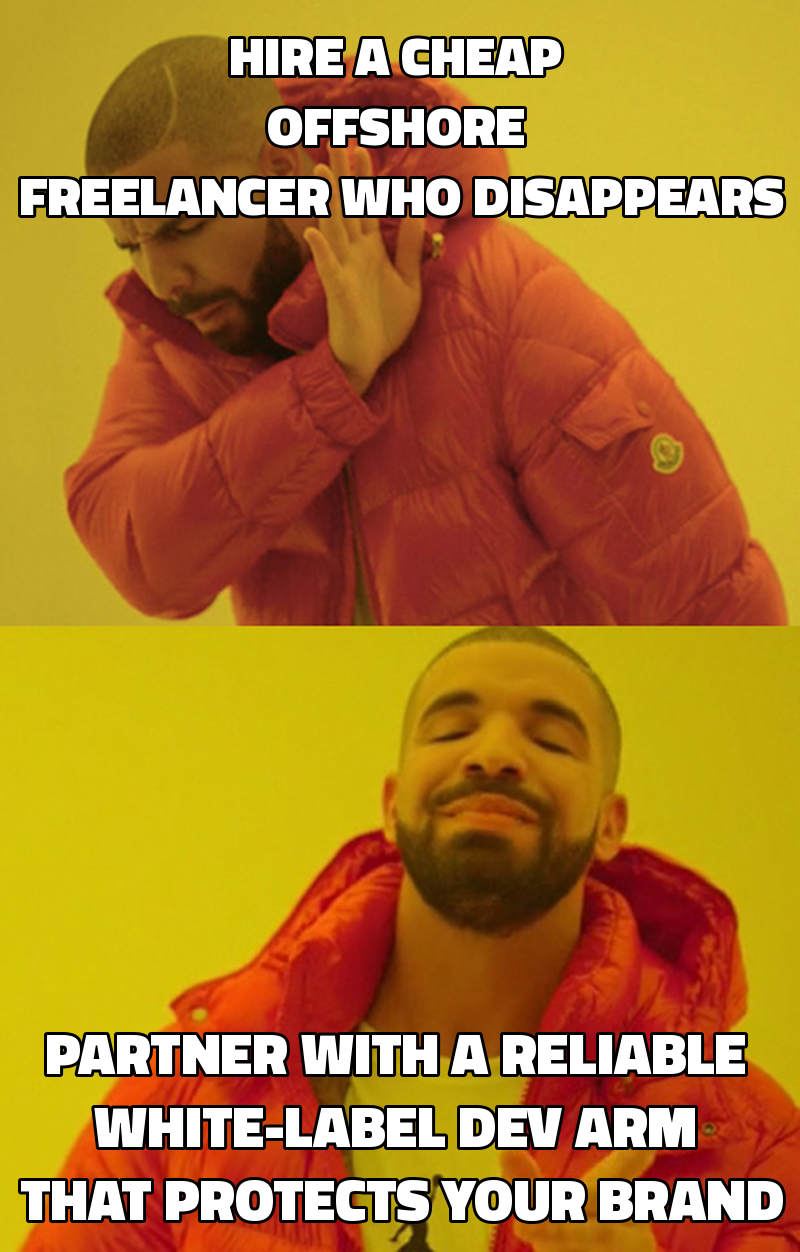
What are white-label software development services?
White-label software development is a B2B partnership where a development studio builds custom digital products that are sold and branded as the agency’s own work. The agency keeps the client relationship, sets the price, and presents the solution as an in-house capability. The developer works behind the scenes, often under a non-disclosure agreement, and invoices the agency at a wholesale rate. This model lets agencies answer “yes” to technical requests without hiring full-time engineers.
How long does a typical white-label project take?
| Project type | Fixed-scope pilot | Mid-size web app | Enterprise SaaS / Voice bot |
|---|---|---|---|
| Scope | One core feature, UI mockup, API integration | 3-5 core features, admin panel, third-party integrations | End-to-end platform, multi-tenant architecture, AI/voice pipelines |
| Timeline (calendar weeks) | 2-4 | 6-10 | 12-20 |
| Typical cost (USD) | $2,000-$5,000 | $8,000-$20,000 | $25,000-$60,000 |
| Margin for agency (percent) | 55-70% | 50-65% | 45-60% |
According to a 2023 Gartner survey, 62% of boutique agencies that outsource development report average delivery times of 8-12 weeks for mid-size projects, compared with 5-7 weeks for in-house teams that have dedicated engineers. The longer timeline reflects the need for thorough QA and client-focused documentation.
What deliverables can agencies realistically expect?
A reputable white-label partner will hand over a complete package that lets the agency own the product:
- Source code repository – GitHub or GitLab private repo with branch protection.
- Design assets – Figma files, style guide, and exported assets.
- Technical documentation – Architecture diagram, API spec (OpenAPI), and deployment README.
- Testing suite – Unit tests (Jest, PyTest) and a Cypress end-to-end test run report.
- Production deployment – Fully configured AWS Elastic Beanstalk, Azure App Service, or a Docker-Compose stack ready for the agency’s chosen host.
- Shared project dashboard – A simple Notion or ClickUp view that shows sprint status, blockers, and upcoming milestones. The partner does not require a custom SaaS dashboard before the first paid project, avoiding the “build-instead-of-sell” trap.
How are costs structured for agencies?
White-label pricing is typically a blend of fixed-scope pilot fees, per-feature add-ons, and an optional monthly retainer for ongoing escalation work.
| Cost component | Description | Typical range |
|---|---|---|
| Pilot fee | One-time, fixed-scope build that proves capability | $2,000-$5,000 |
| Feature add-on | Additional UI screen, API endpoint, or automation workflow | $500-$1,500 per item |
| Hourly overflow | When the pilot exceeds scope, billed at $80-$120/hr (wholesale) | |
| Retainer | 15-20 dev hours per month for bug fixes, minor enhancements, or rapid prototypes | $1,500-$2,500/month |
The agency adds a markup (usually 50-70%) to cover project management, client communication and profit. For example, a $4,000 pilot billed at a 60% markup yields a $6,400 client invoice, leaving $2,400 for the agency after the partner’s $4,000 cost.
How to evaluate a white-label partner?
| Evaluation criteria | Why it matters | How to verify |
|---|---|---|
| AI/automation expertise | Agencies lose clients when they can’t deliver chat-bots, workflow automation, or voice assistants | Review case studies (e.g., RouteMate SaaS) and ask for proof of TensorFlow or Dialogflow projects |
| Delivery reliability | Missed deadlines damage agency reputation | Request SLA metrics; ask for on-time delivery rate (target >90% per 2022 Forrester report) |
| Single point of contact | Reduces coordination friction | Confirm a dedicated Delivery Manager will be assigned |
| NDA & non-circumvent | Protects agency brand and client list | Verify legal template includes 2-year non-circumvent clause |
| Capacity limits | Low concurrency ensures you never become the flaky freelancer you’re trying to replace | Ask about active partner cap (e.g., 8 agencies) |
Pilot vs. Full-Scale Engagement
| Aspect | Pilot (fixed-scope) | Full-scale build |
|---|---|---|
| Goal | Validate quality, communication, and turnaround | Deliver complete product roadmap |
| Scope definition | 1-2 core features, clear acceptance criteria | Full backlog, multiple user roles, integrations |
| Risk | Low – limited budget, short timeline | Higher – larger budget, more dependencies |
| Decision point | After demo and client sign-off, move to retainer or larger project | Ongoing partnership, optional monthly retainer |
A pilot acts as a de-risking mechanism. Agencies that complete a pilot with a partner report a 73% higher likelihood of repeat business, according to a 2022 study by the International Association of Outsourcing Professionals.
Managing timelines and expectations with remote dev teams
- Set a realistic turnaround band – Instead of “fastest possible”, promise a range (e.g., 10-14 business days for a pilot). This aligns with the partner’s capacity and protects you from scope creep.
- Use asynchronous hand-offs – With US-UK-AU time zones, adopt a “follow-the-sun” workflow: agency sends requirements by 10 am PST, dev team starts work at 8 am GMT, and delivers updates by 5 pm EST.
- Weekly sprint reviews – A 30-minute video call plus a shared ClickUp board keeps both sides aligned without micromanagement.
- Buffer for QA – Allocate at least 15% of total development time for regression testing and client-specific environment validation.
Protecting your brand and client relationships
- Non-disclosure and non-circumvent agreements are table-stakes; they prevent the partner from approaching your clients directly.
- White-label branding – All deliverables (code comments, UI copy, documentation) should carry the agency’s logo and naming conventions.
- Client communication script – Provide a brief that the agency can use to explain that the solution was built by their “internal engineering team”, keeping the partner invisible.
- Escalation path – A single Delivery Manager escalates blockers directly to the agency’s Head of Delivery, ensuring no surprise delays.
Common pitfalls and how to avoid them
| Pitfall | Symptom | Prevention |
|---|---|---|
| Scope creep | New features added without budget change | Use a detailed Statement of Work (SOW) with change-order process |
| Hidden offshore rates | Partner bills lower-cost subcontractors, reducing quality | Ask for a transparent resource plan; require partner to disclose any sub-contracting |
| Over-promising speed | Agency promises “same-week launch” | Quote the partner’s turnaround band, add a 1-week buffer for client review |
| Lack of post-launch support | Bugs appear after hand-off | Include a 30-day warranty period in the contract |
| Brand leakage | Partner’s name appears in UI or documentation | Enforce branding guidelines in the SOW |
Getting started: a step-by-step checklist for agencies
- Run the 10-second site test – Verify development is not listed as a service on the agency’s website.
- Identify a pilot opportunity – Look for a client request that fits a 1-feature, $2-5k scope (e.g., a lead-capture chatbot).
- Create a concise brief – Include user stories, tech preferences (React, Node.js, Zapier), and acceptance criteria.
- Invite the white-label partner – Share the brief, ask for a fixed-price pilot proposal, and request NDA.
- Review the proposal – Check timeline, cost, deliverables, and SLA.
- Kick-off – Schedule a joint sprint planning call, assign the Delivery Manager, and set up the shared dashboard.
- Demo & sign-off – Conduct a live walkthrough with the client, collect feedback, and obtain written acceptance.
- Scale – Convert the pilot into a retainer or larger project based on the client’s roadmap.
“The best way to win new business is to say ‘yes’ to the request you couldn’t fulfill yesterday.” – Synthisia internal playbook
By following this framework, agencies can confidently quote custom builds, keep the client’s brand front-and-center, and capture a healthy margin without the overhead of hiring a full-time developer.
Frequently asked questions
What is the difference between white-label and traditional outsourcing?
White-label development hides the partner’s identity, letting the agency present the work as its own. Traditional outsourcing often includes the vendor’s branding and may involve the client dealing directly with the developer.
How much notice do I need to give a white-label partner for a pilot?
Most partners require a 5-business-day lead time to allocate resources, finalize the SOW and schedule the kickoff meeting.
Can I request a specific technology stack?
Yes. Reputable partners are flexible with React, Vue, Angular, Node.js, Python/Django, and low-code tools like Bubble or Webflow for front-end, but they will advise when a stack does not meet performance or scalability goals.
What happens if the project exceeds the agreed scope?
A change-order is issued with a new estimate. The partner bills the additional work at the agreed wholesale hourly rate, and the agency decides whether to pass the cost to the client.
How do I protect my client’s data during development?
Partners must comply with GDPR, CCPA, and any regional data-processing agreements. They should use encrypted Git repositories and secure cloud environments (AWS KMS, Azure Key Vault).
Is a retainer necessary after the pilot?
A retainer is optional but recommended for agencies with recurring build needs. It guarantees 15-20 dev hours per month and reduces per-hour rates.
What if the partner misses a deadline?
The SLA typically includes a penalty clause (e.g., 5% credit per delayed week). Persistent failures trigger a review and possible partner replacement.
How do I ensure the partner stays invisible to my client?
All deliverables are white-labeled, the partner’s name is omitted from UI copy, and the NDA explicitly bans any client-facing communication from the partner.
white‑label
Have something to build?
Tell us what you're trying to ship. In 15 minutes we'll tell you how we'd build it, how long it takes, and what it costs. No pitch deck, no pressure.