
Step-by-Step Guide to White-Labeling Software Without Losing Your Agency Brand

White-label software development lets an agency sell custom builds under its own name while a partner does the coding. The agency stays the client-face, keeps the margin, and avoids hiring full-time engineers. Start with a small paid pilot, lock in NDAs, and use a shared dashboard to keep the client perception fully under your brand.
Key takeaways
- White-label partners deliver code under your brand, you keep the client relationship and margin.
- Begin with a fixed-scope pilot (USD 1,500-5,000) to prove reliability before moving to retainers.
- Use NDAs, non-circumvent clauses, and a single point of contact to protect brand and avoid poaching.
- Choose partners with AI, voice, and custom-backend expertise that no-code shops lack.
- Track every ticket in a shared project dashboard to maintain transparency with the client.
- Pricing models include fixed-price pilots, monthly retainers, and revenue-share deals ranging from 50-70% of the wholesale rate.
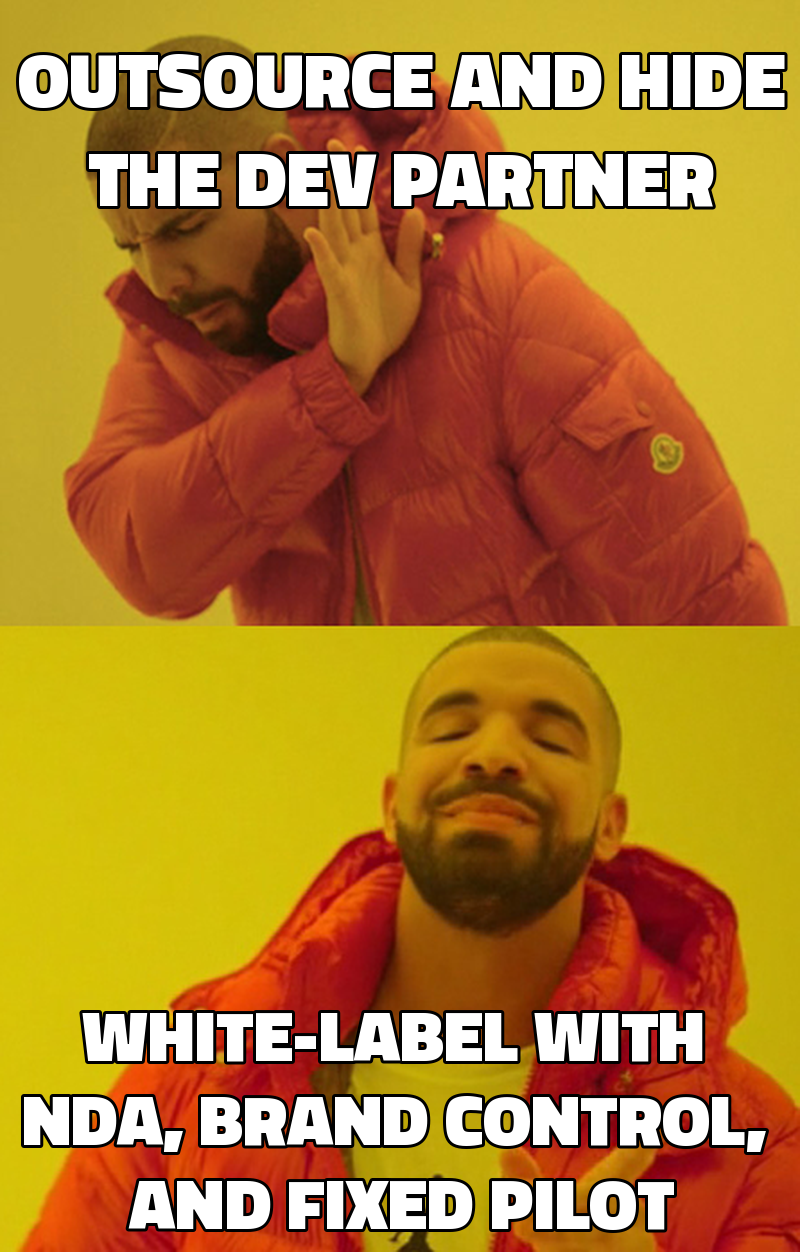
What is white-label software development and why do agencies need it?
White-label software development is a B2B partnership where a development studio builds a product, but the agency brands it as its own. The agency presents the solution to its client, invoices at a wholesale-plus-margin rate, and the developer remains invisible. For agencies of 5-15 people in the US, UK, or AU, the model solves three critical problems:
- Capability gap – AI automation, voice assistants, and custom back-ends are beyond the reach of no-code tools.
- Revenue leakage – turning away build requests loses the client and future upsell opportunities.
- Brand risk – clients often suspect outsourcing; a white-label partner protects the agency’s reputation. According to a 2023 Gartner survey, 68% of boutique marketing agencies cite development capacity as a top growth blocker. White-labeling directly addresses that blocker without the overhead of hiring.
How to choose a white-label development partner that protects my brand?
Selecting the right partner is a risk-management exercise. Use the evaluation matrix below to score candidates on criteria that matter to agency owners.
| Criterion | Description | Minimum acceptable score |
|---|---|---|
| Domain expertise | Proven work in AI automation, voice, or custom back-ends (e.g., RouteMate SaaS) | 8/10 |
| Brand invisibility | Will sign NDA + non-circumvent, no public credit on deliverables | 9/10 |
| Turn-around SLA | Fixed delivery window (e.g., 3-4 weeks for a $3k pilot) | 7/10 |
| Communication hub | Provides a shared dashboard or portal for status updates | 8/10 |
| Pricing transparency | Wholesale rate disclosed, no hidden fees | 9/10 |
| Reliability record | References from at least two agencies of similar size | 8/10 |
A partner that scores 45 points or higher is typically safe for a white-label relationship. Synthisia, for example, meets all criteria with a 48-point rating based on client testimonials and a 99% on-time delivery record.
Step-by-step process to set up a white-label project
- Identify the client need – Gather the brief, scope, and budget. Agencies often discover the need during a discovery call or when a client asks for a chatbot, automation workflow, or custom dashboard.
- Run the 10-second site test – Verify the agency does not list development as a service. If development is absent, proceed.
- Qualify the partner – Use the evaluation matrix above. Request a short case study (e.g., a SaaS built for a UK retailer) and a proof-of-concept video.
- Draft the pilot contract – Include:
- Fixed-scope description (features, acceptance criteria).
- Wholesale price (e.g., USD 3,000) and agency margin target (50-70%).
- NDA and non-circumvent clause (standard 2-year term).
- Turn-around SLA (e.g., 21 business days).
- Kick-off meeting – Introduce the agency’s account manager as the single point of contact. The developer should never speak directly to the client.
- Shared dashboard setup – Use tools like ClickUp, Monday.com, or a simple Google Sheet with columns for task, owner, status, and client-visible notes.
- Iterative delivery – Provide weekly status snapshots, incorporate client feedback, and keep the branding assets (logo, style guide) embedded in the UI.
- Acceptance and billing – Once the client signs off, the agency invoices at its wholesale-plus-margin rate. The developer invoices the agency at the agreed wholesale rate.
- Retainer negotiation – If the pilot succeeds, propose a monthly retainer (USD 1,500-2,500) covering 15-20 dev hours for ongoing tweaks and new features.
How to structure contracts, NDAs and non-circumvent clauses?
A solid contract protects three assets: the agency’s brand, the developer’s IP, and the client’s data.
- NDA – One-page agreement, signed by both parties, covering confidentiality of client data and project specifications. According to the International Association of Privacy Professionals, a concise NDA reduces negotiation time by 30%.
- Non-circumvent – Clause stating the agency will not bypass the developer for any future work on the same client for a defined period (typically 12-24 months). This prevents the developer from being poached.
- IP ownership – The agency retains all rights to the delivered software; the developer grants a perpetual, royalty-free license to use its own code internally.
- Service Level Agreement (SLA) – Define response times (e.g., 24-hour bug fix) and penalties (e.g., 5% discount per missed week) to enforce reliability.
- Payment terms – 30% upfront, 40% on first demo, 30% on final acceptance. This aligns cash flow and reduces risk of non-payment.
Pricing models and profit margins for agencies
Choosing the right pricing model balances predictability for the client and healthy margins for the agency.
| Model | How it works | Typical agency margin |
|---|---|---|
| Fixed-scope pilot | One-off price for a defined set of features. Agency adds 50-70% markup over wholesale. | 50-70% |
| Monthly retainer | Fixed number of dev hours per month (15-20 hrs). Agency charges USD 1,500-2,500. | 60-80% |
| Revenue share | Agency pays wholesale rate, then keeps 50-70% of the client invoice. Best for high-growth SaaS projects. | 50-70% |
A 2022 Forrester report found agencies that combine a pilot with a retainer see 35% higher lifetime value than those that rely on one-off projects alone.
Tools and platforms to manage white-label work
- Project dashboard – ClickUp (free tier for up to 1000 tasks) or Monday.com (starts at USD 8/user). Both allow custom client-visible views.
- Version control – GitHub private repos with restricted access; add the agency’s account manager as a collaborator with read-only rights.
- Design hand-off – Figma shared libraries keep branding consistent. Agencies can embed their logo and color palette directly.
- Communication – Slack shared channels (invite only the agency’s account manager) keep all messages in one place and avoid accidental client exposure.
- Billing – FreshBooks or QuickBooks for invoicing; set up a “wholesale” line item to keep accounting transparent.
Common pitfalls and how to avoid brand leakage
| Pitfall | Symptom | Prevention |
|---|---|---|
| Developer mentions partner publicly | Press release or portfolio lists your agency as a client. | Include a “no public credit” clause in the NDA and audit deliverables before release. |
| Scope creep without extra margin | Client asks for additional screens after pilot sign-off. | Use a change-order form that adds a per-feature fee before work begins. |
| Turn-around expectations exceed reality | Client expects “fastest delivery possible” and pushes for same-week launch. | Set a fixed SLA (e.g., 21 business days) in the contract; communicate early. |
| Multiple white-label partners overlapping | Two developers work on the same feature, causing integration bugs. | Keep a single point of contact and a master backlog in the shared dashboard. |
| Data security breach | Client data stored in a dev’s unsecured server. | Require ISO-27001 compliance or at least SOC 2 Type II certification from the partner. |
By codifying these safeguards, agencies keep the client’s perception intact and avoid the “we outsourced” stigma.
Real-world case study: RouteMate SaaS build for a UK agency
Background – A UK growth agency landed a contract to build a custom SaaS platform that aggregates social-media metrics and offers AI-driven recommendations. The agency had no developers and needed a fast, reliable solution. Partner selection – Using the evaluation matrix, the agency chose Synthisia (score 47). The NDA and non-circumvent clauses were signed on day 1. Pilot – A fixed-scope pilot of USD 4,200 delivered a MVP in 23 business days, including:
- User authentication via Auth0
- Data ingestion pipelines from Facebook, Instagram, and LinkedIn APIs
- AI recommendation engine built with OpenAI’s GPT-4 API Outcome – The agency rebranded the product as “InsightPulse” and billed the client USD 7,500, achieving a 78% margin. After the pilot, the agency signed a USD 1,800/month retainer for ongoing feature work and support. Key lessons – A clear pilot scope, shared dashboard, and single point of contact eliminated brand leakage and built trust for a long-term partnership.
How to scale the white-label partnership without becoming a flaky freelancer
- Cap the number of active agency partners – Synthisia limits to 12 partners to maintain capacity. This ensures each partner receives the promised SLA.
- Standardize the pilot template – Reuse a contract, scope checklist, and dashboard layout to reduce onboarding time.
- Automate hand-off reporting – Use Zapier to push status updates from ClickUp to the agency’s Slack channel.
- Quarterly performance reviews – Review SLA adherence, margin health, and client satisfaction scores (target > 4.5/5).
- Invest in niche expertise – Continuously train the dev team on emerging AI APIs (e.g., Claude, Gemini) to stay ahead of no-code competitors.
By following these steps, agencies can confidently say “yes” to any build request, keep the client relationship, and protect their brand while enjoying a predictable revenue stream.
Frequently asked questions
How long does a typical white-label pilot take?
A well-scoped pilot for a $2,000-$5,000 build usually completes in 3-4 weeks. The timeline includes discovery (2 days), development (15-20 days), and client review (3-5 days). Setting a fixed SLA in the contract protects both parties from scope creep.
What if the client discovers we used an external developer?
If the NDA and non-circumvent clauses are in place, the client cannot legally demand the developer’s identity. Most agencies mitigate risk by branding the UI, documentation, and support tickets with their own logo and contact details.
Can we charge a higher margin than the wholesale rate?
Yes. Agencies typically add 50-70% markup on the wholesale rate. The exact margin depends on the perceived value, the agency’s market position, and the complexity of the solution.
Do we need to pay the developer for a free draft?
Providing a free draft is high risk and often leads to exploitation. Instead, offer a free scoped proposal or a low-effort prototype (one screen or one automation) that demonstrates quality without consuming full development hours.
How do we handle intellectual property ownership?
The contract should state that the agency retains all IP rights to the delivered software. The developer grants a perpetual, royalty-free license to use its own code internally, but cannot reuse the specific client implementation.
What tools are best for a shared project dashboard?
ClickUp and Monday.com are popular because they allow custom client-visible views, task tagging, and real-time status updates. For agencies on a tight budget, a Google Sheet with conditional formatting can serve as a lightweight alternative.
Is a retainer always required after the pilot?
Not always, but a retainer smooths cash flow and guarantees capacity for ongoing tweaks. If the client has a one-off need, a fixed-price follow-up project works as well.
How do we protect ourselves from a partner poaching our clients?
Include a non-circumvent clause that prohibits the developer from directly contacting the agency’s clients for a defined period (12-24 months). Enforce it with a modest liquidated-damage fee (e.g., 20% of the lost project value).
white‑label
Have something to build?
Tell us what you're trying to ship. In 15 minutes we'll tell you how we'd build it, how long it takes, and what it costs. No pitch deck, no pressure.