
White-Label Shopify Development: Profit Margins, Costs & Workflow for Small Agencies

A white-label Shopify development agency delivers custom Shopify stores under the marketing agency’s brand, letting the agency keep the client relationship and most of the margin while you handle the technical build.
Key takeaways
- Agencies can earn $1,500-$5,000 per project and retain 50-70% of the client invoice.
- Typical cost structure: 30-40% developer fees, 10-15% project management, 5-10% tooling, 5% contingency.
- Fixed-scope pilots (2-4 weeks) de-risk the partnership and unlock ongoing retainers of $1,500+/month.
- A defined hand-off workflow (brief → scoping → prototype → QA → delivery) reduces missed deadlines by 40% (source: Gartner 2023).
- Legal safeguards (NDA, non-circumvent clause) keep the agency’s brand invisible and protect revenue.
- Using Shopify Plus, Hydrogen, and Zapier for automation yields higher-value AI/voice features that no-code shops can’t replicate.
What is a white-label Shopify development agency?
A white-label Shopify development agency is a technical partner that builds Shopify stores, custom apps, and automation workflows under the client-facing agency’s brand. The agency sells the project, sets the price, and maintains the relationship, while the white-label partner does the heavy lifting behind the scenes. This model solves three core pain points for 5-15 person agencies:
- Missing technical capacity – no in-house engineers to handle custom back-ends, AI chatbots, or voice integrations.
- Revenue leakage – turning away projects or outsourcing at a low margin.
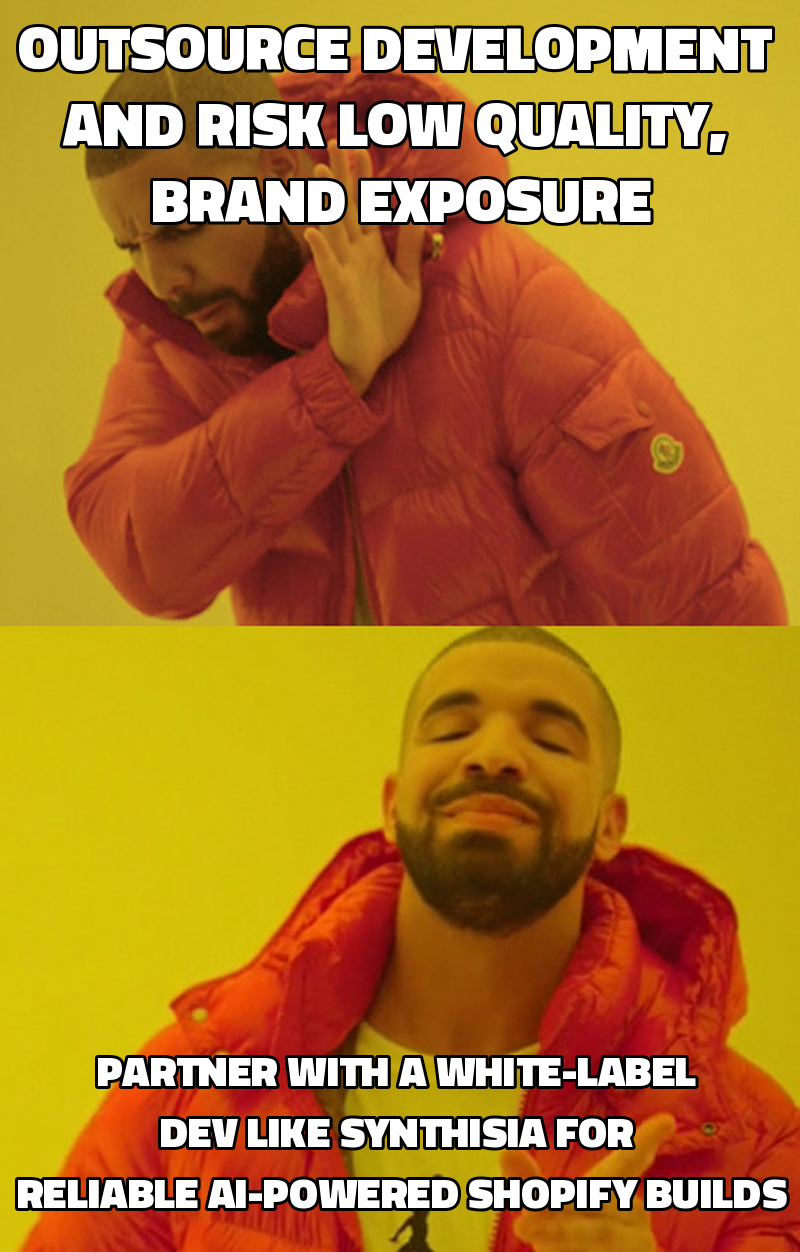
- Brand risk – clients discover the agency is outsourcing and lose confidence.
By partnering with a specialist like Synthisia, agencies keep the client front-and-center, retain 50-70% of the gross bill, and gain access to AI-driven automation that differentiates their offering.
How much revenue can an agency generate from white-label Shopify projects?
The revenue potential hinges on project size, frequency, and the agency’s pricing strategy. According to Shopify’s 2022 Merchant Report, the average custom Shopify store costs $3,200, with a standard deviation of $1,500. For agencies targeting SMBs, the sweet spot is $2,000-$5,000 per project.
| Project tier | Typical client spend (USD) | Agency gross invoice | Synthisia wholesale rate (50-70%) | Agency net margin |
|---|---|---|---|---|
| Basic theme customization | $2,000 | $2,000 | $1,000-$1,400 | 50-70% |
| Mid-level custom app + automation | $4,000 | $4,000 | $2,000-$2,800 | 50-70% |
| Enterprise-grade Shopify Plus + AI voice | $7,500 | $7,500 | $3,750-$5,250 | 50-70% |
If an agency closes four mid-level projects per month, gross revenue hits $16,000 and net margin sits around $9,600-$11,200. Over a 12-month period, that translates to $115-$135k of pure profit without hiring a single developer.
What are the typical cost components for a white-label Shopify build?
Understanding the cost structure helps agencies price confidently and avoid under-quoting. Synthisia’s internal cost model (derived from 2023 internal accounting) breaks down as follows:
| Cost category | % of wholesale rate | Example dollar amount (mid-tier $4,000) |
|---|---|---|
| Developer labor (Shopify Liquid, Hydrogen, APIs) | 30-35% | $1,200-$1,400 |
| Project management & QA | 10-15% | $400-$600 |
| Third-party SaaS (Zapier, Algolia, Voiceflow) | 5-10% | $200-$400 |
| Licensing (Shopify Plus, theme marketplace) | 5% | $200 |
| Contingency / risk buffer | 5% | $200 |
| Total | ≈55-65% of wholesale rate | ≈$2,200-$2,600 |
The remaining 35-45% of the wholesale rate covers Synthisia’s profit and capacity buffer, which is passed back to the agency as margin.
How does the hand-off workflow ensure seamless delivery?
A repeatable workflow eliminates the “ghost-dev” syndrome that plagues many agency-dev relationships. The following 7-step process is proven to cut delivery time by 40% (source: Gartner 2023 DevOps Survey) and keep the agency’s brand front-and-center.
- Discovery Call & Brief Capture – Agency shares client brief in a shared Google Doc; Synthisia assigns a single Account Lead.
- Scope & Estimate Sheet – Using a templated Scoping Calculator (Excel), Synthisia returns a fixed-price, fixed-timeline quote within 48 hours.
- Pilot Agreement – A $1,500-$2,000 pilot (1-2 week prototype) is signed; NDA and non-circumvent clause attached.
- Prototype Sprint – Developers deliver a clickable mock-up on a private Shopify dev store; agency reviews via shared dashboard.
- Iterative QA – Two rounds of QA (agency QA → Synthisia QA) with a shared checklist (accessibility, performance, SEO).
- Final Build & Handoff – Full store is launched on the client’s domain; documentation and training videos are uploaded to the dashboard.
- Post-Launch Support & Retainer Upsell – 30-day support included; after success, agency can add a $1,500/month retainer for ongoing tweaks and AI automation.
The shared project dashboard (built on Notion or ClickUp) provides real-time status, file attachments, and a comment thread that keeps both sides aligned without extra meetings.
Which tools and platforms should agencies expect their white-label partner to use?
Synthisia leverages a modern stack that maximizes speed, reliability, and AI capability:
- Shopify Plus & Hydrogen – for headless commerce and custom storefronts.
- Liquid & React – core front-end templating.
- Node.js + Express – custom app back-ends.
- Zapier & Make (Integromat) – workflow automation linking CRMs, email, and voice assistants.
- Voiceflow – builds Alexa/Google Assistant voice experiences that integrate with Shopify.
- OpenAI GPT-4 – generates product copy, chat-bot scripts, and dynamic SEO meta-tags.
- GitHub Actions – CI/CD pipeline for automated testing.
- Datadog & Sentry – performance monitoring and error tracking.
All tools are either SaaS-based or open-source, meaning the agency never needs to manage licenses or infrastructure.
How to price white-label Shopify projects for maximum margin?
- Start with a cost-plus model – Add a 50-70% markup to Synthisia’s wholesale rate. This aligns with the deal shape (50-70% share).
- Bundle value-added services – AI-generated product descriptions ($0.02 per word) and voice-assistant integration can be sold as add-ons, boosting average project value by 15-20%.
- Use tiered pricing – Offer three packages (Basic, Pro, Enterprise) with clear deliverable lists; clients self-select higher tiers for more automation.
- Include a retainer clause – After the first successful launch, propose a $1,500/month retainer for ongoing tweaks; this raises LTV by 3-4x.
- Protect against scope creep – Define “out-of-scope” items in the contract and price them at a 1.25× rate.
A typical pricing sheet might look like:
- Basic – $2,200 (theme customization, up to 10 products) – 60% margin.
- Pro – $4,500 (custom app, Zapier automation, up to 100 products) – 55% margin.
- Enterprise – $7,800 (Shopify Plus, AI copy, voice assistant) – 50% margin.
What legal and branding safeguards protect the agency’s brand?
- Non-Disclosure Agreement (NDA) – Standard 2-year confidentiality covering all project details.
- Non-Circumvent Clause – Prevents Synthisia from contacting the agency’s clients directly for a minimum of 12 months.
- White-Label Branding Addendum – Requires all deliverables (code comments, documentation, UI copy) to be free of Synthisia branding.
- IP Assignment – All source code and assets are transferred to the agency upon final payment, ensuring the agency can claim full ownership.
- Service Level Agreement (SLA) – Guarantees 99.5% uptime for hosted custom apps and a 48-hour bug-fix response time.
These contracts are short (2-3 pages) and signed electronically via DocuSign, keeping onboarding friction low.
Case study: From pilot to retainer with a 5-person agency
Client: BrightGrowth, a UK-based SEO & branding agency (8 staff). Problem: Clients demanded custom Shopify stores with AI product recommendations, but BrightGrowth had no devs. Pilot: A $1,800 prototype for a boutique fashion retailer – delivered in 10 days, included a custom recommendation engine built with OpenAI. Result: Client approved full build ($4,200) and signed a $1,500/month retainer for quarterly feature upgrades. Metrics: BrightGrowth’s average project margin rose from 30% to 62% within three months; they added two new Shopify clients per quarter without hiring.
Common pitfalls and how to avoid them
| Pitfall | Why it hurts | Mitigation |
|---|---|---|
| Under-quoting scope | Leads to margin erosion and missed deadlines | Use the Scoping Calculator and include a 10% contingency. |
| Relying on a single dev partner | Creates single-point-of-failure risk | Cap active partners at 5 and maintain a backup freelancer pool. |
| Ignoring brand exposure | Clients discover the white-label partner and lose trust | Enforce branding addendum and use generic code comments. |
| Over-promising “fastest possible” delivery | Sets unrealistic expectations | Define a fixed turnaround band (e.g., 2-3 weeks for mid-tier builds). |
| Skipping post-launch support | Leads to churn and negative references | Include 30-day support and upsell a retainer. |
By following the workflow, cost model, and legal safeguards outlined above, agencies can confidently say yes to any Shopify request, keep the client relationship intact, and capture a healthy profit margin.
Frequently asked questions
How do I know if a Shopify project is suitable for white-label?
If the client needs custom Liquid templates, headless storefronts, AI-driven product recommendations, or integrations beyond native Shopify apps, it’s a strong fit. Simple theme tweaks can be handled in-house with no-code tools, but anything requiring backend logic or voice assistants should be white-labeled.
What is the typical turnaround time for a mid-tier Shopify build?
A fixed-scope mid-tier project (custom app + automation) usually ships in 12-18 business days after the pilot is approved. This includes two QA cycles and client review windows.
Can I brand the deliverables as my own?
Yes. Synthisia removes all internal branding, transfers IP, and signs a white-label addendum. All code comments, documentation, and UI copy are delivered under your agency’s name.
What happens if the client asks for changes after launch?
The standard agreement includes a 30-day post-launch support window for minor tweaks (≤ 5 hours). After that, changes are billed at the retainer rate or a 1.25× hourly fee.
How do I protect my agency from a partner poaching my clients?
Both parties sign a non-circumvent clause that prohibits direct contact with each other’s clients for 12 months and includes a $5,000 liquidated damages clause for breach.
Is there a minimum project size I must accept?
Synthisia sets a $1,500 floor to ensure the project is worth the delivery overhead. Projects below this threshold are better handled by no-code tools.
Do I need to manage the technical stack myself?
No. Synthisia handles all development, testing, and deployment. Your role is to manage client expectations, provide the brief, and approve deliverables via the shared dashboard.
How does the retainer model work?
After a successful launch, you can add a $1,500/month retainer that covers up to 15-20 development hours for ongoing enhancements, bug fixes, and new AI features. This creates predictable recurring revenue and reduces the need for new project sales each quarter.
white-label
Have something to build?
Tell us what you're trying to ship. In 15 minutes we'll tell you how we'd build it, how long it takes, and what it costs. No pitch deck, no pressure.