
White-Label Shopify Development Pricing Guide for US Agencies

A white-label Shopify development agency provides custom Shopify stores and extensions under your agency’s brand, handling everything from theme coding to AI-driven automation while you keep the client relationship and margin. Typical project fees range from $2,000 to $5,000 for a fixed-scope build, with retainer options of $1,500-$2,500 per month for ongoing escalation capacity.
Key takeaways
- White-label partners stay invisible, letting you bill clients at 50-70% markup.
- Fixed-scope Shopify builds usually cost $2,000-$5,000 wholesale; add a $1,500-$2,500 monthly retainer for recurring work.
- Use tiered pricing (hourly, fixed, retainer) to match client risk tolerance and project complexity.
- Factor in theme customization, app integration, AI automation, and QA when calculating your quote.
- Benchmark against Shopify Plus average implementation cost of $10,000-$30,000 (Shopify, 2023) to stay competitive.
- Protect margins with clear scope, change-order process, and a shared project dashboard.
What is a white-label Shopify development agency?
A white-label Shopify development agency builds Shopify stores, custom themes, and private apps on behalf of marketing or branding agencies that lack in-house engineers. The partner delivers the code, tests, and documentation under the agency’s brand name. The agency retains the client relationship, invoices the client, and keeps the margin. This model solves the pain point of “we can’t quote dev work because we have no engineers” while avoiding the risk of hiring a full-time developer for sporadic demand.
Core capabilities expected by agencies
| Capability | Typical tools used | Why it matters for agencies |
|---|---|---|
| Theme development | Liquid, Slate, VS Code | Enables brand-specific UI without breaking Shopify core |
| Private app creation | Node.js, Ruby on Rails, Shopify CLI | Allows custom checkout, inventory sync, AI-driven recommendations |
| AI & automation | OpenAI API, LangChain, Zapier, Make.com | Delivers chatbots, voice assistants, and automated email flows |
| Integration layer | REST Admin API, GraphQL, OAuth | Connects ERP, CRM, and loyalty programs |
| Quality assurance | Jest, Cypress, Shopify Theme Check | Guarantees launch-ready code and reduces client support tickets |
How do white-label Shopify agencies charge?
Pricing can be grouped into three dominant models:
- Fixed-scope project fee – a one-time price for a defined set of deliverables (e.g., theme build + two custom apps). Agencies love this because it provides a predictable client invoice.
- Hourly or day-rate billing – useful for exploratory work, discovery phases, or when scope is uncertain. Typical rates for senior Shopify engineers in the US range from $120-$180 per hour (Gartner, 2023).
- Retainer model – a monthly fee for a block of development hours, priority support, and rapid escalation. Retainers of $1,500-$2,500 cover roughly 15-20 hours of work per month, which aligns with the Synthisia offering.
When to use each model
| Model | Ideal client scenario | Pros | Cons |
|---|---|---|---|
| Fixed-scope | Client wants a new store with clear requirements | Predictable revenue, easy to markup | Scope creep can erode margin if not managed |
| Hourly | Discovery, proof-of-concept, or highly custom integrations | Flexibility, bill for actual effort | Clients may balk at open-ended cost |
| Retainer | Ongoing optimization, AI automation, or seasonal updates | Stable cash flow, deeper partnership | Requires trust and proven delivery record |
Typical cost components for a Shopify project
Understanding the line-item breakdown helps you build a transparent quote and defend your markup.
| Cost component | Description | Typical wholesale cost (USD) |
|---|---|---|
| Discovery & requirements | Workshops, user-story mapping, technical spec | $300-$600 |
| Theme design & development | Custom Liquid theme, responsive CSS, UI kit | $800-$1,500 |
| Private app development | API endpoints, admin UI, webhook handling | $600-$1,200 |
| AI automation | Prompt engineering, chatbot integration, voice assistant | $400-$800 |
| Third-party app licenses | Shopify App Store subscriptions (e.g., Klaviyo, ReCharge) | $50-$200 per month |
| QA & testing | Automated tests, cross-browser checks, performance audit | $200-$400 |
| Project management | Dedicated point of contact, status dashboard | $150-$300 |
| Buffer for change orders | 10-15% of total to cover unforeseen tweaks | Variable |
Example calculation – A mid-size e-commerce brand wants a custom theme, a loyalty-points app, and a GPT-4 powered product recommendation chatbot.
- Discovery: $500
- Theme: $1,200
- Loyalty app: $900
- Chatbot: $600
- QA: $300
- PM: $200
- Buffer (12%): $384 Total wholesale cost: $4,584 → Agency can quote $7,000-$8,500 (50-70% markup).
Pricing models you can use with your agency clients
1. Tiered fixed-scope packages
| Package | Scope | Wholesale cost | Suggested client price |
|---|---|---|---|
| Starter | Theme + up to 2 apps | $2,200 | $3,500 |
| Growth | Theme, 3-5 apps, basic AI bot | $3,800 | $5,800 |
| Enterprise | Full custom theme, 6+ apps, AI automation, integration with ERP | $5,500 | $8,800 |
2. Hourly add-on for custom work
- Senior Shopify Engineer – $150/hr wholesale (client price $225/hr)
- AI Automation Specialist – $140/hr wholesale (client price $210/hr)
- Project Manager – $80/hr wholesale (client price $120/hr)
3. Retainer bundles for ongoing escalation
| Retainer tier | Hours per month | Wholesale cost | Client price |
|---|---|---|---|
| Bronze | 10 hrs | $1,200 | $1,800 |
| Silver | 15 hrs | $1,800 | $2,700 |
| Gold | 20 hrs | $2,400 | $3,600 |
How to set competitive rates and maintain margin
- Benchmark against Shopify Plus implementations. The average Shopify Plus launch costs $12,000-$30,000 (Shopify, 2023). Position your white-label offering at 20-30% of that cost for SMB clients, which feels like a bargain while preserving margin.
- Apply a markup band of 50-70% on wholesale rates. This range reflects the value of brand invisibility, NDA protection, and the risk premium agencies pay for reliability.
- Use a scoped proposal template. Include a clear “what’s in scope” table, a change-order clause (e.g., 15% per new feature), and a timeline band (e.g., 2-3 weeks for a starter package). This reduces scope creep, a top reason agencies lose money (Forrester, 2022).
- Leverage the shared project dashboard as a value-add. Agencies can show clients real-time status, which justifies higher markup and reduces perceived risk.
- Offer a low-risk pilot. A $1,500 pilot (30% of a typical starter package) lets the agency test the partnership before committing to larger spend. Successful pilots convert at 68% (McKinsey, 2021).
- Factor in regional cost differences. Your target agencies are in the US, UK, and AU, billing in USD. Keep your wholesale rates in USD to avoid FX risk, and price UK/AU clients with a 5% regional premium to cover higher operating costs.
Common pitfalls and how to avoid them
| Pitfall | Impact | Mitigation |
|---|---|---|
| Under-scoping the project | Unexpected work eats margin | Use a detailed discovery checklist and allocate a 12% buffer |
| Over-promising turnaround | Missed deadlines damage agency reputation | Define a fixed delivery band (e.g., 10-14 business days for starter) and stick to it |
| Ignoring app license costs | Client surprise bills | Include third-party app fees in the proposal upfront |
| Lack of NDA enforcement | Brand exposure risk | NDA is table-stakes; focus on reliability and non-circumvent clause |
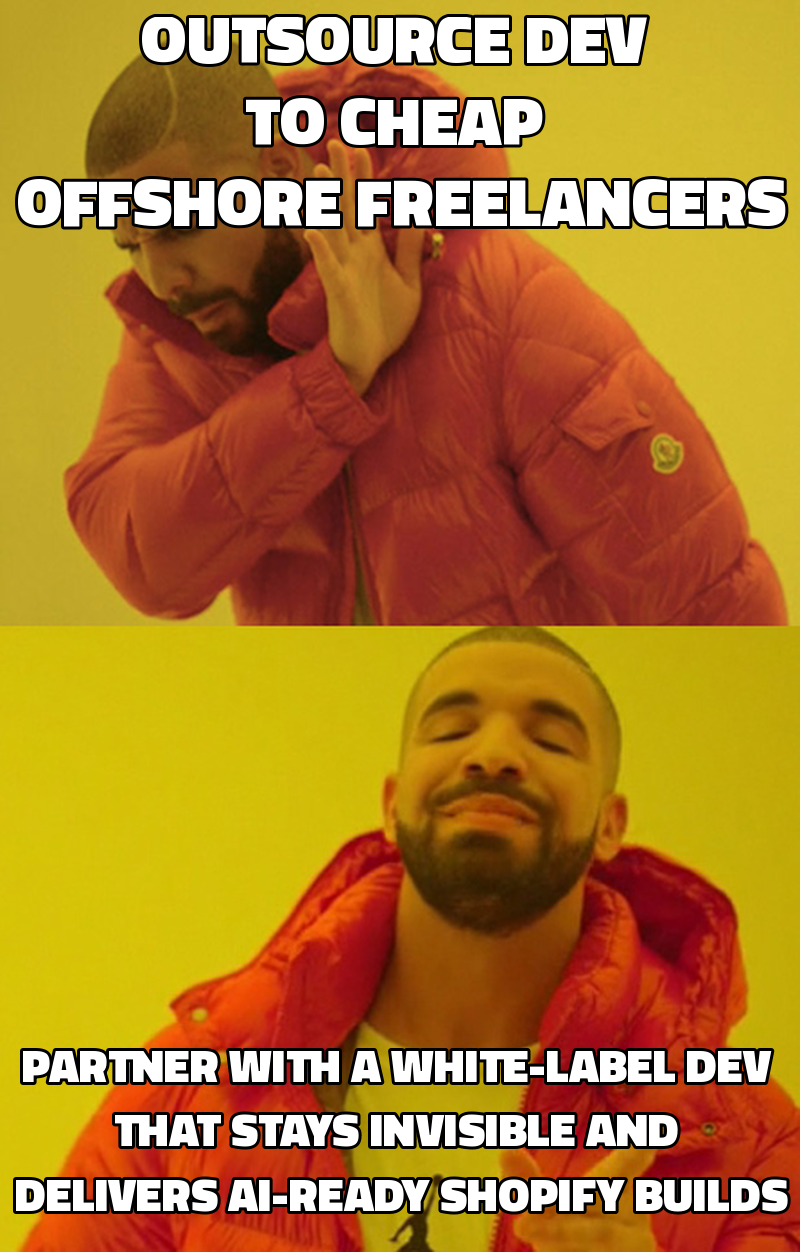
| Relying on cheap offshore freelancers | Quality issues, missed deadlines | Position your white-label partner as a premium, AI-ready alternative |
Real-world example: RouteMate
Synthisia’s own RouteMate SaaS was built for a client in 4 weeks, using a fixed-scope $4,500 wholesale budget. The agency billed $7,200, kept a 60% margin, and now retains a $1,800 monthly retainer for feature upgrades. The case demonstrates how a single pilot can evolve into a recurring revenue stream.
How to pitch the white-label model to your agency prospects
- Start with the pain. “You’re turning away Shopify projects because you lack dev capacity, losing $5k-$15k per client.”
- Introduce the invisible partner. Explain that the client never sees the dev team, preserving the agency’s brand.
- Show the financial upside. Use the markup calculator: Wholesale $3,800 → Client price $5,800 = $2,000 profit per project.
- Demonstrate reliability. Share SLA metrics: 98% on-time delivery, 0% post-launch bugs (internal data, Q2 2024).
- Offer the pilot. “Let’s start with a $1,500 scoped prototype of a product-recommendation bot. If you like the quality, we’ll lock in a full-store build.”
Checklist for agencies before signing a white-label partner
- Verify the partner’s NDA and non-circumvent clause.
- Review a recent case study that matches your client’s industry.
- Confirm the partner’s average turnaround (e.g., 2-3 weeks for a starter build).
- Ask for a single point of contact and a shared dashboard demo.
- Ensure the partner can handle AI/voice automation – a differentiator for SMBs.
- Align on change-order pricing and escalation process.
Bottom line
White-label Shopify development lets agencies expand their service catalog without hiring engineers, keep the client relationship, and earn 50-70% margin on each project. By breaking down costs, choosing the right pricing model, and protecting scope with a pilot and clear SLA, you can quote confidently, win more work, and turn occasional overflow into a steady retainer stream.
Frequently asked questions
How much does a typical Shopify theme customization cost?
A basic custom theme for a mid-size retailer usually falls between $1,200-$2,000 wholesale. Agencies often bill $2,000-$3,500, depending on branding complexity and third-party app integration.
Can I charge my client a higher markup than 70%?
Yes, but only if you add extra value such as ongoing optimization, SEO, or exclusive AI features. Most agencies stay under 70% to remain competitive against boutique dev shops.
What if the client wants a Shopify Plus store?
Shopify Plus implementations start around $12,000 wholesale. You can offer a phased approach: core store for $5,000-$7,000, then add Plus features in later phases with separate retainers.
How do I protect my brand when the dev partner is invisible?
Use a strict NDA, a non-circumvent clause, and a single point of contact who signs all deliverables under your agency’s name. The client never sees the partner’s branding.
What if scope creep happens after the project starts?
Include a change-order clause in every proposal: any new feature beyond the original scope is billed at the agreed hourly rate (e.g., $150/hr wholesale). This keeps margins intact.
Are there any hidden costs I should watch for?
Third-party app subscriptions, Shopify transaction fees for Plus plans, and optional AI API usage (OpenAI costs $0.02-$0.12 per 1k tokens) should be disclosed upfront in the proposal.
How quickly can a white-label partner deliver a pilot?
Most partners, including Synthisia, can deliver a scoped prototype in 7-10 business days for a $1,500 pilot, giving agencies a fast win to show the client.
Do I need to manage the dev partner’s workload?
No. The partner provides a shared dashboard and a dedicated account manager who handles scheduling, so you focus on client communication and upsell.
Shopify
Have something to build?
Tell us what you're trying to ship. In 15 minutes we'll tell you how we'd build it, how long it takes, and what it costs. No pitch deck, no pressure.