
How Agencies Can Build a Branded White-Label Delivery App Without Hiring Developers

A white-label delivery app is a fully branded, ready-to-launch mobile or web app that you can sell to your client under your agency’s name without writing any code yourself. It lets you answer every "Can you build a delivery platform?" request, keep the margin, and protect your brand while the technical work stays invisible.
Key takeaways
- White-label delivery apps let agencies keep the client relationship and margin while outsourcing all code.
- Start with a fixed-scope pilot (US$1,500-5,000) to prove reliability before moving to retainer work.
- Choose a partner that can add AI automation, voice ordering, and PCI-DSS compliant payments – capabilities no-code tools alone cannot provide.
- Use a shared project dashboard to give your client real-time visibility without exposing the dev partner.
- Follow a 7-step end-to-end process: discovery, scoping, UX/UI, backend, AI/voice, testing, deployment, handover.
- Evaluate partners with a criteria table (cost, speed, tech stack, compliance, support) to avoid hidden risks.
What is a white-label delivery app and why agencies need it?
A white-label delivery app is a pre-built, fully customizable solution that you re-brand with your agency’s logo, colors, and domain. The underlying code lives with the development partner, but the client only sees your brand. This model solves three core pains for 5-15 person agencies:
- Lost revenue – agencies often turn away delivery-app requests because they lack dev capacity.
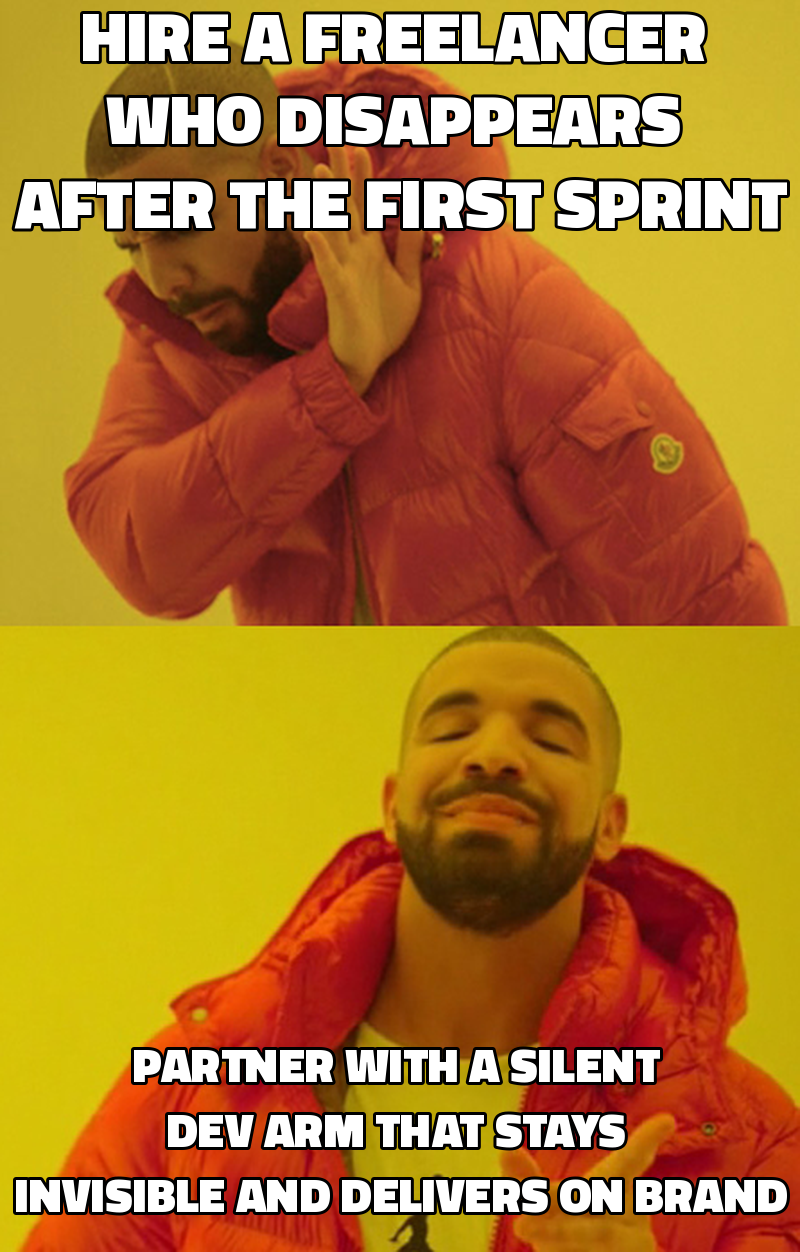
- Brand risk – clients worry about a third-party being visible; a white-label partner stays invisible under an NDA.
- Scope uncertainty – a fixed-scope pilot gives a clear timeline and price, eliminating guesswork.
According to a 2023 Gartner survey, 62% of SMBs plan to add on-demand delivery services in the next 12 months, meaning the demand curve is steep for agencies that can answer quickly.
End-to-end development process
Below is the exact workflow we use at Synthisia (the Silent Dev Arm) to deliver a white-label delivery app from first call to client hand-over.
1. Discovery call and pain validation
- Ask the agency’s client-facing leader (Founder, COO, Head of Delivery) to describe the delivery use case, geographic coverage, and required integrations (payment, POS, SMS).
- Capture the Live Need gate: is there a project that needs to start within 2-4 weeks?
- Document regulatory constraints: PCI-DSS for payments, GDPR for EU customers, and local food-service licensing if applicable.
2. Fixed-scope pilot proposal
Create a scoped proposal that includes:
- Core features (order catalog, cart, checkout, driver tracking, admin dashboard).
- One AI automation (e.g., predictive reorder suggestions) and one voice ordering flow (Google Dialogflow or Amazon Lex).
- Timeline: 3-4 weeks for MVP, 1 week for client review, 1 week for revisions.
- Pricing: US$1,500-5,000 depending on feature count, plus a 30-day money-back guarantee if milestones are missed.
Pro tip: Use the "Pilot → Retainer" model. Once the pilot succeeds, propose a monthly retainer of US$1,500 for 15-20 dev hours of ongoing escalation.
3. UX/UI design under your brand
- Deliver wireframes in Figma with your agency’s style guide.
- Include brand assets (logo, color palette) so the client never sees the dev partner’s logo.
- For agencies that use Webflow or Sketch, provide editable components to keep the design loop fast.
4. Backend architecture selection
| Layer | Recommended Tech | Why it fits agencies |
|---|---|---|
| Mobile/Web Front-end | React Native (iOS/Android) or Flutter | Single codebase, fast iteration, easy to re-brand |
| API & Business Logic | Node.js on AWS Lambda + Express | Pay-as-you-go, scales with spikes, no server maintenance |
| Database | Firebase Firestore (NoSQL) | Real-time sync, low admin overhead |
| Payments | Stripe Connect (PCI-DSS) | Global support, easy onboarding for SMBs |
| Messaging | Twilio SMS/WhatsApp | Reliable driver-client communication |
| AI/Automation | Google Dialogflow CX + custom Python micro-services | Voice ordering and recommendation engine without building ML from scratch |
The stack is deliberately cloud-native so the partner can spin up environments in minutes, and the agency never worries about server patches.
5. AI automation and voice ordering
- Predictive reorder: Use Dialogflow intents to capture “I want my usual” and a lightweight TensorFlow.js model hosted on Google Cloud Functions to suggest items based on past orders.
- Voice ordering: Integrate Amazon Lex for US/UK English, map intents to the same order API, and return confirmation via Twilio voice call.
- Document compliance: store voice recordings for 30 days only, encrypt at rest, and delete on request to meet GDPR.
6. QA, security, and compliance testing
- Run automated unit tests with Jest (frontend) and Mocha (backend).
- Conduct a PCI-DSS Level 1 self-assessment checklist for the Stripe integration.
- Perform a GDPR data-mapping exercise: list personal data fields, define retention policies, and add a “Delete My Data” endpoint.
- Use BrowserStack for cross-device testing on iOS 14-16, Android 11-13, and major browsers.
7. Deployment and client hand-over
- Deploy the mobile app to Apple App Store and Google Play under the agency’s developer account (you provide the credentials).
- Host the admin web portal on Vercel with a custom domain (admin.youragency.com).
- Provide a Project Dashboard (Google Data Studio or Notion) that shows sprint progress, build version, and open bugs. The dashboard is shared with the agency’s COO and the client’s project manager.
- Conduct a 2-hour training session for the agency’s operations team on how to add new menu items, manage drivers, and view analytics.
Pricing and partnership model
| Item | Agency pays Synthisia | Agency charges client |
|---|---|---|
| Fixed-scope pilot | US$1,500-5,000 (50-70% of client bill) | US$3,000-8,000 (covers margin, branding, project mgmt) |
| Monthly retainer | US$1,500 for 15-20 hrs | US$2,500-3,500 (adds value-added support) |
| Overage (per hour) | US$120 | US$180 |
The wholesale rate ensures the agency keeps at least 30% gross margin while the partner retains enough to cover senior dev time and compliance work.
How to evaluate a white-label partner
| Criterion | What to ask | Red flag |
|---|---|---|
| Technical depth | Can you build AI-driven voice ordering and integrate Stripe Connect? | Only no-code tools listed |
| Compliance experience | Have you completed PCI-DSS Level 1 or GDPR audits? | No documented compliance |
| Turnaround speed | What is your average time from scoping to MVP? | > 8 weeks for a simple catalog |
| Ownership model | Do you sign NDAs and non-circumvent agreements? | Refuses legal contracts |
| Post-launch support | How many hours of bug-fix support are included per month? | “Support on request only” |
Select a partner that scores green on all rows; otherwise you risk hidden delays or compliance breaches.
Implementation checklist (downloadable PDF optional)
| Phase | Deliverable | Owner | Due |
|---|---|---|---|
| Discovery | Completed questionnaire, regulatory checklist | Agency Lead | Day 1 |
| Scoping | Fixed-scope pilot contract, signed NDA | Synthisia | Day 3 |
| Design | Figma wireframes, brand guide applied | Agency Design Lead | Day 7 |
| Development | Code repo (GitHub), CI/CD pipeline set up | Synthisia Dev Team | Day 21 |
| AI/Voice | Dialogflow intents, Lex bot, test scripts | Synthisia AI Engineer | Day 24 |
| QA | Test report, security audit, compliance sign-off | QA Lead | Day 28 |
| Deployment | App Store submission, admin portal live | Synthisia Ops | Day 30 |
| Handover | Training deck, project dashboard access | Agency PM | Day 31 |
Real-world case study: RouteMate
RouteMate, a logistics SaaS built for Australian food-delivery startups, was delivered in 6 weeks using the same stack. The agency that sold it kept the brand, billed the client US$12,000, and paid Synthisia US$5,500 – a 54% margin. The client praised the seamless voice ordering feature, and the agency added a retainer for quarterly feature upgrades.
Frequently asked questions
How long does a white-label delivery app take to launch?
A typical MVP takes 4-6 weeks from signed pilot to live app, assuming the agency provides brand assets and payment credentials within the first week. Complex AI flows or multi-region compliance can add 1-2 weeks.
What if the client wants a native iOS-only app?
We use React Native, which compiles to native iOS and Android binaries from the same codebase. If the client insists on a pure Swift app, the cost rises by roughly 30% and the timeline adds 2 weeks.
Can we keep the source code for future tweaks?
The partner retains the master repository under a joint-ownership agreement. The agency receives a read-only branch for audit purposes and can request feature branches under the retainer.
How do we protect our brand from being exposed?
All deliverables are water-marked with the agency’s logo. The NDA covers all code, documentation, and communication. The partner never contacts the client directly unless the agency invites them.
What compliance certifications are required for payments?
Stripe Connect handles PCI-DSS compliance for you, but you still need to store no raw card data. For EU clients, ensure GDPR consent dialogs are present and provide a data-deletion endpoint.
What happens if the pilot goes over budget?
The pilot contract includes a fixed-price cap. Any work beyond the agreed scope is quoted separately before execution, so the agency never faces surprise invoices.
Is there a minimum project size?
We set a US$1,500 floor because the overhead of onboarding, compliance checks, and project management exceeds smaller amounts. Projects below that are better served by a no-code platform.
How do we scale from one pilot to a long-term partnership?
After the pilot, propose a monthly retainer that covers 15-20 dev hours for bug fixes, minor feature requests, and quarterly AI model updates. This creates predictable cash flow and keeps the partner’s capacity dedicated to your agency.
Ready to say yes to every delivery-app request? Contact Synthisia for a pilot proposal and start turning missed opportunities into recurring revenue.
white‑label
Have something to build?
Tell us what you're trying to ship. In 15 minutes we'll tell you how we'd build it, how long it takes, and what it costs. No pitch deck, no pressure.