
White-Label Casino Software Development: Compliance, Security, and Revenue Insights for Agency Leaders

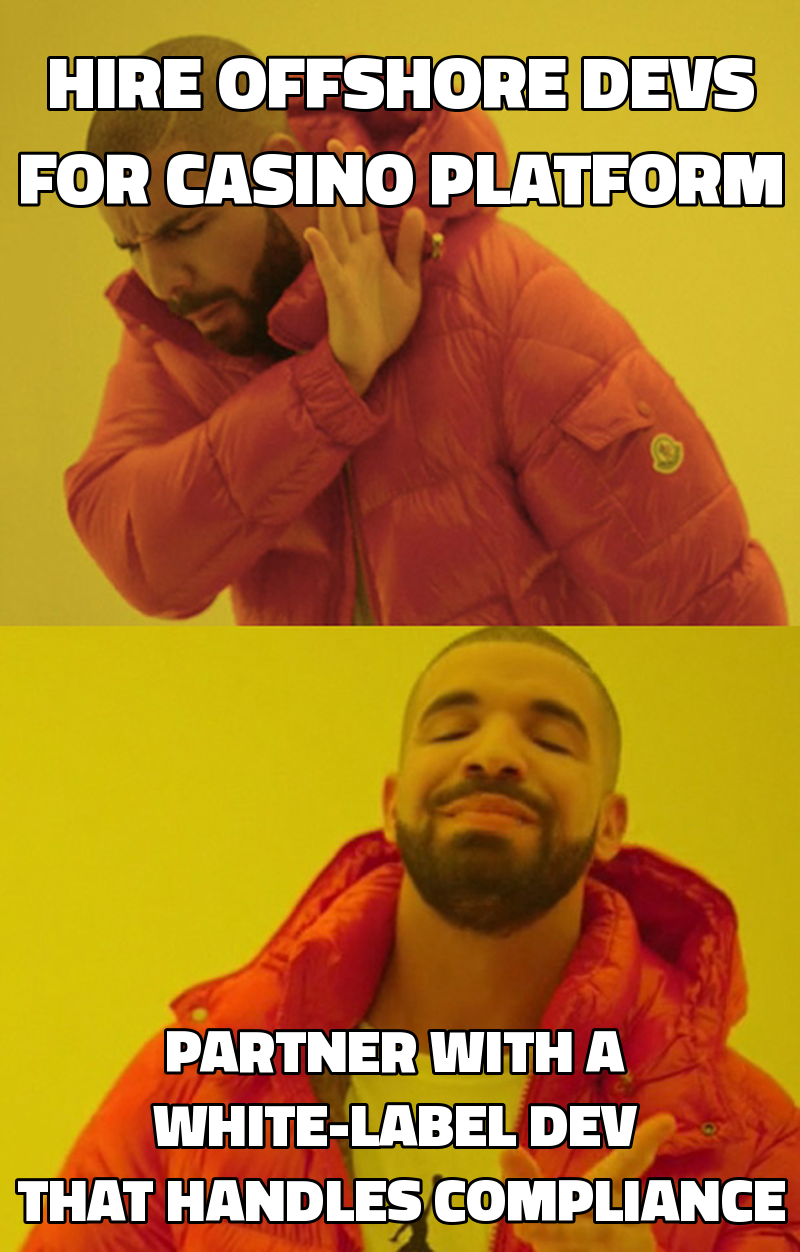
White-label casino software development is a partnership where a specialist provider builds and hosts the gambling platform under the agency’s brand, handling licensing, security, and ongoing operations.
Key takeaways
- White-label partners assume licensing with regulators such as the UK Gambling Commission, Malta Gaming Authority, and Curacao eGaming.
- PCI DSS and ISO 27001 compliance are non-negotiable for protecting player payment data.
- Agencies typically retain 50-70% of the client bill, translating to $1,500-$3,500 profit per $5,000-$10,000 project.
- Fixed-scope pilots de-risk the relationship and prove delivery speed before a retainer is added.
- Choosing a partner with AI-driven automation and voice integration differentiates the agency’s service offering.
What is white-label casino software development?
White-label casino software development means a third-party technology firm creates a complete gambling platform, games library, back-office, payment gateway, and compliance layer, while the agency markets it as its own solution. The agency keeps the client relationship, sets the price, and collects the margin. The provider remains invisible, protected by NDA and non-circumvent clauses.
Why agencies consider outsourcing casino platforms
| Reason | Typical agency pain | White-label benefit |
|---|---|---|
| Lack of dev talent | No in-house engineers, high hiring cost | Partner delivers full stack under agency brand |
| Regulatory complexity | Need licences from UKGC, MGA, etc. | Partner already holds licences and compliance processes |
| Security obligations | PCI DSS audits expensive for small firms | Provider maintains ISO 27001 and regular penetration testing |
| Revenue ceiling | Turning away build requests loses margin | Retain 50-70% of project value, add recurring retainer |
| Brand protection | Clients fear outsourcing | NDA ensures agency stays front-face, partner stays hidden |
How compliance works in a white-label model
Compliance is the most regulated part of online gambling. A white-label partner must:
- Hold a primary gambling licence in a jurisdiction accepted by the target market (e.g., UKGC for UK players, MGA for EU, Curacao for global reach).
- Implement responsible-gaming tools required by the regulator, such as self-exclusion lists and age verification APIs.
- Conduct regular AML (anti-money-laundering) checks and report suspicious activity to the appropriate authority.
- Maintain audit trails for every financial transaction, which are reviewed during regulator inspections.
Regulator snapshot
- UK Gambling Commission (UKGC) – Requires a UK licence, annual compliance fees of £2,000-£5,000, and strict advertising standards.
- Malta Gaming Authority (MGA) – Offers a European-wide licence, annual fee of €8,000, and a 5-year renewal cycle.
- Curacao eGaming – Lower cost, €2,500-€3,500 annual fee, but limited to markets that accept Curacao licences.
Security standards you cannot ignore
A casino platform processes thousands of payment cards daily. The following standards are mandatory:
- PCI DSS Level 1 – Annual on-site audit, quarterly network scans, and tokenisation of card data.
- ISO 27001 – Information security management system, covering data encryption at rest and in transit.
- OWASP Top 10 – Regular code reviews to mitigate injection, broken authentication, and other web-app risks.
- DDoS mitigation – Providers typically use Cloudflare Spectrum or Akamai Kona Site Defender to absorb traffic spikes.
Revenue considerations and pricing models
Agencies can choose between two primary pricing structures when working with a white-label partner:
| Model | Agency cash flow | Partner risk | Typical margin |
|---|---|---|---|
| Fixed-scope pilot (e.g., $3,000 project) | Up-front payment from client, low ongoing cost | Provider builds to spec, limited support | 50-70% retained by agency |
| Ongoing dev retainer (e.g., $1,500/month) | Predictable monthly expense, supports multiple projects | Continuous capacity commitment | 60-80% retained over time |
Example profit calculation
- Client pays $7,500 for a custom casino portal.
- Partner charges $3,500 wholesale.
- Agency retains $4,000, which is a 53% margin before internal overhead.
- Adding a $1,500 retainer for post-launch support can push total margin above 70% on recurring revenue.
Choosing the right white-label partner
When evaluating a partner, agencies should score them on three pillars: compliance, technology depth, and reliability.
| Pillar | Evaluation criteria | Minimum acceptable score |
|---|---|---|
| Compliance | Holds UKGC or MGA licence, PCI DSS Level 1, ISO 27001 certification | Yes |
| Technology | Supports AI-driven game recommendations, voice-activated betting, and API-first architecture (REST/GraphQL) | Yes |
| Reliability | SLA ≤ 99.5% uptime, average bug-fix turnaround ≤ 48 hours, reference clients in the US/UK/AU | Yes |
Red flags
- No documented licences or security certifications.
- Promises “fastest delivery possible” without a defined turnaround band.
- Offers a free first deliverable that is a full-scale prototype – this usually signals low perceived value.
The pilot approach: de-risking the partnership
- Scope definition – Agree on a single feature set (e.g., user registration, wallet integration, and three slot games). Limit the scope to 150-200 development hours.
- Fixed price – Set a price between $2,500-$5,000, matching the agency’s typical project range.
- Timeline – Commit to a 4-week delivery window, with a 2-day buffer for QA.
- Success metrics – Completion of all acceptance criteria, zero critical bugs, and compliance checklist sign-off.
- Retainer offer – After pilot sign-off, propose a $1,500-$2,000 monthly retainer for ongoing updates, new game integrations, and regulatory renewals.
Common risks and how to mitigate them
| Risk | Impact | Mitigation |
|---|---|---|
| Regulatory change mid-project | Licence may need amendment, causing delays | Partner maintains a regulatory watch service, informs agency of upcoming changes |
| Security breach | Loss of player data, fines, brand damage | Partner enforces PCI DSS, conducts quarterly penetration tests, provides incident response plan |
| Scope creep | Margins erode, timeline slips | Fixed-scope pilot, change-order process with hourly rate for extra work |
| Partner over-commitment | Delivery delays, flaky reputation | Cap active partners at 12, enforce SLA, monitor capacity dashboard |
Real-world case study: RouteMate’s white-label success
RouteMate, a SaaS workflow automation platform, partnered with Synthisia to launch a white-label casino solution for a UK-based digital agency. Within 6 weeks they delivered a fully licensed platform (UKGC), integrated Stripe and PayPal for payments, and added voice-activated betting using Amazon Alexa. The agency kept the client relationship, billed $9,200, and paid Synthisia $3,600. The margin was 61%, and the agency secured a $1,800 monthly retainer for ongoing game updates.
Frequently asked questions
How long does it take to get a gambling licence?
Licencing timelines vary: UKGC can take 6-12 months for a full licence, while Curacao can issue a licence in 4-6 weeks. A white-label partner that already holds a licence can launch the platform instantly under their umbrella.
What games can I offer without building them myself?
Most partners provide a library of ready-made slots and table games from providers like Microgaming, NetEnt, and Evolution Gaming. Custom game development is an add-on that typically starts at $8,000 per title.
Do I need to host the platform myself?
No. The white-label provider hosts the platform on a PCI-DSS-certified cloud (AWS or Azure) and handles scaling, backups, and DDoS protection.
How is revenue split calculated?
Agencies set the client price, then pay the partner a wholesale rate (usually 30-50% of the client bill). The remaining amount covers agency margin, internal costs, and profit.
Can I brand the platform fully?
Yes. White-label solutions allow full white-labeling of UI, domain, and marketing assets. The partner’s logo remains hidden in compliance reports only.
What happens if a regulator fines the platform?
The partner’s licence is the legal entity responsible for compliance. However, contracts typically include indemnification clauses protecting the agency from regulatory penalties.
Is ongoing support included?
Most partners include 30-day post-launch support in the pilot price. Ongoing updates, new game integrations, and regulatory renewals are covered under a monthly retainer.
How do I ensure data privacy for EU players?
Choose a partner that hosts data in the EU or UK and complies with GDPR. ISO 27001 certification is a strong indicator of proper data handling.
white‑label
Have something to build?
Tell us what you're trying to ship. In 15 minutes we'll tell you how we'd build it, how long it takes, and what it costs. No pitch deck, no pressure.