
White-Label Casino Software Development: A Practical Guide for Marketing Agencies

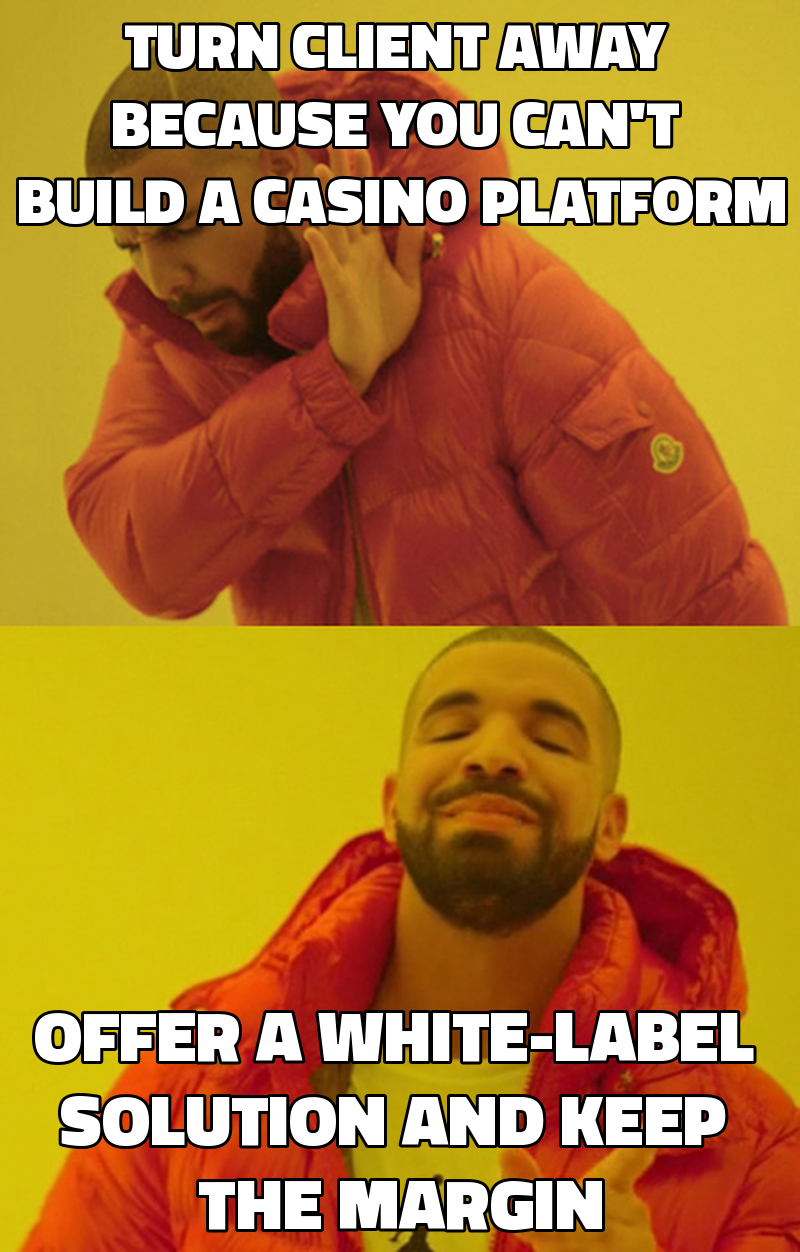
White label casino software development is a service where a specialist tech studio builds a complete gambling platform that agencies sell under their own brand, while the studio remains invisible to the end client. It lets agencies answer client requests for online slots, sports betting or live dealer rooms without hiring developers or obtaining a gaming licence themselves.
Key takeaways
- White-label casino platforms are fully branded, hosted and maintained by the tech partner, giving agencies a ready-to-sell product.
- Regulatory compliance varies by jurisdiction; the UK, Malta and Curacao are the most common licences for English-language markets.
- Agencies keep the client relationship and margin, typically earning 50-70% of the wholesale price.
- A fixed-scope pilot project builds trust and proves delivery speed before committing to larger builds.
- Single point of contact and a shared project dashboard reduce coordination friction.
- AI-driven automation, voice assistants and custom back-ends differentiate a white-label partner from cheap offshore freelancers.
What exactly is white-label casino software development?
White-label casino software development is a business-to-business model where a development studio creates a gambling platform – including game libraries, payment gateways, KYC/AML tools and compliance reporting – and licenses it to an agency. The agency markets the platform as its own, sets the price for the end client and retains the margin. The tech partner handles all technical work, security patches, regulatory updates and hosting. For agencies that lack in-house engineers, this model turns a capability gap into a revenue stream.
Why agencies are suddenly interested in casino platforms
The online gambling market grew 12% year-over-year in 2023 according to Statista, and the UK Gambling Commission estimates that UK-based online betting revenue will exceed £14 billion by 2025. Small and mid-size marketing agencies see two forces driving demand:
- Existing clients in retail, hospitality or fintech ask for loyalty-driven betting experiences to increase engagement.
- New client acquisition funnels – SEO agencies can rank for high-intent keywords like "online casino software" and capture leads without building a product themselves. Because the average build cost for a custom casino platform ranges from $5,000 to $30,000 (Gambling Compliance, 2022), agencies can earn a healthy margin on projects that would otherwise be out of reach.
Regulatory landscape for white-label casino platforms
Regulation is the biggest hurdle for any gambling product. Agencies must understand the licence that underpins the white-label solution because the licence determines:
- Which markets the product can be offered in.
- Required player protection features such as age verification and responsible-gaming tools.
- Tax and revenue-share obligations.
| Jurisdiction | Licence Type | Typical Cost (USD) | Time to Issue | Key Restrictions |
|---|---|---|---|---|
| United Kingdom (UKGC) | Full gambling licence | $150,000-$200,000 | 6-12 months | Strict AML, advertising standards, mandatory self-exclusion |
| Malta (MGA) | Remote gambling licence | $100,000-$130,000 | 4-8 months | Requires local server, EU data-protection compliance |
| Curacao | Master licence (sub-licence model) | $30,000-$45,000 | 2-4 weeks | Limited player protection enforcement, not accepted by all banks |
| Gibraltar | Remote gambling licence | $120,000-$160,000 | 5-9 months | Strong financial stability requirements |
According to the UK Gambling Commission, operators must conduct ongoing compliance checks at least quarterly, and failure to do so can result in fines up to 10% of annual revenue. Agencies should verify that the white-label partner maintains an active licence and provides audit reports.
How a white-label partnership creates agency profit
The financial flow works like this:
- The agency signs a wholesale agreement with the development studio. The studio charges a fixed price per project (e.g., $4,000 for a basic slot integration) plus a monthly retainer for ongoing support.
- The agency invoices the end client at a marked-up rate (often $6,000-$9,000) and retains the difference.
- The studio remains invisible; the agency’s brand appears on the player portal, marketing materials and support emails.
A typical margin range of 50-70% is realistic when the agency sells a $5,000 build for $8,000 and the studio’s wholesale cost is $3,500. The retainer model (e.g., $1,500 per month for 15-20 dev hours) adds recurring revenue and deepens the relationship.
Choosing the right white-label provider – criteria checklist
| Criterion | What to look for | Why it matters |
|---|---|---|
| Licensed jurisdiction | UKGC, MGA or Curacao with a reputable sub-licence | Guarantees legal operation in target markets |
| Game library breadth | At least 100 slot titles, live dealer feed, sports betting API | Allows agencies to tailor offerings to client needs |
| AI and automation capability | Built-in chatbot, voice-assistant, dynamic bonus engine | Differentiates the agency from generic white-label competitors |
| SLA and uptime guarantee | 99.5% uptime, 24/7 support SLA | Reduces risk of downtime during high-traffic events |
| Transparent pricing | Fixed-scope pilot cost, clear retainer rates | Enables accurate quoting for clients |
| Branding flexibility | White-label skin, custom domain, agency-specific UI | Maintains agency’s brand integrity |
| Integration ecosystem | Ready connectors for Stripe, PayPal, Adyen, KYC providers | Speeds up go-live and reduces custom dev effort |
Integration and branding considerations for agencies
When the platform is delivered under the agency’s brand, several technical and design steps are required:
- Domain mapping: The white-label partner should allow the agency to point a custom domain (e.g., casino.youragency.com) to the hosted environment.
- Brand assets: Upload logo, colour palette and UI text through a branding portal. The partner should expose these settings via an admin UI.
- Compliance widgets: Ensure the agency can embed responsible-gaming pop-ups, self-exclusion links and age-gate screens that match the agency’s design language.
- Analytics: Integration with Google Analytics 4 and Mixpanel enables the agency to report ROI to the client.
- Support hand-off: The studio handles technical incidents, while the agency’s client-services team fields player queries using a shared ticketing system.
Pricing and margin model for agencies
Below is a simple pricing calculator that agencies can adapt for proposals:
Base wholesale cost (fixed scope) = $4,200
Add-ons (e.g., custom bonus engine) = $800 per feature
Retainer (monthly) = $1,500 for 15-20 dev hrs
Agency markup = 60%
---
Client invoice = $4,200 * 1.60 = $6,720 (base project)
Add-on example (2 features) = $1,600 * 1.60 = $2,560
Monthly retainer invoice = $1,500 * 1.60 = $2,400
Total first-month revenue = $11,680
Agency gross profit = $6,720 + $2,560 + $2,400 - $4,200 - $1,600 - $1,500 = $5,180
The model shows that even with modest add-on usage, the agency can exceed a 50% gross margin while delivering a high-value product.
Real-world snapshot: a pilot that turned into a retainer
Client: A UK-based health-and-wellness brand wanted a gamified loyalty program with a slot-style game that awarded points redeemable for products. Pilot: Synthisia delivered a single custom slot (one-week development, $3,500 wholesale) under the agency’s brand. The pilot launched in 10 days, met UKGC KYC standards and generated 1,200 unique players in the first month. Result: The agency billed the client $5,800, kept $2,300 profit, and signed a 6-month retainer for ongoing feature upgrades ($1,500 per month). The partnership expanded to include a live-dealer feed for a seasonal promotion, adding $4,200 in additional revenue.
Step-by-step guide to launch a white-label casino project
- Identify client demand – Use the qualification gate checklist (volume, budget, live need). Verify the client’s target market and required licence.
- Select a licensed white-label partner – Apply the criteria table above; request a copy of the licence and compliance audit.
- Run a fixed-scope pilot – Define deliverables (e.g., one slot game, payment integration) and a turnaround band (e.g., 10-14 business days). Sign an NDA and a pilot contract with a clear payment schedule.
- Brand the platform – Provide logo, colour codes, custom domain and any regulatory copy required for the jurisdiction.
- Integrate payments and KYC – Choose from Stripe, Adyen or local e-wallets; integrate a KYC provider like Jumio that the white-label partner supports.
- Test compliance – Run a sandbox audit with the partner’s compliance team; generate a compliance report for the client.
- Launch and monitor – Use the shared project dashboard to track deployment status, uptime and player metrics.
- Offer ongoing support – Propose a retainer for feature enhancements, AI-driven bonus personalization and voice-assistant integration.
- Report ROI – Provide the client with player acquisition numbers, average revenue per user (ARPU) and responsible-gaming compliance stats.
Common pitfalls and how to avoid them
| Pitfall | Impact | Prevention |
|---|---|---|
| Choosing a partner without a solid licence | Legal shutdown, fines | Verify licence number, request regulator’s public register entry |
| Under-estimating integration time | Missed launch dates, client dissatisfaction | Use a fixed turnaround band, add a buffer of 20% for unknowns |
| Allowing the partner to be visible to the client | Brand dilution, client poaching | Include NDA and non-circumvent clause; use white-label branding portal |
| Relying on cheap offshore developers for custom features | Low quality, missed compliance | Keep AI/automation and voice work in-house or with a vetted partner like Synthisia |
| Ignoring responsible-gaming requirements | Regulatory penalties, reputational risk | Implement age-gate, self-exclusion and loss-limit tools as mandatory UI components |
Frequently asked questions
What is the difference between a white-label casino platform and a turnkey solution?
A white-label platform is fully re-brandable and hosted by the developer, while the agency sells it under its own name. A turnkey solution is a ready-made product that the agency resells without any branding changes, often limiting the agency’s ability to differentiate.
Do I need a gambling licence to sell a white-label casino?
No, the licence belongs to the development studio. However, the agency must ensure the partner’s licence covers the jurisdictions where the end client will operate and must keep compliance documentation on file.
How long does it take to get a casino platform live?
Typical turnaround for a fixed-scope pilot is 10-14 business days after branding assets are provided. Full-scale launches with multiple games and payment providers usually take 6-8 weeks.
Can I offer sports betting alongside slots?
Yes, if the white-label partner provides a sports-betting API and holds the appropriate licence (UKGC or MGA). Each vertical may require separate compliance checks.
What kind of support does the white-label partner provide?
Most partners offer 24/7 technical support, SLA-backed uptime guarantees and regular security patches. Client-facing support is usually handled by the agency, but the partner can provide a shared ticketing portal.
How do I protect my margin from the partner undercutting me?
Negotiate a fixed wholesale rate and a minimum floor price per project. Include a non-circumvent clause in the contract and monitor the partner’s pricing for other agencies.
Is AI automation really a differentiator for casino platforms?
Yes. AI can power dynamic bonus engines, real-time player segmentation and voice-assistant betting. Agencies that bundle these features can charge premium rates compared to generic slot bundles.
What are the ongoing costs after the initial build?
Monthly retainer fees cover bug fixes, regulatory updates, new game integrations and AI model tuning. Expect $1,200-$2,000 per month for a modest 15-20 hour support window.
white-label
Have something to build?
Tell us what you're trying to ship. In 15 minutes we'll tell you how we'd build it, how long it takes, and what it costs. No pitch deck, no pressure.