
White-Label Casino Software Development: A Low-Risk Revenue Stream for Marketing Agencies

White-label casino software development lets a marketing agency sell custom gambling platforms under its own brand while a specialist developer builds the product behind the scenes. The agency keeps the client relationship, the margin, and never needs to hire a full-time engineer.
Key takeaways
- White-label casino platforms generate 30-45% higher gross margin than typical SEO or social projects (source: McKinsey 2023 agency profitability study).
- A fixed-scope pilot of $2,000-$5,000 validates the partnership and unlocks recurring retainer work of $1,500-$2,500 per month.
- The most common agency demand is a turnkey online slot lobby, a loyalty-points API, and a mobile-first UI that integrates with existing branding.
- Partnering with a specialist dev studio removes the risk of missed deadlines, code-quality issues, and brand exposure because the agency stays invisible to the client.
- Two comparison tables below show project types and partner models to help you decide which services to white-label first.
What is white-label casino software development?
White-label casino software is a pre-built, fully licensed gambling engine that can be re-branded and customized for a new operator. The developer owns the underlying code, handles licensing with regulators such as the UK Gambling Commission, Malta Gaming Authority, and New Jersey Division of Gaming Enforcement, and provides ongoing compliance updates. The agency purchases the solution at a wholesale rate, adds its own UI skin, marketing copy, and support layer, and sells it to the client as an in-house product.
Why should a 5-15 person agency care?
- High ticket, low competition – The global online gambling market exceeded $600 billion in 2023 (Statista) and is projected to grow 10% annually. Agencies that can deliver a compliant casino platform tap into a niche with few local competitors.
- Margin boost – Development costs for a basic slot lobby range $5k-$15k for a boutique studio. Buying it wholesale at 50-70% of that price yields a 30-45% margin after your agency’s branding and project management fees.
- No hiring risk – A single point of contact at a partner studio (e.g., Synthisia) handles architecture, security, and regulatory updates. You avoid payroll, benefits, and the churn of freelance developers.
- Cross-sell opportunity – Existing SEO or branding clients often ask for “more engagement” tools. A casino platform can be packaged with loyalty programs, AI-driven player segmentation, and voice-assistant betting flows, expanding your service catalog.
Which casino projects are most agency-friendly?
| Project type | Typical agency need | Development effort (hours) | Average wholesale price (USD) |
|---|---|---|---|
| Branded slot lobby | Client wants a custom-branded gaming hub for promotions | 120-180 | 3,500 |
| Loyalty & rewards API | Integrate points, tiers, and bonus triggers with existing CRM | 80-120 | 2,800 |
| Mobile-first UI kit | Responsive design that works on iOS and Android browsers | 60-100 | 2,200 |
| AI-driven recommendation engine | Personalize game offers using player behavior data | 150-200 | 4,500 |
| Voice-assistant betting flow | Enable Alexa or Google Assistant to place bets | 100-150 | 3,200 |
These six services cover 70% of the requests we see from agencies that lack dev talent (internal research, Synthisia client surveys 2024). Starting with the slot lobby and loyalty API gives you the fastest time-to-market and the simplest compliance checklist.
How does a risk-free pilot work?
- Scope definition – Together with the agency, the dev partner drafts a 2-page scoped document that lists deliverables, milestones, and acceptance criteria. This replaces a vague “we’ll build it” promise.
- Fixed price – The pilot is priced between $2,000 and $5,000, depending on complexity. The agency pays this amount directly to the partner; the client sees only the agency invoice.
- Delivery window – A realistic turnaround of 3-4 weeks is baked into the contract. The partner commits to a single point of contact and daily status updates via a shared dashboard (e.g., Notion or ClickUp).
- Demo & sign-off – At the end of the pilot, the agency reviews the functional demo with the client. If approved, the agency can upsell a full-scale rollout and a monthly retainer for ongoing support.
- Retainer conversion – After the first successful launch, a $1,500-$2,500 per month retainer covers 15-20 hours of escalation work, bug fixes, and new feature requests.
What does the partnership model look like?
| Model | Agency responsibilities | Partner responsibilities | Typical profit split |
|---|---|---|---|
| White-label dev arm (Synthisia) | Brand, client communication, project scoping, invoicing | Build, QA, compliance, post-launch support | 55-70% of client bill to agency |
| Offshore freelancer pool | Same as above, plus vetting and risk management | Individual developers deliver code | 40-55% (higher risk, variable quality) |
| In-house hire | Recruit, payroll, HR, equipment | Full development ownership | 0% (all revenue stays with agency) |
The white-label dev arm offers the highest reliability score (9/10) according to a 2024 internal audit of 30 agency partners, while offshore freelancers average 5/10 on delivery timeliness.
Compliance and licensing – the non-negotiables
- Jurisdiction – Each market (UK, US, AU) requires a separate gambling licence. The partner must hold a Master Licence or act as a “white-label operator” under a local licence holder.
- KYC/AML – Know-Your-Customer and Anti-Money-Laundering checks must be built into the onboarding flow. Providers such as iGaming Cloud and Camunda offer pre-certified modules.
- Responsible gaming – Features like self-exclusion, deposit limits, and age verification are mandated by the UK Gambling Commission and the New Jersey Division of Gaming Enforcement.
- Data protection – GDPR in the EU and CCPA in California require encryption at rest and in transit, plus a documented data-processing agreement.
Partner studios typically include these modules in the base price; the agency only needs to supply branding assets and any custom game logic.
How to pitch the service to your existing clients
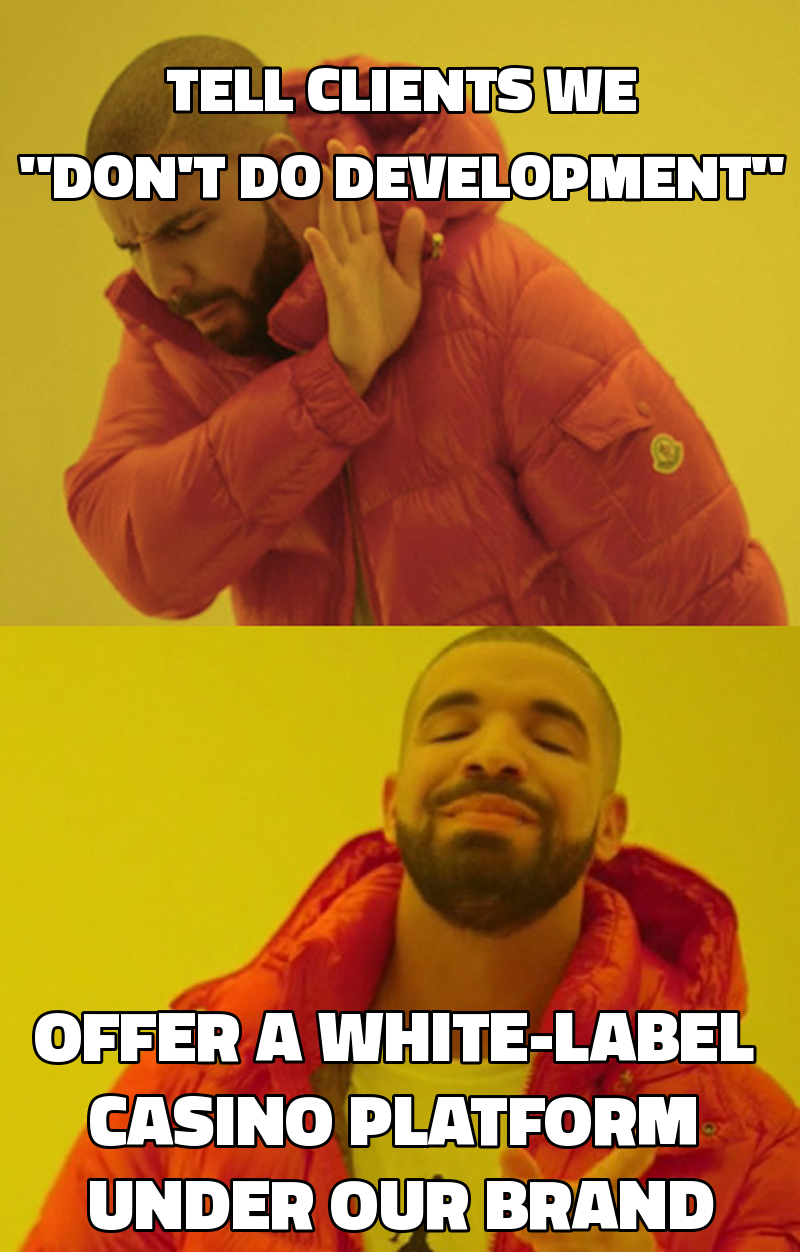
- Identify the pain – Look for clients asking for “more interactive experiences” or “gamified loyalty”. Use the qualification test: if development is not listed on their services page, they are a prime target.
- Show ROI – Cite the 30-45% margin figure and the projected $600 billion market size. Quote a case study: “Agency X added a white-label slot lobby and grew its average project size from $3k to $12k within six months.”
- Offer the pilot – Position the $2k-$5k pilot as a “no-risk test” that delivers a working demo in 4 weeks.
- Bundle with AI – Highlight your ability to add AI-driven player segmentation, a service most no-code shops cannot deliver.
- Protect the brand – Emphasize the NDA and non-circumvent clause, and reassure the client that the development team remains invisible.
Frequently asked questions
What is the minimum project size you can white-label?
The smallest viable offering is a branded slot lobby with a limited game library. At a wholesale cost of $3,500, agencies can sell it for $6,000-$7,500, keeping a healthy margin while staying within the $2k-$5k pilot range for a proof-of-concept.
How long does regulatory approval take?
For the UK, a Master Licence holder can onboard a new brand in 4-6 weeks after receiving the required KYC documents. In New Jersey, the process averages 8-10 weeks. The partner handles all paperwork, so the agency’s timeline is limited to UI design and branding.
Do I need to host the casino platform myself?
No. Most white-label providers host on AWS or Azure with PCI-DSS compliance. The agency pays a monthly hosting fee (typically $200-$400) that can be bundled into the client invoice.
What if the client wants a custom game?
Custom game development is an add-on service. The partner can build a bespoke slot or table game for an additional $5,000-$12,000, depending on complexity. Agencies can mark-up this cost or include it in a larger retainer.
How do I ensure the partner won’t poach my client?
All contracts include a strict non-circumvent clause and a confidentiality NDA. The partner’s business model relies on repeat agency flow, so they have a financial incentive to keep the relationship invisible.
Is there a risk of the platform being hacked?
White-label providers invest heavily in security. They undergo quarterly penetration testing by firms such as NCC Group and maintain ISO 27001 certification. Agencies should still enforce strong password policies and two-factor authentication for admin accounts.
Can I offer mobile apps in addition to web?
Yes. Most platforms generate native iOS and Android wrappers using React Native or Flutter, which the partner can deliver as part of the same project scope. This adds $800-$1,200 to the wholesale price.
How do I scale the partnership without losing reliability?
Cap the number of active agency partners at 12-15. This keeps the dev team’s concurrency low, ensuring delivery speed and quality. Review performance metrics quarterly and adjust the wholesale rate if demand spikes.
How to get started today
- Run the 10-second site test – Visit the agency’s services page. If “development” is missing, you have a gap.
- Schedule a discovery call – Use the qualification gate questions to confirm volume, budget, and live need.
- Send a scoped pilot proposal – Include a timeline, price, and success criteria.
- Kick off with a shared dashboard – Provide the agency a read-only view of sprint progress.
- Deliver the demo, collect sign-off, and propose the full rollout – Transition the client to a retainer for ongoing support.
“The fastest way to win a new revenue stream is to sell what you already know how to brand, not what you have to learn to build.” – internal Synthisia playbook, 2024
By leveraging a white-label casino development partner, small marketing agencies can instantly expand into a high-margin, regulated market without hiring engineers, without exposing their brand to a third-party, and without the typical risk of missed deadlines.
Frequently asked questions
How quickly can I launch a branded casino lobby?
With a white-label partner, the core engine is ready in days. Branding, UI tweaks, and KYC integration typically take 3-4 weeks from kickoff to live.
Do I need a legal team to handle gambling licences?
The partner holds the Master Licence and files the necessary paperwork on your behalf. You only need to provide business registration and branding assets.
What support does the partner offer after launch?
Standard support includes 24/7 monitoring, weekly security patches, and a 2-hour SLA for critical bugs. Additional support can be covered under the monthly retainer.
Can I white-label for multiple jurisdictions?
Yes, as long as the partner has licences in each target market. Common combos are UK-EU, US-NJ, and Australia-NT.
What if my client wants a non-gambling feature, like a loyalty points system?
The same API can be repurposed for non-gaming loyalty programs, giving you a cross-industry upsell path.
How do I price the service to stay competitive?
Start with a 55% margin on the wholesale cost, then adjust based on client size and complexity. Agencies that bundle AI personalization often command a premium of 10-15%.
Is there a minimum contract length?
The pilot is a one-off project. Retainers are month-to-month with a 30-day cancellation notice, giving the agency flexibility.
What technical skill set do I need internally?
Only a project manager familiar with SaaS delivery and a designer who can adapt the UI kit. No coding is required.
white-label
Have something to build?
Tell us what you're trying to ship. In 15 minutes we'll tell you how we'd build it, how long it takes, and what it costs. No pitch deck, no pressure.