
When White-Label App Development Beats In-House Builds for Small Agencies

White-label application development lets a marketing agency deliver custom web, SaaS, AI-automation or voice solutions under its own brand while a specialist developer does the heavy lifting. The sweet spot is projects that cost $2,000-$5,000 for a pilot, take 2-4 weeks to ship, and solve a client need the agency cannot meet with no-code tools alone.
Key takeaways
- Pilot projects of $2K-$5K, 2-4 weeks, deliver 50-70% gross margin for agencies.
- Ideal project types: AI-driven chatbots, custom dashboards, integration hubs, voice assistants, and niche SaaS tools.
- White-label beats offshore freelancers on reliability, brand safety, and repeatable revenue.
- Use a fixed-scope pilot to lock trust, then scale to retainer-based support.
- Track every build on a shared dashboard to keep the agency in control of client communication.
- Compare in-house, no-code, offshore, and white-label options with a criteria matrix before deciding.
Why small agencies need a white-label dev partner
Agencies with 5-15 staff often sell strategy, content, SEO and paid media, but they lack the technical bandwidth to build custom applications. According to a 2023 Forrester survey, 62% of boutique agencies said they lose revenue because they cannot quote development work confidently. The pain points listed in the ICP – turning away clients, fearing brand exposure, and dealing with flaky freelancers – all point to a gap that a white-label partner can fill.
A white-label partner provides:
- Invisible expertise – the agency keeps its brand front-and-center while the partner works behind the scenes under NDA.
- Predictable capacity – low concurrency ensures the partner never becomes the flaky freelancer they are replacing.
- Specialized tech – AI automation, voice, and custom back-ends that no-code platforms like Webflow or Bubble cannot handle.
- Single point of accountability – a dedicated project manager who owns delivery, as proven by the RouteMate SaaS case study.
Project types that deliver the highest ROI
| Project type | Typical client need | Ideal budget (USD) | Typical timeline | Expected margin for agency |
|---|---|---|---|---|
| AI-driven chatbot or workflow automation | Reduce manual lead qualification, 24/7 support | 2,000-5,000 | 2-4 weeks | 55-70% |
| Custom dashboard / analytics portal | Provide KPI visibility for e-commerce or SaaS clients | 5,000-12,000 | 4-8 weeks | 50-65% |
| Voice assistant (Alexa, Google Action) | Brand-specific voice experiences for retail or events | 3,000-8,000 | 3-6 weeks | 55-70% |
| Integration hub (Zapier-style but bespoke) | Connect CRM, email, ad platforms into a single workflow | 4,000-10,000 | 5-9 weeks | 50-65% |
| Niche SaaS MVP (subscription tool for a client) | New revenue stream for the client’s customers | 8,000-20,000 | 8-12 weeks | 45-60% |
These categories share two common traits: they are too complex for pure no-code solutions, yet they are not large enough to justify a full-time engineer. The budget range aligns with the agency’s wholesale pricing model (50-70% of the client bill) and stays above the $1,500 floor that makes the partnership financially viable.
Timeline thresholds that protect profit
A fixed-scope pilot of 2-4 weeks keeps the agency’s cash conversion cycle short and limits exposure to scope creep. Gartner (2022) notes that projects longer than 12 weeks have a 35% higher risk of budget overruns, especially when managed by a remote freelancer. By capping pilots at 4 weeks and then moving to a retainer model (≈15-20 dev hours per month for $1,500), agencies lock in recurring revenue while the partner can plan capacity.
Comparison of development approaches
| Approach | Cost per hour (USD) | Time to market | Brand exposure risk | Scalability |
|---|---|---|---|---|
| In-house hire (senior full-stack) | 120-150 | 4-6 weeks for simple MVP | Low (internal team) | High (but fixed cost) |
| Offshore freelancer (India/Philippines) | 25-45 | 6-10 weeks, variable quality | Medium (client may notice) | Medium (depends on availability) |
| No-code platform (Bubble, Webflow) | 0-30 (platform fee) | 1-3 weeks for simple sites | Low (agency builds) | Low (limited to platform capabilities) |
| White-label partner (Synthisia) | 50-80 (wholesale rate) | 2-4 weeks for pilot, 6-12 weeks for full | Very low (partner invisible) | High (partner can scale with retainer) |
The white-label option sits between cost and speed, offering the reliability of an in-house team without the payroll burden, and a faster, higher-quality delivery than most offshore freelancers.
How to evaluate a white-label partner
- Technical depth – Ask for proof of AI/voice projects (e.g., RouteMate, a production SaaS built on Node.js, PostgreSQL, and Dialogflow).
- Process transparency – A shared project dashboard (e.g., Notion or ClickUp view) that updates status in real time.
- Legal safeguards – NDA and non-circumvent clauses are table-stakes; the real trust comes from a pilot that includes a fixed-price milestone.
- Capacity commitment – Verify the partner caps active agency partners (Synthisia limits to 12) to avoid over-extension.
- Support model – Post-launch bug fixes and a retainer for ongoing enhancements should be part of the contract.
Step-by-step pilot launch
| Step | Action | Owner | Outcome |
|---|---|---|---|
| 1 | Define scoped problem statement (e.g., "automate lead routing from Facebook ads to HubSpot") | Agency + Partner PM | Clear deliverable list |
| 2 | Agree on fixed price (within $2K-$5K) and timeline (2-4 weeks) | Agency (signs) | Budget locked |
| 3 | Sign NDA & non-circumvent | Both parties | Brand safety |
| 4 | Kick-off meeting, share access (Git repo, API keys) | Partner PM | Alignment on tech stack |
| 5 | Mid-point demo (demo day) | Partner | Early feedback, reduce rework |
| 6 | Final delivery, client hand-off materials | Partner | Agency can brand and present |
| 7 | Review ROI (margin, client satisfaction) | Agency | Decision to move to retainer |
If the pilot meets the margin target (≥55%) and the client is happy, the agency can transition to a monthly retainer of $1,500-$2,500 for 15-20 dev hours, covering bug fixes, minor enhancements, and new feature sprints.
Protecting the agency’s brand
Clients often worry they will discover an outsourced partner. To mitigate:
- Use a white-label contract that obligates the partner to never disclose its involvement.
- Provide client-ready deliverables (UI mockups, code snippets) that carry the agency’s branding.
- Keep communication channels (email, Slack) under the agency’s domain.
- Offer a single point of contact – the agency’s account manager – so the client never speaks directly with the developer.
Pricing model and wholesale rates
Synthisia’s deal shape outlines a wholesale rate of 50-70% of the client bill. For a $5,000 project, the agency keeps $2,500-$3,500 after paying the partner. The minimum floor of $1,500 ensures the partner covers its overhead. Retainer pricing of $1,500 per month for 15-20 hours translates to an effective hourly rate of $75-$100 for the agency, well above offshore rates but below the cost of hiring a senior engineer.
Real-world example: RouteMate
RouteMate is a logistics SaaS built for a mid-size Australian freight broker. The agency needed a custom dashboard, API integrations with Xero and ShipStation, and a voice-activated status checker. Synthisia delivered a pilot in 3 weeks for $4,800, then moved to a $1,800/month retainer for ongoing enhancements. The agency reported a 68% gross margin on the pilot and retained the client for a 12-month contract, increasing annual revenue by $22,000.
Risks and mitigations
| Risk | Impact | Mitigation |
|---|---|---|
| Scope creep during pilot | Margin erosion | Fixed-scope contract, change-order pricing |
| Partner capacity overload | Missed deadlines | Partner caps active agency count, use SLA metrics |
| Client discovers outsourcing | Brand damage | NDA, white-label deliverables, single contact point |
| Technology mismatch (e.g., agency expects no-code) | Rework | Early technical assessment, clear tech stack agreement |
| Payment delays from agency | Cash flow strain | 30-day net terms, milestone invoicing |
By addressing these proactively, agencies can enjoy the upside of white-label development without the typical headaches of offshore freelancing.
How to start the conversation with a potential partner
- Identify the trigger signal – a recent case study showing a web app deliverable but no engineering staff.
- Run the 10-second site test – confirm “development” is not listed as a service.
- Ask the three qualification gates – volume, budget, live need now.
- Present the pilot framework – show the agency the exact steps, price, and timeline.
- Close on the margin – illustrate the 50-70% wholesale rate and retainer upside.
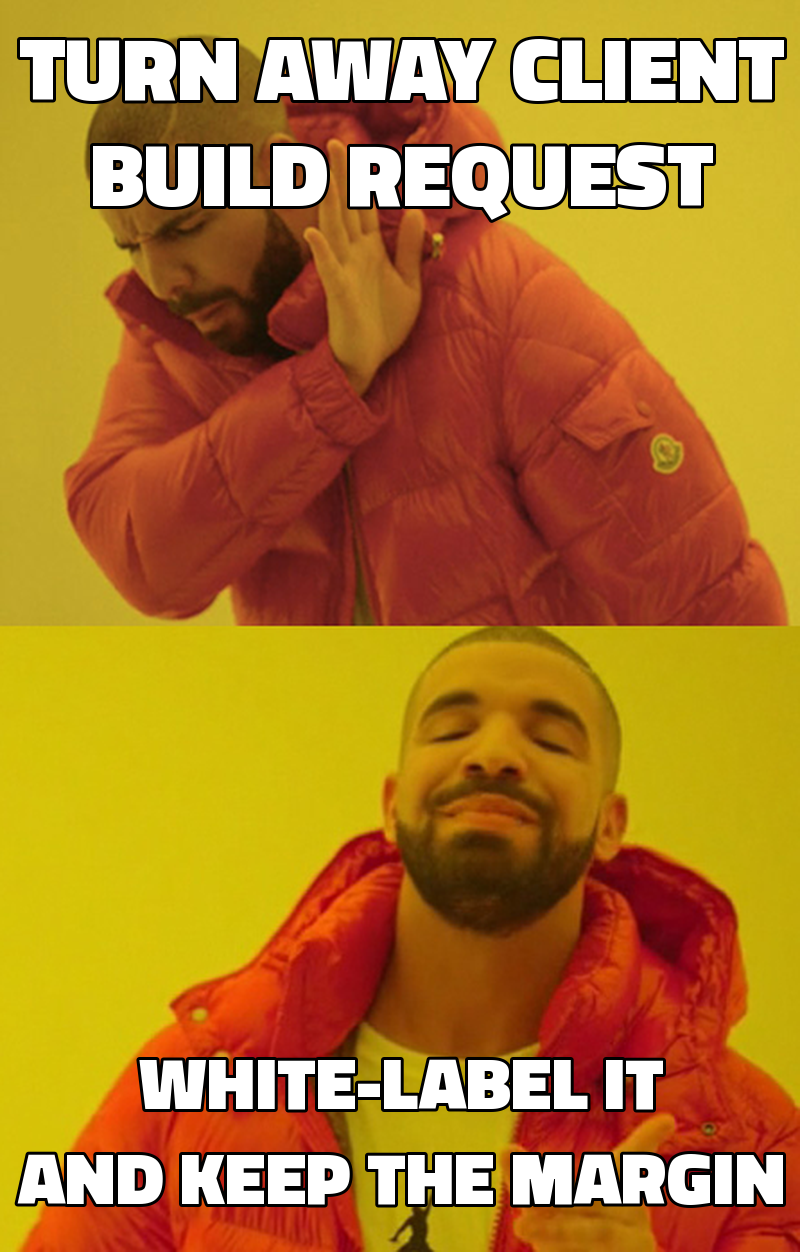
When the agency sees a clear path from “I can’t quote this” to “I can say yes, keep the margin, and protect my brand,” the decision is almost automatic.
Frequently asked questions
What is the difference between white-label and a regular subcontractor?
A white-label partner works behind the scenes, delivering code that the agency brands as its own. The partner signs NDA and non-circumvent clauses, provides a single point of contact, and usually offers a shared project dashboard. A regular subcontractor may expose its name to the client, have looser accountability, and often charges higher rates without the wholesale margin.
How long should a pilot project be before moving to a retainer?
Most agencies see a clear ROI after a 2-4 week pilot that stays within the $2K-$5K budget range. If the pilot hits a margin of 55%+ and the client is satisfied, the agency can propose a retainer of $1,500-$2,500 per month for ongoing support and feature work.
Can I use a white-label partner for a full SaaS product launch?
Yes, but the budget should be at least $8,000-$20,000 and the timeline 8-12 weeks. The partner will handle architecture, security, and scaling, while the agency focuses on go-to-market, branding, and client relationships.
What if my client asks who built the app?
The white-label agreement obligates the partner to remain invisible. You can provide client-ready assets (screenshots, documentation) that carry your logo. If a client insists on technical details, you can say the work was completed by your internal development team.
How do I protect my margin from the partner’s price changes?
Negotiate a fixed wholesale rate for the pilot and a capped hourly rate for the retainer. Include a clause that any price increase must be communicated 30 days in advance and will not affect ongoing projects.
Is there a risk of the partner poaching my clients?
A reputable white-label partner signs a non-circumvent clause that legally prevents them from contacting your clients directly. Synthisia’s contract also includes a penalty clause for breach, providing additional security.
What tools does the partner use for project tracking?
Synthisia uses ClickUp for task management and a shared read-only dashboard that clients can view via a secure link. This keeps the agency in control of communication while providing real-time status updates.
How do I know if my agency is big enough for a white-label partnership?
The sweet spot is 5-15 staff with at least three concurrent client projects that require custom development. If you regularly turn away build requests or have a recent developer job post, you are a strong candidate.
white-label
Have something to build?
Tell us what you're trying to ship. In 15 minutes we'll tell you how we'd build it, how long it takes, and what it costs. No pitch deck, no pressure.