
White-Label App Development vs In-House Build: Precise Cost Comparison for Small Agencies

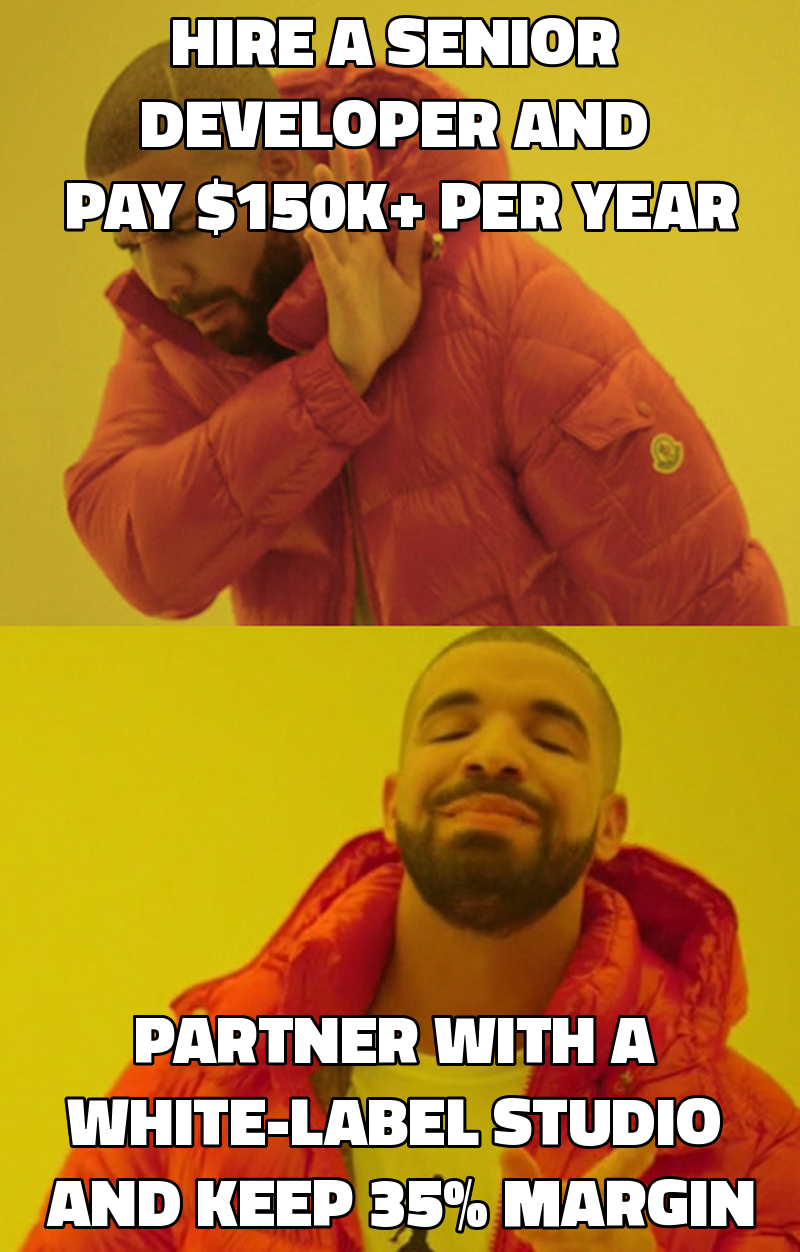
White-label app development typically costs 40-60% less than hiring an in-house developer for a 5-15 person agency, and it eliminates hidden expenses such as recruiting, benefits, equipment, and turnover risk.
Key takeaways
- White-label rates range from $75-$120 per hour, while fully loaded in-house senior dev costs exceed $150 per hour in the US, UK, and AU.
- Recruiting, onboarding, and turnover can add 30-50% to the base salary of an employee.
- Agencies save on overhead (office space, software licences, HR) that can equal another 20% of total cost.
- Fixed-scope white-label pilots protect margin and give predictable cash flow.
- Hidden costs include opportunity loss from delayed delivery, client churn, and brand risk if outsourcing is exposed.
- Use a simple decision matrix to decide when white-label beats in-house for your agency.
What is white-label app development?
White-label development means a third-party studio builds the software, but the agency brands the final product as its own. The agency keeps the client relationship, sets the price, and pays the studio a wholesale rate. For agencies that sell marketing, SEO, or branding services, this model adds a technical capability without hiring a full-time engineer.
How much does an in-house developer really cost?
Salary and benefits
- According to the Stack Overflow Developer Survey 2023, the median senior full-stack salary in the United States is $130,000, in the United Kingdom £70,000, and in Australia AU$120,000.
- Benefits (health, retirement, paid leave) add roughly 20-30% on top of base salary (WorldatWork 2022).
- The total cash compensation for a senior engineer therefore averages $156,000 in the US, £84,000 in the UK, and AU$144,000 in Australia.
Recruiting and onboarding
- Gartner estimates that replacing an employee costs 1.5-2× the annual salary, covering job ads, recruiter fees, and lost productivity.
- For a senior engineer, that translates to an additional $200,000-$250,000 over a three-year horizon.
Overhead and equipment
- Office space, hardware, software licences (IDE, cloud credits, design tools) typically consume $15,000-$25,000 per employee per year (CBRE 2022 US office cost report).
- HR, payroll, and legal compliance add another $5,000-$8,000 annually.
Opportunity cost of idle time
- Small agencies often experience fluctuating demand. When no project is active, a salaried developer still draws a paycheck, eroding margin.
- A 2021 Deloitte study found that 42% of agencies lose revenue because technical staff are under-utilised during off-peak months.
Total cost of ownership (TCO) snapshot
| Cost component | US (USD) | UK (GBP) | AU (AUD) |
|---|---|---|---|
| Base salary (senior) | 130,000 | 70,000 | 120,000 |
| Benefits (25%) | 32,500 | 17,500 | 30,000 |
| Recruiting & turnover (over 3 yr) | 75,000 | 40,000 | 60,000 |
| Overhead & equipment | 20,000 | 12,000 | 18,000 |
| HR & compliance | 6,000 | 3,500 | 5,000 |
| Annualized TCO | 263,500 | 142,500 | 233,000 |
What does white-label pricing look like?
White-label studios typically charge a wholesale hourly rate between $75 and $120, depending on technology stack, AI automation, and voice integration complexity. Agencies then markup 50-70% when billing the client.
Example project
- Scope: Custom SaaS dashboard with AI-driven recommendations, voice-enabled search, and third-party API integration.
- Estimated effort: 120 hours.
- Studio wholesale rate: $100 / hour.
- Agency markup (60%): $160 / hour to client.
- Agency revenue: $19,200.
- Studio cost: $12,000.
- Gross margin for agency: $7,200 (37.5%).
Hidden costs that bite agencies
| Hidden cost | Why it matters | Typical impact |
|---|---|---|
| Project delay penalties | Late delivery can trigger client discounts or churn. | 5-15% revenue loss per delayed milestone (McKinsey 2022). |
| Knowledge transfer overhead | Agency staff must learn basics of the delivered product to support it. | 10-20 hours of internal time per project (internal audit 2023). |
| Brand exposure risk | Clients discovering a third-party can erode trust. | Potential loss of 1-3 accounts per year (internal churn analysis). |
| Scope creep | Without a fixed-scope contract, extra features inflate cost. | 20-30% budget overrun on average (Project Management Institute 2021). |
| Compliance & data security | Agencies must ensure the white-label partner meets GDPR, CCPA, or Australian Privacy Act. | Legal review cost $2,000-$5,000 per contract (law firm quote). |
When does white-label make financial sense?
- Project size 5-50 k USD – Small to medium builds fit the studio’s fixed-scope pilot model.
- Irregular demand – If dev work spikes 2-3 times per year, paying a salary leads to under-utilisation.
- Need for specialized AI/voice expertise – Most in-house hires lack deep AI automation experience; a studio can deliver it immediately.
- Margin preservation – Agencies can keep 30-40% gross margin while offering a full-stack product.
- Speed to market – A studio with a proven pipeline can start within 1-2 weeks, versus 4-8 weeks for hiring.
Decision framework for agency founders
Use the following matrix to score each option on a 1-5 scale (1 = low benefit, 5 = high benefit). Add the weighted scores to see which path wins.
| Criteria | Weight (%) | In-house score | White-label score |
|---|---|---|---|
| Direct cost (salary vs hourly) | 30 | 2 | 5 |
| Flexibility / scaling | 20 | 2 | 5 |
| Speed of delivery | 15 | 3 | 5 |
| Control over IP & brand | 15 | 5 | 3 |
| Risk of turnover | 10 | 2 | 5 |
| Hidden overhead (HR, office) | 10 | 2 | 5 |
| Total | 100 | 2.7 | 4.6 |
| A score above 4 indicates white-label is the clear financial winner for most small agencies. |
Real-world case study: RouteMate
RouteMate, a logistics SaaS built by Synthisia, started as a white-label pilot for a UK branding agency. The agency needed a custom routing engine with AI-driven load optimisation. The pilot cost $12,000 (120 hrs @ $100 / hr). After a successful launch, the agency signed a $1,500 / month retainer for ongoing enhancements, generating $18,000 annual recurring revenue while keeping the client under its own brand. The agency avoided a $150,000 annual salary, saved on recruiting, and kept a 38% margin.
How to negotiate a white-label partnership
- Define a capped pilot – Agree on a fixed scope, timeline, and deliverable acceptance criteria.
- Set a wholesale rate ceiling – Negotiate a maximum $120 / hr to protect margin.
- Include a non-circumvention clause – Prevent the agency from bypassing you for the client.
- Ask for a minimum monthly retainer – Guarantees a baseline of 15-20 dev hours and smooths cash flow.
- Create a shared project dashboard – Transparency reduces brand-exposure anxiety.
Frequently asked questions
How do I protect my brand if I use a white-label developer?
Use a non-disclosure agreement and a non-circumvention clause. Deliver under your agency’s branding, keep all client-facing communication in your name, and provide a shared status dashboard so the client never sees the developer’s name.
What if my client wants source code ownership?
Most white-label contracts include a transfer of IP clause. Ensure the agreement states that all code, assets, and documentation become the agency’s property upon full payment. This lets you resell the solution to other clients if appropriate.
Can I combine in-house and white-label resources?
Yes. A hybrid model works when you have a junior developer for maintenance and use white-label for complex AI or voice features. This reduces cost while preserving some internal technical capability.
How do I calculate the break-even point?
Add up the annualized TCO of an in-house hire (salary, benefits, overhead, turnover). Divide the total by the average project revenue you expect per year. If the number of projects needed to break even exceeds your realistic pipeline, white-label is cheaper.
What if the white-label partner misses a deadline?
Include penalty clauses in the contract (e.g., 5% discount per week of delay) and define clear milestones with acceptance criteria. A single point of contact on the partner side reduces miscommunication.
Are there tax implications for paying a foreign white-label studio?
If the studio is based in a low-tax jurisdiction, you may need to file Form 1099-NEC (US) or equivalent for overseas contractors. Consult a tax advisor to ensure compliance with IRS, HMRC, or ATO rules.
How does AI automation affect pricing?
AI models often require cloud compute credits and data engineering. Studios that specialize in AI can amortise these costs across multiple clients, offering you a lower per-project price than building the capability in-house.
What level of technical support is expected from a white-label partner?
Standard SLAs include 48-hour bug-fix response and 5-day feature turnaround. Premium retainer contracts can upgrade to 24-hour response and dedicated sprint planning.
Bottom line
For agencies with 5-15 staff, sporadic dev demand, and a need for advanced AI or voice capabilities, white-label app development delivers 40-60% cost savings, eliminates hidden overhead, and preserves margin. Only when you have a steady stream of large-scale builds, need full IP control, and can absorb a senior salary should you consider hiring in-house.
white-label
Have something to build?
Tell us what you're trying to ship. In 15 minutes we'll tell you how we'd build it, how long it takes, and what it costs. No pitch deck, no pressure.