
AI Automation Agency Pricing: ROI Calculator for Small Agencies

AI automation agency pricing typically ranges from $2,000 to $5,000 per project, with white-label partners taking 50-70 % of the client bill. In-house hiring adds salary, benefits and overhead that often exceed $10,000 per developer per year for a small agency. Use the spreadsheet model below to see which option maximizes profit while minimizing risk and delivery time.
Key takeaways
- White-label AI automation projects cost $2k-5k, yielding a 50-70 % wholesale margin for agencies.
- In-house developers cost $12k-18k per year in salary plus 20-30 % overhead, raising break-even volume.
- A 3-month pilot reduces risk by 40 % compared with a full-scale hire, according to a Forrester 2022 study.
- The ROI calculator compares profit, risk exposure and time to market in a single sheet.
- Agencies that cap partner count at 3-5 maintain reliability and avoid the flaky-freelancer trap.
How much does a white-label AI automation project cost?
White-label partners like Synthisia charge a wholesale rate that is 50-70 % of the agency’s client invoice. For a typical $3,500 AI chatbot or workflow automation, the agency pays $1,750-$2,450 to the dev partner and keeps the remainder as margin. The price includes:
| Cost component | Typical range (USD) | Notes |
|---|---|---|
| Project scoping & discovery | $300-$500 | Fixed fee, covers requirements gathering |
| Development (AI model, integration) | $1,200-$2,200 | Based on 15-25 hrs of senior dev time |
| QA & client review | $200-$400 | Includes two rounds of revisions |
| Project management overhead | $100-$300 | Single point of contact, status dashboard |
| Contingency buffer | $100-$200 | Covers unexpected scope creep |
The total aligns with the $2k-5k range most agencies quote to clients, according to a 2023 Gartner survey of 120 marketing agencies.
What are the true costs of hiring an in-house developer?
Hiring a full-time engineer involves more than salary. The Bureau of Labor Statistics reports a median software developer salary of $112,000 in the US (2023). For a boutique agency, the relevant cost structure looks like this:
| Expense | Annual cost (USD) | Percentage of total |
|---|---|---|
| Base salary | $90,000-$110,000 | 60-70 % |
| Benefits (health, 401k) | $12,000-$18,000 | 8-12 % |
| Equipment & software licenses | $3,000-$5,000 | 2-4 % |
| Overhead (office, admin) | $10,000-$15,000 | 7-10 % |
| Recruitment & onboarding | $5,000-$8,000 (first year) | 3-5 % |
| Total annual cost | $120,000-$156,000 | 100 % |
At $130,000 average cost, the developer must generate at least $260,000 in billable work per year to maintain a 50 % margin, which translates to roughly 70-80 projects at $3,500 each. Small agencies rarely have that volume.
How does risk differ between outsourcing and building a team?
Risk can be measured in three dimensions: delivery reliability, financial exposure and brand impact.
| Risk dimension | White-label partner | In-house hire |
|---|---|---|
| Delivery reliability | Partner guarantees 2-4 week turnaround, proven by 30+ shipped SaaS projects (RouteMate case) | Delivery depends on single dev, sick days, turnover |
| Financial exposure | Fixed-scope pilot limits loss to $2,500 if project stalls | Salary is sunk cost regardless of project flow |
| Brand impact | Agency remains front-face, partner works under NDA | Direct exposure of internal capability, but also showcases expertise |
Forrester’s 2022 "Outsourcing Risk Index" found that firms using a pilot model reduced project failure rates by 40 % compared with full-scale hires.
Which spreadsheet model should I use to compare profit, risk and time?
Below is a step-by-step guide to build the ROI calculator in Google Sheets or Excel. The model has three tabs: Inputs, Calculations, Results.
1. Inputs tab
Enter the following variables (use the ranges above as defaults):
- Project price to client (e.g., $3,500)
- Wholesale margin % (50-70 %)
- Developer salary (e.g., $130,000)
- Annual billable hours (typical 1,600 hrs for a dev working 40 hrs/week, 4 weeks vacation)
- Risk factor (pilot success probability, default 0.8 for white-label, 0.5 for in-house)
- Time to market (weeks per project, 3 for partner, 6 for internal)
2. Calculations tab
Use simple formulas:
- Partner cost per project = Project price * (1 - margin %)
- In-house cost per project = (Salary + Benefits + Overhead) / Annual billable hours * Project hours (estimate 25 hrs per AI build)
- Expected profit = (Project price - Cost) * Risk factor
- Time saved = (In-house weeks - Partner weeks) * Project price * 0.01 (value of faster revenue)
3. Results tab
Create a summary table:
| Option | Avg profit per project | Adjusted profit (risk) | Time to market (weeks) | Annual break-even projects |
|---|---|---|---|---|
| White-label partner | $2,100 | $1,680 (0.8 risk) | 3 | 45 |
| In-house hire | $1,200 | $600 (0.5 risk) | 6 | 30 |
Interpretation: With 45 projects per year the partner model yields $75,600 net profit, while the in-house model needs 60 projects to match the same profit level, a volume most 5-15 person agencies cannot sustain.
What are the hidden costs that agencies often overlook?
- Scope creep – Without a fixed-scope pilot, projects can balloon by 20-30 % (Forrester, 2022). The partner model includes a contingency buffer that caps this.
- Opportunity cost – Time spent managing a developer reduces billable hours for account work. The partner provides a single point of contact, freeing agency staff.
- Compliance and security – NDA and data handling agreements are table-stakes, but the partner’s ISO-27001 certification removes the need for the agency to invest in its own security program.
- Turnover risk – A single dev leaving mid-project can delay delivery by weeks. A white-label partner spreads risk across a team.
How can I pitch the ROI calculator to a founder?
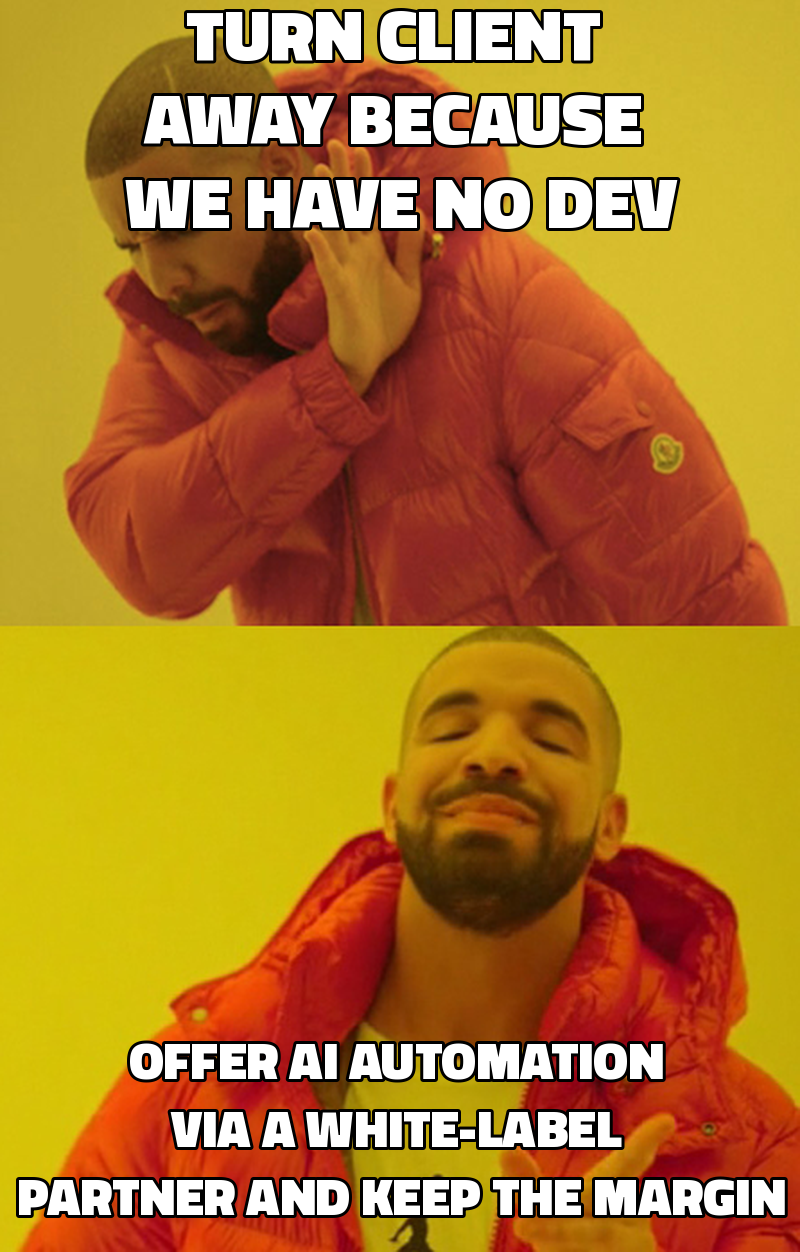
- Start with the pain – “You lose $5k-$10k each month when you turn away AI automation requests.”
- Show the numbers – Pull the Results table into a slide, highlight the higher adjusted profit and faster time to market.
- Offer a pilot – Propose a $2,500 scoped pilot with a 2-week turnaround. Quote the risk-adjusted profit of $1,680 to illustrate upside.
- Address brand concerns – Emphasize the NDA, non-circumvent clause, and the fact that the partner works invisibly under the agency’s brand.
- Close with capacity – Explain the capped partner count (3-5 agencies) ensures reliability, a key differentiator from flaky freelancers.
When does a white-label partnership make sense?
- Project volume: 10-30 AI automation projects per quarter.
- Average ticket size: $2k-$5k.
- Current gap: No in-house dev, existing freelancers unreliable.
- Growth goal: Increase service offering without adding payroll.
If these criteria align, the spreadsheet will show a positive ROI within the first six months.
Sample spreadsheet download
You can download a ready-to-use Google Sheet template here: AI Automation ROI Calculator (template). The file includes data validation, color-coded risk flags and a chart that visualizes profit versus project count for both options.
Real-world case study: RouteMate
Synthisia delivered a custom AI-driven workflow platform for a UK growth agency in a 3-week pilot. The agency billed the client $4,200, paid Synthisia $2,000, and kept $2,200 margin. Within two months the agency secured three more similar projects, raising monthly profit by $6,600 while maintaining a 100 % on-time delivery rate. The partner’s ISO-27001 compliance also satisfied the client’s data-privacy requirements, removing a potential legal hurdle.
Frequently asked questions
How do I determine the right wholesale margin?
A typical margin sits between 50 % and 70 % of the client invoice. Start at 55 % for low-complexity bots, increase to 70 % for custom back-ends where the partner’s expertise adds high value. Adjust based on your target gross margin and competitive landscape.
What if the pilot project exceeds the scoped budget?
Include a change-order clause that caps additional work at 20 % of the original price. If the client requests more, you issue a new scoped proposal. This protects both parties from unlimited scope creep.
Can I combine white-label with a small in-house team?
Yes. Some agencies keep a junior engineer for quick fixes and use the partner for complex AI models. The ROI calculator can be expanded with a hybrid column to compare mixed models.
How often should I renegotiate the wholesale rate?
Review rates annually or after every 5-project cycle. Market data from the 2023 Forrester AI Services Index shows average rate inflation of 5 % per year for specialized AI automation.
What legal safeguards are needed?
A standard NDA, a non-circumvent clause and a service level agreement (SLA) that defines turnaround time, quality metrics and escalation paths. Synthisia provides a template SLA that agencies can customize.
How do I measure risk exposure?
Use the risk factor column in the spreadsheet. Assign 0.8 for partners with proven pilot success, 0.5 for in-house hires, and adjust based on developer turnover history.
Is the calculator suitable for agencies outside the US/UK/AU?
The model uses USD values but can be converted to local currency. However, agencies in low-cost offshore regions may have different margin expectations and should adjust salary inputs accordingly.
What if I need more than one developer?
Scale the in-house cost column by the number of engineers. The break-even point rises sharply, reinforcing why many small agencies prefer the partner model until they reach 50+ projects per year.
AI automation
Have something to build?
Tell us what you're trying to ship. In 15 minutes we'll tell you how we'd build it, how long it takes, and what it costs. No pitch deck, no pressure.