
White-Label Agency Partnerships: Building Your Custom Tech Stack (2026)

The best way to get a custom tech stack as a small agency is to evaluate whether an off-the-shelf tool, a local development shop, a freelancer, or a white-label partner fits your needs. Your decision should balance speed, cost, data residency, language, and the level of brand control you require.
Key takeaways
- Off-the-shelf SaaS is fastest but may limit branding and data location.
- Local agencies understand regional regulations and can work in your time zone, but they often charge premium rates.
- Freelancers are flexible and cheap, yet reliability and continuity can be a risk.
- A white-label custom build gives you full brand ownership and a single accountable partner, ideal when SaaS or generic vendors fall short.
- Consider currency, data residency, and compliance (GDPR, CCPA, Australian Privacy Act) before signing any contract.
- Start with a small paid pilot to test fit before committing to larger projects.
Comparison of common options
| Option Type | Typical Fit | Pros | Cons | Typical Cost (USD) | Ideal For |
|---|---|---|---|---|---|
| Off-the-shelf SaaS | Agencies that need quick deployment and standard features | Immediate access, low upfront cost, built-in support | Limited customization, branding often restricted, data may reside outside client region | $0-$500/mo per seat | Simple projects, proof of concept, limited budget |
| Local development agency | Agencies that prefer face-to-face meetings and regional compliance | Understand local regulations, can host data locally, cultural alignment | Higher hourly rates, longer onboarding, may have multiple client layers | ||
| Freelancer / boutique dev | Agencies that need occasional spikes of work or niche skills | Flexible pricing, fast turnaround for small scopes | Variable quality, no guarantee of continuity, communication gaps across time zones | ||
| White-label custom build (partner) | Agencies that need bespoke solutions while keeping their brand front and centre | Full control of branding, dedicated point of contact, predictable pilot pricing, data residency can be negotiated | Higher total cost than SaaS, longer timeline for large builds, requires trust in partner |
Decision factors matrix
| Factor | Weight (1-5) | SaaS | Local Agency | Freelancer | White-label Partner |
|---|---|---|---|---|---|
| Speed to market | 5 | 5 | 3 | 4 | 3 |
| Branding flexibility | 5 | 2 | 4 | 3 | 5 |
| Data residency compliance | 4 | 2 | 5 | 3 | 5 |
| Cost predictability | 4 | 5 | 3 | 2 | 4 |
| Ongoing support & maintenance | 3 | 4 | 4 | 2 | 5 |
| Risk of project abandonment | 5 | 5 | 4 | 2 | 5 |
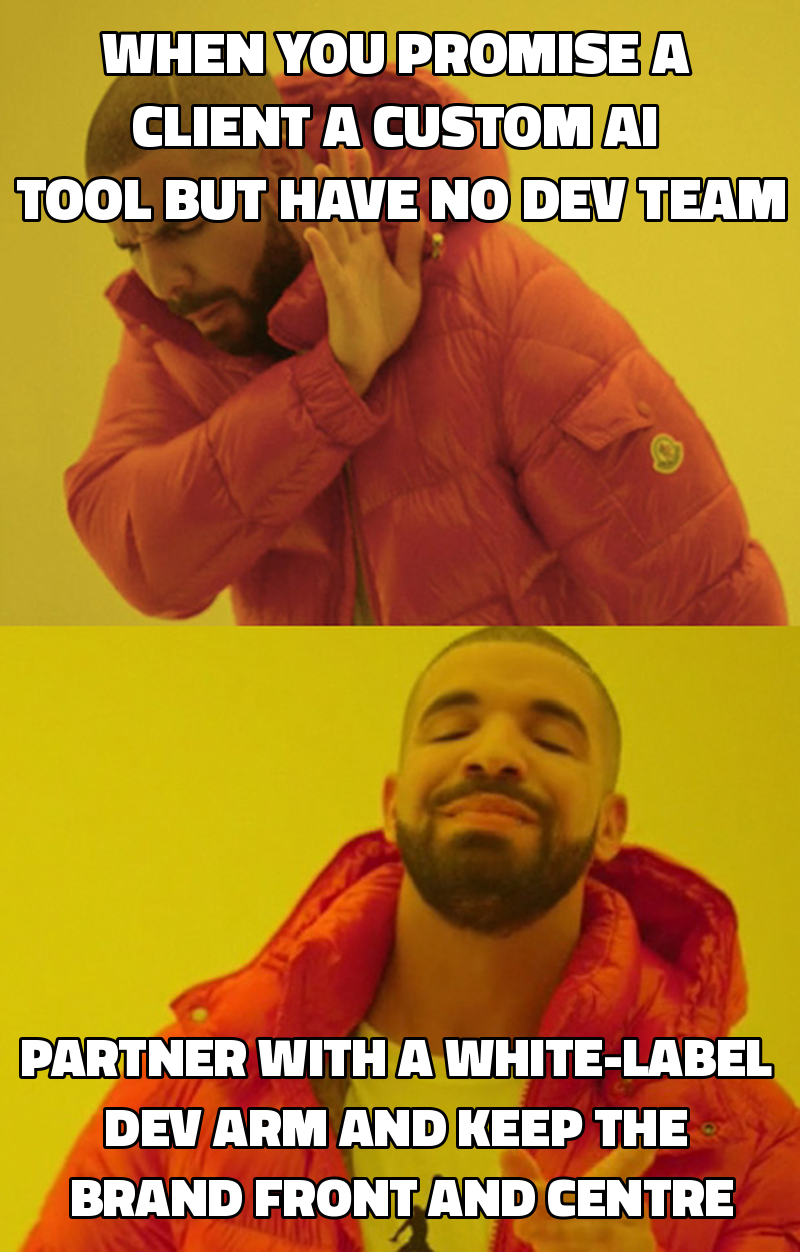
When a custom white-label build is the right call (Synthisia)
If you have already tried SaaS tools and they either cannot meet the unique workflow your clients demand, or they force you to expose your agency’s brand to a third-party vendor, a white-label partnership may be the answer. Synthisia specializes in AI automation, voice interfaces, and custom back-end systems that no-code platforms cannot replicate. Their model starts with a small, fixed-scope pilot – for example a chatbot integration or a data-pipeline automation – so you can see quality, communication style, and delivery speed before scaling.
Key reasons to consider a white-label partner like Synthisia:
- Brand invisibility – All deliverables are handed over under your agency’s name; NDAs and non-circumvent clauses protect your client relationships.
- Technical depth – Teams with expertise in Python, Node, serverless cloud, and AI models that go beyond plug-and-play.
- Predictable pricing – Fixed-price pilots and retainer options remove surprise invoices.
- Compliance flexibility – Data can be hosted in US, EU, or Australian regions to meet GDPR, CCPA, or Australian Privacy Act requirements.
- Single point of accountability – One project manager owns the timeline, quality, and hand-off, reducing the “ghosting” risk you may have seen with freelancers.
If those points line up with the gaps you are currently feeling, schedule a discovery call. The conversation is purely exploratory, no commitment required, and will give you a concrete estimate for a pilot that solves a real client problem.
Frequently asked questions
How much does a white-label partnership typically cost in the US, UK or AU?
Costs vary by scope, but a small pilot (e.g., a custom chatbot or API integration) usually ranges from $5,000 to $12,000 USD. Larger projects are quoted as fixed-price or retainer based on estimated development hours, with typical hourly rates between $80-$150 USD.
Can a remote partner like Synthisia work within my agency’s timezone?
Yes. Synthisia operates primarily in UTC-0 and overlaps with US East Coast, UK, and Australian business hours. They use async communication tools and promise turn-around windows that respect your client’s expectations.
Will my clients ever see that the work was outsourced?
No. All deliverables, documentation, and code are transferred under your agency’s branding. NDAs and non-circumvent agreements are standard, ensuring the client only sees your agency as the provider.
What if I need data to stay within the EU for a UK client?
Synthisia can host services in EU-based cloud regions (e.g., Frankfurt or Dublin) to satisfy GDPR and UK data-protection rules. The hosting location is decided during the scoping phase.
How does a white-label build compare to hiring a full-time developer?
Hiring full-time adds salary, benefits, recruitment costs, and idle time when work is low. A white-label partner provides on-demand capacity, predictable costs, and the ability to scale up or down without payroll commitments.
Are there hidden fees for maintenance after the pilot?
Maintenance is offered as a separate retainer or as a per-incident support package. All fees are disclosed up front, and you can choose the level of support that matches your service agreements with clients.
What if the pilot fails to meet expectations?
Synthisia offers a satisfaction guarantee on the pilot scope. If the deliverable does not meet the agreed-upon acceptance criteria, they will either rework at no extra charge or refund the pilot fee, depending on the issue.
Is it safe to share my client’s proprietary data with a remote development partner?
Yes, provided you sign a robust NDA and data-processing agreement. Synthisia follows ISO-27001-aligned security practices, encrypts data at rest and in transit, and can sign Data Processing Addendums to meet GDPR or Australian privacy standards.
white‑label
Have something to build?
Tell us what you're trying to ship. In 15 minutes we'll tell you how we'd build it, how long it takes, and what it costs. No pitch deck, no pressure.