
What to Expect from a US White-Label Web Development Agency

A white-label web development agency in the USA is a partner that builds custom sites, apps, and automation projects under your agency’s brand, while you keep the client relationship and margin. The agency handles all engineering, testing, and deployment, and you receive a finished product that you can present as your own work. Expect clear timelines, structured communication, and documented quality standards that match the expectations of US, UK, and AU agency clients.
Key takeaways
- Fixed-scope pilots usually ship in 2-4 weeks, with a 5-day review window built in.
- Communication follows a twice-weekly video call, daily Slack updates, and a shared project dashboard.
- Quality is measured by automated test coverage (minimum 80%), design sign-off in Figma, and performance metrics from Google PageSpeed (score ≥ 90).
- Pricing is wholesale 50-70 % of the agency’s client bill, with a $1,500 floor per project and a $1,500 monthly retainer for ongoing escalation.
- The partnership is invisible to the client – NDAs and non-circumvent clauses are standard.
- Capacity is capped at 8 active agency partners to guarantee reliability.
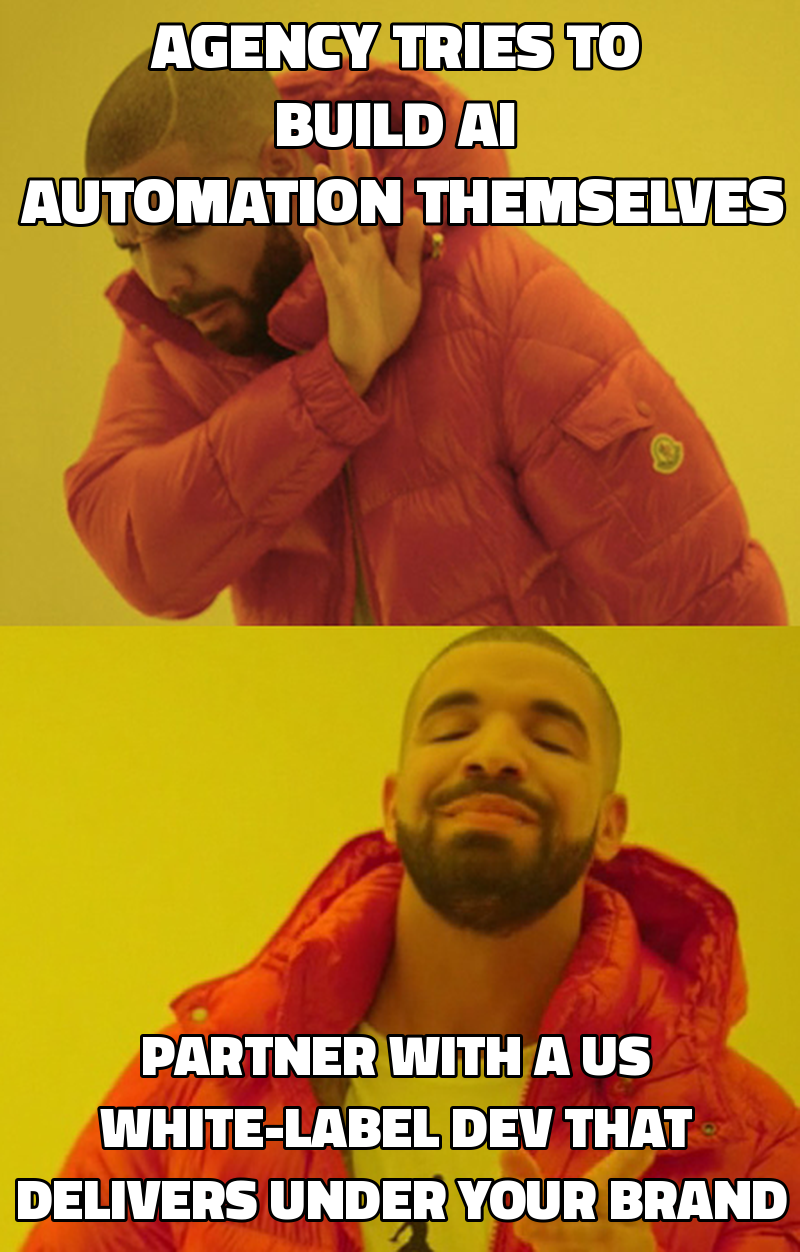
What is a US white-label web development agency?
A US white-label partner is a development studio that works behind the scenes for marketing, SEO, branding, or social agencies that do not have in-house engineers. They specialize in custom back-ends, AI automation, voice integrations, and full-stack SaaS products that no-code tools cannot deliver. The agency you work with retains all client-facing branding, invoices the client, and pays the dev studio a wholesale rate. This model lets founders and directors say yes to high-margin projects without hiring a full-time engineer.
Why US-based matters for agencies in the US, UK, and AU
- Time-zone overlap: Most US agencies have at least 4-6 hours of overlap with the West Coast, and AU agencies get a 2-hour overlap with the East Coast, enabling real-time collaboration.
- Currency stability: Billing in USD avoids exchange-rate risk for UK and AU partners.
- Legal certainty: US contracts are enforceable under California law, which is familiar to many SaaS founders.
- Talent pool: According to the 2023 Stack Overflow Developer Survey, 42 % of US developers specialize in React/Node, a stack that powers most custom agency projects.
Typical delivery timeline for a fixed-scope pilot
| Phase | Duration (business days) | Key Deliverables |
|---|---|---|
| Discovery & Scoping | 2-3 | Detailed brief, wireframes, acceptance criteria |
| Design Handoff | 1-2 | Figma prototype, style guide |
| Development Sprint 1 | 5-7 | Core UI, API endpoints, unit tests (≥ 80 % coverage) |
| Review & Feedback | 2-3 | Agency review, bug list, performance report |
| Development Sprint 2 | 4-6 | Final features, integration tests, CI/CD pipeline |
| UAT & Sign-off | 2-4 | Client-ready build on staging, security audit |
| Deployment | 1 | Production launch, post-launch monitoring |
Total: 18-28 business days (approximately 3-5 weeks). The timeline includes a built-in buffer for feedback cycles, which is critical because agencies often need to align the build with a larger campaign launch.
Communication norms you’ll see
- Kick-off call (30 min) – Introduces the single point of contact (usually a Senior Delivery Manager) and reviews scope.
- Twice-weekly video sync (45 min) – One call focuses on progress, the other on risk mitigation and upcoming milestones.
- Daily Slack channel – Real-time status updates, quick questions, and file sharing. The dev studio uses a dedicated #agency-partner channel.
- Shared project dashboard – Built in Notion or ClickUp, the dashboard shows task status, burndown chart, and upcoming deliverables.
- Weekly email summary – Sent every Friday, it recaps what was completed, what is in review, and next week’s plan.
- Post-launch debrief (15 min) – Reviews performance metrics, gathers feedback, and discusses next steps.
Tools most agencies use
- Project management: ClickUp, Asana, or Monday.com (the dev studio can import tasks via API).
- Design handoff: Figma with the "Inspect" mode enabled.
- Version control: GitHub private repo with branch protection rules.
- Continuous integration: GitHub Actions or CircleCI, with automated linting and test runs.
- Hosting: Vercel for Next.js front-ends, AWS Elastic Beanstalk for Node back-ends, and Netlify for static sites.
Quality standards you can count on
| Metric | Minimum Requirement | How it is verified |
|---|---|---|
| Automated test coverage | 80 % of unit and integration tests | CI pipeline badge on GitHub PRs |
| Performance | Google PageSpeed Insights ≥ 90 for mobile, ≥ 95 for desktop | Automated Lighthouse run on each PR |
| Security | OWASP Top 10 mitigations, no critical findings | Quarterly third-party security scan (e.g., Snyk) |
| Accessibility | WCAG 2.1 AA compliance for core UI | Axe-core automated audit in CI |
| Code quality | ESLint (Airbnb) and Prettier enforced | Pull-request lint check |
Audits are shared with the agency partner via a PDF report after each milestone. According to a 2022 Clutch study, agencies that receive a formal quality audit are 34 % more likely to retain the dev partner for a second project.
Pricing model you’ll see on the contract
- Wholesale rate: 55 % of the client-facing price (typical range 50-70 %).
- Project floor: $1,500 – any project below this is rejected because the overhead of onboarding exceeds profit.
- Fixed-scope pilot: $2,000-$5,000 depending on complexity, paid upfront.
- Retainer after pilot: $1,500/month for up to 20 hours of escalation work, with a 10 % discount after three months of continuous billing.
- Change-order policy: Scope changes > 10 % of original estimate trigger a new SOW and 1-day turnaround for impact analysis.
How to evaluate a potential US white-label partner
| Evaluation criteria | What to ask | Red flag |
|---|---|---|
| Delivery speed | "What is your average turnaround for a 5-page site with custom API?" | Average > 6 weeks |
| Communication cadence | "How many live touchpoints do you provide per week?" | Only email, no video calls |
| Test coverage | "What % of your code is covered by automated tests?" | < 60 % |
| Client confidentiality | "Do you sign NDAs and non-circumvent agreements?" | Refuses to sign |
| Post-launch support | "What SLA do you offer for bug fixes after launch?" | No SLA or > 48 hour response |
Quick qualification checklist for agency founders
- No in-house dev team (headcount 5-15, no engineers listed).
- Recent client case study that mentions a web app or automation.
- Active Slack or email channel for partner communication.
- Willing to run a $2k pilot before a retainer.
- Accepts a 5-day UAT window and a post-launch debrief.
Comparison of US white-label vs offshore freelancers
| Factor | US White-Label Agency | Offshore Freelancer |
|---|---|---|
| Time-zone overlap | 4-6 hours (US) or 2 hours (AU) | Usually 12-14 hours offset, async only |
| Legal protection | US contract, NDA, non-circumvent clause | Limited enforceability, often informal |
| Consistency | Dedicated Delivery Manager, SLA | Variable, depends on individual availability |
| Quality assurance | Automated testing, performance audits, security scans | Often ad-hoc, no formal QA process |
| Pricing stability | Fixed wholesale rate per project | Hourly rates fluctuate, hidden costs |
Real-world example: RouteMate pilot
Synthisia delivered a custom SaaS platform for a UK growth agency in 22 business days. The agency kept the brand on all client-facing screens, while Synthisia handled the Node.js back-end, React front-end, and AWS Lambda automation. The pilot cost $3,200 wholesale, the agency billed the client $5,600, and the partnership moved to a $1,500/month retainer after a successful launch. The agency reported a 27 % increase in win-rate for automation projects because they could finally say yes.
Frequently asked questions
How long does a typical white-label project take?
A fixed-scope pilot usually finishes in 3-5 weeks, including discovery, two development sprints, review, and deployment. Larger SaaS builds can extend to 8-10 weeks, but the partner will provide a detailed timeline before the contract is signed.
What communication tools will we use?
The partner uses Slack for daily updates, Zoom for twice-weekly video calls, and a shared Notion dashboard for task tracking. All code lives in a private GitHub repo, and design assets are handed off in Figma.
How is quality measured?
Quality is measured by automated test coverage (≥ 80 %), performance scores from Google PageSpeed (≥ 90 mobile), security scans from Snyk, and WCAG 2.1 AA accessibility checks. A PDF audit is delivered after each milestone.
What if the scope changes mid-project?
Scope changes under 10 % of the original estimate are handled as a change order with a 1-day impact analysis. Larger changes trigger a new statement of work and a revised timeline.
Will my clients know I’m using a third-party developer?
No. The partnership is fully white-label; all deliverables carry your agency’s branding. NDAs and non-circumvent clauses protect your client relationships.
How do I know the partner is reliable?
Reliability is proven by a capped partner roster (max 8 active agencies), documented SLA (24-hour bug-fix response), and a track record of at least three successful pilots. Clutch reports that agencies with a capped partner model retain 82 % of their dev partners after the first year.
What does the retainer cover?
The $1,500/month retainer gives you up to 20 hours of escalation work, priority queueing, and a quarterly health check of all active builds. Unused hours roll over for up to two months.
Can we start with a free draft?
A free draft is risky for both sides. Instead, Synthisia offers a scoped prototype (one screen or one automation) for $250, which demonstrates quality without consuming full development resources.
Bottom line
Hiring a US white-label web development agency gives you predictable delivery timelines, transparent communication, and measurable quality standards that let you expand your service offering without hiring expensive engineers. By starting with a low-risk pilot, you can verify the partnership, protect your brand, and unlock new revenue streams for AI automation, voice integration, and custom SaaS products.
white-label
Have something to build?
Tell us what you're trying to ship. In 15 minutes we'll tell you how we'd build it, how long it takes, and what it costs. No pitch deck, no pressure.