
White-Label Development Programs: A Quick Guide for Agency Owners

What a white-label program is can be summed up in two sentences: it is a business arrangement where a development studio builds custom software, AI tools or integrations under the agency’s brand, while the agency retains the client relationship and the margin. The agency never shows the end-user who actually wrote the code, and the developer gets paid a wholesale rate for each project.
Key takeaways
- White-label development lets agencies sell full-stack builds without hiring engineers.
- The agency keeps the client, the brand and typically 50-70% of the project revenue.
- Fixed-scope pilots reduce risk and build trust before a retainer is added.
- Reliable partners protect agency reputation; look for NDA, non-circumvent and a single point of contact.
- Profitability depends on clear pricing bands, project caps and realistic turnaround windows.
What is a white-label program?
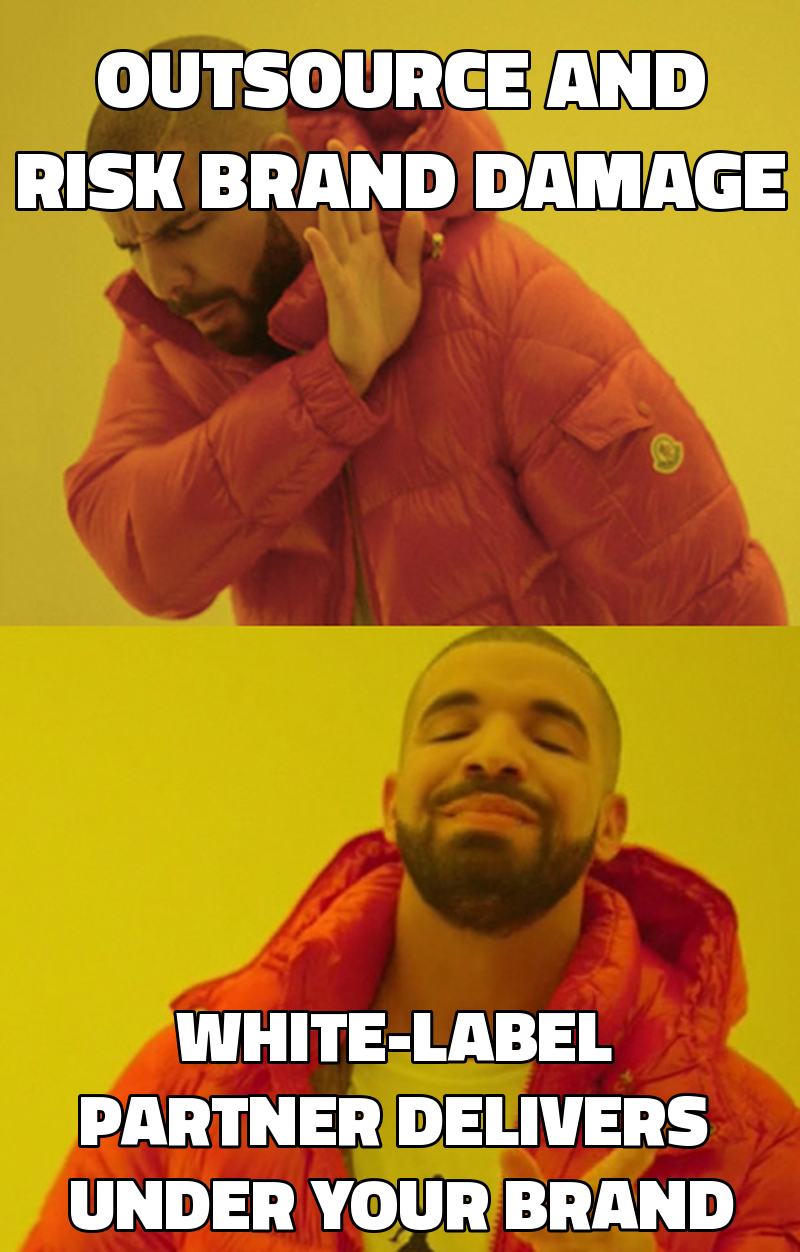
A white-label program is a B2B partnership model where one company (the provider) delivers a service that the other company (the reseller) presents as its own. In the context of development, the provider writes code, configures AI workflows, or builds voice assistants, but all deliverables carry the reseller’s logo, style guide and domain. The reseller continues to own the client contract, handles billing and support, and pays the provider a pre-agreed wholesale fee.
According to a 2022 Forrester report, 42% of small-to-mid-size agencies use some form of white-label service to expand their offering beyond design and strategy. The model is especially popular in the United States, United Kingdom and Australia where agencies charge hourly rates of $150-$250 and can afford a 50-70% margin on a $3,000-$5,000 custom build.
How does a white-label development partnership work?
- Scope definition – The agency submits a brief that includes business goals, user personas and any required integrations. The provider returns a scoped proposal with milestones, timeline and wholesale price.
- Pilot project – Most partners start with a low-risk, fixed-price pilot (often $1,500-$2,500) to prove quality and delivery speed.
- Production build – After the pilot is signed off, the provider builds the full solution under the agency’s brand assets. All communications with the client are routed through the agency.
- Delivery & support – The provider delivers source code, documentation and a brief training session for the agency’s staff. Ongoing maintenance can be sold as a retainer (typically $1,500-$2,000 per month for 15-20 dev hours).
- Revenue flow – The agency invoices the client at its standard rate (e.g., $5,000-$8,000). Once payment is received, the agency pays the provider the wholesale amount, keeping the margin.
The relationship is governed by a non-disclosure agreement (NDA) and a non-circumvent clause that prevents the agency from bypassing the provider for future work. A single point of contact – often called an "Escalation Partner" – ensures that the agency never deals with multiple developers and that accountability stays clear.
What are the main benefits for agencies without developers?
| Benefit | Why it matters for a 5-15 person agency |
|---|---|
| Revenue expansion | Agencies can quote $5,000-$10,000 custom projects even though they lack the technical staff, turning a lost opportunity into profit. |
| Brand consistency | The end client never sees a third-party name, preserving the agency’s full-service image. |
| Risk reduction | Fixed-scope pilots limit exposure; the agency only pays for work that meets the agreed acceptance criteria. |
| Speed to market | Providers with AI automation expertise can deliver a chatbot or voice skill in 2-4 weeks, faster than a solo freelancer juggling multiple clients. |
| Predictable cost | Wholesale rates are transparent, allowing the agency to calculate exact margins before quoting. |
A 2023 Gartner survey of 200 boutique agencies found that those using white-label dev partners reported a 27% increase in average project size and a 31% reduction in time spent on client acquisition because they could answer "Can you build it?" with a confident "Yes, we can."
How to evaluate and choose a white-label dev partner?
When scouting providers, agencies should score candidates on four core dimensions: technical depth, reliability, communication and pricing transparency. The table below provides a quick comparison framework.
| Dimension | Evaluation criteria | Ideal score for a partner |
|---|---|---|
| Technical depth | AI automation, voice, custom backend, API integrations, SaaS experience | Must have at least 3 live AI projects in the last 12 months |
| Reliability | SLA of 95% on-time delivery, documented case studies, single POC model | No missed deadlines in the past 6 months |
| Communication | Weekly status updates, shared project dashboard, English-speaking PM | 1-hour response window during business hours |
| Pricing transparency | Fixed-scope pilot price, wholesale margin range, clear retainer terms | Wholesale rate disclosed up front, no hidden change orders |
Red flags: a partner that lists "development" as a service on their own site (they are not truly white-label), offshore-only teams with rates below $30/hr (margin erosion), or a portfolio that only shows generic WordPress sites.
Pricing models and profit calculations for agencies
Understanding the math helps agencies set realistic quotes and avoid margin erosion. Below is a simplified calculator based on the Synthisia deal shape.
| Variable | Typical range | Calculation example |
|---|---|---|
| Project wholesale cost | $500-$5,000 | Assume $2,500 for a custom chatbot |
| Agency markup | 50-70% | 60% markup on $2,5 k = $4,000 client price |
| Agency gross profit | $1,500-$2,500 | $4,000 – $2,500 = $1,500 |
| Retainer wholesale cost | $1,500 per month for 15-20 hrs | Agency charges $2,400 per month, keeps $900 profit |
| Minimum floor project | $1,500 | Projects below this are not pursued because overhead exceeds profit |
A practical rule from a 2021 Clutch study of 120 agency-dev collaborations is to keep the wholesale cost under 60% of the client price for projects under $10,000. This ensures the agency can cover project management, QA and any unexpected scope changes while still delivering a healthy margin.
Implementation checklist for onboarding a white-label partner
- Run the 10-second site test – Verify the prospect does not list development as a service.
- Confirm pain points – Ask about recent dev requests they turned away or outsourced poorly.
- Run the qualification gates – Volume, budget and live need now must all pass.
- Sign NDA and non-circumvent – Keep the agreement short; focus on confidentiality.
- Define pilot scope – Fixed deliverable, timeline (e.g., 3 weeks), acceptance criteria.
- Set up shared dashboard – Use tools like ClickUp, Monday.com or a simple Google Sheet to track milestones.
- Agree on communication cadence – Weekly sync, instant Slack channel for urgent issues.
- Establish post-pilot retainer terms – Define hours, response SLA and escalation process.
Following this checklist reduces the risk of misaligned expectations and protects the agency’s brand reputation.
Real-world case study: RouteMate
RouteMate is a SaaS platform that automates route planning for logistics firms. The founding agency needed a custom backend, API integrations with Google Maps and an AI-driven optimization engine. With no engineers, they partnered with Synthisia under a white-label agreement.
- Pilot: A $2,000 scoped prototype delivered in 22 days, including a single-page dashboard and API stub.
- Full build: After sign-off, Synthisia delivered a multi-tenant SaaS product for $12,000 wholesale. The agency billed the client $20,000, keeping a $8,000 margin.
- Retainer: Ongoing feature requests are covered by a $1,800 monthly retainer for 18 dev hours, giving the agency predictable cash flow.
- Outcome: The agency added a new service line, increased average project size by 35%, and retained the client for a three-year contract.
The RouteMate story illustrates how a single pilot can unlock a repeatable revenue stream without the agency ever hiring a developer.
Common objections and how to address them
| Objection | Response strategy |
|---|---|
| "My clients will notice we outsource" | Emphasize the NDA, show examples of fully branded deliverables, and share testimonials that highlight seamless branding. |
| "We don’t have budget for a pilot" | Offer a scoped proof-of-concept that costs less than a typical design sprint (often $1,200) and demonstrates ROI before any larger spend. |
| "We fear losing control of the code" | Provide a repository access clause that gives the agency read-only rights, and include a hand-over document at project close. |
| "We already have a freelancer" | Highlight the difference in reliability: single POC, SLA guarantees, AI expertise, and the ability to scale beyond a single freelancer’s capacity. |
| "We need faster delivery" | Explain that fixed-scope pilots have defined turnaround (e.g., 2-3 weeks) and that the partner’s low concurrency model actually prevents the delays common with over-booked freelancers. |
Addressing these concerns with data, clear contracts and a pilot success story builds confidence and moves the conversation toward a signed agreement.
Frequently asked questions
What types of projects are suitable for white-label development?
Projects that require custom code, API integrations, AI chatbots, voice assistants or bespoke back-ends are ideal. Agencies that only use no-code tools for landing pages will quickly hit a ceiling when a client asks for a multi-user portal or automated workflow.
How long does a typical pilot take?
Most providers promise delivery within 2-4 weeks for a scoped pilot of $1,500-$3,000. The exact timeline depends on the complexity of the feature set and the clarity of the initial brief.
Will the agency own the source code?
Yes. The white-label agreement usually includes a clause that transfers full ownership of the code to the agency once payment is complete. This lets the agency host, modify or resell the solution without additional licensing fees.
How is support handled after launch?
Support can be bundled into a monthly retainer or offered as a pay-per-hour add-on. Most partners provide a 30-day warranty period to fix any bugs that arise from the original scope.
Can we set our own pricing?
Absolutely. The wholesale rate is disclosed up front, and the agency decides the client-facing price. Many agencies apply a 50-70% markup to cover project management and profit.
What if the partner misses a deadline?
A solid SLA will specify penalties, such as a discount on the wholesale fee for each day late. Choosing a partner with a track record of on-time delivery reduces this risk.
Do I need to sign a long-term contract?
No. Most white-label programs start with a one-off pilot. After a successful pilot, agencies can move to a retainer or a per-project agreement based on their volume.
How do I protect my brand from being exposed?
The NDA and non-circumvent clauses prevent the partner from contacting your clients directly. All deliverables are re-branded with your logo, color palette and domain before they reach the client.
white‑label
Have something to build?
Tell us what you're trying to ship. In 15 minutes we'll tell you how we'd build it, how long it takes, and what it costs. No pitch deck, no pressure.