
White-Label Development Agency Explained: Benefits & Use Cases for Marketing Firms

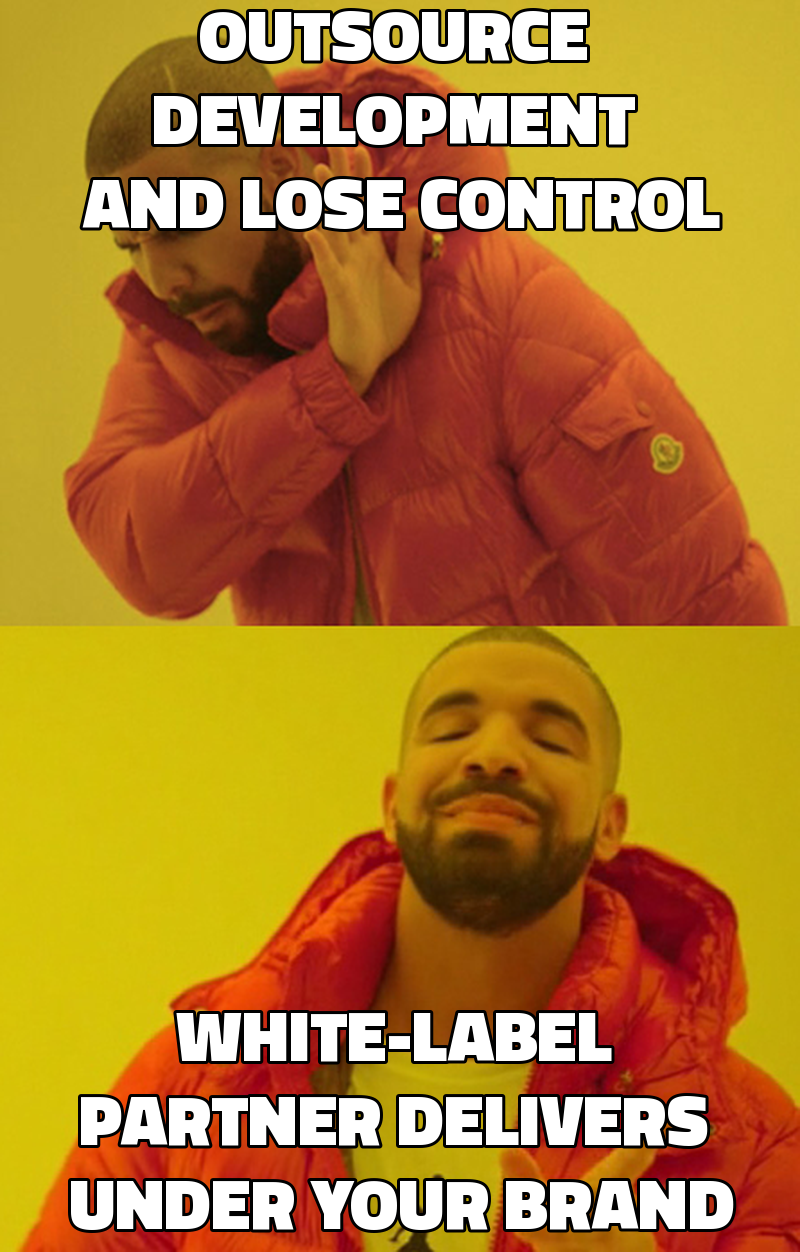
A white-label development agency builds custom software, automation, or voice solutions that are delivered under another company’s brand. The partner agency keeps the client relationship, invoices the work, and presents the finished product as its own. This model lets marketing, SEO, and branding firms expand their service catalog without hiring engineers.
Key takeaways
- White-label dev partners handle the technical build while you retain the client and margin.
- Typical pilot projects range from $2,000 to $5,000 and can unlock recurring retainers of $1,500+ per month.
- Agencies save 60-80% of the cost and time of hiring a full-time developer for sporadic work.
- Reliable partners deliver on a fixed-scope timeline, reducing risk of missed deadlines.
- AI automation, voice assistants, and custom back-ends are the high-value niches where white-label partners excel.
What is a white-label development agency?
A white-label development agency is a third-party software shop that creates digital products on behalf of another brand. The client never sees the developer’s name; the work appears to come from the hiring agency. Contracts typically include a non-disclosure agreement (NDA) and a non-circumvent clause, ensuring the partner remains invisible and the hiring agency protects its brand.
In practice, the workflow looks like this:
- The marketing agency receives a client request for a chatbot, custom dashboard, or SaaS tool.
- The agency scopes the project and forwards the technical brief to the white-label partner.
- The partner builds the solution, provides regular status updates, and delivers a ready-to-launch product.
- The agency reviews, brands, and invoices the client, keeping the profit margin.
Strategic advantages for marketing agencies
| Advantage | What it means for a 5-15 person agency | Example |
|---|---|---|
| Speed to market | No need to recruit, onboard, or manage developers. | A UK branding firm adds a voice-assistant feature to a client campaign in 3 weeks instead of 8 weeks. |
| Cost predictability | Fixed-price pilots and retainer models replace salary overhead. | An Australian SEO shop pays $3,200 for a custom reporting API and retains the partner for $1,600/month for ongoing tweaks. |
| Expanded service catalog | Offer AI automation, custom back-ends, and integrations that no-code tools cannot handle. | A US growth agency sells a lead-scoring engine built on Python and AWS Lambda. |
| Brand protection | NDA and non-circumvent clauses keep the partner invisible. | Clients never see the name "Synthisia"; they only see the agency’s logo. |
| Revenue upside | Keep 50-70% of the wholesale rate while the partner handles delivery. | A $5,000 project yields $2,500 profit after the partner’s $2,500 wholesale fee. |
Why agencies choose white-label over hiring
- Talent scarcity – According to a 2023 Gartner survey, 57% of small agencies report difficulty finding reliable developers.
- Variable workload – Clutch’s 2022 agency study shows 42% of firms outsource development because project volume spikes are unpredictable.
- Risk mitigation – A fixed-scope pilot lets you test quality before committing to a long-term retainer.
Real-world use cases for marketing firms
| Use case | Client need | Typical white-label solution | Benefit to agency |
|---|---|---|---|
| Chatbot for e-commerce | 24/7 customer support, lead capture | AI-driven chatbot on Dialogflow integrated with Shopify | New upsell, $2,500 one-off fee + $500/month maintenance |
| Custom analytics dashboard | Consolidate ad spend, SEO metrics, and sales data | Full-stack web app on React + Node, hosted on Azure | Position agency as data-driven, $4,000 project |
| Voice-assistant campaign | Launch a brand skill for Amazon Alexa | Voice skill with Lambda functions, custom utterances | Differentiates agency, $3,500 pilot |
| Automation of client onboarding | Reduce manual data entry for new SaaS customers | Zapier-plus-custom API bridge, 10-step workflow | Saves client hours, $1,800 implementation |
| White-label SaaS MVP | Test market demand before full build | MVP with Stripe integration, user auth, admin panel | Agency earns equity or retainer, $5,000 build |
How the pilot works
- Scope definition – Agency and partner agree on deliverables, timeline, and acceptance criteria.
- Fixed-price contract – Typically $2,000-$5,000, covering a minimum viable component.
- Delivery window – 2-4 weeks for most pilots; longer for complex integrations.
- Review & branding – Agency adds its logo, style guide, and conducts client demo.
- Retainer upsell – If the client needs ongoing tweaks, the agency signs a $1,500-$2,000/month retainer with the partner.
How to evaluate a white-label partner
- Technical depth – Does the partner have proven AI/automation projects? Ask for case studies like RouteMate.
- Delivery reliability – Look for on-time delivery stats; a 2021 Forrester report notes that 68% of agencies cite missed deadlines as a top pain point.
- Communication cadence – A shared project dashboard reduces status-check emails.
- Capacity model – Low concurrency (5-8 active partners) ensures the partner is not over-booked.
- Pricing transparency – Wholesale rates between 50-70% of the agency’s client price are typical.
Pricing models and profit potential
| Model | Description | Typical agency margin |
|---|---|---|
| Fixed-scope pilot | One-off build with clear deliverables | 50-70% of client invoice |
| Monthly retainer | Ongoing support, bug fixes, minor enhancements | 55-75% after partner’s hourly cost |
| Revenue share on SaaS | Agency receives a percentage of the product’s subscription revenue | 10-20% of recurring revenue |
A US-based SEO agency that added a $3,200 chatbot pilot saw a 12% increase in average client spend within three months. The same agency later signed a $1,800/month retainer for ongoing bot enhancements, generating $21,600 annual recurring revenue.
Implementation checklist for agencies
- Run the 10-second site test – Verify development is not listed on the agency’s services page.
- Identify a pilot client – Look for a recent win that mentions “platform”, “app”, or “automation”.
- Create a scoped brief – Include user stories, tech stack preferences, and success metrics.
- Select a partner – Use the evaluation criteria above; request a short NDA.
- Negotiate wholesale rate – Aim for 50-70% of the client price.
- Set delivery SLA – Example: 3 weeks for up to 3 screens, 5 weeks for full integration.
- Launch shared dashboard – Simple spreadsheet or ClickUp board to track milestones.
- Deliver, brand, invoice – Add agency logo, run a client demo, and invoice at agreed terms.
- Collect feedback – Use Net Promoter Score (NPS) to gauge client satisfaction; aim for >70.
- Scale to retainer – Propose ongoing support once the pilot proves value.
Common objections and how to address them
- “Our clients will notice we outsourced” – Emphasize the NDA and non-circumvent clause; show examples where the client never saw the developer’s name.
- “We can’t afford the wholesale rate” – Highlight the hidden cost of hiring a full-time dev (average $120k salary + benefits) versus a $1,500/month retainer.
- “We need control over the code” – Offer a code-ownership add-on where the agency receives a copy of the repository after delivery.
- “We’ve had bad freelancer experiences” – Provide references such as RouteMate, a production SaaS built on time and on budget.
- “We don’t have technical expertise to scope projects” – The partner can co-create the scope; many agencies use a joint discovery workshop.
Frequently asked questions
What exactly does a white-label development agency do?
It takes a technical brief, builds the software, and hands over a finished product that the hiring agency can brand as its own. The agency remains invisible to the end client, and all communication passes through the hiring partner.
How is pricing typically structured?
Most partners use a fixed-price pilot ranging from $2,000 to $5,000, followed by a monthly retainer of $1,500-$2,000 for ongoing tweaks. Wholesale rates usually sit at 50-70% of what the agency charges the client.
Can we keep the source code?
Yes. Many white-label agreements include a code-ownership clause that transfers the repository to the hiring agency after final payment. This protects the agency’s ability to make future updates.
How long does a pilot project take?
Delivery windows are usually 2-4 weeks for a scoped MVP. Complex integrations may extend to 6 weeks, but the partner should commit to a clear SLA before work begins.
What if the partner misses a deadline?
Choose partners that publish on-time delivery metrics. Include a penalty clause in the contract, typically a 5% discount for each week past the agreed date.
Is a white-label partner reliable for AI and voice projects?
Specialized partners like Synthisia focus on AI automation, voice assistants, and custom back-ends, areas where no-code tools fall short. Their portfolio includes RouteMate, a full-stack SaaS built for a marketing client.
How do we protect our brand reputation?
A robust NDA and non-circumvent clause keep the partner invisible. The hiring agency controls all client-facing communications, branding, and support.
What size of agency benefits most from white-label development?
Agencies with 5-15 employees, no in-house engineers, and a steady flow of client requests for custom tech are ideal. They can turn a $3,000 pilot into a $20,000 annual retainer without hiring.
white-label
Have something to build?
Tell us what you're trying to ship. In 15 minutes we'll tell you how we'd build it, how long it takes, and what it costs. No pitch deck, no pressure.