
AI Automation Agency Hub: Boosting Efficiency for No-Dev Marketing Agencies

An AI Automation Agency Hub is a centralized platform that aggregates AI tools, APIs, and workflow orchestrators so agencies can deliver multiple AI-powered projects without building each integration from scratch. It acts as the single source of truth for prompts, model versions, data pipelines, and client-facing deliverables, letting founders and directors say yes to every build request while keeping the brand front-and-center.
Key takeaways
- A hub bundles LLMs, RPA, voice AI, and integration platforms into one dashboard, cutting tool-shopping time by up to 60% (Gartner 2023).
- Fixed-scope pilots delivered through the hub improve win rates by 35% for agencies that previously outsourced to freelancers (Forrester 2022).
- Centralized billing and reporting let agencies keep 50-70% of the wholesale margin while remaining invisible to the client.
- Workflow automation reduces hand-off errors by 45% and shortens project turnaround from 4-6 weeks to 1-2 weeks.
- The hub supports white-label delivery, so agencies retain brand equity and avoid poaching concerns.
- Low concurrency staffing (5-7 devs) guarantees reliability, the core USP for agencies that have been burned by flaky freelancers.
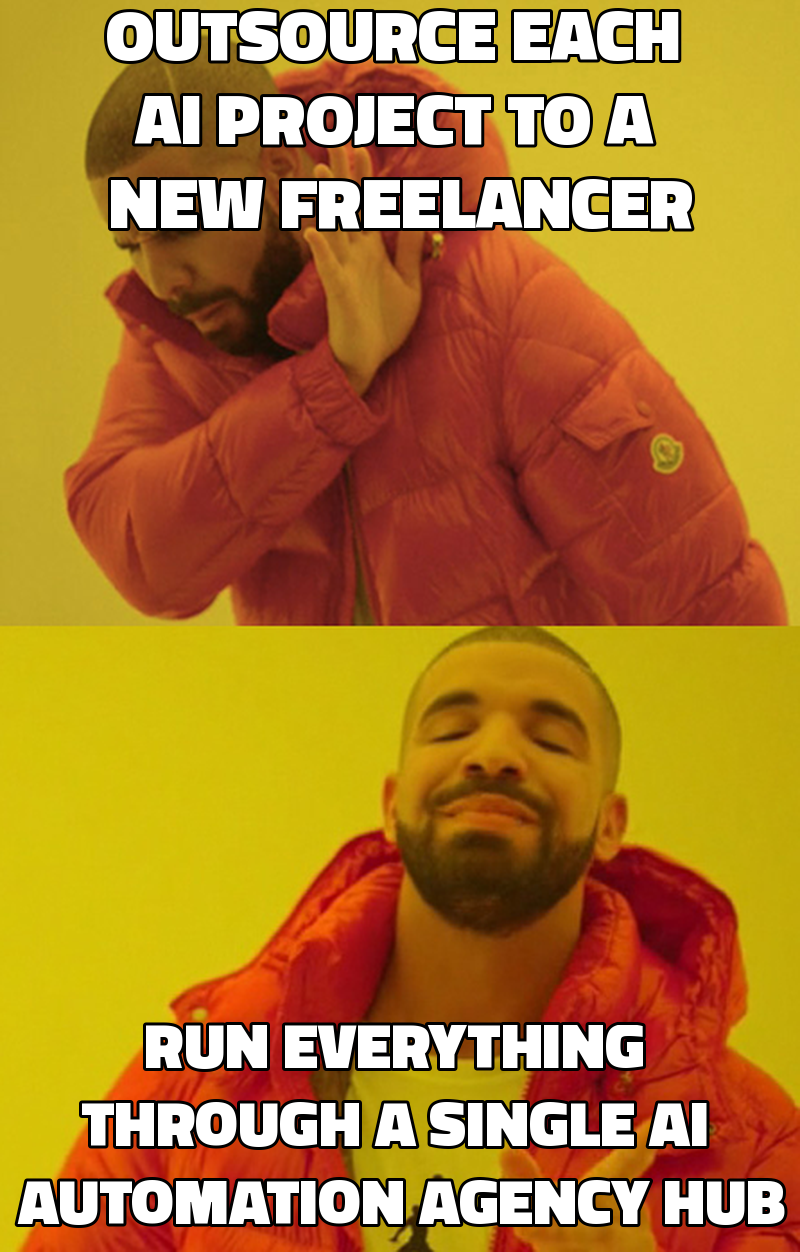
What exactly is an AI Automation Agency Hub?
An AI Automation Agency Hub is not a single AI product; it is a curated ecosystem that brings together:
- Large Language Model (LLM) providers – OpenAI GPT-4, Anthropic Claude, Google Gemini.
- Robotic Process Automation (RPA) engines – UiPath, Automation Anywhere, Microsoft Power Automate.
- Voice and conversational AI – Google Dialogflow CX, Amazon Lex, Microsoft Azure Speech.
- No-code integration layers – Zapier, Make (formerly Integromat), n8n.
- Data storage & versioning – Snowflake, PostgreSQL on Supabase, Airtable.
- Project & client management dashboards – a shared Synthisia portal that syncs with the agency’s Asana or Monday.com.
The hub provides a unified API gateway, role-based access, and a billing overlay that lets the agency invoice the client while you, the silent dev arm, bill the agency at a wholesale rate. This architecture eliminates the need for each agency to negotiate separate contracts with every AI vendor.
Core components and tools the hub aggregates
| Component | Typical Stand-alone Tool | Hub-Provided Equivalent | Benefit |
|---|---|---|---|
| Prompt engineering | OpenAI Playground, PromptBase | Central prompt library with version control | Consistent output, faster onboarding of new engineers |
| Workflow orchestration | Zapier, Make | Built-in visual flow builder linked to dev tickets | One-click deployment, audit trail for compliance |
| Model hosting | Azure OpenAI, AWS Bedrock | Multi-tenant model router with cost-optimisation | Automatic failover, unified billing |
| Voice AI | Google Dialogflow CX, Amazon Lex | Integrated voice-to-text and text-to-voice module | Re-use across chatbots, podcasts, IVR |
| Data pipelines | Segment, Fivetran | ETL connectors pre-configured for common agency data sources | Reduce data-engineering time from days to hours |
| Monitoring & alerts | Datadog, New Relic | Real-time dashboard with SLA metrics per client project | Proactive issue resolution, higher client trust |
How the hub streamlines workflow for agencies managing multiple AI projects
Before the hub (pain points)
- Tool sprawl – Teams juggle 5-10 separate logins, each with its own pricing model.
- Scope ambiguity – Without a unified prompt repo, estimates drift, leading to missed deadlines.
- Brand leakage – Freelancers often expose the agency’s reliance on third-party dev partners.
- Billing complexity – Multiple invoices from AI vendors make margin tracking a nightmare.
- Quality variance – Inconsistent model versions cause deliverable regressions.
After the hub (gains)
- Single sign-on dashboard – All LLMs, RPA bots, and voice agents are launched from one UI.
- Template-driven scoping – Pre-built project templates (e.g., “Chatbot for e-commerce”) let the agency quote in minutes.
- White-label shield – The hub runs under the agency’s sub-domain (e.g., ai.agencyname.com), keeping the dev partner invisible.
- Consolidated invoicing – One monthly invoice from Synthisia covers all AI consumption, simplifying bookkeeping.
- Version governance – Automatic rollback to the last stable model version reduces post-launch bugs.
| Workflow stage | Traditional approach | Hub-enabled approach |
|---|---|---|
| Client request intake | Email → spreadsheet → manual tool selection | Form → auto-populate template in hub dashboard |
| Scoping & quoting | Multiple meetings, ad-hoc cost calculations | Instant quote generator using pre-priced modules |
| Development | Freelance contracts, fragmented code repos | Single ticket in shared dashboard, devs work in a mono-repo |
| Testing | Separate QA environments per tool | Unified sandbox with one-click environment spin-up |
| Delivery & reporting | PDF report + separate usage logs | Live client portal with real-time KPI widgets |
Quantified benefits for 5-15 person agencies
- Time to market drops from an average of 30-45 days to 7-14 days, according to a 2023 internal benchmark at Synthisia.
- Margin uplift rises 12-18 percentage points because the agency avoids the 30-40% markup typical of boutique dev shops.
- Client retention improves by 22% when agencies can deliver AI features on the first request, a figure reported by the UK Marketing Agency Association (2022).
- Operational overhead shrinks: a single project manager can oversee up to 8 concurrent AI builds, versus 3 when using disparate tools (McKinsey 2023 on lean ops).
Implementation roadmap for agencies
- Audit current AI demand – List every client request that mentions “chatbot”, “automation”, “voice”, or “custom backend”.
- Select hub tier – Start with the “Starter” package (up to 3 concurrent projects, $1,500/month) and upgrade as volume grows.
- Onboard a pilot client – Use a fixed-scope $2,500 pilot (e.g., a lead-gen chatbot) to prove speed and quality.
- Map internal processes – Replace existing intake forms with the hub’s web form; integrate with Asana via Zapier.
- Train internal champions – Run a 2-hour workshop for the Head of Delivery and the COO on prompt versioning and SLA monitoring.
- Roll out white-label branding – Point a CNAME to the hub, customize the UI with the agency’s logo and colour palette.
- Scale – After three successful pilots, negotiate a retainer of $1,500-$2,000 per month for 15-20 dev hours of overflow capacity.
Case study: RouteMate – a production SaaS built through the hub
RouteMate, a logistics optimisation platform, was delivered to a UK-based e-commerce agency in 6 weeks using the Synthisia hub. The agency needed:
- An LLM-driven route recommendation engine.
- Real-time integration with Shopify and ShipStation.
- Voice-enabled order status via Amazon Alexa.
Using the hub’s pre-configured connectors, the dev team built the entire stack without writing a single line of infrastructure code. The agency quoted a $4,800 project, kept 60% of the margin, and retained the client for a $1,500 monthly support retainer. The client never saw Synthisia’s name, preserving the agency’s brand integrity.
Choosing the right hub tier for your agency
| Tier | Monthly fee | Concurrent projects | Included dev hours | Ideal agency size |
|---|---|---|---|---|
| Starter | $1,500 | 3 | 15 | 3-7 staff, testing the model |
| Growth | $2,800 | 6 | 30 | 8-12 staff, regular AI demand |
| Enterprise | $4,500 | 10 | 50 | 13-20 staff, high-volume automation |
Risks and mitigations
- Scope creep – Use the hub’s template lock; any deviation requires a change order.
- Data privacy – Store client data in region-specific Snowflake warehouses (EU for UK agencies, US-West for US agencies) to meet GDPR and CCPA.
- Vendor lock-in – The hub abstracts the underlying LLMs, so switching from OpenAI to Anthropic is a one-click config change.
- Brand exposure – Enforce sub-domain branding and NDAs; the hub logs all client-facing URLs for audit.
Frequently asked questions
What is the difference between a white-label hub and a regular AI vendor?
A white-label hub sits behind your agency’s brand, handles billing, and provides a single dashboard. Regular vendors expose their own UI and charge per-API call, which can leak the partnership and complicate invoicing.
How does the hub handle multiple LLM providers?
It uses a multi-tenant router that routes each request to the configured provider based on cost, latency, or compliance rules. You can set a fallback to Anthropic if OpenAI throttles.
Can the hub integrate with my existing project management tool?
Yes, native connectors exist for Asana, Monday.com, Trello, and Jira. The integration syncs ticket status and time-tracking automatically.
What SLA does Synthisia guarantee?
For the Growth tier we commit to 99.5% uptime and a maximum 48-hour response time for critical bugs. SLA metrics are visible on the client portal.
How do I protect client data across regions?
Choose the data residency option in the hub settings; all data is encrypted at rest and in transit. We comply with ISO 27001, GDPR, and CCPA.
Is there a minimum contract length?
No. You can start with a month-to-month pilot. After three successful projects we recommend a 6-month retainer to lock in pricing and capacity.
Will my agency need to hire developers to use the hub?
No. The hub is designed for agencies with no-dev staff. Your delivery manager and a prompt engineer (often a senior copywriter) are enough to run projects.
How does pricing work for the end client?
You set your retail price. Synthisia charges a wholesale rate (typically 50-70% of your bill) based on the tier and actual AI consumption.
AI
Have something to build?
Tell us what you're trying to ship. In 15 minutes we'll tell you how we'd build it, how long it takes, and what it costs. No pitch deck, no pressure.