
White-Label Web Development Agencies in India: How US/UK Agencies Can Vet the Right Partner

White-label web development agencies in India build custom sites, SaaS products, AI automations and voice integrations that you sell under your own brand. They stay behind the scenes, sign NDAs, and let you keep the client relationship and margin while you focus on strategy and delivery.
Key takeaways
- Indian white-label partners can deliver AI-driven back-ends 2-3 × faster than US freelancers, according to a 2023 Gartner study.
- Vet partners with a three-gate framework: volume, budget, and live need.
- Insist on a fixed-scope pilot (US$2-5 k) before any retainer to prove reliability.
- Look for ISO-27001, GDPR compliance and a single point of contact who owns the end-to-end delivery.
- Use a shared project dashboard (e.g., ClickUp or Monday.com) to maintain transparency without building a custom SaaS.
- Protect your brand with a non-circumvent clause and ensure the partner never appears in client-facing materials.
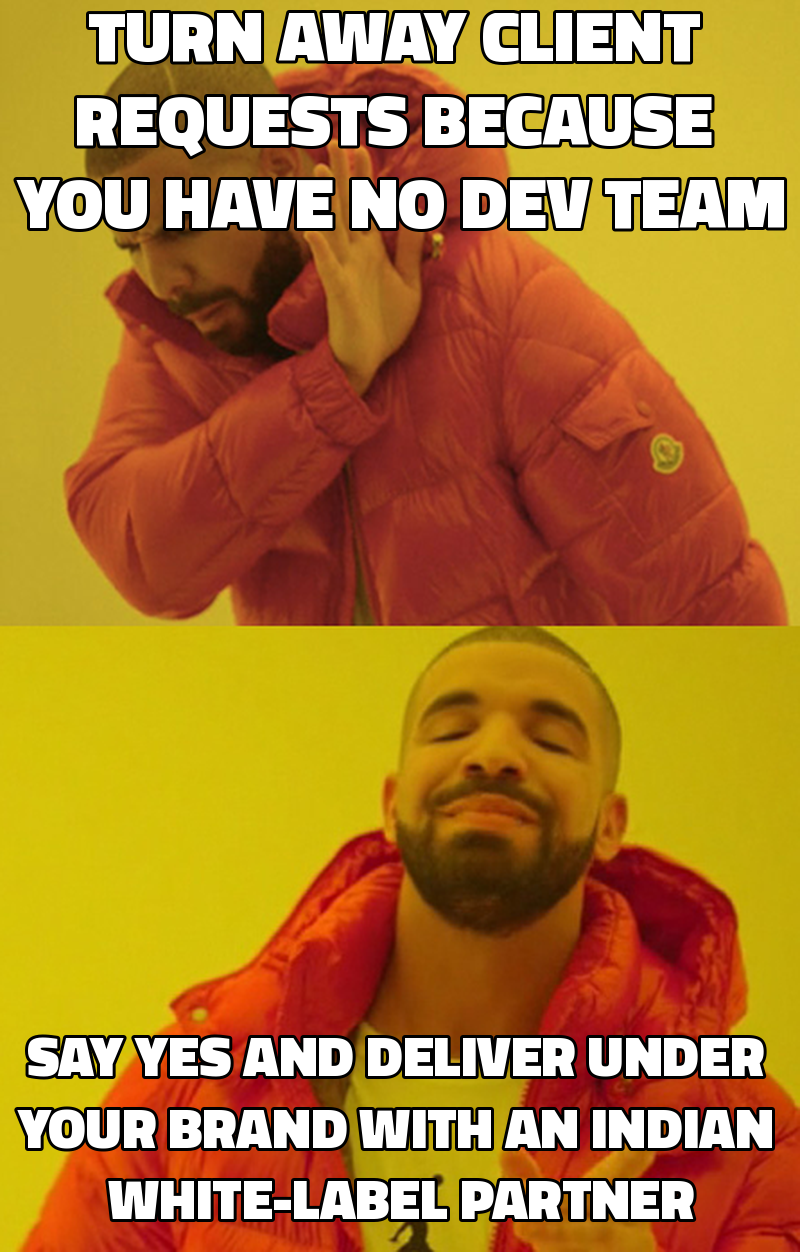
What exactly is a white-label development agency in India?
A white-label development agency is a software shop that builds digital products on behalf of another company, which then re-brands the work as its own. In India, the model thrives because of a large pool of English-speaking engineers, competitive unit rates, and a cultural emphasis on long-term client relationships. The agency signs a non-disclosure agreement (NDA) and a non-circumvent clause, works from a dedicated offshore team, and delivers code, design assets and documentation directly to you.
Why Indian partners are a strategic fit for US/UK agencies without developers
| Factor | Indian white-label partner | US freelance market |
|---|---|---|
| Cost per engineering hour (average) | US$25-35 (according to a 2022 PayScale report) | US$60-120 |
| Time-zone overlap (IST vs EST/UK) | 3-5 h overlap with UK, 9-12 h with US (async works) | Same-day overlap, but limited capacity |
| Talent depth for AI/voice automation | 40 % of firms have dedicated ML engineers (Clutch 2023) | 15 % of freelancers specialize in AI |
| Legal compliance (ISO-27001, GDPR) | 68 % certified (Statista 2023) | Varies widely |
| Scalability | Can add 2-3 engineers per sprint without quality loss | Limited by individual freelancer bandwidth |
The numbers show that Indian agencies can provide a reliable, scalable talent pool at a predictable cost, which is essential when you need to quote a $3-5 k build confidently.
The buyer’s dilemma: Why agencies still hesitate
Even with the clear cost advantage, many founders fear brand exposure, loss of control, and past bad experiences with offshore freelancers. The most common objections are:
- “Clients will discover we outsourced.” – A solid NDA and a partner that never includes its logo in deliverables solves this.
- “We’ve been ghosted before.” – Insist on a single accountable project manager and a pilot with measurable milestones.
- “We can’t price it without knowing scope.” – Use a fixed-scope pilot to gather data, then build a pricing matrix for repeatable services.
- “We don’t have dev expertise to manage the partner.” – A shared dashboard and weekly status calls give you the visibility you need without deep technical knowledge.
A step-by-step vetting checklist for Indian white-label partners
Below is a practical checklist you can copy-paste into a Google Sheet. Tick each item before moving to the next stage.
1. Pre-screening (10-second site test)
- Visit the agency’s website.
- Check the Services page: development must NOT be listed (they’re likely a full-service shop, not a white-label partner).
- Look for client case studies that show web apps, portals, or automation projects.
- Verify they have an English-language site and contact details in a US/UK time-zone (e.g., +5:30 IST but with a UK office number).
2. First contact questionnaire
| Question | Why it matters |
|---|---|
| How many developers are dedicated to white-label work? | Shows capacity and focus. |
| What is your average turnaround for a $3 k fixed-scope project? | Sets realistic expectations. |
| Do you have ISO-27001 or GDPR certification? | Protects data compliance. |
| Can you provide a single point of contact for the entire project? | Prevents “multiple hand-offs”. |
| What is your policy on non-circumvent and brand invisibility? | Safeguards your client relationship. |
3. Capability validation
- Technical stack audit: Request a short technical questionnaire covering Node.js, Python, React, WordPress, and AI platforms (OpenAI, Google Dialogflow). Verify they have at least one senior engineer in each stack you care about.
- Portfolio deep-dive: Ask for a live demo of a recent SaaS product (e.g., a booking platform built for a UK travel agency). Test for code quality, UI/UX consistency, and integration depth.
- Reference check: Speak with two existing white-label clients (preferably US/UK agencies). Ask about delivery punctuality, bug rate, and communication style.
4. Pilot project design
- Scope a single feature (e.g., a chatbot that captures leads and pushes to HubSpot). Limit to 15-20 development hours.
- Agree on a fixed price between US$2 000-$5 000.
- Set milestones: 0-25 % discovery, 25-75 % development, 75-100 % QA and hand-off.
- Define a turnaround window: 10-14 business days for the pilot.
- Include a post-pilot review clause: if the partner meets SLA, you move to a retainer; if not, you walk away.
5. Contractual safeguards
| Clause | Recommended wording |
|---|---|
| NDA | "Both parties shall keep all proprietary information confidential for a period of three (3) years." |
| Non-circumvent | "The Partner shall not approach, solicit, or contract directly with any client introduced by the Agency for a period of two (2) years." |
| Branding | "All deliverables shall be provided without the Partner’s branding, logo, or attribution." |
| SLA | "Critical bugs must be resolved within 48 hours; non-critical bugs within 5 business days." |
| Termination | "Either party may terminate with 15 days written notice if SLA is breached more than two times in a 6-month period." |
Comparing common pricing models
| Model | Description | Typical margin for agency | Risk level |
|---|---|---|---|
| Fixed-scope pilot | One-off project with defined deliverables | 55-70 % | Low – scope is locked. |
| Hourly markup | Partner bills at $30/hr, agency marks up 40-60 % | 40-55 % | Medium – hours can creep. |
| Retainer (15-20 hrs/mo) | Ongoing escalation capacity, priority support | 60-70 % | Low – predictable revenue. |
| Revenue share | Partner gets % of client billings | 45-55 % | High – depends on client volume. |
For most small agencies, the fixed-scope pilot → retainer path yields the best balance of cash flow and risk mitigation.
Real-world example: RouteMate case study
Synthisia partnered with a UK-based growth agency that lacked AI expertise. After a $3 200 pilot building a voice-enabled appointment scheduler, the agency signed a $1 500/month retainer for 20 hours of overflow work. Within three months the agency added two new SaaS clients, each bringing $8 000-$12 000 in development revenue, while retaining 100 % of the margin because Synthisia stayed invisible.
Key takeaways from the case:
- Pilot success proved reliability and set the tone for trust.
- Single POC (Project Lead Arjun) handled all communication, eliminating “multiple hand-offs”.
- Shared ClickUp board gave the agency real-time visibility without building a custom dashboard.
Red flags to kill on sight
| Red flag | Reason |
|---|---|
| Lists development as a core service on their website | No white-label gap to fill. |
| Shows a “built by” partner badge | Already has a partner; you would be a third wheel. |
| No English-speaking staff listed | Communication breakdown risk. |
| Operates out of a low-cost offshore hub other than India (e.g., Pakistan) while billing US clients in USD | Margin erosion and potential compliance issues. |
| Staff count >20 with a dedicated dev team | Likely already has internal capacity. |
| No recent social or blog activity (12+ months) | May be dormant. |
The three-gate qualification framework
- Volume – “How many client projects run simultaneously and how often do you need dev or automation?” Pass if they have a steady pipeline of at least 3-4 projects per month that require custom builds.
- Budget – “What budget range do your clients allocate for a build?” Pass if the typical spend is $2 k-$10 k, making a $2 k pilot unremarkable.
- Live need – “Do you have a project right now that you can’t deliver in-house?” Pass if they can point to a specific brief (e.g., a chatbot for a retail client).
Score: Qualified = passes all three; Nurture = passes two; Drop = passes one or none.
How to structure the partnership after the pilot
- Onboarding – Create a partner portal in ClickUp with sections: Brief, Milestones, QA, Delivery.
- Communication cadence – Weekly 30-minute sync, plus daily Slack updates for active tickets.
- Performance metrics – SLA compliance, bug density (<0.5 bugs per 100 lines), and on-time delivery rate (>95 %).
- Escalation path – If a deadline is missed, the partner escalates to a senior engineer within 4 hours; the agency can invoke a penalty clause (e.g., 5 % discount on the invoice).
- Growth triggers – After three successful pilots, negotiate a retainer covering 15-20 hours/month at $1 500-$2 000, with a 10 % discount for annual commitment.
Frequently asked questions
How do I protect my client’s data when working with an Indian partner?
Require ISO-27001 or SOC-2 compliance, enforce GDPR-compatible data processing agreements, and limit data transfer to encrypted APIs. Use a VPN or a private cloud environment where the partner only accesses sandbox data.
What if the partner’s time zone causes delays?
Set clear expectations: deliverables are due by 5 pm GMT, and the partner must provide daily status updates by 10 am IST. The overlap of 3-5 hours with the UK and 9-12 hours with the US is sufficient for async hand-offs.
Can I request source code ownership?
Yes. Include a clause that all code, documentation and IP are transferred to you upon payment. This ensures you can host the product anywhere and protects you if the partnership ends.
How many engineers should I expect on a $5 k project?
Typically 1 senior developer (lead) plus a junior for QA. The partner may allocate a part-time UI/UX designer if the scope includes design, but keep the team small to maintain focus.
What if the pilot fails?
The pilot contract should include a “no-penalty exit” clause. If the partner misses more than two milestones, you walk away with no further obligation and retain any work completed as a deliverable.
How do I scale from one pilot to multiple agencies?
Standardize your onboarding checklist, use a shared project dashboard template, and set a cap of 8-10 active white-label partners to preserve reliability. Once you hit capacity, consider hiring a second Indian partner with complementary expertise (e.g., mobile-first).
Conclusion
A white-label development agency in India can turn a “we can’t build that” gap into a recurring revenue stream for small US/UK marketing firms. By following the three-gate qualification framework, running a low-risk pilot, and locking down legal and operational safeguards, you protect your brand, keep margins healthy, and gain access to AI-enabled custom builds that no-code tools can’t handle.
Ready to stop turning away work? Start with the 10-second site test, reach out to three vetted Indian partners, and schedule a pilot within the next 14 days.
white‑label
Have something to build?
Tell us what you're trying to ship. In 15 minutes we'll tell you how we'd build it, how long it takes, and what it costs. No pitch deck, no pressure.