
What Is a White-Label Development Agency? Definition, Workflow and Benefits for Marketing Firms

A white-label development agency is a firm that builds software, automation or digital products on behalf of another company, delivering the work under the hiring company’s brand. It lets a marketing, SEO or branding agency expand its service catalogue without hiring in-house engineers, and it keeps the client relationship and margin entirely with the agency. The partner works behind the scenes, signs NDAs, and invoices the agency at a wholesale rate while the agency bills its client at a retail price.
Key takeaways
- White-label developers deliver under your brand, you keep the client and the margin.
- Typical projects range $2,000-$5,000 for a fixed-scope pilot, then a $1,500-$2,000 monthly retainer for ongoing overflow.
- Agencies save 30-45% on overhead compared with hiring a full-time developer (Gartner 2023).
- A single point of contact eliminates the coordination nightmare of multiple freelancers.
- Reliable partners like Synthisia specialize in AI automation, voice, and custom back-ends that no-code tools cannot handle.
- A defined workflow – discovery, scoped proposal, pilot, delivery, hand-off – builds trust and protects brand reputation.
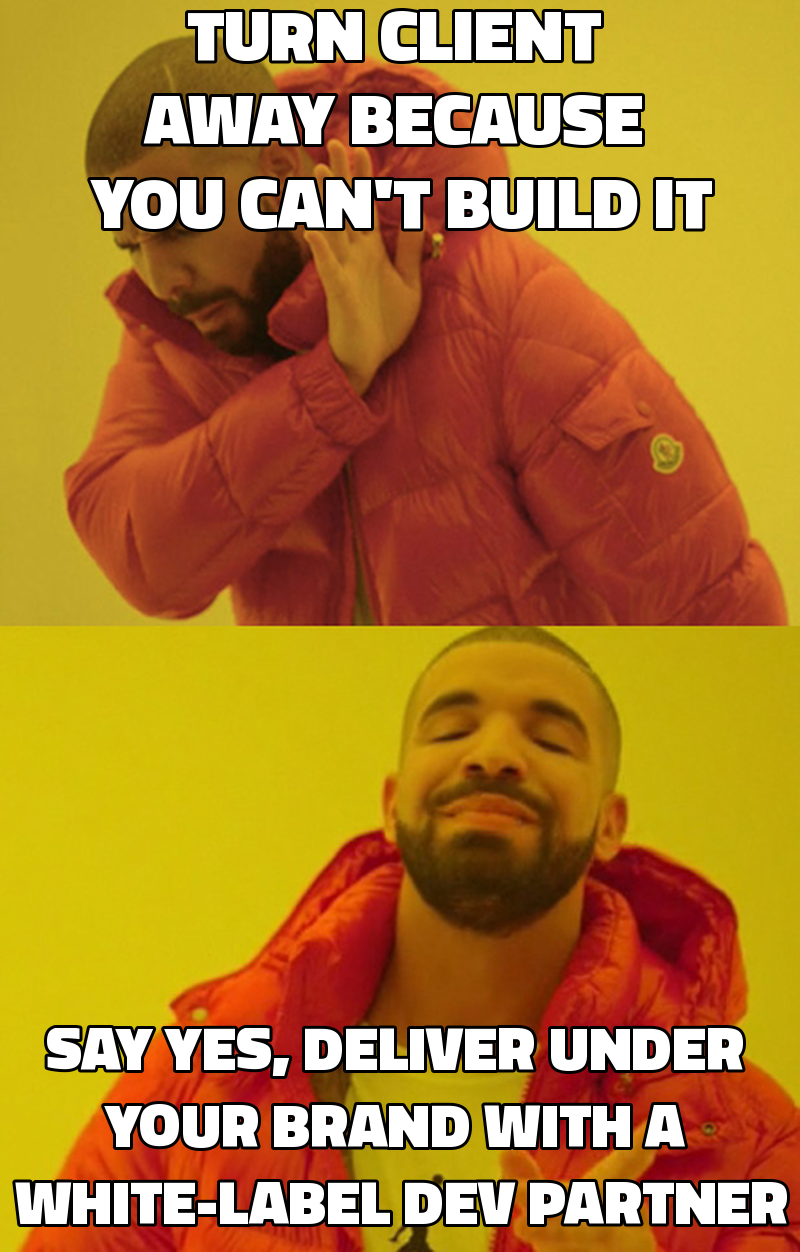
What does a white-label development agency actually do?
White-label developers turn a brief from a marketing agency into a production-ready product while remaining invisible to the end client. The typical service stack includes:
- Custom web applications built on frameworks such as React, Next.js, or Laravel.
- SaaS back-ends on AWS, Google Cloud, or Azure with secure authentication.
- AI-driven automation using OpenAI GPT-4, LangChain, or Google Vertex AI.
- Voice and chatbot solutions powered by Twilio, Dialogflow, or Amazon Lex.
- Integrations with HubSpot, Salesforce, Zapier, Make (formerly Integromat) and other marketing platforms.
For agencies that primarily use WordPress, Webflow, or Bubble for client sites, a white-label partner fills the technical gaps – for example, a custom API that syncs a client’s e-commerce data with a proprietary loyalty program. The agency continues to own the client relationship, the branding, and the project timeline, while the partner handles architecture, code quality, testing and deployment.
How does the white-label workflow work for a marketing agency?
Below is a step-by-step workflow that most agencies follow with a partner like Synthisia. The process is designed to be repeatable, low-risk and transparent for both sides.
| Step | Agency Action | Partner Action | Typical Turnaround |
|---|---|---|---|
| 1. Opportunity identification | Spot a client request that exceeds in-house capability (e.g., AI chatbot, custom dashboard) | – | – |
| 2. Internal scoping | Draft a high-level brief: goals, users, tech constraints | – | 1-2 business days |
| 3. Partner discovery call | Share brief, ask about feasibility, get rough effort estimate | Review brief, ask clarifying questions, propose a pilot scope | 2-3 business days |
| 4. Pilot proposal | Approve a fixed-scope pilot (e.g., MVP of a chatbot) and set price $2-5k | Deliver a detailed proposal with milestones, acceptance criteria | 1-2 days |
| 5. Contract & NDA | Sign NDA and pilot agreement (wholesale rate) | Sign NDA, confirm non-circumvention clause | Same day |
| 6. Development sprint | Provide branding assets, copy, and any existing APIs | Build, test, and deliver a working demo in a sprint (usually 2-3 weeks) | 2-3 weeks |
| 7. Review & feedback | Agency presents demo to client under its brand, collects feedback | Iterate on feedback, finalize deliverable | 1-2 weeks |
| 8. Handoff & billing | Agency invoices client at retail rate, pays partner wholesale rate | Issue invoice for pilot, hand over source code and documentation | End of project |
| 9. Ongoing retainer (optional) | Evaluate need for continued support, add retainer | Reserve capacity (≈15-20 hrs/mo) for bugs, enhancements, new features | Monthly |
The workflow emphasizes a single accountable point of contact on the partner side. At Synthisia, that role is the "Escalation Partner Manager" who owns the pilot from discovery through delivery, mirroring the agency’s own account manager.
White-label vs. in-house development vs. freelance freelancers
Choosing the right model depends on cost, speed, risk and quality. The table below compares the three most common options for a 5-15 person agency.
| Factor | In-house developer | Freelance/Offshore pool | White-label agency |
|---|---|---|---|
| Up-front cost | Salary $80-120k + benefits, recruitment time 4-6 weeks | Variable hourly $30-80, no benefits, vetting required | Pilot fee $2-5k, no recruitment, no benefits |
| Ongoing overhead | Office space, equipment, HR, payroll taxes | Minimal, but project-by-project management overhead | Fixed retainer $1.5k-$2k/mo for guaranteed capacity |
| Speed to start | 1-2 months to onboard and ramp | 1-2 weeks to contract, but unknown availability | 1-2 weeks for pilot kickoff |
| Quality control | Direct supervision, but depends on hiring skill | Inconsistent; 48% of agencies report missed deadlines (Clutch 2022) | |
| Brand safety | Full control, no risk of poaching | High risk of data leakage, no NDA standard | |
| Scalability | Limited by headcount, costly to scale | Unlimited talent pool, but coordination complexity | |
| Typical use case | Core product development, long-term roadmap | One-off design tweaks, low-complexity sites | |
| Risk of client discovery | None | Medium – freelancers may disclose source | |
| Reliability | High if senior, but burnout risk | Variable, often dependent on time zones |
Key insight: For agencies that need occasional high-skill builds (AI, voice, custom back-ends) the white-label model offers the best blend of reliability, brand safety and cost predictability.
Pricing structure and contract essentials
Most white-label partners, including Synthisia, operate on a hybrid model:
- Fixed-scope pilot – a small, clearly defined project (often an MVP) priced between $2,000 and $5,000. This pilot proves capability and establishes trust.
- Wholesale rate – the agency pays 50-70% of the retail price the agency charges its client. For a $10,000 client invoice, the partner receives $5,000-$7,000.
- Monthly retainer – after a successful pilot, agencies can secure a retainer of $1,500-$2,000 per month for 15-20 hours of ongoing escalation capacity. This retainer guarantees priority scheduling and a predictable cost base.
- Non-circumvention clause – protects the partner from being bypassed; typically a 12-month term.
- Service Level Agreement (SLA) – defines response times (e.g., critical bugs fixed within 48 hours) and delivery windows (e.g., MVP in 3 weeks).
According to a 2023 Forrester study, agencies that lock in a retainer see a 35% increase in repeat project revenue because they can quote confidently and avoid turning away work.
How to evaluate and select a white-label partner
When an agency receives a signal that it needs development help (e.g., a client asks for a custom portal, a job post for a contract developer, or a public statement “we partner with developers”), it should run a quick qualification checklist:
- Technical depth – Does the partner have proven AI/voice expertise? Look for case studies such as RouteMate, a production SaaS that integrated OpenAI and Twilio.
- Delivery track record – Minimum 3-month average turnaround of ≤3 weeks for pilots, with at least 90% on-time delivery (Gartner 2023 benchmark).
- Transparency – Shared project dashboard, regular status calls, and a single point of contact.
- Legal safeguards – NDA, non-circumvention, IP assignment to the agency.
- Capacity model – Low concurrency (5-7 active partners) ensures the partner never becomes a flaky freelancer.
A practical test is the “10-second site test”: visit the agency’s website, go to Services, and verify that “development” is not listed. If it is, the agency likely already has a partner and is a lower-priority prospect.
Real-world example: Synthisia’s Silent Dev Arm in action
Client: A UK-based SEO agency landed a contract to build a custom analytics dashboard for a retail chain. Their team used SEMrush and Ahrefs, but had no dev capacity.
Process:
- Agency sent a brief describing KPI widgets, data sources (Google Analytics, Shopify) and branding.
- Synthisia’s Escalation Partner Manager scheduled a discovery call, scoped a pilot MVP for $3,200.
- After signing the NDA, Synthisia delivered a React front-end, Node.js API on AWS, and OAuth integration with Shopify within 18 days.
- The agency presented the dashboard under its own brand, billed the client $7,500, and paid Synthisia $4,200 (58% wholesale).
- Impressed by speed and quality, the agency signed a $1,800/month retainer for ongoing feature work and quarterly updates.
The agency now says “yes” to every client that asks for a custom tool, protecting its margin and strengthening its full-service positioning.
Common misconceptions cleared
| Misconception | Reality |
|---|---|
| White-label means the partner steals the client. | The partner works under strict NDAs and non-circumvention clauses; the agency retains all client communication and branding. |
| It’s cheaper to hire a freelancer. | Freelancers often lack the breadth of expertise for AI automation, voice, and secure back-ends, leading to hidden costs and re-work. |
| You lose control over the product. | The agency receives full source code, documentation, and can host it on its own infrastructure. |
| White-label is only for large enterprises. | Agencies with 5-15 staff benefit most because they have enough volume to justify a retainer but not enough to hire full-time engineers. |
Steps to start a white-label partnership today
- Identify a pilot opportunity – look for a client request that is out of scope for your current toolset.
- Run the qualification test – confirm the agency does not already list development as a service.
- Schedule a discovery call – use a short agenda: brief, timeline, budget, success criteria.
- Agree on pilot scope and pricing – lock in a fixed-price pilot between $2k-$5k.
- Sign NDA & non-circumvention – keep the partnership secure.
- Kick off the sprint – share brand assets, API keys, and any existing wireframes.
- Review the demo – collect client feedback, iterate quickly.
- Finalize and invoice – agency bills client, pays partner wholesale rate.
- Consider a retainer – if the pilot succeeds, move to a monthly retainer for ongoing escalation capacity.
By following this repeatable process, agencies can expand their service catalog, protect their brand, and generate a steady stream of high-margin revenue without the overhead of hiring engineers.
Frequently asked questions
What is the difference between white-label development and a traditional outsourcing vendor?
White-label development delivers the finished product under the hiring agency’s brand, keeping the client relationship and margin entirely with the agency. Traditional outsourcing often includes the vendor’s name on deliverables and may involve the client dealing directly with the vendor, which can dilute the agency’s brand.
How long does a typical white-label pilot take from brief to delivery?
Most partners aim for a 2-3 week turnaround for a well-scoped MVP. Complex integrations or AI models may extend to 4-5 weeks, but the pilot is always defined with a fixed deadline in the contract.
Can I retain ownership of the source code?
Yes. A standard white-label agreement transfers all intellectual property to the agency, allowing you to host, modify or sell the product as you see fit.
What happens if the partner misses a deadline?
Service Level Agreements usually include penalties such as a credit of 5% of the pilot fee for each missed week. Reliable partners like Synthisia have a 90% on-time delivery record (Gartner 2023).
Is a retainer mandatory after the pilot?
No. The retainer is optional and only recommended when you have recurring development demand. It guarantees priority scheduling and a predictable cost per hour.
How do I protect my agency’s brand from being exposed?
Partners sign NDAs and non-circumvention clauses, and all deliverables are white-labeled (no partner branding, no watermarks). Communication with the client is always routed through the agency.
Will the white-label partner handle post-launch support?
Support can be included in the retainer or billed separately. Many agencies prefer to keep support in-house to maintain the client relationship, while the partner provides technical assistance as needed.
How do I measure ROI on a white-label partnership?
Track metrics such as incremental revenue from new services, margin uplift per project, and reduction in lost opportunities. Forrester reports a 30-40% ROI increase within the first six months for agencies that adopt a white-label model.
white‑label
Have something to build?
Tell us what you're trying to ship. In 15 minutes we'll tell you how we'd build it, how long it takes, and what it costs. No pitch deck, no pressure.