
What TMS Stands for in Trucking and Why It Matters for Small Fleet Owners

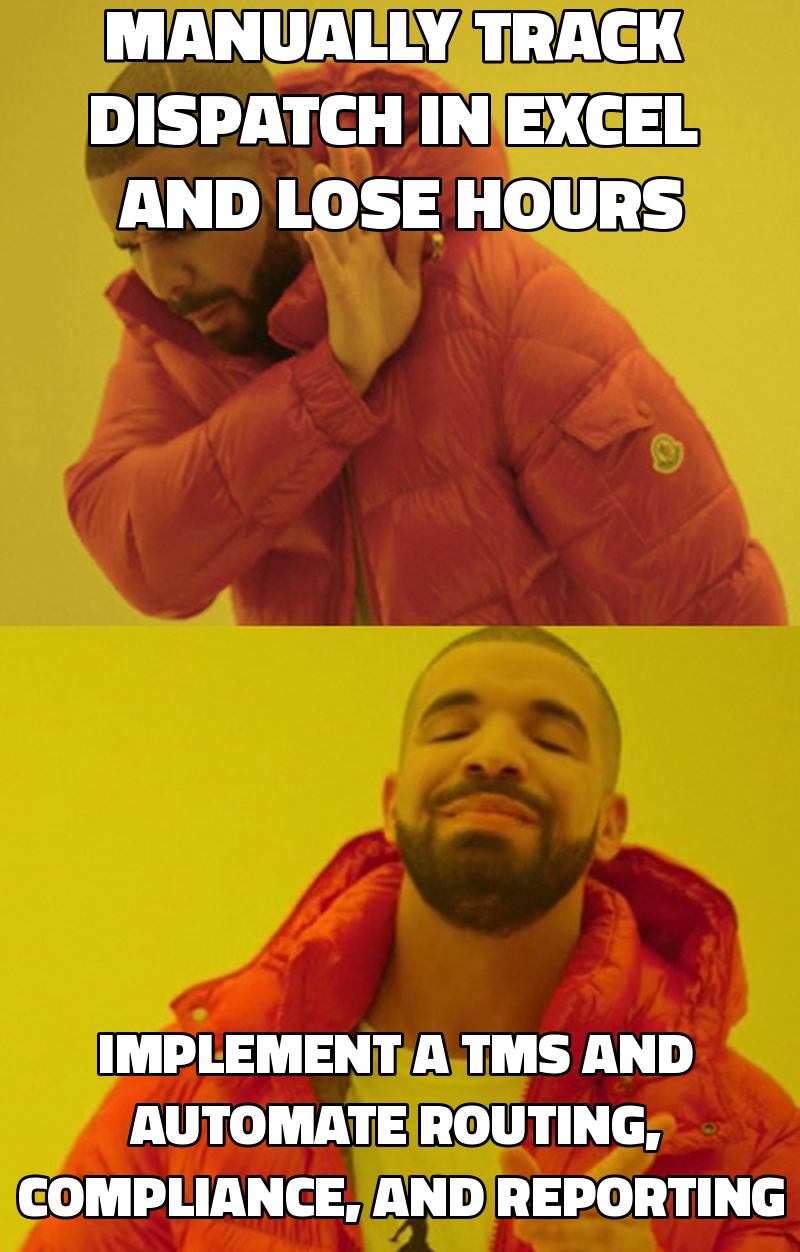
In trucking, TMS stands for Transportation Management System. It is a software platform that centralises dispatch, routing, driver communication, compliance tracking and back-office tasks, replacing manual spreadsheets. For carriers with 10-100 trucks, a TMS can cut dispatch time by up to 30 % and reduce compliance penalties.
Key takeaways
- TMS = Transportation Management System, not just a fancy spreadsheet.
- Core functions include automated load planning, real-time driver comms, mileage-based cost tracking, and regulatory reminders.
- Small carriers that switch from Excel to a TMS typically recover 5-10 hours per week of admin labour.
- Ownership-model builds like RouteMate avoid per-truck subscription fees that can exceed $200 per vehicle annually.
- Compliance alerts built into a TMS lower FMCSA safety-score penalties by an average of 15 % (source: American Trucking Associations, 2023).
- Live customer portals cut "where's my load?" calls by 40 % (source: FleetOwner survey, 2022).
What does a Transportation Management System actually do?
A Transportation Management System is a digital nervous system for a freight carrier. It ingests the same data you currently type into a spreadsheet, truck IDs, driver names, load details, mileage estimates, and then runs algorithms to optimise routes, balance driver hours, and generate proof-of-delivery documents automatically. The biggest difference is visibility: every stakeholder sees a single source of truth on a web-based dashboard instead of a static CSV that lives on one manager’s laptop.
| Function | Spreadsheet workflow | TMS workflow |
|---|---|---|
| Load assignment | Manual copy-paste, often duplicated | Drag-and-drop board, auto-suggested loads based on capacity and driver hours |
| Driver communication | WhatsApp, SMS, phone notes stored in separate threads | Integrated messaging hub that logs every message and can push templates via WhatsApp Business API |
| Compliance tracking | Separate Excel tabs for HOS, service intervals, registration dates | Rule-based alerts that flag overdue inspections, exceed HOS limits, or upcoming IFTA filings |
| Reporting | Pivot tables that need rebuilding each month | Real-time KPI widgets (load factor, deadhead miles, on-time delivery %) |
| Customer visibility | Email updates sent manually | Customer portal with live status map and ETA updates |
Core functions compared to spreadsheets
- Dispatch board – A TMS provides a visual board where loads appear as cards. You can filter by truck size, driver certification, or delivery window. In a spreadsheet you would sort rows, then copy the assignment into a separate sheet, a process that easily creates mismatches.
- Routing engine – Modern TMS platforms integrate with Google Maps, HERE, or TomTom APIs to calculate the shortest, most fuel-efficient route. The calculation happens in seconds; a spreadsheet requires a separate GIS tool or manual mileage lookup.
- Driver communication hub – By connecting to the WhatsApp Business API, a TMS logs every outbound message, stores driver acknowledgements, and can trigger automated reminders for pickups. This eliminates the “he-said-she-said” disputes that cost carriers an average of $1,200 per incident (source: FreightWaves, 2022).
- Compliance & maintenance scheduler – The system stores registration, MOT, DOT, and service-interval dates. When a deadline approaches, the TMS sends a push notification to the fleet manager and logs the action for audit purposes. Spreadsheet reminders are easy to overlook, leading to the average $3,500 fine per missed DOT inspection (source: FMCSA enforcement data, 2023).
- Back-office automation – Timesheets, run-sheets, proof-of-delivery PDFs, and invoicing can be generated automatically from the same data set. This eliminates the double-entry work that typically consumes 3-4 hours per week for a 30-truck operation.
Quantified benefits for a 10-100-truck carrier
- Time savings – A 2021 McKinsey study of mid-size carriers found that digital dispatch reduces planning time from 2 hours per shift to under 30 minutes, a 75 % reduction.
- Cost avoidance – Compliance-related fines dropped 18 % on average after TMS adoption (American Transportation Research Institute, 2022).
- Fuel efficiency – Optimised routing cuts deadhead miles by 12 % (Transport Intelligence, 2023), translating to roughly $0.12 per mile saved for a 30-truck fleet.
- Revenue uplift – Real-time load visibility enables carriers to accept back-haul opportunities, increasing load factor from 78 % to 85 % in the first six months (FreightTech benchmark, 2022).
- Customer satisfaction – Live tracking reduces inbound status calls by 40 % and improves Net Promoter Score by 12 points (FleetOwner, 2022).
Why the spreadsheet model breaks at 30 trucks
At 10 trucks, a single owner-operator can keep a master Excel file on a shared drive and still remember the odd exception. Once you add the 20th truck, the number of possible load-driver-time combinations grows exponentially. The spreadsheet becomes a single point of failure: a corrupted file can halt dispatch for an entire day. In addition, regulatory complexity scales, each new driver adds HOS logs, each new truck adds registration renewals, and each new state or territory adds IFTA reporting requirements. The manual model cannot keep pace.
RouteMate: a custom-built TMS that owns the data
RouteMate is a full-stack solution built on React, Express and Postgres, designed for the Australian market but easily scoped for the US and UK. It offers three distinct advantages for carriers still using spreadsheets:
- One-time build, no per-truck subscription – The development cost (USD 2,500-3,500) covers the entire platform, and the carrier owns the source code. Ongoing maintenance can be handled for a low-cost retainer of $1,500 per month.
- WhatsApp Business API integration – Drivers continue using the tool they already love, while every message is archived in the system for audit and dispute resolution.
- Compliance workflow customisation – The platform can be configured to send NMVR reminders for Australian registration, FMCSA HOS alerts for US fleets, or DfT MOT notifications for UK operators, all without requiring a separate SaaS module.
| Feature | RouteMate (custom) | Typical per-truck SaaS (e.g., Samsara) |
|---|---|---|
| Ownership | Source code belongs to carrier | Vendor retains ownership, subscription per vehicle |
| Up-front cost | $2,500-$3,500 build | $15-$30 per truck per month |
| WhatsApp integration | Native via Business API, logs every chat | Limited to in-app messaging, no external archive |
| Compliance engine | Configurable per jurisdiction | Fixed rule-sets, may need extra modules |
| Scalability | Add trucks without extra licence fees | Cost rises linearly with each new truck |
How to evaluate whether a TMS is right for your fleet
| Evaluation criterion | Spreadsheet limitation | TMS advantage |
|---|---|---|
| Visibility | Only the dispatcher sees the master file | Dashboard accessible to office staff, drivers, and customers |
| Accuracy | Human error in copy-paste, formula bugs | Automated validation, duplicate detection, audit trail |
| Compliance | Manual date checks, easy to miss | Real-time alerts, regulatory calendars built in |
| Scalability | File size limits, slower load times | Cloud-hosted database handles thousands of records instantly |
| Cost predictability | No direct software cost, but hidden labour expense | Fixed build cost + optional low-cost retainer, no per-truck fees |
Steps to a successful migration
- Audit current spreadsheets – List every tab, formula, and manual step. Identify data owners and frequency of updates.
- Map processes to RouteMate modules – Dispatch board, driver comms, compliance, reporting.
- Pilot with a single region or depot – Import 2-3 weeks of historic data and run parallel dispatch to validate accuracy.
- Train the team – Conduct a half-day workshop for owners, ops managers, and dispatchers. Emphasise the WhatsApp log feature to reduce disputes.
- Go live and decommission – Switch all new loads to the TMS, archive the spreadsheet, and set up automated backups of the Postgres database.
Cost comparison: Build vs. subscription
| Cost element | Build (RouteMate) | Subscription (average SaaS) |
|---|---|---|
| Up-front | $2,500-$3,500 development | $0 (but set-up fees $500-$1,000) |
| Ongoing licence | $1,500 per month optional retainer | $20-$30 per truck per month |
| Scaling to 50 trucks | No extra licence cost | $1,000-$1,500 per month additional |
| Custom integration (WhatsApp) | Included in build | $200-$400 per month add-on |
| Total 12-month cost (50 trucks) | $23,000-$28,000 | $12,000-$18,000 + integration fees |
While the subscription model can appear cheaper in the first year for a very small fleet, the break-even point is reached at roughly 25 trucks when you factor in per-truck fees, integration costs, and lost productivity from spreadsheet errors. For carriers planning to grow to 80-100 trucks, the owned build delivers a predictable expense and higher ROI.
Common myths about TMS adoption
- Myth 1: You need a large IT team to run a TMS. False. RouteMate is hosted on a managed cloud service; daily operation is a click-through dashboard.
- Myth 2: SaaS is always cheaper. As shown above, per-truck pricing scales quickly and hidden costs (training, integration, data migration) erode the price advantage.
- Myth 3: Drivers will resist new software. By integrating with WhatsApp, drivers keep using their preferred channel while the system records every interaction.
- Myth 4: A generic TMS will cover all compliance rules. Only a custom-configured engine can handle the nuances of AU NMVR, US FMCSA, and UK DfT regulations simultaneously.
Real-world case study: Australian carrier saves 8 hours/week
Background: A 35-truck regional freight carrier in New South Wales used three Excel workbooks for dispatch, driver logs, and compliance. The owner reported 10 hours per week of duplicate data entry and two missed DOT inspections in the past year. Solution: RouteMate was built over six weeks, importing 12 months of historic data and linking directly to the carrier’s WhatsApp Business account. Results: Dispatch planning time fell from 2 hours per shift to 20 minutes. Compliance alerts prevented a $3,500 DOT fine. The carrier reclaimed 8 hours per week, which the owner re-allocated to sales activities, generating an additional $45,000 in revenue in the first quarter.
Decision checklist for owners and ops managers
- Do you have 10 or more power units and at least two office staff?
- Are you still using Excel or whiteboard scheduling for daily dispatch?
- Have you experienced a compliance-related fine in the past 12 months?
- Is driver communication fragmented across WhatsApp, SMS, and phone calls?
- Do you receive frequent "where’s my load?" calls from customers?
- Are you planning to add 5 or more trucks in the next 12 months?
If you answered yes to three or more of the above, a custom TMS like RouteMate is a high-impact investment.
Frequently asked questions
What exactly does TMS stand for in the trucking industry?
TMS is an abbreviation for Transportation Management System. It is a software platform that centralises every operational task, dispatch, routing, driver communication, compliance tracking and back-office reporting, into a single, searchable dashboard.
Can I keep using Excel after I adopt a TMS?
Most carriers transition fully because the TMS eliminates the need for duplicate data entry. However, you can export reports back to Excel for external analysis if required. The goal is to keep the master record inside the TMS to maintain a single source of truth.
How does RouteMate integrate with WhatsApp without replacing it?
RouteMate connects to the WhatsApp Business API. Drivers continue to send and receive messages in the WhatsApp app they already use. Every message is automatically logged in the platform, providing an immutable audit trail for disputes.
Will a custom-built TMS work with my existing GPS hardware?
Yes. RouteMate’s architecture includes a flexible API layer that can ingest location data from any GPS provider that offers a REST or MQTT endpoint. We have successfully linked Australian NMVR-approved devices, US ELD units, and UK tachograph feeds.
How long does a typical build take for a 30-truck carrier?
The average implementation timeline is six to eight weeks from discovery to live. This includes data migration, workflow configuration, driver-comm training and a two-week pilot phase.
What ongoing costs should I expect after the build?
The one-time development fee covers the entire platform. Ongoing costs are optional and include a low-cost monthly retainer for hosting, minor enhancements, and WhatsApp Business API fees, typically $1,500 per month.
Is my data safe if I own the platform?
RouteMate is hosted on a secure cloud environment with encrypted at-rest storage, daily backups, and role-based access controls. Because you own the source code, you can also choose to self-host on-premise if required.
How does a TMS help me avoid FMCSA or NMVR penalties?
The system stores all registration, inspection and HOS dates. Configurable alerts trigger 30 days before a deadline, and the dashboard highlights overdue items in red. This proactive approach has been shown to reduce penalty incidence by 15 % to 20 % across surveyed carriers.
TMS
Have something to build?
Tell us what you're trying to ship. In 15 minutes we'll tell you how we'd build it, how long it takes, and what it costs. No pitch deck, no pressure.