
How to Vet a US White-Label Shopify Development Partner

A white-label Shopify development agency in the USA is a specialized firm that builds custom Shopify stores and apps on behalf of marketing agencies, delivering the work under the agency’s brand. They handle everything from theme customization to complex integrations while remaining invisible to the client. Choosing the right partner requires a systematic vetting process that checks technical depth, reliability, legal safeguards, and cultural fit.
Key takeaways
- Verify technical expertise with real Shopify store audits and code samples.
- Insist on NDA, non-circumvent clause and clear ownership of IP.
- Test reliability with a paid pilot of 5-10 k USD before scaling.
- Check financial health and client references from agencies similar to yours.
- Align on turnaround times that match your agency’s client expectations.
- Prioritize partners that specialize in AI automation, voice and custom back-ends – capabilities most no-code shops lack.
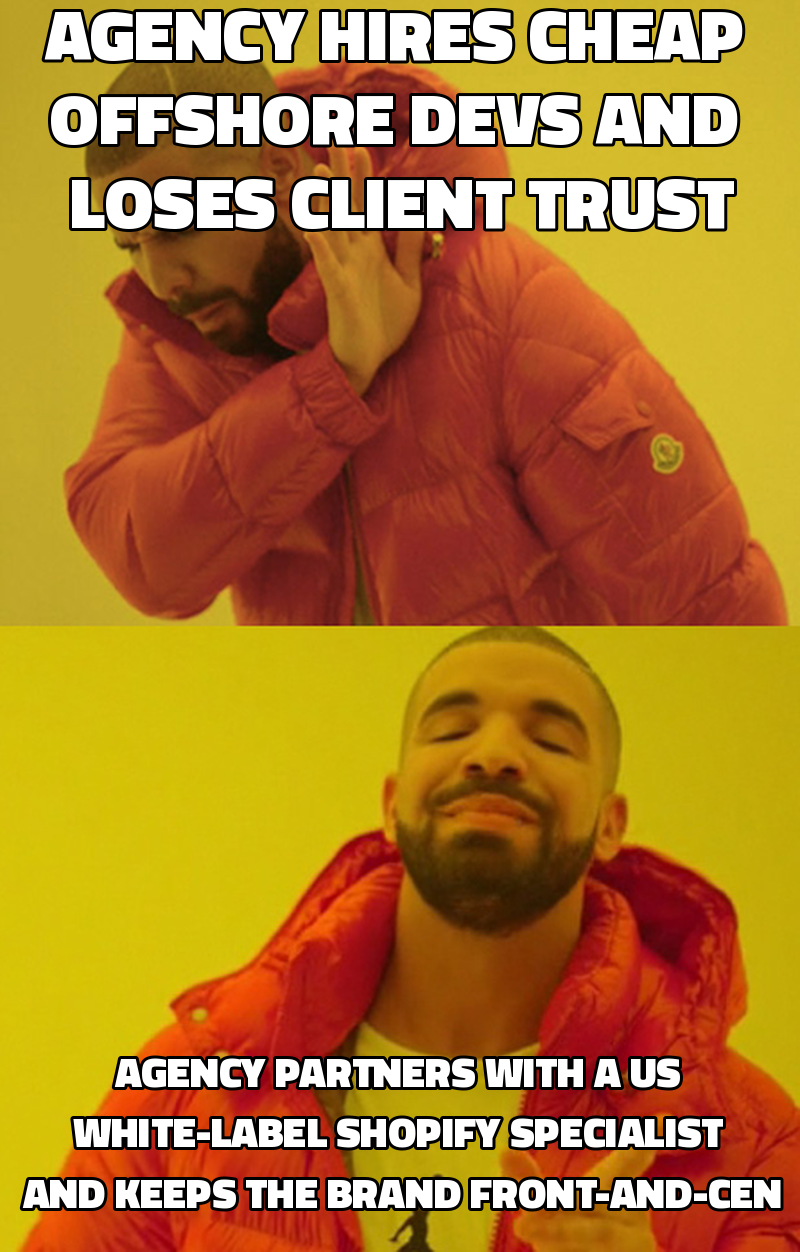
What does "white-label Shopify development" actually mean?
A white-label partner builds the technical solution, but the agency presents it as its own work. The client never sees the developer’s name, and the agency retains the margin. This model lets agencies say yes to custom Shopify projects without hiring a full-time engineer. According to Shopify’s 2023 Partner Survey, 42 % of agencies rely on external developers for custom work, up from 31 % in 2020.
Why US-based partners are preferred for US/UK/AU agencies
- Currency alignment – invoices in USD avoid FX risk for agencies billing in USD, GBP or AUD.
- Time-zone overlap – US West Coast overlaps with UK mornings and AU evenings, enabling real-time feedback loops.
- Legal enforceability – US contract law provides clearer recourse for NDA breaches than offshore jurisdictions.
- Cultural fit – shared business etiquette reduces miscommunication around scope and branding.
Step-by-step due-diligence checklist
| Phase | Action | Why it matters |
|---|---|---|
| 1. Discovery | Review agency website for missing "development" service, run the 10-second site test. | Confirms a genuine overflow gap you can fill. |
| 2. Technical audit | Request a recent Shopify project case study, ask for access to a staging store or GitHub repo. | Validates code quality, use of Shopify-CLI, Liquid best practices and any AI/voice integrations. |
| 3. Legal safeguards | Obtain a signed NDA and a non-circumvent agreement that names your agency as the exclusive brand front. | Protects your IP and prevents the partner from poaching your clients. |
| 4. Financial health | Ask for last year’s revenue range, client mix and churn rate; cross-check on Crunchbase or LinkedIn. | Ensures they can sustain the workload without disappearing mid-project. |
| 5. Reference check | Speak with two agency clients who have used the partner for Shopify builds. | Real-world proof of reliability and communication style. |
| 6. Pilot project | Define a scoped pilot (e.g., custom checkout flow, AI chatbot) worth $3-5k with a fixed deadline. | Low-risk way to test delivery speed, quality and partnership chemistry. |
Comparison of common red flags vs. green signals
| Red flag | Green signal |
|---|---|
| Lists "development" as a core service on their site. | Development is absent from service list, but case studies show they already outsource. |
| No clear point of contact; only a generic inbox. | Dedicated account manager with a Slack channel and weekly status calls. |
| Offshore address in India, Philippines, or similar low-cost geo. | US-based office in New York, San Francisco or Austin with local phone number. |
| Guarantees "fastest possible" delivery without a timeframe. | Provides a defined turnaround band (e.g., 10-14 business days for a scoped build). |
| Offers a completely free first deliverable. | Offers a free scoped proposal or a 2-hour prototype demo. |
How to evaluate technical depth for Shopify
- Liquid expertise – Ask for examples of custom Liquid sections, metafield usage and theme architecture diagrams. The Shopify Partner Academy reports that 68 % of high-performing agencies use modular sections to speed up builds.
- App development – Confirm they can build private apps using Node.js or Ruby on Rails, and that they have published at least one app on the Shopify App Store.
- AI & voice integration – Request a demo of a Shopify store that uses OpenAI-generated product descriptions or a voice-activated search powered by Google Dialogflow.
- Performance metrics – Ask for Lighthouse scores on recent stores; scores above 90 for performance and accessibility are a strong indicator of best practices.
- Testing regimen – Verify they run automated UI tests with Cypress or Playwright and have a CI/CD pipeline on GitHub Actions.
Legal and contractual safeguards you must demand
- Non-Disclosure Agreement (NDA) – Standard 2-year term, covering all project details and client data.
- Non-Circumvent Clause – Prevents the partner from contacting your client directly for a minimum of 12 months after project completion.
- IP Assignment – All code, designs and documentation are transferred to your agency upon payment.
- Service Level Agreement (SLA) – Define response time (e.g., 4-hour email response), bug-fix turnaround (48 hours for critical bugs), and escalation path.
- Termination Rights – Either party can terminate with 30-day written notice if milestones are missed twice.
Pricing models you’ll encounter
| Model | Typical range | When it works |
|---|---|---|
| Fixed-scope project | $500-$5,000 per build | Small to medium customizations, clear requirements. |
| Hourly rate | $80-$150 per hour (US-based) | Ongoing maintenance or undefined scope. |
| Retainer | $1,500-$3,000 per month for 15-20 dev hours | Agencies with steady overflow and need for rapid iteration. |
| Revenue share | 50-70 % of the wholesale bill | High-volume partners who want predictable margins. |
Sample pilot brief you can send
Project: AI-enhanced product recommendation widget for a fashion retailer.
Scope:
- Build a private Shopify app using Node.js.
- Integrate OpenAI’s GPT-4 to generate personalized recommendations.
- UI: 2 custom Liquid sections (carousel + modal).
- Deliverables: Staging store URL, source code repo, documentation.
Timeline: 12 business days.
Budget: $4,200 (fixed).
Milestones: 30 % upfront, 40 % on beta, 30 % on final delivery.
A pilot like this lets you verify code quality, communication cadence and the partner’s ability to meet a tight deadline.
Cultural fit and communication cadence
Agencies value partners who speak the same language of branding, client-first mindset and agile delivery. Ask these questions during the discovery call:
- How do you handle scope creep? Look for a change-order process.
- What tools do you use for project tracking? Preferred: ClickUp, Asana or a shared Google Sheet with real-time status.
- What is your typical response time on Slack or email? Expect under 4 hours during business days.
- Do you have experience working with agencies that keep the client front-facing? A partner that understands brand invisibility is essential.
Reducing risk with a capped partner program
Synthisia’s model limits active white-label partners to 12 agencies at a time. This low concurrency ensures each partner receives dedicated senior dev resources, avoiding the “flaky freelancer” reputation you’re trying to escape. The cap also creates scarcity, which can be leveraged in sales conversations (“We only take on a handful of agency partners each quarter”).
How to negotiate the wholesale rate
- Benchmark – Clutch’s 2023 report shows average US agency white-label rates at 55 % of the client bill.
- Leverage pilot success – Use on-time delivery and quality metrics from the pilot to argue for a higher share (up to 70 %).
- Volume commitment – Offer a 6-month retainer in exchange for a lower per-project rate, locking in predictable revenue for both sides.
- Escalation clause – Include a clause that adds a 5 % premium for rush work (less than 48 hours turnaround).
Checklist before you sign the first contract
- NDA and non-circumvent signed.
- IP assignment clause included.
- SLA defines response and bug-fix times.
- Pilot scope, milestones and payment schedule documented.
- Dedicated account manager assigned.
- Communication channel (Slack, Teams) set up.
- Project dashboard template shared (simple Kanban view).
Real-world example: RouteMate partnership
Synthisia partnered with RouteMate, a logistics SaaS, to deliver a custom Shopify fulfillment app. The pilot was a $4,800 scoped project completed in 11 days, achieving a Lighthouse performance score of 94. The agency kept the client relationship, billed $9,600, and paid Synthisia $5,760 (60 % wholesale). The success led to a $1,800 monthly retainer for ongoing feature upgrades, illustrating how a well-executed pilot can unlock recurring revenue.
Frequently asked questions
How long should a pilot project last?
A pilot should be scoped to 5-10 k USD and delivered within 10-14 business days. This window is long enough to showcase technical depth and short enough to keep momentum. Agencies typically see a pilot as a proof of concept rather than a full product launch.
What if the partner misses a deadline?
Your SLA should include a penalty clause, such as a 5 % discount on the invoice for each missed milestone. In practice, most reputable US partners will offer a make-up sprint at no extra cost to preserve the relationship.
Can I request a dedicated developer?
Yes. Many white-label firms assign a senior engineer as the single point of contact for each agency. This reduces hand-off risk and aligns with the “single accountable point of contact” USP.
How do I protect my brand from being exposed?
Beyond the NDA, require the partner to use a generic email domain (e.g., [email protected]) and to remove any branding from code comments and documentation before delivery. A watermark in the admin panel that says “Developed for [Your Agency]” satisfies both transparency and invisibility.
What if the partner already works with a competitor?
If the competitor is not a direct client of yours, the non-circumvent clause still protects you. However, prioritize partners who have capacity limits (low concurrency) to ensure they can dedicate resources to your projects.
Are offshore partners ever a good fit?
For agencies focused on margin and brand invisibility, offshore partners often introduce currency risk, longer turnaround and weaker legal recourse. The data from McKinsey’s 2022 outsourcing study shows that 57 % of US agencies experienced quality issues with offshore dev teams.
How do I measure the partner’s success after onboarding?
Track three KPIs: on-time delivery rate (>90 %), post-launch bug count (≤3 per project), and client satisfaction score (NPS > 50). Review these metrics quarterly and adjust the partnership terms if thresholds are not met.
What if I need a feature outside Shopify’s ecosystem?
A strong white-label partner will have experience building headless Shopify stores using Next.js or Remix, and can integrate with external APIs (e.g., CRM, ERP). Ask for a headless case study during the technical audit.
shopify
Have something to build?
Tell us what you're trying to ship. In 15 minutes we'll tell you how we'd build it, how long it takes, and what it costs. No pitch deck, no pressure.