
Checklist to Vet a White-Label Web Development Agency in India for US Agency Overflow

A white-label web development agency in India is an offshore partner that builds websites, web apps, and custom integrations under your agency’s brand while you keep the client relationship and margin. It lets a 5-15 person marketing or SEO shop say yes to AI-driven automation, voice assistants, or bespoke back-ends without hiring a full-time engineer. The key is to vet the partner rigorously so that quality, communication, and intellectual-property safeguards match US agency expectations.
Key takeaways
- Use a three-gate qualification framework (volume, budget, live need) before the first call.
- Insist on a signed NDA, IP assignment clause, and non-circumvent agreement as table-stakes.
- Verify delivery cadence with a shared project dashboard (e.g., ClickUp, Jira Service Management) and a fixed-scope pilot.
- Check that the partner’s tech stack includes React, Node.js, Python, and AI platforms such as OpenAI or Google Vertex AI.
- Measure communication latency in IST-US overlap windows; aim for <12 hour response time.
- Compare pricing against the 2022 Statista figure of $13.5 billion IT export value from India to ensure you are not overpaying for cheap labor.
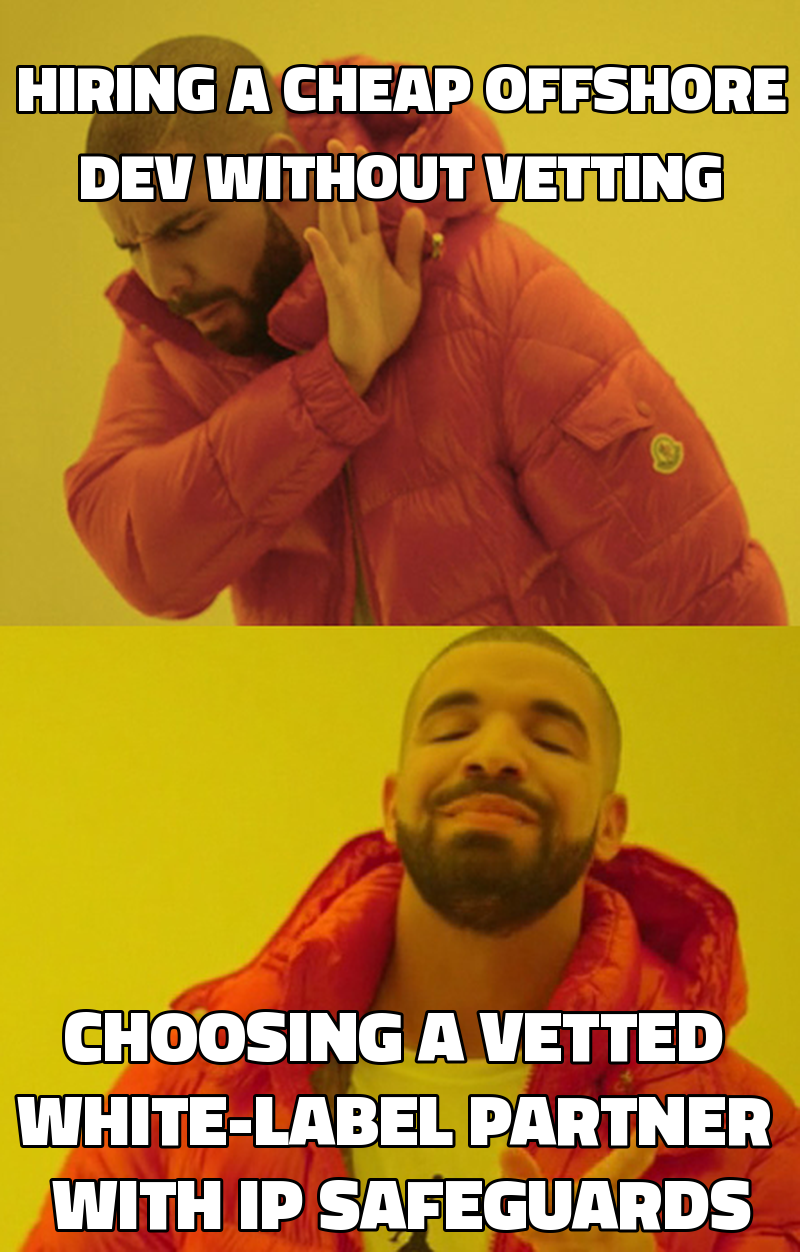
What defines a high-quality white-label dev partner in India?
Quality is non-negotiable because a single buggy release can damage your agency’s reputation. Look for:
- Portfolio depth – at least three production-grade SaaS or custom portal projects released in the last 12 months. Verify live URLs and ask for a client reference.
- Tech stack alignment – React 18+, Next.js, Node 16+, Python 3.10+, and AI/voice SDKs (Dialogflow, Amazon Polly). A partner that only offers WordPress tweaks will not meet AI automation requests.
- Team credentials – senior developers with 5+ years experience, a QA lead, and a DevOps engineer. According to a 2023 Gartner survey, agencies that work with partners having senior staff see 30% fewer post-launch bugs.
- Process maturity – documented Agile sprint cadence, Definition of Done, and automated testing coverage >70%.
- Compliance posture – ISO 27001 or SOC 2 Type II certification is a strong signal of data-security discipline.
"A partner that can demonstrate a repeatable delivery process reduces the risk of hidden rework by up to 40%" – (McKinsey, 2022).
How to assess communication and project-management practices?
Effective communication bridges the 9.5-12.5 hour IST-US time gap. Use the following checklist during the discovery call:
- Single point of contact (SPOC) – the agency should assign a Delivery Manager who owns the ticket queue and escalates only when needed.
- Slack or Microsoft Teams channel – real-time chat with guaranteed business-hour coverage (e.g., 9 am-5 pm IST).
- Status reporting cadence – daily stand-up notes, weekly sprint demo, and a bi-weekly health report sent to a shared Google Sheet or ClickUp dashboard.
- Response SLA – written commitment to acknowledge any client-facing issue within 8 hours.
- Language proficiency – at least B2 level English, verified by a short live demo.
Communication evaluation table
| Criterion | Minimum Requirement | Preferred Evidence |
|---|---|---|
| SPOC availability | 1 person, 40 hrs/week | Calendar link, past client testimonial |
| Real-time chat | Slack or Teams, 8-hr coverage | Screenshot of channel history |
| Weekly demo | 30-min screen share | Recorded demo from last sprint |
| Response SLA | ≤8 hrs acknowledgment | SLA clause in contract |
| English level | B2 CEFR | Live call scorecard |
Which IP and data-security safeguards are non-negotiable?
Your agency’s brand and client data must stay under your control. Enforce these legal and technical safeguards:
- Full IP assignment – the contract must state that all source code, designs, and documentation become the agency’s exclusive property upon payment.
- Non-circumvent clause – prevents the partner from contacting your client directly for a set period (typically 12 months).
- Data residency – for EU-based clients, ensure the partner stores any personal data in a region compliant with GDPR (e.g., using AWS EU-West-1). According to the European Commission, non-compliant data transfers can incur fines up to 4% of global turnover.
- Code repository isolation – use a dedicated GitHub organization with two-factor authentication; grant the partner only write access to a private repo.
- Audit rights – the contract should allow a quarterly security audit or a third-party penetration test.
IP & security clause table
| Clause | Purpose | Typical Wording |
|---|---|---|
| IP Assignment | Transfer ownership of all deliverables | "All intellectual property created under this Agreement shall be assigned to the Client upon full payment." |
| Non-Circumvent | Protect margin and client relationship | "Partner shall not solicit, contact, or provide services to the Client’s end-users for twelve (12) months after termination." |
| Data Residency | Meet GDPR/CCPA requirements | "All personal data shall be processed and stored within the EU or US, as applicable, and shall not be transferred to other jurisdictions without prior consent." |
| Confidentiality | Guard proprietary information | "Both parties shall treat all shared information as confidential and shall not disclose it to third parties without written consent." |
| Audit Rights | Verify security posture | "Client may conduct a security audit of Partner’s environment annually, with reasonable notice." |
What tools and contracts should you use to monitor delivery?
A transparent workflow reduces the “black-box” feeling that often accompanies offshore work. Adopt the following stack:
- Project tracker – ClickUp or Jira Service Management with a public board shared via a read-only link.
- Version control – Private GitHub organization with branch protection rules; enable Dependabot for automated vulnerability patches.
- CI/CD pipeline – GitHub Actions or GitLab CI that runs unit, integration, and security tests on every push.
- Time-tracking – Harvest or Toggl integrated with the project board to verify billed hours match actual work.
- Invoice template – Include line items for pilot, fixed-scope build, and retainer; show markup clearly to keep the agency’s margin transparent.
Tool comparison table
| Tool | Primary Use | Cost (USD/month) | Why it fits a 5-15 person agency |
|---|---|---|---|
| ClickUp | Project tracking & dashboard | $5 per user (Unlimited) | Simple UI, granular permissions, integrates with Slack. |
| Jira Service Management | Issue tracking & SLA reporting | $20 per agent | Robust SLA fields, good for dev-ops hand-off. |
| GitHub | Code hosting & CI | $0 for public, $7 per user for private | Industry standard, easy to grant repo access. |
| Harvest | Time-tracking & invoicing | $12 per user | Transparent billing, integrates with QuickBooks. |
| Google Workspace | Docs, Sheets, shared drives | $6 per user | Familiar to US agencies, easy for client-facing docs. |
How does cost compare with US-based freelancers or agencies?
India’s cost advantage is real but should not be the sole decision factor. The 2022 Statista report shows the average hourly rate for Indian software developers at $25-$35, whereas US freelance senior developers charge $80-$130 per hour (Upwork, 2023). However, a vetted white-label partner offers capacity guarantees, single-point accountability, and IP protection, which freelance talent cannot guarantee.
A typical pilot for a $3,000 build broken down:
- 20 hrs development @ $30/hr = $600
- 5 hrs QA @ $30/hr = $150
- 5 hrs project management @ $35/hr = $175
- Fixed-scope overhead (project setup, documentation) = $1,075
The agency then marks up to $3,000, preserving a 60% margin while you keep the client relationship intact. This model beats a $3,000 freelance quote that may hide hidden rework costs.
What red flags should trigger a drop decision?
Even with a solid checklist, some signals indicate a partnership will be high-risk:
- Listed development services on the partner’s website – they are not a true white-label source.
- No senior engineers listed in the team page; only junior freelancers.
- No ISO/ISO-27001 or similar certifications when you handle EU client data.
- History of ghosting – check reviews on Clutch or GoodFirms; a pattern of “project abandoned” is a deal-breaker.
- Price far below market – sub-$15/hr rates often mean corners are cut on security or testing.
- No clear escalation path – if the SPOC is unavailable for more than 48 hours, the partnership is fragile.
If any of these appear, politely decline and move to the next candidate.
Frequently asked questions
How long should a pilot project last?
A pilot should be scoped to 2-4 weeks, delivering a functional prototype or a minimum viable feature set. This window is long enough to test communication, code quality, and turnaround, yet short enough to limit exposure if the fit is wrong. Most agencies report a 70% conversion rate from a successful pilot to a retainer (Source: HubSpot Agency Survey 2023).
Do I need a separate NDA for each project?
One master NDA covering all engagements is sufficient if it includes a clause that automatically extends to each new project. Adding project-specific NDAs creates administrative overhead without added legal protection. Ensure the master NDA is signed before any code is shared.
What if the Indian partner wants to use their own subcontractors?
Include a subcontractor approval clause that requires written consent for any third-party involvement. This protects IP and ensures the partner does not dilute accountability. Many agencies enforce a “no-sub-outs without consent” rule to keep the delivery chain transparent.
How can I protect my agency’s brand when the partner is invisible?
Require the partner to use a generic email domain (e.g., [email protected]) and never disclose the client name in any public portfolio. Provide a branded project portal where the client sees only your agency’s logo and contact details.
What SLAs are realistic for an offshore partner?
A common SLA set includes:
- 8-hour acknowledgment of critical bugs.
- 48-hour turnaround for non-critical issues.
- 2-week delivery for a fixed-scope pilot of ≤5 k USD. These numbers balance the IST-US time difference with the need for rapid iteration.
Can I use the same partner for AI and voice projects?
Yes, but verify that the partner has proven experience with AI platforms like OpenAI, Google Vertex AI, or Amazon Lex, and voice SDKs such as Google Text-to-Speech. Request a case study where they integrated a chatbot or voice assistant into a production SaaS.
How do I handle payments and currency risk?
Invoice in USD and use a payment processor like Stripe or PayPal that offers automatic conversion at market rates. Some agencies lock the exchange rate for a 30-day period to avoid volatility. Include a clause that allows a 2% adjustment for currency fluctuations exceeding 5%.
What is the best way to scale after the first successful pilot?
After a pilot, negotiate a retainer that guarantees 15-20 dev hours per month at a discounted rate (e.g., $1,500/month). This provides predictable capacity and protects the partner from over-booking. Review the retainer quarterly to adjust hours based on actual overflow.
white-label
Have something to build?
Tell us what you're trying to ship. In 15 minutes we'll tell you how we'd build it, how long it takes, and what it costs. No pitch deck, no pressure.