
How to Vet a White-Label Development Partner in India for US Agencies

White label web development agency in india is a third-party software shop that builds custom sites, apps or automations under your agency's brand while you retain the client relationship. Choosing the right partner reduces missed deadlines, quality issues and brand risk, letting you say yes to more client projects without hiring in-house developers.
Key takeaways
- Verify IP ownership with a signed NDA and a clear work-for-hire clause before any code is written.
- Run a paid pilot of 5-10 k USD scoped to a single feature; use delivery speed and communication quality as the primary trust signals.
- Insist on a dedicated account manager who provides a shared project dashboard and weekly status calls in a compatible time window (IST ± 2 h).
- Check the partner's technical stack against your agency's typical requests: AI automation (Python, Node.js), voice APIs (Google Dialogflow, Amazon Lex) and custom back-ends (PostgreSQL, MongoDB).
- Compare at least three vendors on a weighted scorecard that includes cost, security certifications (ISO 27001, SOC 2), team size and past agency references.
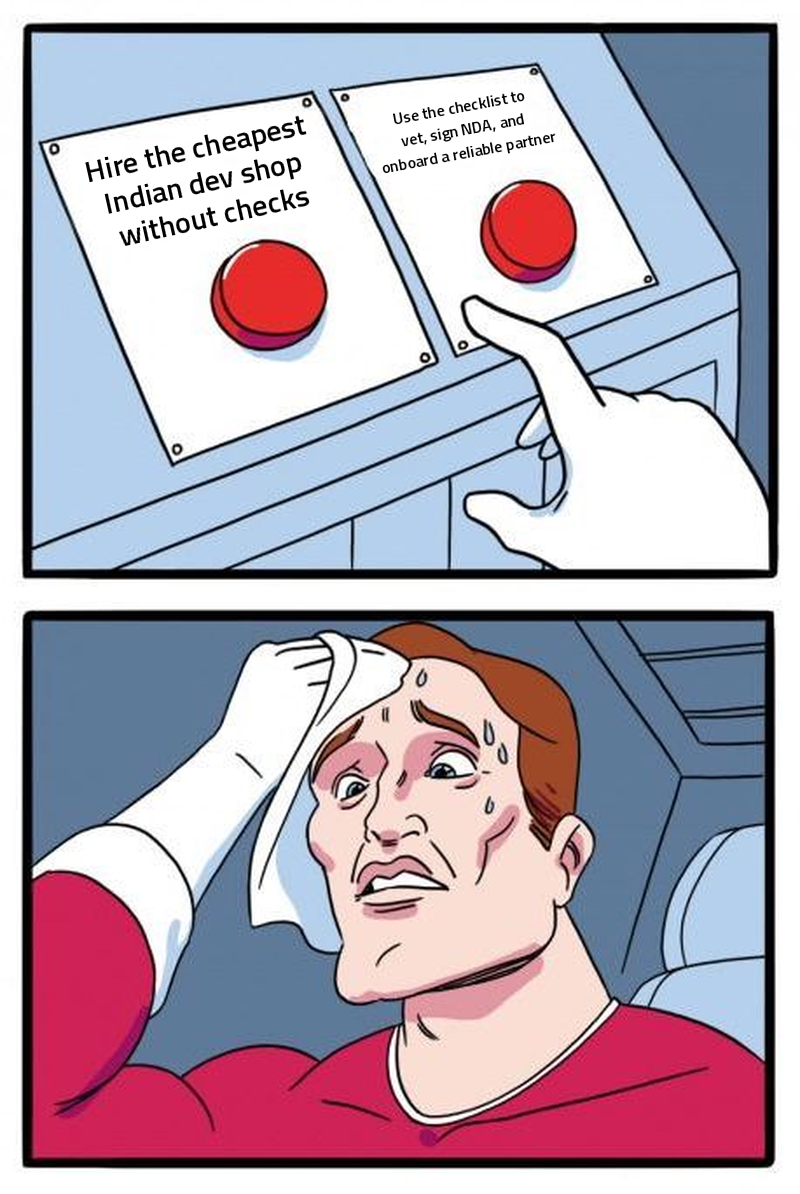
What is a white-label development partner in India?
A white-label partner delivers fully branded software solutions on behalf of another company. The client never sees the partner's name; invoices, proposals and support are issued under the agency's brand. Indian firms are popular because they combine a large pool of English-speaking engineers with cost structures that allow US agencies to maintain healthy margins.
According to a 2022 NASSCOM report, India supplied 55 % of global software outsourcing revenue, with the United States accounting for the largest share of contracts. The same report notes that agencies value "brand invisibility" as a top criteria, ranking it above price for 38 % of respondents.
Why US/UK/AU agencies look to India
| Reason | Typical Benefit | Example |
|---|---|---|
| Time zone overlap | 4-6 h of async work windows, enabling daily updates without overnight calls | A UK agency can receive a build update at 9 am GMT while the Indian team finishes overnight work. |
| Cost efficiency | 30-45 % lower hourly rates than Eastern Europe for senior developers | A senior Node.js engineer in Bangalore charges $35-45 USD/hour versus $65-80 USD in Poland. |
| Talent depth | Access to specialists in AI, voice, and micro-services that are scarce in small agencies | Teams that have shipped production SaaS products using TensorFlow and Google Cloud Speech. |
The risk matrix you must address
| Risk | Impact on agency | Mitigation |
|---|---|---|
| Missed deadline | Lost client trust, possible churn | Fixed-scope pilot with penalty clause for >10 % delay. |
| Poor code quality | Increased maintenance cost, brand damage | Require code review standards (ESLint, SonarQube) and a post-delivery audit. |
| IP leakage | Legal exposure, competitive disadvantage | NDA + work-for-hire clause, verify ISO 27001 certification. |
| Communication gaps | Scope creep, rework | Dedicated account manager, shared dashboard, daily stand-up notes. |
| Currency fluctuation | Margin erosion | Quote in USD, lock exchange rate for the pilot period. |
Step-by-step vetting checklist
1. Legal and contractual safeguards
- NDA and work-for-hire agreement: Must state that all code, designs and documentation are the exclusive property of the agency.
- Data protection compliance: Verify GDPR-compatible processes if you handle EU client data, and confirm adherence to India’s Personal Data Protection Bill (drafted 2023).
- Termination clause: Include a 30-day notice period and a hand-over plan for source code and documentation.
2. Financial stability and pricing model
- Request the last two years of audited financial statements or a credit report from a reputable bureau such as CRISIL.
- Compare pricing structures: fixed-price per feature vs. hourly rates. Fixed-price pilots (5-10 k USD) are preferred for predictability.
- Confirm that the quoted rates include all taxes (GST) and that invoicing will be in USD to avoid hidden conversion fees.
3. Technical competence
- Stack verification: Ask for a technology matrix covering front-end (React, Vue, Next.js), back-end (Node, Django, Laravel), AI/ML (Python, TensorFlow, PyTorch) and voice platforms (Dialogflow, Lex).
- Portfolio audit: Look for at least three agency-focused case studies that include a live URL, project timeline and measurable outcomes (e.g., 20 % increase in conversion rate).
- Code quality process: Ensure they use CI/CD pipelines, automated testing (Jest, Cypress) and version control on GitHub or GitLab with protected branches.
4. Delivery and communication cadence
- Time-zone overlap: Confirm that a senior manager is available between 9 am-12 pm IST, which aligns with 8 pm-11 pm US ET. This window allows daily hand-off.
- Project dashboard: Insist on a shared view in tools like ClickUp, Monday.com or a simple Google Sheet that shows status, blockers and upcoming milestones.
- Reporting frequency: Minimum weekly written summary plus a 30-minute video call for any sprint review.
5. Security and compliance
- Request ISO 27001 or SOC 2 Type II certification. According to a 2023 Gartner survey, 62 % of agencies consider security certification a make-or-break factor when selecting offshore partners.
- Verify that the partner follows OWASP Top 10 best practices and conducts quarterly vulnerability scans.
- Ensure they have a documented incident response plan and a single point of contact for security alerts.
6. Cultural fit and scalability
- Conduct a 30-minute “culture call” with the proposed delivery lead to gauge English fluency, responsiveness and alignment on agency values (e.g., transparency, client-first mindset).
- Ask about their current utilization rate. A healthy range is 70-80 %; anything above 90 % may indicate over-commitment and risk of flaky delivery.
- Confirm they have a bench of at least two senior developers who can step in if the primary lead becomes unavailable.
7. Reference checks
- Request at least two agency references that match your size (5-15 person agency) and service mix (SEO, branding, automation).
- Ask each reference about:
- Delivery punctuality on the last three projects.
- Quality of code and post-launch support.
- Whether the partner ever disclosed their own brand to the client.
- Document the responses in a comparison matrix.
Comparison of top Indian outsourcing hubs
| City | Avg senior dev rate (USD/hr) | Time-zone overlap with US ET | Typical talent pool |
|---|---|---|---|
| Bangalore | 38 | 9.5-12.5 h | AI/ML, enterprise SaaS |
| Hyderabad | 34 | 9-12 h | Mobile, voice APIs |
| Pune | 36 | 9-12 h | Full-stack, DevOps |
| Chennai | 32 | 8-11 h | Front-end, WordPress extensions |
Scoring template you can use on every vendor
| Criterion | Weight % | Vendor A | Vendor B | Vendor C |
|---|---|---|---|---|
| Legal safeguards (NDA, IP) | 15 | 9 | 8 | 10 |
| Pricing transparency | 10 | 7 | 9 | 8 |
| Technical stack fit | 20 | 9 | 7 | 8 |
| Delivery speed (pilot) | 15 | 8 | 6 | 9 |
| Communication quality | 15 | 9 | 8 | 7 |
| Security certifications | 10 | 8 | 7 | 9 |
| Cultural fit & English | 10 | 9 | 6 | 8 |
| Scalability & bench | 5 | 7 | 8 | 6 |
| Total | 100 | 84 | 70 | 75 |
A score above 80 is typically safe for a first-pilot partnership. Anything below 70 should be revisited or rejected.
How to structure the pilot project
- Scope definition – Limit to one core feature (e.g., a chatbot integration) with a clear acceptance criteria checklist.
- Fixed price – Quote $5 k USD inclusive of design, development, QA and one round of revisions.
- Timeline – 3-week delivery window with a 48-hour buffer for unforeseen issues.
- Milestones – 0 % at kickoff, 30 % at prototype demo, 60 % at beta release, 10 % on final sign-off, 0 % retained until post-launch support period ends.
- Success metrics – Code passes 80 % unit test coverage, client approves UI within 48 hours of demo, and the partner provides a full source zip with documentation.
If the pilot meets all metrics, you can negotiate a wholesale rate of 55-65 % of the partner’s invoice, matching the deal shape outlined in your internal model.
Red flags to walk away from
- No written IP clause – even if they claim “all work is yours”.
- Refusal to share a public portfolio or only shows internal projects.
- Utilization rate consistently above 90 % – indicates they are already stretched.
- Lack of any security certification when you handle EU or health data.
- Communication that relies solely on asynchronous Slack messages without scheduled calls.
Ongoing partnership best practices
- Quarterly health reviews – Review SLA adherence, bug rates and upcoming capacity.
- Joint roadmap sessions – Align on upcoming agency service expansions (e.g., voice-first experiences) and ensure the partner can staff those skills.
- Escalation protocol – Define a 24-hour response SLA for production incidents; the partner should provide a dedicated on-call engineer.
- Profit-share transparency – Share the wholesale-to-retail margin model so the partner understands the incentive to maintain quality.
"The most successful white-label relationships treat the partner as an extension of the agency, not a cost center," says Laura Chen, senior partner manager at a leading US digital agency, in a 2023 interview with MarketingProfs.
Frequently asked questions
How much should I expect to pay for a pilot?
A typical pilot for a single feature ranges from $4 k to $7 k USD. The price includes design, development, QA and one revision cycle. Keeping the scope tight ensures you can evaluate speed, quality and communication without a large upfront commitment.
Do I need a separate NDA for each project?
One master NDA that covers all future work is sufficient if it includes a clause stating that every deliverable is a work-for-hire. You can add a project-specific addendum that references the master agreement.
What if the Indian partner wants to list my agency as a reference?
That is acceptable and can be a win-win. Ask them to use a generic description (e.g., "a US-based digital marketing agency") unless you give explicit permission to name your brand.
How do I handle timezone differences for urgent bugs?
Set up a 24-hour on-call rotation with the partner’s senior engineer. Provide a shared incident ticket system (e.g., Jira) and agree on a maximum response time of 4 hours for critical issues.
Can I use the same partner for both white-label and direct contracts?
Yes, but keep the contracts separate. Direct contracts should include a clause that the partner will not disclose the work to any third party, preserving your brand exclusivity.
What security standards should the partner meet?
At minimum ISO 27001 or SOC 2 Type II. For agencies handling health or financial data, look for HIPAA or PCI-DSS compliance. Verify the certifications with a third-party audit report.
How many partners should I work with simultaneously?
Start with one pilot partner. Once you have a proven track record, you can add a second partner to increase capacity, but keep the total active partners under three to maintain reliability.
Is it safe to pay in USD to an Indian company?
Yes, most reputable Indian firms have USD-based bank accounts or use services like PayPal, TransferWise (Wise) or direct wire transfers. Always confirm the invoicing currency in the contract to avoid exchange-rate surprises.
white-label
Have something to build?
Tell us what you're trying to ship. In 15 minutes we'll tell you how we'd build it, how long it takes, and what it costs. No pitch deck, no pressure.