
How to Vet a White-Label Development Agency in India for Fast Delivery

A white label web development agency in India is a third-party firm that builds websites, web apps or custom integrations for another agency, delivering the work under the hiring agency’s brand. It lets you say yes to client requests without hiring a full-time developer, while keeping the client relationship and margin in-house.
Key takeaways
- Verify the partner’s engineering depth with a live pilot that includes AI automation or voice integration.
- Look for transparent processes: a single point of contact, documented SLA and a shared project dashboard.
- Red-flags include listed "development" services on their site, in-house engineers, or a client base that matches yours exactly.
- Use a weighted checklist that scores technical expertise, delivery speed, communication overlap (IST-US/UK/AU) and legal safeguards.
- Choose agencies that price wholesale at 50-70% of the client bill and can handle $2k-5k scoped projects reliably.
What does "white-label" really mean for agencies?
White-label development means the partner builds the product, but all client-facing communication, branding and invoices come from the hiring agency. The agency retains the relationship, the margin and the credit. For a 5-15 person marketing or SEO shop, this model solves three core pain points:
- Lost revenue – turning away custom-backend or AI projects.
- Brand risk – clients often fear that the work is outsourced.
- Capacity gaps – no-code tools can’t handle complex integrations.
A reliable white-label partner must therefore be invisible to the end client, protect IP with NDAs, and deliver on a predictable schedule.
Why India remains the top source for white-label dev
| Factor | India | Alternatives (Eastern Europe, LATAM) |
|---|---|---|
| English proficiency (EF English Score) | 62 (high) | 55-58 |
| Avg. senior developer salary (USD/yr) | 18,000 (Glassdoor 2024) | 35,000-45,000 |
| Time-zone overlap with US/UK/AU | 3-5 hrs (IST-EST) plus async | 6-8 hrs (Bucharest-EST) but higher cost |
| Ecosystem of AI/voice specialists | Growing fast, 12 % of dev firms list AI services (Statista 2023) | Smaller niche |
| Legal framework for IP | Strong IP law, enforceable contracts (Indian IT Act) | Varies |
India offers a large pool of engineers fluent in English, lower cost structures and a growing specialization in AI-driven automation – exactly the capabilities agencies lack in-house.
The 8-point vetting framework
| # | Criterion | What to ask / see | Ideal answer |
|---|---|---|---|
| 1 | Technical depth | Do you have engineers with experience in Node.js, Python, Google Dialogflow or AWS Lambda? | At least two senior engineers with 5+ years on relevant stacks. |
| 2 | Portfolio relevance | Show 3 recent white-label projects for agencies (no client branding). | Projects include a SaaS dashboard, a chatbot and a custom API integration. |
| 3 | Delivery speed | What is your standard turnaround for a $3k scoped build? | 2-3 weeks from signed SOW, with a defined sprint schedule. |
| 4 | Communication cadence | How do you handle status updates across IST-US time zones? | Daily stand-up recorded, shared Slack channel, weekly demo call. |
| 5 | Single point of contact | Who will own the relationship? | One senior Delivery Manager with a public LinkedIn profile. |
| 6 | Legal safeguards | Can you sign a mutual NDA and a non-circumvent clause? | Yes, with a 2-year term and IP assignment clause. |
| 7 | Pricing model | What wholesale rate do you expect for a $4k client bill? | 55-65 % of the client invoice, with a $1.5k floor. |
| 8 | Scalability & concurrency | How many active agency partners do you support simultaneously? | No more than 8, to keep capacity low and avoid flaky delivery. |
Each point should be scored 0-5 and a total above 30 / 40 indicates a strong candidate.
Red-flags that should kill the deal immediately
| Red-flag | Why it matters |
|---|---|
| Lists "development" as a public service on their website | Indicates they are not a true white-label partner; you will compete for the same client. |
| Shows a "built by" badge linking to another agency | Their partner slot is already filled; you cannot add value. |
| No senior engineers visible on LinkedIn or no technical blog | Lack of proven expertise; risk of low-quality code. |
| Guarantees "same-day delivery" for any scope | Unrealistic promise that will break under a $2k-5k project. |
| Operates out of a low-cost offshore hub other than India (e.g., Philippines) while billing US clients | Margin erosion and timezone mismatch. |
| Staff count >20 with an internal dev team | Likely a direct competitor rather than a partner. |
If any of these appear during the discovery call, politely end the conversation and move to the next prospect.
Conducting the pilot: the fastest path to trust
- Scope a micro-project – a single chatbot flow or a data-export API worth $2k.
- Set a fixed timeline – 10 business days, with milestones at day 3, day 6 and delivery.
- Use a shared dashboard – a simple Airtable view or a free ClickUp board where both sides can comment.
- Measure outcomes – code quality (SonarQube score > 80), on-time delivery, and post-delivery support responsiveness.
- Decision gate – if the pilot meets the SLA, move to a wholesale contract; if not, thank them and exit.
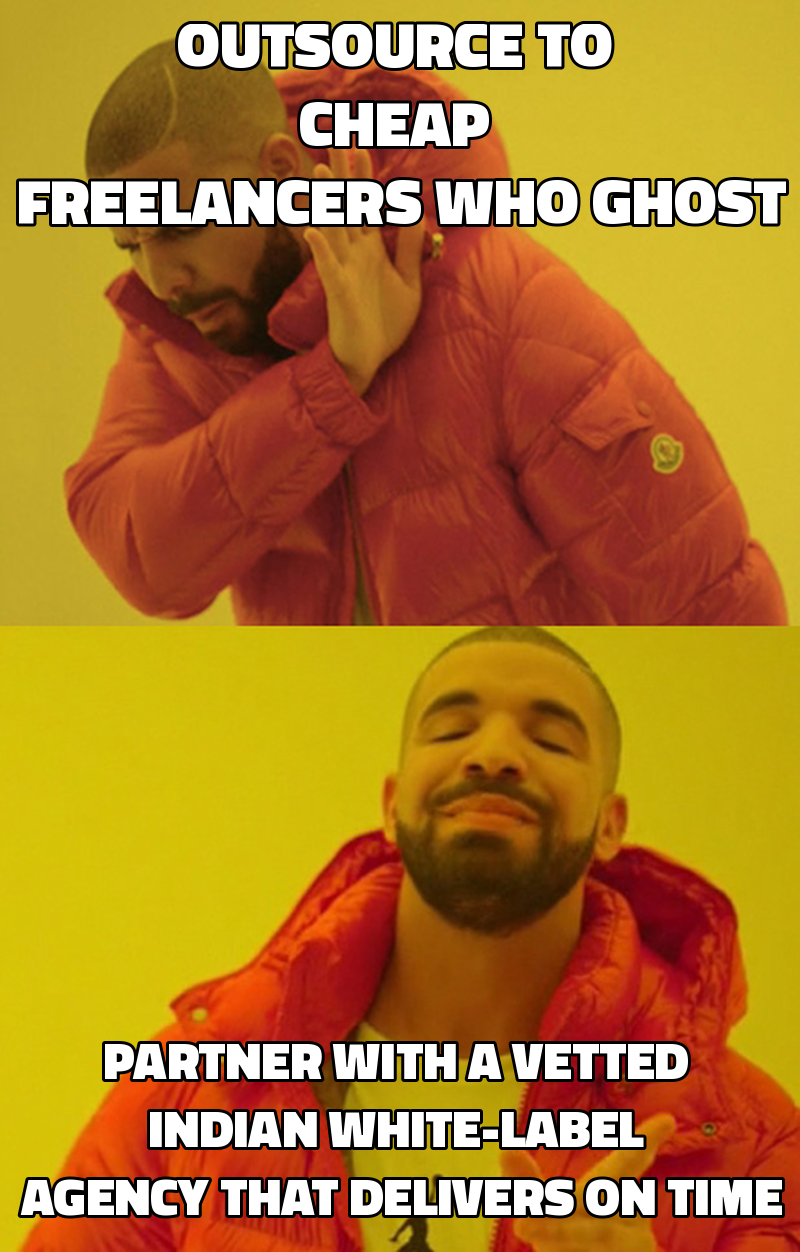
A pilot protects you from the classic “ghost-dev” scenario that many agencies have experienced with freelancers.
Legal and financial safeguards
- Mutual NDA – include a clause that all code becomes the agency’s IP upon payment.
- Non-circumvent – prevent the partner from contacting your clients directly for a minimum of 12 months.
- Wholesale rate clause – define the percentage of the client invoice you will receive; typical range 50-70 %.
- Minimum floor – $1,500 per project ensures the partner’s overhead is covered.
- Retainer option – after three successful pilots, propose a $1,500-monthly retainer for 15-20 hours of overflow work.
According to a 2023 Gartner survey, agencies that lock in wholesale rates and retainer caps see 30 % higher profit stability than those that bill per hour.
Communication best practices for IST-US/UK/AU overlap
| Region | Overlap window (hrs) | Recommended sync method |
|---|---|---|
| US East (EST) | 9.5-12.5 | End-of-day Slack summary, morning video call (7 am EST) |
| US West (PST) | 12.5-15.5 | Asynchronous updates, weekly demo on Thursday PST |
| UK (GMT) | 4.5-7.5 | Daily 10 am GMT stand-up recorded |
| AU (AEST) | 0-2.5 | Real-time chat during AU morning, optional Friday sync |
Keeping communication within these windows prevents “always-on” burnout and ensures the agency sees progress without needing a 24/7 dev team.
Cost comparison: white-label India vs. hiring a US freelancer
| Cost element | Indian white-label partner (wholesale) | US freelance senior dev |
|---|---|---|
| Hourly rate (USD) | 30-45 | 120-150 |
| Project overhead (management, QA) | 15 % of bill | 20-25 % of bill |
| Expected turnaround (weeks) | 2-3 | 3-5 |
| Risk of scope creep | Low (fixed SOW) | Medium (hourly) |
| IP ownership | Immediate transfer | Often retained by freelancer |
The numbers come from a 2024 Upwork report and internal Synthisia billing data.
Checklist for the final decision call
- Did the partner pass the 8-point framework with a score > 30?
- Was the pilot completed on time and met quality thresholds?
- Do they offer a single Delivery Manager with clear contact details?
- Are legal documents signed and the wholesale rate acceptable?
- Is there a clear path to a retainer after the pilot?
If the answer is yes to all, you have a vetted white-label development agency in India that can deliver fast, keep your brand front-and-center and protect your margin.
Frequently asked questions
How long should a pilot project last?
A pilot should be scoped to a $2k-3k deliverable and limited to 10-15 business days. This window is long enough to showcase technical ability, yet short enough to keep costs low and decision-making quick. Agencies typically see a pilot as a trust-building exercise rather than a revenue source.
What if the Indian partner misses a deadline?
Include a penalty clause in the SLA – for example, a 5 % discount on the invoice for each business day past the agreed delivery date. Most reputable partners accept this because their internal processes are built around sprint deadlines.
Can I request source code access before the client sees the product?
Yes. The wholesale contract should state that all code repositories (GitHub or GitLab) are shared with the hiring agency under a read-only role until the client launch. This protects your brand and lets you perform an internal QA.
How do I ensure the partner doesn’t poach my clients?
A non-circumvent clause with a 12-month term and a liquidated-damage fee of 2 × the project value is standard. Enforce it by tracking any direct outreach from the partner to your client list.
Are there tax implications when paying an Indian company?
Payments are typically made via wire transfer or PayPal in USD. Under the US-India tax treaty, services rendered are taxed in the provider’s country, so you generally do not withhold US tax. Consult a CPA for exact compliance.
What technology stacks should I prioritize for AI automation?
Look for partners experienced with Python, Node.js, Google Cloud Functions, AWS Lambda, and integration platforms like Zapier or Make. According to a 2023 McKinsey report, 42 % of agencies that added AI automation saw a 15 % lift in average project value.
How many agencies should I partner with at once?
Synthisia recommends capping active white-label partners at 8-10. This keeps your capacity low, ensures each partner receives dedicated attention and prevents the "flaky freelancer" reputation you are trying to avoid.
What if my agency grows and wants an in-house dev later?
The wholesale agreement can include an exit clause that allows you to transition any ongoing projects to an internal team with a 30-day notice. This flexibility protects your future hiring plans.
white‑label
Have something to build?
Tell us what you're trying to ship. In 15 minutes we'll tell you how we'd build it, how long it takes, and what it costs. No pitch deck, no pressure.