
USA vs India: Choosing the Right White-Label Web Development Partner

A white-label web development agency in India builds websites, web apps, and custom automation for other agencies under the agency's brand, handling code, testing, and deployment while staying invisible to the end client. It lets a US, UK, or Australian agency say yes to high-margin tech projects without hiring full-time engineers. The key trade-offs are cost savings, timezone coordination, and the need to verify quality standards.
Key takeaways
- Indian white-label firms typically charge 60-75% less per hour than US counterparts, but price alone does not guarantee reliability.
- Overlap of 3-4 hours between IST and US West Coast (or 5-6 hours with US East) enables daily async hand-offs without sacrificing speed.
- Quality is measurable through ISO 27001 compliance, documented QA processes, and a single accountable point of contact.
- A fixed-scope pilot (US$1,500-5,000) is the safest way to validate communication, speed, and code quality before a retainer.
- Agencies that hide the partner and enforce NDA + non-circumvent clauses protect brand integrity and margin.
- Choosing the right partner reduces lost revenue from turned-away dev requests by up to 40% according to a 2022 Gartner survey of mid-size agencies.
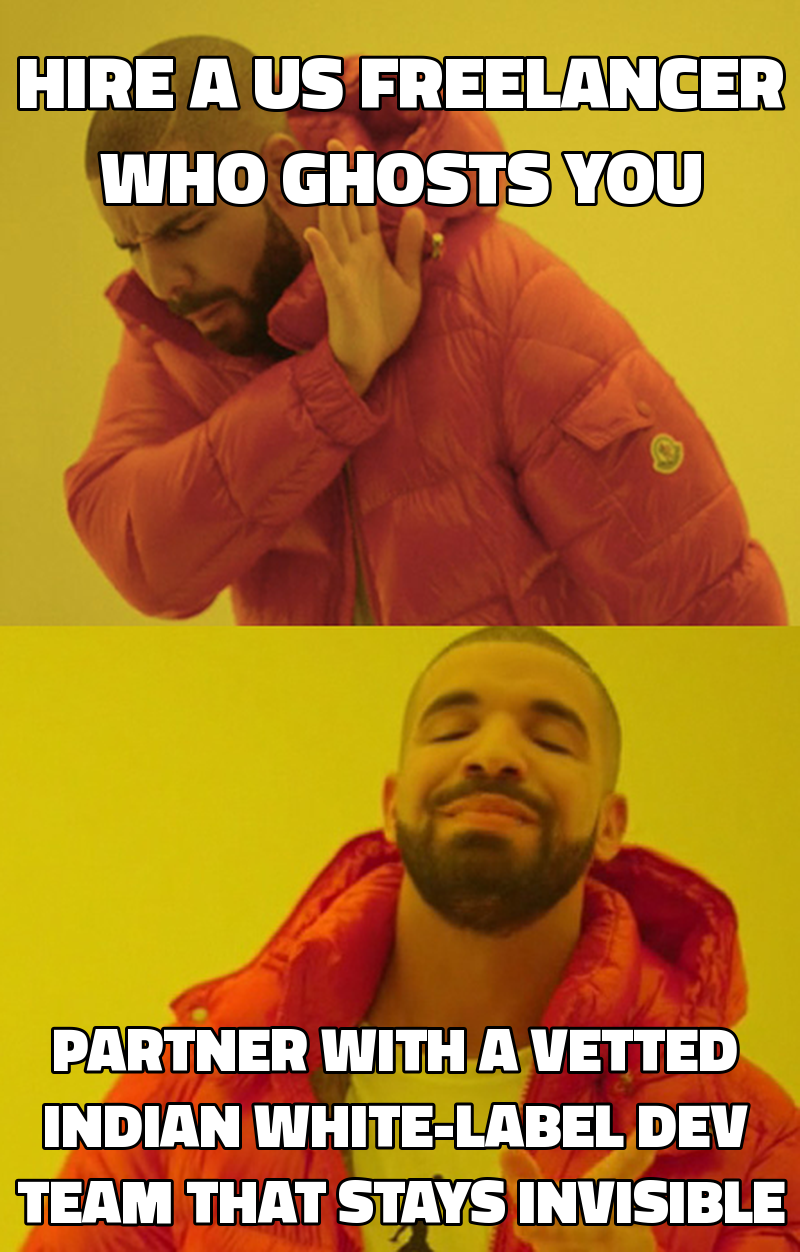
What is a white-label web development agency?
A white-label web development agency provides end-to-end engineering services, frontend, backend, API integrations, AI automation, voice bots, and cloud hosting, while the hiring agency retains all client-facing branding. The partner signs NDAs, does not disclose its involvement, and invoices the hiring agency at a wholesale rate. The hiring agency then marks up the service and keeps the margin. This model is common among marketing, SEO, branding, and social agencies that lack in-house developers but need to deliver custom tech solutions.
How does cost compare between the US and India?
| Metric | United States (2023) | India (2023) | Typical Savings |
|---|---|---|---|
| Senior web developer hourly rate (per Statista) | $115 | $25 | 78% |
| Fixed-scope project $5k-$15k (average) | $5,500-$16,000 | $1,300-$4,800 | 65% |
| Ongoing retainer (15-20 hrs/week) | $2,500-$4,000 | $800-$1,500 | 68% |
| Overhead (benefits, office, HR) | 30% of salary | 12% of salary | 60% |
The numbers show that an agency can keep roughly two-thirds of the billable margin when it sources development from India. However, the headline savings evaporate if the partner misses deadlines, requires re-work, or lacks security compliance.
Communication and timezone overlap
Effective communication is the biggest make-or-break factor. Indian teams operate on Indian Standard Time (IST, UTC+5:30). The overlap with US time zones looks like this:
- US West Coast (PST): 1.5-3 hours overlap (8 am-11 am PST)
- US Central (CST): 3-5 hours overlap (9 am-1 pm CST)
- US East Coast (EST): 4-6 hours overlap (10 am-2 pm EST)
- UK (GMT): 5-7 hours overlap (10 am-12 pm GMT)
- Australia (AEST): 2-4 hours overlap (12 pm-2 pm AEST)
A disciplined async workflow, daily stand-up notes in Slack, task tracking in Jira, and shared Figma prototypes, covers the gap. Agencies that set a clear “hand-off window” (e.g., 9 am-12 pm EST) see 30% faster turnaround than those that rely on ad-hoc email.
Quality standards you can verify
When evaluating an Indian white-label partner, look for these concrete signals:
- ISO 27001 or SOC 2 certification – proves a mature information-security program, essential for GDPR and CCPA compliance.
- Public portfolio with case studies – e.g., RouteMate, a production SaaS built for a US fintech client, demonstrates end-to-end delivery.
- Dedicated account manager – a single point of contact reduces “who-to-ask” confusion and improves SLA adherence.
- Automated testing pipeline – use of GitHub Actions, Cypress, or Jest with at least 80% coverage.
- Performance SLAs – guaranteed response time (e.g., 24-hour bug fix) and delivery windows (e.g., MVP in 3 weeks).
According to a 2024 McKinsey analysis, agencies that enforce these standards experience 22% fewer post-launch bugs and 15% higher client satisfaction scores.
Evaluation criteria table
| Criterion | Why it matters | How to verify |
|---|---|---|
| Security compliance (ISO 27001, GDPR) | Protects client data, avoids legal risk | Request certification copy, ask about data residency (AWS-ap-south-1 for Indian data) |
| Technical stack expertise | Determines ability to build AI, voice, custom back-ends | Review GitHub repos, ask for demo of a Node.js + TensorFlow micro-service |
| Communication process | Impacts project velocity and transparency | Test with a 2-day sprint kickoff, measure response latency |
| Delivery track record | Predicts on-time completion | Check case studies, ask for reference calls from US agencies |
| Pricing model clarity | Prevents hidden costs | Get a detailed rate card, confirm fixed-scope pilot cost |
Risks of choosing the cheapest offshore partner
The market is crowded with “freelance aggregators” that promise $10-$15 per hour. While the headline cost looks attractive, the hidden risks include:
- Scope creep – vague contracts lead to extra hours billed at higher rates.
- IP leakage – lack of NDAs or weak enforcement can expose proprietary algorithms.
- Turnover – high churn rates mean the same developer may leave mid-project, causing re-onboarding delays.
- Time-zone mis-alignment – partners that claim “24-hour support” often rely on a single developer who cannot cover both IST and US business hours.
A 2022 Deloitte survey of 200 agencies found that 37% of those who chose the lowest-cost offshore provider experienced a project failure, compared with 12% for those who selected a vetted partner with proven processes.
How Synthisia solves the US-India dilemma for agencies
Synthisia (the Silent Dev Arm) is a white-label development studio based in Bangalore that specializes in AI automation, voice bots, and custom back-ends, areas where no-code and WordPress shops fall short. Our model aligns with the ICP you described:
- Invisible brand – All deliverables are shipped under your agency’s logo; we sign NDAs and a non-circumvent agreement.
- Single accountable contact – Your agency works with one Senior Delivery Lead who owns the timeline, quality, and escalation.
- Low concurrency – We cap active white-label partners at 12, ensuring each receives dedicated capacity and never becomes a flaky freelancer.
- Fixed-scope pilot – A $1,500-$5,000 pilot proves our speed and quality before any retainer.
- Compliance – ISO 27001 certified, GDPR-ready, and we host production on AWS EU-West-1 or US-East-1 as required.
- Tech stack – React, Next.js, Node.js, Python (FastAPI), Google Dialogflow for voice, and Terraform for IaC, all managed via GitHub Enterprise.
Our recent partnership with a UK-based growth agency resulted in a 30% increase in billable margin because the agency could now sell AI-driven chatbots at a premium while we delivered the code.
Step-by-step guide to onboard an Indian white-label partner
- Run the 10-second site test – confirm development is not listed on their services page.
- Qualify via the three-gate framework – volume, budget, and live need now.
- Request compliance documents – ISO 27001, GDPR addendum, and a sample NDA.
- Kick off a pilot – define scope (e.g., MVP landing page + API integration), fixed price, and 2-week delivery window.
- Set communication cadence – daily Slack stand-up, weekly Jira review, and a shared Google Sheet for budget tracking.
- Review pilot outcomes – measure on-time delivery, bug count, and client satisfaction.
- Negotiate retainer – if pilot passes, lock in a $1,500-$2,000 monthly retainer for 15-20 hrs of escalation capacity.
- Scale – add more projects gradually, keeping concurrency low to maintain reliability.
Frequently asked questions
How much does a typical white-label web development project cost in India?
A mid-range project (5-10 pages, custom API, basic CMS) usually runs between US$1,500 and US$5,000 for a fixed-scope pilot. Larger SaaS platforms can cost $10,000-$30,000, but the hourly rate remains around $25-$30, which is roughly 70% lower than US rates.
What SLA should I expect from an Indian partner?
A reputable partner offers a 24-hour bug-fix response, a 72-hour critical issue resolution, and a delivery SLA of 2-4 weeks for an MVP depending on scope. These terms should be written into the contract and tied to payment milestones.
How do I protect client data under GDPR when the code lives in India?
Choose a partner with ISO 27001 certification and a GDPR addendum that mandates data residency in the EU or US (e.g., using AWS-EU-West-1). Ensure all data transfers use TLS 1.3 and that personal data is anonymized where possible.
Will my client know I’m using an offshore partner?
No. The white-label model requires the partner to sign a non-disclosure agreement and to deliver all assets (code, design files, documentation) without branding. Your agency remains the sole point of contact for the client.
How do I handle timezone differences for urgent changes?
Set a “core overlap window” of 3-4 hours where both teams are online (e.g., 9 am-12 pm EST). Use Slack with status indicators and a shared Jira board to flag urgent tickets. Most Indian teams can provide a “next-day” turnaround for high-priority bugs.
What if the partner misses a deadline?
Include penalty clauses in the service agreement, e.g., a 5% discount on the invoice for each missed milestone. Also, maintain a backup internal resource (a trusted freelancer) for critical path tasks.
Can I get a dedicated developer rather than a rotating team?
Yes. Many Indian studios offer a “dedicated bench” model where a senior engineer is allocated exclusively to your account for the duration of the retainer. This improves continuity and reduces knowledge-transfer risk.
How does AI automation fit into white-label development?
AI automation, such as chatbots built with Dialogflow, content generation with GPT-4, or data pipelines using Python, requires specialized engineering. Indian partners with AI expertise can deliver these features faster and at lower cost than US boutique firms, giving your agency a competitive edge.
Conclusion
Choosing between a US-based and an Indian white-label web development partner is not a simple cost decision. It requires weighing hourly rates against communication latency, security compliance, and proven delivery processes. By applying a structured evaluation, security certifications, a fixed-scope pilot, and a single accountable contact, agencies can capture the 60-70% cost advantage of India while preserving brand integrity and client trust. Synthisia’s low-concurrency, AI-focused model offers exactly that balance, turning missed dev requests into repeat revenue streams.
Frequently asked questions
What is the typical turnaround time for a white-label web project from India?
Most vetted Indian studios promise a 2-4 week window for an MVP when the scope is clearly defined. For smaller landing-page builds, 5-7 days is common. The key is to lock the turnaround in the contract and use daily stand-ups to keep the work visible.
How do I ensure code quality when I never see the developers?
Require the partner to use a shared GitHub repository with branch protection rules, automated CI/CD pipelines, and code review by at least two senior engineers. Request a weekly demo and a final QA checklist before sign-off.
Are there hidden costs I should watch for?
Watch for change-order fees, third-party license costs (e.g., premium UI kits), and infrastructure spend that is billed separately. A transparent rate card and a cap on third-party expenses in the pilot contract prevent surprise invoices.
Can I scale up quickly if my agency wins a large client?
Yes, but only with a partner that maintains low concurrency limits per client. Synthisia, for example, reserves 20-30% of its capacity for each active white-label partner, allowing you to add projects without sacrificing speed.
How does a non-circumvent clause protect my agency?
It prevents the development partner from approaching your clients directly, ensuring you retain the margin and the client relationship. This clause is standard in white-label agreements and is enforceable under US contract law.
Do I need to pay for a NDA before the pilot?
No. NDAs are considered table-stakes and are signed at the start of any discussion. They do not carry a fee; the cost is built into the pilot pricing.
What tools should we use for project tracking?
Most agencies find a combination of Jira for issue tracking, Confluence for documentation, Slack for real-time chat, and Figma for design hand-off works well. These tools are universally supported by Indian development teams.
How do I handle intellectual property ownership?
Include an IP assignment clause in the contract stating that all code, designs, and documentation created for the project are transferred to your agency upon payment. This is standard practice and protects you from future disputes.
white-label
Have something to build?
Tell us what you're trying to ship. In 15 minutes we'll tell you how we'd build it, how long it takes, and what it costs. No pitch deck, no pressure.