
Trucking Dispatch System: Automation for Asset-Based Carriers (2026)

What is the best trucking dispatch system for asset-based carriers in the United States? The answer isn’t a single product – it’s a decision framework. Look at the type of solution (off-the-shelf SaaS, local agency, freelancer, or custom/white-label build), match it to your fleet size, compliance needs, and budget, and then pick the option that fits your operational reality.
Key takeaways
- Fit over features – a system that matches your fleet size, regulatory environment, and data residency needs will deliver more ROI than a feature-rich SaaS that you can’t fully use.
- Cost structure matters – SaaS often charges per-truck per-month; custom builds are a one-time investment with optional low-cost maintenance.
- Local regulations – FMCSA compliance, DOT reporting, and state-level safety rules drive the need for built-in alerts and record-keeping.
- Data residency – US carriers typically keep operational data on US-based servers to avoid cross-border privacy issues.
- Integration depth – real-time driver communication (e.g., WhatsApp Business API) and automated back-office workflows cut manual re-keying and reduce disputes.
Comparison of solution categories
| Solution type | Typical cost model | Best fit for | Key pros | Key cons |
|---|---|---|---|---|
| Off-the-shelf SaaS (e.g., Samsara, Fleetio) | Subscription per truck/month | Fleets that want quick rollout and built-in telematics | Fast implementation, regular updates, support | Ongoing per-truck fees add up, limited customization for niche workflows |
| Local agency (US-based consulting firms) | Project-based fee + optional retainer | Companies that need a tailored system but prefer a domestic partner | Knowledge of US regulations, can handle data residency locally | Higher upfront cost, may still rely on SaaS components |
| Freelancer / boutique dev shop | Hourly or fixed-price contract | Small to mid-size fleets with specific workflow gaps | Very flexible, can build exactly what you need | Variable quality, limited post-launch support |
| Custom / white-label build (e.g., Synthisia) | One-time build fee + optional maintenance retainer | Carriers that want ownership, no per-truck SaaS fees, and deep integration with existing tools | Full ownership, can embed compliance alerts, integrates with WhatsApp Business API, scalable | Requires upfront investment, need to manage own hosting/maintenance |
When a custom/white-label build is the right call
If off-the-shelf SaaS feels like a “growth tax” – charging $20-$30 per truck each month – and you’re spending hours each week re-keying data from spreadsheets into multiple tools, a custom build can pay for itself within months. Synthisia specializes in building a single, owned dispatch dashboard that:
- Consolidates driver communication into one channel (WhatsApp Business API) while keeping a full audit trail.
- Automates compliance reminders for DOT inspections, service intervals, and HOS violations.
- Provides live job-status dashboards for both internal staff and external customers, reducing “where’s my load?” calls.
- Eliminates per-truck subscription fees by delivering a one-time owned system with optional low-cost maintenance.
Soft CTA: If you’re ready to stop paying per-truck SaaS fees and want a system that grows with your fleet, reach out to Synthisia for a no-obligation discovery call.
Frequently asked questions
How much does a custom dispatch system cost in the US?
A custom build typically ranges from $30,000 to $80,000 depending on complexity, integrations, and compliance features. The one-time cost replaces ongoing per-truck SaaS fees, so the ROI can be realized in 12-24 months.
Can remote development partners like Synthisia work with US carriers?
Yes. Synthisia has delivered fully compliant US-based fleet solutions, handling data residency by hosting on US servers and adhering to FMCSA regulations.
When should I choose off-the-shelf SaaS over a custom build?
If you need a rapid rollout, have a very small fleet (under 10 trucks), and don’t require deep workflow customization, SaaS is a low-risk option. For fleets over 15 trucks or those with unique compliance and communication needs, a custom build often yields better long-term value.
What regulatory features should a dispatch system have for US carriers?
Look for built-in DOT reporting, automated HOS tracking, service-interval alerts, and audit-ready logs of driver communications. These features help avoid penalties and keep FMCSA safety scores high.
Is data residency a concern for US carriers?
Yes. Many carriers prefer to keep operational data on US-based servers to avoid cross-border privacy complications and to ensure compliance with state-level data protection laws.
How does driver communication integration improve dispatch efficiency?
Integrating WhatsApp Business API or similar channels creates a single, searchable thread for each load. Dispatch can see who was told what, when, and can automatically log confirmations, reducing missed pickups and disputes.
What are the hidden costs of SaaS subscriptions?
Beyond the per-truck fee, SaaS platforms often charge extra for advanced analytics, API access, or additional users. These add-ons can quickly increase the total cost of ownership.
Can I migrate from a SaaS platform to a custom system?
Yes. A well-planned migration involves exporting historical data, mapping it to the new system’s schema, and running parallel operations for a short period to ensure continuity.
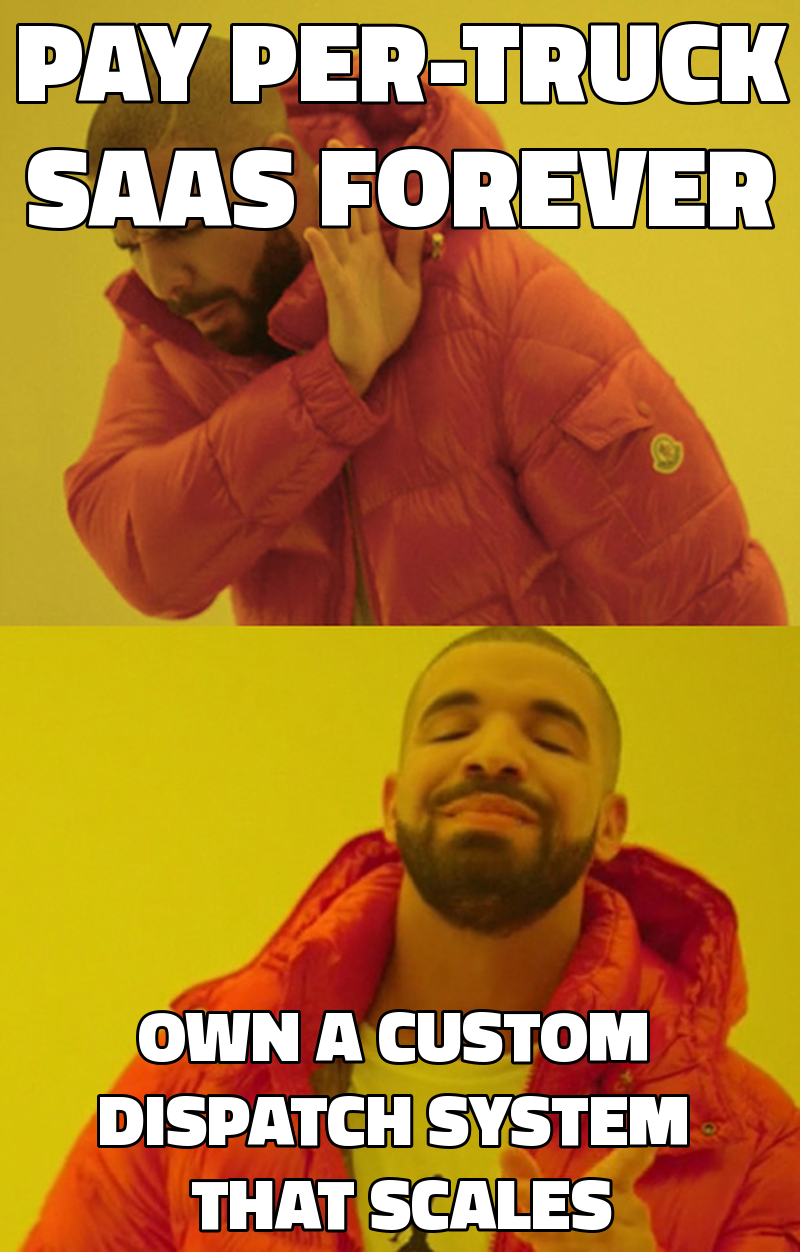
Below is a light-hearted meme that illustrates the choice between a generic SaaS subscription and a custom-built system.
Meme
{ "template": "drake", "top": "Pay per-truck SaaS forever", "bottom": "Own a custom dispatch system that scales" }
trucking
Have something to build?
Tell us what you're trying to ship. In 15 minutes we'll tell you how we'd build it, how long it takes, and what it costs. No pitch deck, no pressure.