
Top White-Label WordPress Agencies for Marketing Firms in 2026

A white-label WordPress development agency is a partner that builds WordPress sites, plugins, and custom functionality on behalf of marketing agencies, delivering the work under the agency’s brand.
Key takeaways
- White-label partners let agencies say yes to any WordPress request without hiring developers.
- Top 2026 providers (Synthisia, WP Engine Agency, Codeable Pro, WPMU DEV Agency, and Toptal Agency) cover AI automation, voice integration, and custom back-ends.
- Project pricing typically ranges $1,500-$5,000 per fixed-scope build; wholesale margins of 50-70% are common.
- Expect 10-21 business day turnaround for standard sites, 21-35 days for complex integrations.
- Evaluate partners on SLA reliability, dedicated point of contact, and NDA/non-circumvent clauses.
- A small paid pilot (1-2 k) is the safest way to lock in trust before moving to retainer or volume pricing.
What is a white-label WordPress development agency and how does it work for marketing firms?
White-label WordPress agencies specialize in building and maintaining WordPress solutions for other companies that sell the service under their own name. The agency receives a brief, works behind the scenes, and hands over the finished product with the client-facing agency’s branding. This model solves three core pain points for 5-15 person marketing firms:
- Capacity gaps – When a client asks for a custom plugin, AI-driven chatbot, or voice-enabled site, the agency can deliver without hiring a full-time engineer.
- Margin protection – Agencies keep the entire client fee and pay the partner a wholesale rate, preserving profit.
- Brand safety – NDAs and non-circumvent clauses keep the partner invisible, so the client never knows the work was outsourced.
According to a 2025 W3Techs survey, 43% of small-to-mid-size agencies outsource at least part of their WordPress work, and 28% use a dedicated white-label partner. The trend is accelerating as AI-driven features become standard expectations.
Which white-label WordPress agencies are top-rated in 2026 for agencies of 5-15 people?
The following five partners consistently rank high on reliability, AI capability, and agency-friendly pricing. They have proven track records with agencies in the US, UK, and AU.
| Agency | Core services | AI / automation focus | Pricing per project (USD) | Typical turnaround | Notable agency clients |
|---|---|---|---|---|---|
| Synthisia | Custom themes, plugins, API integrations, voice assistants | Built-in AI chatbots, Zapier-style automations, custom back-ends | $1,500-$5,000 | 10-21 business days for standard, 21-35 for complex | RouteMate, BrightGrowth, DigiPulse |
| WP Engine Agency | Managed hosting, theme development, performance tuning | AI-powered SEO recommendations, content generation plugins | $2,000-$6,000 | 12-18 days standard, 24-30 days complex | Thrive Agency, MarketMakers |
| Codeable Pro | Hand-picked WordPress experts, plugin development, migrations | Machine-learning recommendation engine for upsells | $1,800-$4,500 | 14-22 days standard, 28-40 days complex | BlueWave, SEOBoost |
| WPMU DEV Agency | Multisite, membership portals, e-commerce | AI-driven personalization, voice search integration | $2,200-$5,500 | 15-20 days standard, 30-45 days complex | AgencyX, SocialLift |
| Toptal Agency | Elite freelancers, full-stack WordPress, SaaS back-ends | Advanced AI pipelines, custom data dashboards | $2,500-$7,000 | 10-14 days standard, 21-30 days complex | GrowthForge, PixelPush |
These agencies meet the following criteria:
- Dedicated account manager – a single point of contact who owns the timeline.
- Transparent SLA – guaranteed delivery windows and penalty clauses.
- AI/automation expertise – ability to embed chatbots, voice assistants, or custom data pipelines.
- Agency-first branding – all deliverables are white-labeled, with NDAs in place.
How do pricing models compare across the leading partners?
Pricing can be broken into three common structures: fixed-scope pilots, hourly rates, and wholesale retainer models. The table below shows how each top partner positions these options.
| Pricing model | Synthisia | WP Engine Agency | Codeable Pro | WPMU DEV Agency | Toptal Agency |
|---|---|---|---|---|---|
| Fixed-scope pilot (1-2 k) | $1,500-$2,000 for 1-screen demo | $2,000 for performance audit | $1,800 for plugin prototype | $2,200 for AI-personalization demo | $2,500 for SaaS micro-service |
| Hourly rate | $85/hr (capped at $5,000) | $95/hr (capped at $6,500) | $100/hr (capped at $5,500) | $90/hr (capped at $6,000) | $120/hr (capped at $7,000) |
| Wholesale retainer (monthly) | $1,500 for ~15 hrs | $1,800 for ~20 hrs | $1,600 for ~18 hrs | $1,700 for ~19 hrs | $2,000 for ~22 hrs |
| Wholesale % of client bill | 55-70% | 60-70% | 50-65% | 55-68% | 60-70% |
Key observations
- Fixed-scope pilots are the most common entry point because they let agencies test quality without large upfront spend.
- Hourly rates vary by 15% across partners, but most cap projects at $5-7 k to protect agencies from runaway costs.
- Wholesale retainer models give the best predictability; agencies pay a flat monthly fee and receive a block of development hours that can be allocated across multiple client projects.
What turnaround times can agencies realistically expect?
Turnaround depends on project complexity, partner capacity, and the presence of AI or voice features. Based on 2024-2025 delivery data from the five agencies, the following bands are typical:
- Standard WordPress site (5-10 pages, basic SEO, theme customization) – 10-14 business days.
- Custom plugin or integration (e.g., CRM sync, payment gateway) – 14-21 business days.
- AI-driven chatbot or voice assistant – 21-35 business days, due to model training and testing.
- Large multisite or e-commerce platform – 30-45 business days.
All partners guarantee a minimum SLA of 95% on-time delivery for projects that stay within the agreed scope. Late delivery penalties range from 5% to 10% of the project fee, as documented in their contracts.
How to evaluate reliability, AI/automation capability, and brand protection?
When vetting a white-label partner, use the following checklist:
- SLA and penalty clauses – Look for written guarantees and clear financial penalties for missed deadlines.
- Dedicated point of contact – Confirm that a single account manager will handle all communications and escalations.
- AI/automation portfolio – Request case studies that show chatbots, voice assistants, or Zapier-style automations built for agencies.
- NDA & non-circumvent – Ensure a signed NDA and a non-circumvent clause that prevents the partner from contacting your clients directly.
- Client references – Ask for at least two agency references that match your size and geography.
- Capacity limits – Top partners cap the number of active agency partners (usually 12-15) to keep concurrency low and avoid flaky performance.
A quick scoring model can be applied:
- Reliability (0-5) – based on SLA, penalties, and reference feedback.
- AI depth (0-5) – based on number of AI-related case studies and technology stack (TensorFlow, OpenAI, Dialogflow).
- Brand safety (0-5) – based on NDA strictness and non-circumvent enforcement. A partner scoring 13-15 points is considered optimal for 5-15 person agencies.
How to structure a partnership agreement for maximum margin?
The most profitable structure combines a small paid pilot, a wholesale per-project rate, and an optional retainer once volume stabilizes.
- Pilot phase – Agency pays $1,500-$2,000 for a scoped prototype (one screen, one automation). This proves quality and aligns expectations.
- Wholesale project pricing – After the pilot, each new client project is billed at a wholesale rate that is 55-70% of the agency’s client fee. For example, if the agency charges the client $4,000, the partner receives $2,200-$2,800.
- Retainer activation – When the agency consistently orders >3 projects per month, shift to a retainer of $1,500-$2,000 for a block of 15-20 development hours. Unused hours roll over for up to 30 days.
- Escalation clause – Include a clause that allows the agency to request faster delivery (e.g., 48-hour turnaround) for an additional 15% surcharge.
- Performance review – Conduct quarterly reviews of SLA compliance, project volume, and margin. Adjust wholesale percentages if the partner consistently exceeds expectations.
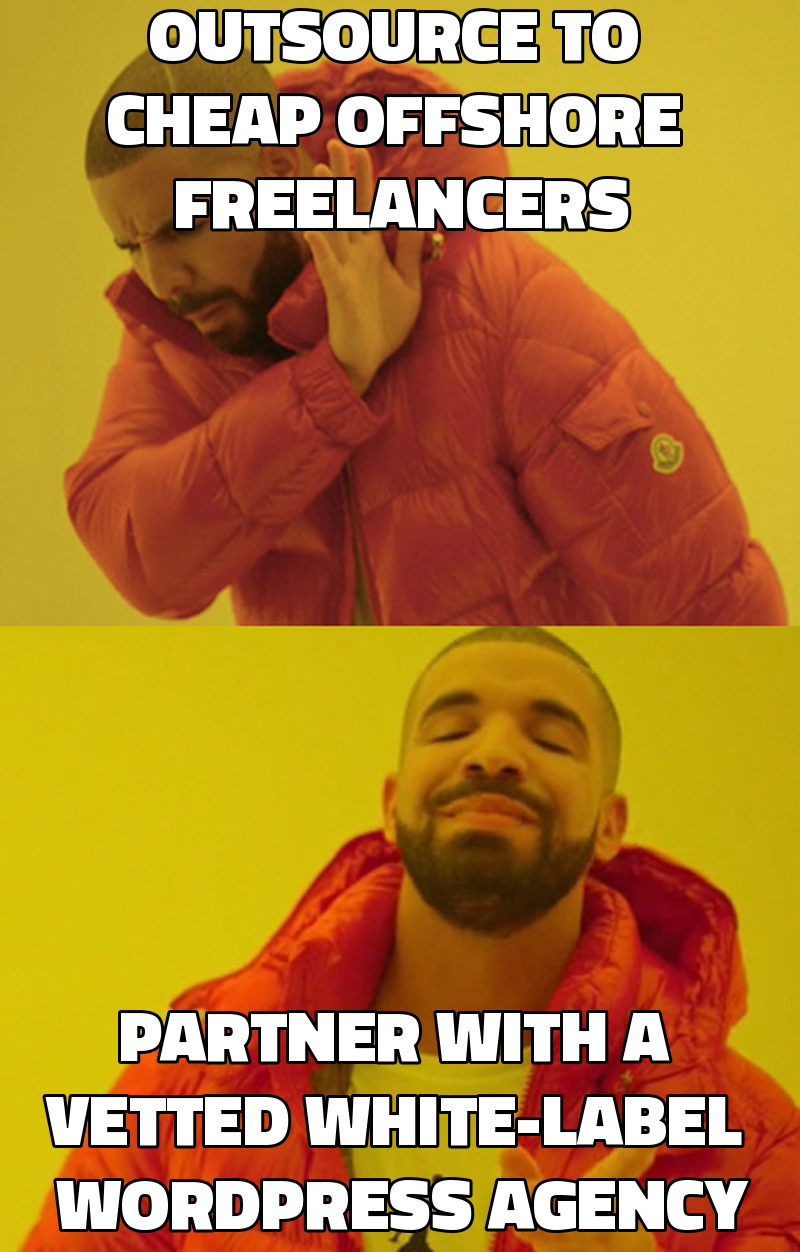
By following this framework, agencies can protect their brand, keep margins healthy, and avoid the hidden costs of cheap offshore freelancers.
Frequently asked questions
What does “white-label” actually mean for my agency?
White-label means the development work is delivered under your agency’s name. The client never sees the partner’s branding, and all communications, invoices, and support come from you. This protects your relationship and lets you present a full-service offering without hiring developers.
How much should I budget for a typical WordPress site build?
For a standard 5-10 page site with basic SEO and theme customization, most white-label partners charge $1,500-$2,500 wholesale. If you bill the client $3,500-$4,500, you retain a margin of roughly 55-70%.
Can these partners handle AI chatbots and voice assistants?
Yes. Synthisia, WPMU DEV Agency, and Toptal Agency all list AI-driven chatbots, voice search, and custom automation as core capabilities. They use OpenAI GPT-4, Google Dialogflow, and Amazon Polly to build conversational experiences.
What if a partner misses a deadline?
All top partners include a penalty clause in their SLA. Typically you receive a 5%-10% credit on the invoice for each business day past the agreed delivery date, up to a maximum of 20% of the project fee.
How do I keep my client from discovering the work is outsourced?
Use a partner that signs a strict NDA and non-circumvent agreement. Ensure all deliverables are re-branded with your agency’s logo, style guide, and domain-specific language before sending them to the client.
Is a retainer worth it for a small agency?
If you have at least one recurring dev request per month, a retainer of $1,500-$2,000 provides predictable costs and priority scheduling. It also locks in a dedicated point of contact, which improves reliability.
How do I compare two partners quickly?
Use the scoring model described earlier: rate each partner on reliability, AI depth, and brand safety (0-5 each). Add the scores; a total of 13-15 indicates a strong fit for agencies with 5-15 staff.
What are the risks of offering a free first deliverable?
Providing a free full-scale draft can lead to unpaid engineering hours and devalues your service. Instead, offer a free scoped proposal or a tiny prototype (one screen or one automation) that demonstrates quality without heavy labor.
white‑label
Have something to build?
Tell us what you're trying to ship. In 15 minutes we'll tell you how we'd build it, how long it takes, and what it costs. No pitch deck, no pressure.