
Top White-Label AI Automation Development Firms for Marketing Agencies

White-label software development companies build custom AI automation solutions that agencies sell under their own brand, handling all coding, testing and delivery while staying invisible to the client. They let you say yes to every chatbot, voice assistant or workflow automation request without hiring a full-time engineer or risking brand exposure.
Key takeaways
- White-label partners handle end-to-end development, keeping your brand front and center.
- Look for firms with proven AI/ML projects, fixed-scope pilots and clear NDA terms.
- Typical project size for agencies is $2,000-$5,000; retainers start around $1,500 per month for 15-20 dev hours.
- Pricing varies by region; US-based firms charge $150-$200/hr, near-shore $80-$120/hr.
- Evaluate partners on AI expertise, delivery speed, communication tools and post-launch support.
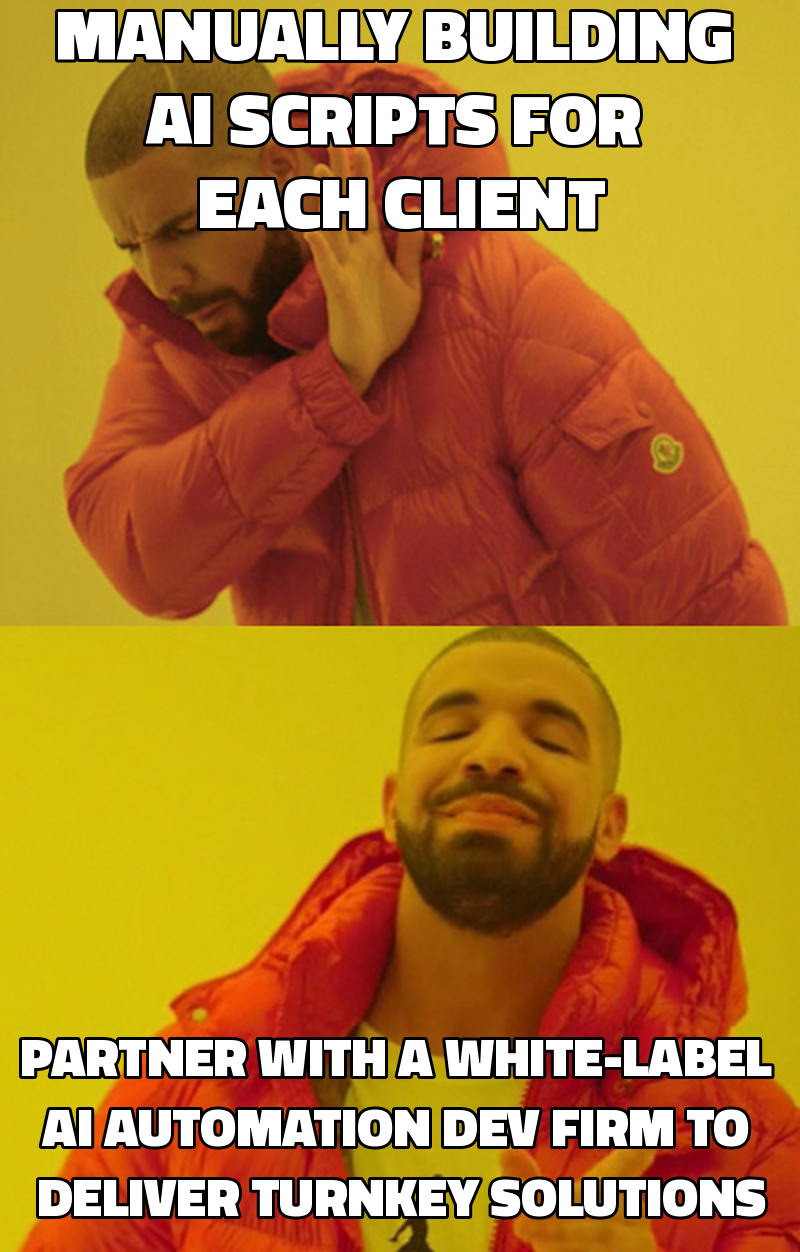
What is a white-label software development company?
A white-label software development company creates digital products, web apps, SaaS platforms, voice bots, AI-driven automation, on behalf of another business that re-brands the final deliverable as its own. The client agency retains the customer relationship, invoices the end user, and pays the dev partner a wholesale rate. This model is common in marketing, SEO and branding agencies that lack in-house engineers but need to expand service portfolios.
Why do marketing agencies need AI-automation white-label partners?
- Client demand is rising – Statista reports that 68% of SMBs plan to adopt AI tools by 2025, and agencies are the primary advisors for these purchases.
- No-code limits – Platforms like Zapier and Bubble cannot handle custom natural-language processing or voice-to-text pipelines, which require Python, TensorFlow or Azure Cognitive Services.
- Margin protection – By paying a wholesale rate of 50-70% of the client bill, agencies keep 30-50% margin while avoiding salary and benefits of a full-time dev.
- Brand safety – A solid NDA and non-circumvent clause ensures the agency’s name stays on the project, preventing poaching.
- Speed to market – Dedicated white-label teams can deliver a production-ready AI chatbot in 2-3 weeks, compared to 6-8 weeks for an internal hire.
Top 7 white-label AI-automation development firms for agencies
| Company | AI Expertise | Typical Turnaround* | Pricing (USD) | NDA / Non-Circumvent | Notable Clients |
|---|---|---|---|---|---|
| XenonStack | Deep learning, NLP, computer vision | 2-4 weeks for MVP | $120-$180/hr or fixed $3,000-$7,000 per project | Standard NDA, 2-year non-circumvent | HubSpot, IBM, Deloitte |
| Toptal Enterprise | Elite freelance pool, AI/ML specialists | 3-5 weeks for custom model | $150-$200/hr, 10% discount on volume | Custom NDA, 3-year clause | Shopify, Atlassian |
| Intellectsoft | End-to-end AI pipelines, voice assistants | 4-6 weeks for production bot | $100-$150/hr, $4,500 flat for chatbot | NDA, non-circumvent up to 2 years | Porsche, NHS |
| Cleveroad | Mobile-first AI, chat & voice integration | 3-4 weeks for cross-platform | $80-$120/hr, $2,500-$5,000 per module | NDA, 1-year clause | Vodafone, L’Oréal |
| BairesDev | Large near-shore talent pool, AI ops | 3-5 weeks for scalable API | $90-$130/hr, $3,000-$6,000 per project | NDA, 2-year non-circumvent | Johnson & Johnson, Disney |
| AltexSoft | Data-science focus, recommendation engines | 4-6 weeks for custom recommendation | $110-$160/hr, $5,000-$9,000 for full stack | NDA, 2-year clause | Siemens, Nasdaq |
| Eleks | Enterprise AI, voice-bot platforms | 5-7 weeks for enterprise-grade | $130-$190/hr, $6,000-$12,000 per solution | NDA, 3-year non-circumvent | Coca-Cola, NASA |
*Turnaround is for a minimum viable product (MVP) that can be iterated after launch.
Company snapshots
XenonStack – Founded in 2008, headquartered in San Jose, CA, with delivery centers in India. Gartner lists XenonStack among “Top 10 AI Service Providers” (2023). Pros: strong ML research team, clear fixed-scope pilots. Cons: higher hourly rates, limited weekend support.
Toptal Enterprise – Curates the top 3% of freelance talent worldwide. According to Forrester, Toptal’s AI freelancers deliver 30% faster than traditional agencies. Pros: access to senior PhDs, flexible scaling. Cons: onboarding takes 1-2 weeks, rates are premium.
Intellectsoft – Mid-size firm with a dedicated AI Lab in Minsk. Clutch reports a 4.7/5 rating from agency clients. Pros: robust QA, post-launch monitoring. Cons: communication can be slower due to Eastern-European timezone overlap.
Cleveroad – Focuses on mobile-first AI experiences. Good fit for agencies that sell iOS/Android automation apps. Pros: rapid UI prototyping, lower rates. Cons: less depth in large-scale NLP models.
BairesDev – Largest near-shore provider in Latin America. According to IDC, Latin-American AI talent grew 22% YoY (2022). Pros: English-fluent teams, 24-hour overlap with US timezones. Cons: larger client base can stretch capacity during peak seasons.
AltexSoft – Specializes in recommendation engines and predictive analytics. Pros: strong data-science pipelines, transparent pricing. Cons: limited voice-assistant experience.
Eleks – Enterprise-grade delivery with a focus on regulated industries. Pros: compliance expertise (HIPAA, GDPR), strong DevOps. Cons: higher minimum project size, longer onboarding.
How to evaluate a white-label partner for AI automation?
| Criterion | Why it matters | How to verify |
|---|---|---|
| AI portfolio | Shows ability to handle custom models, not just off-the-shelf APIs. | Request case studies of chatbots, voice bots, or predictive pipelines. |
| Fixed-scope pilot experience | Reduces risk for agencies new to dev outsourcing. | Ask for a sample pilot contract and timeline. |
| Communication cadence | Agencies need daily status updates without micromanaging. | Test with a 48-hour sprint demo; check use of Slack or Asana. |
| NDA & non-circumvent enforcement | Protects your brand and client list. | Review their standard NDA template; confirm clause length. |
| Post-launch support | AI models require monitoring and retraining. | Verify SLA for model drift alerts and bug fixes. |
| Pricing transparency | Prevents surprise mark-ups. | Insist on a price sheet with hourly rates and fixed-price ranges. |
Typical pricing models and what to expect
- Fixed-scope pilot – One-off price for a defined MVP (e.g., $3,500 for a chatbot with 3 intents). Most agencies start here to prove value.
- Time-and-materials – Hourly rate with weekly timesheets; useful for exploratory AI research.
- Retainer + usage – $1,500/month covers 15-20 dev hours plus $50 per additional hour; ideal for ongoing automation tweaks.
- Revenue-share – Rare, but some partners accept 10-15% of the client fee for large-scale SaaS builds.
According to Clutch, 38% of agencies prefer fixed-scope pilots for AI projects because they align with agency cash-flow cycles. The average hourly rate for US-based AI developers is $150-$200 (Gartner, 2023), while near-shore rates average $90-$130.
How to structure a partnership deal
- Step 1 – Pilot contract: Define scope, deliverables, acceptance criteria, and a 2-week turnaround guarantee. Include a 30-day payment term.
- Step 2 – Wholesale pricing: Negotiate a 55% discount off the partner’s list price. For a $5,000 client invoice, you pay $2,250-$2,750, keeping a healthy margin.
- Step 3 – SLA & support: Set a 99% uptime SLA for hosted AI services and a 48-hour bug-fix response window.
- Step 4 – Dashboard access: Use a shared Asana board or a simple Notion page for real-time status; avoid building a custom SaaS dashboard until you have recurring revenue.
- Step 5 – Review & scale: After three successful pilots, discuss a retainer model that guarantees 15-20 dev hours per month for $1,500-$2,000.
Frequently asked questions
How does a white-label dev partner keep my brand invisible?
The partner signs a strict NDA and a non-circumvent clause that prohibits them from contacting your client directly. All deliverables are provided without their branding, and invoices are issued to you, not the end client. This arrangement is standard in agency-dev relationships and is enforced through legal agreements rather than technical measures.
What AI capabilities should I expect from a white-label partner?
At minimum, the partner should be able to build chatbots using Dialogflow or Azure Bot Service, integrate voice assistants via Amazon Alexa or Google Assistant, and create custom ML models with Python, TensorFlow or PyTorch. Advanced partners also offer model monitoring, automated retraining pipelines, and data-privacy compliance.
Can I get a fixed price for a custom AI project?
Yes. Most reputable white-label firms offer a fixed-scope pilot that outlines every feature, data source, and integration point. The price is locked once the scope is signed, and change requests are handled through a change-order process. This protects agencies from budget overruns.
How long does it take to launch a basic chatbot?
A typical MVP with 3-5 intents, basic UI and integration to a CRM can be delivered in 2-3 weeks. More complex bots that require custom NLP training or multi-language support usually need 4-6 weeks. Turnaround time is a key differentiator when comparing partners.
What are the risks of a “free first deliverable” offer?
Offering a free draft can lead to unpaid engineering effort and de-values the service in the eyes of agency buyers. Instead, provide a free scoped proposal or a low-cost prototype (e.g., one screen or one intent) that demonstrates quality without committing full development resources.
How do I protect my agency’s margin when the partner raises prices?
Negotiate a wholesale rate ceiling in the master partnership agreement and include a price-review clause that caps annual increases at 5-7%. Also, lock in multi-project volume discounts (e.g., 10% off after five pilots) to keep margins predictable.
Do I need a technical background to manage the partnership?
While a deep coding background isn’t required, understanding the basics of AI model lifecycle, data privacy, and integration points helps you ask the right questions and set realistic expectations with clients. Many agencies assign a Head of Delivery or Operations Director as the internal champion.
Is it better to choose a US-based or near-shore partner?
US-based firms provide the highest hourly rates but often deliver faster due to timezone alignment and cultural fit. Near-shore partners in Latin America or Eastern Europe offer lower rates (20-30% less) with good English proficiency and overlapping work hours. Choose based on the balance of cost, speed, and the complexity of the AI solution you need.
white-label
Have something to build?
Tell us what you're trying to ship. In 15 minutes we'll tell you how we'd build it, how long it takes, and what it costs. No pitch deck, no pressure.