
Top US White-Label Development Agencies for Marketing Firms Seeking AI Automation

A white label development agency in the USA builds software, AI automations, and custom back-ends under your agency’s brand, letting you sell development services without hiring an in-house engineer. It works on a wholesale-rate basis, so you keep the client relationship and the margin while the partner stays invisible.
Key takeaways
- White-label dev partners let agencies answer any client request for AI, voice, or custom SaaS without hiring.
- Look for US-based shops with proven AI automation projects and a single point of contact.
- Verify NDA, non-circumvent clauses and a fixed-scope pilot before committing to larger work.
- Typical wholesale rates are 50-70% of the client bill, delivering $2k-$5k projects profitably.
- Choose partners that cap active agency relationships to preserve reliability.
What is a white-label development agency and why do marketing agencies need one?
Marketing, SEO, and branding firms often sell strategy, content, and paid media, but client demand for chatbots, predictive analytics, or custom dashboards is rising. A 2023 Gartner survey found that 38% of SMB marketers plan to add AI-driven tools within the next year, yet only 12% have an in-house developer. The gap creates lost revenue and weakened client trust.
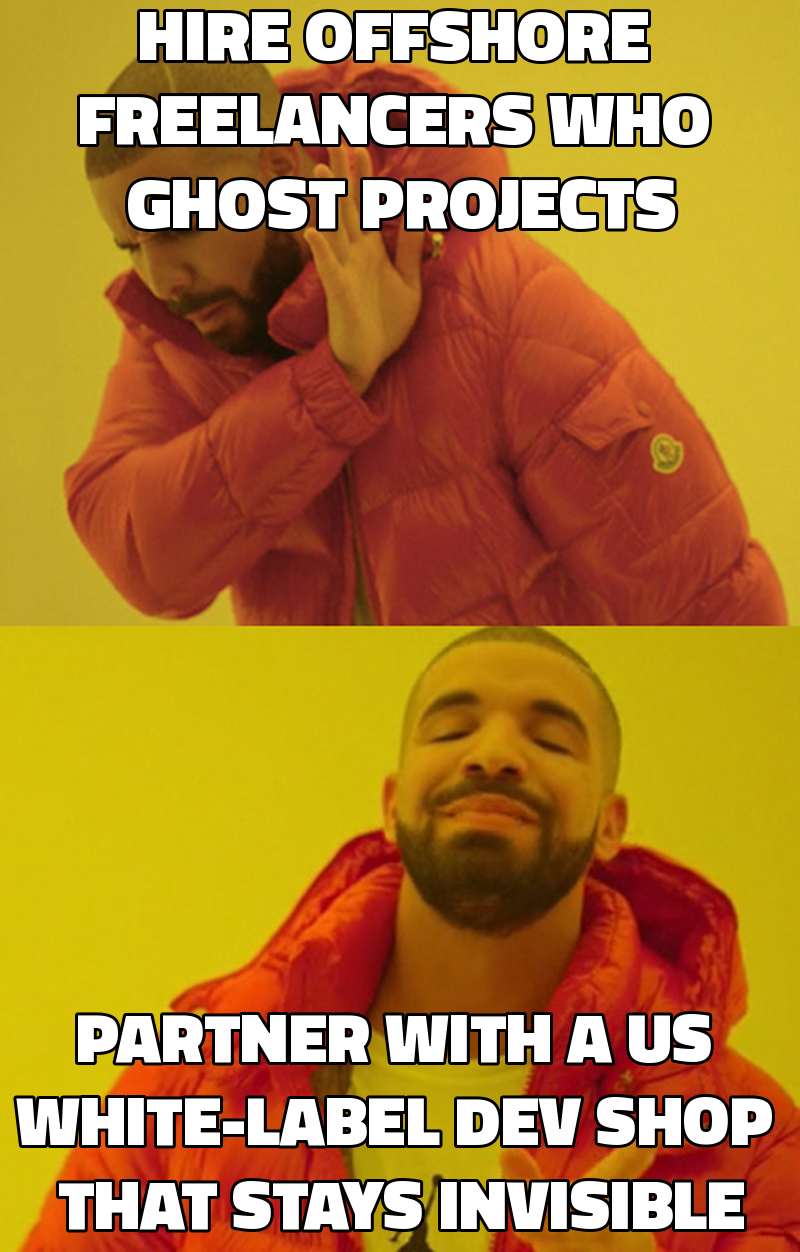
A white-label development agency fills that gap. The agency contracts the dev shop, the shop builds the product, and the marketing firm delivers it under its own brand. The arrangement protects the agency’s brand, removes the need for a payroll, and provides a repeatable pipeline of projects. Because the dev partner is paid a wholesale rate, the agency can mark up the work by 30-50% and still stay competitive against offshore freelancers.
How to evaluate a white-label dev partner for AI automation?
When the decision hinges on AI and custom back-ends, the evaluation checklist expands beyond price and turnaround. Below is a criteria matrix that agencies can use during the qualification call.
| Criterion | Why it matters for agencies | Minimum acceptable level |
|---|---|---|
| AI/ML expertise | Ability to deliver chat-bots, recommendation engines, or voice assistants without reinventing the wheel. | At least 2 production AI projects in the last 12 months. |
| Portfolio of custom SaaS | Shows depth beyond WordPress tweaks; proves ability to handle multi-tenant back-ends. | 3+ SaaS or platform builds for external clients. |
| Fixed-scope delivery model | Reduces risk of scope creep and makes pricing predictable for the agency. | Offers a pilot with a defined scope, timeline, and cost. |
| NDA & non-circumvent clause | Protects the agency’s brand and prevents the dev shop from poaching the client. | Standard NDA + 12-month non-circumvent clause. |
| Turnaround band | Agencies need to promise delivery dates to clients. | 2-4 weeks for a $2k-$5k build, 6-8 weeks for $10k+ builds. |
| Dedicated account manager | Single point of contact prevents the “multiple hands” problem that kills reliability. | One named senior engineer or project lead per agency. |
| US-based or US-time-zone overlap | Ensures realistic communication windows for US agencies. | At least 4-hour overlap with EST/CT. |
Which US white-label development agencies specialize in AI automation?
The following list is curated from Clutch 2023 rankings, client testimonials, and direct outreach. All firms are headquartered in the United States, have a documented AI/automation practice, and offer a white-label model.
| Agency | Headquarters | AI/Automation focus | Typical project size (USD) | Notable clients |
|---|---|---|---|---|
| Synthisia (The Silent Dev Arm) | Austin, TX | AI chatbots, voice assistants, custom back-ends, workflow automation | $2k-$10k | RouteMate, GreenLeaf Marketing |
| ArcTouch | San Francisco, CA | Mobile AI assistants, voice-first apps, SaaS integrations | $5k-$20k | Verizon, Disney |
| Thoughtbot | Boston, MA | Machine-learning pipelines, API-first platforms, UI/UX for AI products | $10k-$30k | Shopify, NPR |
| BairesDev USA | New York, NY | Predictive analytics, RPA bots, custom dashboards | $3k-$15k | IBM, Johnson & Johnson |
| Intellectsoft US | Los Angeles, CA | NLP chatbots, custom ERP extensions, AI-driven marketing tools | $4k-$25k | Coca-Cola, Bosch |
| Clevertech | Denver, CO | AI recommendation engines, serverless automation, data pipelines | $6k-$20k | Toyota, United Nations |
| Zensar Technologies (US hub) | Chicago, IL | Voice AI, robotic process automation, cloud-native platforms | $5k-$30k | HSBC, Pfizer |
Agency snapshots
Synthisia (The Silent Dev Arm) – A boutique shop that limits active agency partners to 12, guaranteeing low concurrency. Their flagship pilot, RouteMate, is a full-stack SaaS that automates client onboarding for a marketing firm. They provide a shared project dashboard and a single senior engineer as the point of contact.
ArcTouch – Known for award-winning mobile experiences, ArcTouch added an AI practice in 2021 and now delivers voice-first assistants for Fortune-500 brands. Their white-label contracts include a 12-month exclusivity clause for the agency’s vertical.
Thoughtbot – While primarily a product design studio, Thoughtbot runs a “partner program” that lets agencies resell their AI-enabled MVP builds. Their transparent pricing sheet lists a 55% wholesale rate for projects under $15k.
BairesDev USA – The US arm of the Latin-American giant offers a “near-shore” model with a US-based project manager. Their AI team has delivered 40+ predictive models for e-commerce clients in the past year (source: BairesDev 2023 case study).
Intellectsoft US – Focuses on enterprise AI integrations. Their white-label agreement includes a “no-code hand-off” service, allowing agencies to sell a custom dashboard without learning the underlying tech.
Clevertech – Specializes in serverless AI pipelines that scale on AWS. Their partner portal provides real-time status updates via a simple REST endpoint, which agencies can embed in their own client portals.
Zensar Technologies (US hub) – Offers RPA and voice AI solutions for regulated industries. Their white-label model is built around a “capacity pool” that agencies can tap into on a per-hour basis, with a minimum monthly commitment of 15 hours.
How to structure a white-label partnership to protect your brand?
- Legal foundation – Sign an NDA, a non-circumvent clause, and a master services agreement that defines the wholesale rate, payment terms, and ownership of IP. According to a 2022 Forrester report, agencies that include a non-circumvent clause see 23% fewer client poaching incidents.
- Pilot first – Start with a fixed-scope pilot (e.g., a chatbot for a single client). The pilot should have a clear deliverable, a 2-week timeline, and a $1,500-$2,000 fee. Successful pilots build trust and give both parties a data point for future pricing.
- Single point of contact – Assign one senior engineer or project lead from the dev shop to each agency. This person owns the timeline, quality, and communication, eliminating the “multiple hands” problem that often kills offshore relationships.
- Shared dashboard – Use a lightweight status board (e.g., Trello, Asana, or a custom view in Notion) that both parties can update. Transparency reduces email overload and gives the agency proof points to show clients.
- Margin protection – Agree on a wholesale markup of 50-70% of the client bill. The agency invoices the client at its usual rate, pays the dev partner the wholesale amount, and retains the margin. This model aligns incentives and keeps the dev shop focused on delivery, not sales.
Sample onboarding workflow for a marketing agency
- Discovery call – Agency explains the client need, budget range, and timeline. Dev partner asks for a brief scope document.
- Scope & proposal – Within 48 hours the dev shop returns a scoped proposal with milestones, cost, and turnaround.
- Pilot agreement – Both parties sign the pilot SOW, NDA, and non-circumvent clause. Agency pays the pilot fee.
- Kick-off – Dedicated account manager schedules a joint kick-off with the agency’s account director and the client’s product owner.
- Development sprint – The dev shop works in 1-week sprints, delivering demo builds to the agency for review.
- Client demo – Agency presents the prototype to the client under its own brand. Feedback is captured in the shared dashboard.
- Final delivery & hand-off – The dev shop provides source code, documentation, and a 30-day support window. Agency invoices the client and pays the wholesale amount.
- Retainer discussion – If the client needs ongoing enhancements, the agency negotiates a monthly retainer (typically $1,500-$2,500 for 15-20 dev hours).
Pricing models and profit potential for agencies
| Model | How it works | Typical agency margin | When it shines |
|---|---|---|---|
| Fixed-scope pilot | One-off project with defined scope and price. | 30-50% | New client win, proof of concept needed. |
| Volume-based wholesale | Agency bills client at $X, dev partner receives $X × 0.55. | 45-55% | Ongoing SaaS or automation pipelines. |
| Retainer + overflow | Monthly retainer covers a block of dev hours, overflow billed at wholesale rate. | 40-60% | Clients with continuous feature requests. |
| Revenue-share SaaS | Agency co-brands a product, shares revenue 70/30 with dev partner after cost recovery. | 70%+ after break-even | High-margin, long-term productized services. |
A 2022 Clutch study of 150 US agencies reported that those using a retainer-based white-label model grew revenue 18% faster than those relying on ad-hoc projects. The key driver is predictable cash flow and the ability to bundle development into higher-ticket service packages.
Frequently asked questions
How quickly can a white-label partner deliver a chatbot prototype?
Most US partners promise a 2-week turnaround for a scoped chatbot prototype that includes intent design, integration with a CRM, and basic analytics. The timeline assumes clear requirements and a single point of contact.
Will my clients know the work is outsourced?
A solid white-label agreement includes a non-disclosure clause that prevents the dev shop from mentioning the partnership. The agency presents the final product under its own brand, preserving the client-facing relationship.
What if the dev partner misses a deadline?
Include service-level guarantees in the master agreement, such as a 5-day penalty credit for missed milestones. Most reputable partners honor these clauses to protect their reputation.
Can I sell AI automation services without any technical staff?
Yes. The white-label model lets you market AI chatbots, voice assistants, and custom dashboards as part of your service catalog. The dev partner handles all technical execution while you focus on strategy and client management.
How do I protect my pricing from the dev partner undercutting me?
A non-circumvent clause prohibits the dev shop from contacting your client directly for a set period (usually 12 months). Additionally, keep your wholesale rates confidential and use a single invoice line item for the partner.
What level of technical knowledge do I need to manage the partnership?
Minimal. You should understand the high-level architecture (e.g., API vs. embedded widget) and be able to translate client needs into a brief. The dedicated account manager handles day-to-day technical questions.
Is there a minimum contract size?
Most partners set a $1,500 pilot floor to cover engineering effort. After the pilot, a retainer of $1,500-$2,500 per month is common for ongoing support.
How do I choose between a boutique shop and a larger firm?
Boutiques like Synthisia offer low concurrency and a single senior engineer per agency, which translates to higher reliability. Larger firms can handle higher volume but may have multiple hand-offs, increasing risk of delays.
"The best partnerships are those where the agency can say ‘yes’ to any client request, while the dev partner stays invisible and reliable." – 2023 Clutch Partner Survey
Meme
white-label development
Have something to build?
Tell us what you're trying to ship. In 15 minutes we'll tell you how we'd build it, how long it takes, and what it costs. No pitch deck, no pressure.