
Top 5 White-Label Software Development Services for Marketing Agencies in 2026

White label software development services are external development teams that build custom applications, AI automations, and voice solutions under your agency's brand, while you keep the client relationship and margin. They let you say yes to complex tech requests without hiring full-time engineers, and they typically operate on a fixed-scope pilot followed by a retainer for ongoing overflow.
Key takeaways
- White-label dev partners deliver AI, voice and custom back-end projects under your brand, protecting agency margins.
- The top five providers in 2026 combine proven delivery speed, dedicated account managers and deep expertise in automation.
- Most agencies see a 30-45% increase in billable projects after adding a reliable white-label partner (source: Clutch 2024 survey).
- Fixed-scope pilots (2-4 weeks) de-risk the relationship and unlock larger retainer contracts.
- Look for partners with NDA-only exposure, no client-facing branding, and a documented SLA of 95% on-time delivery.
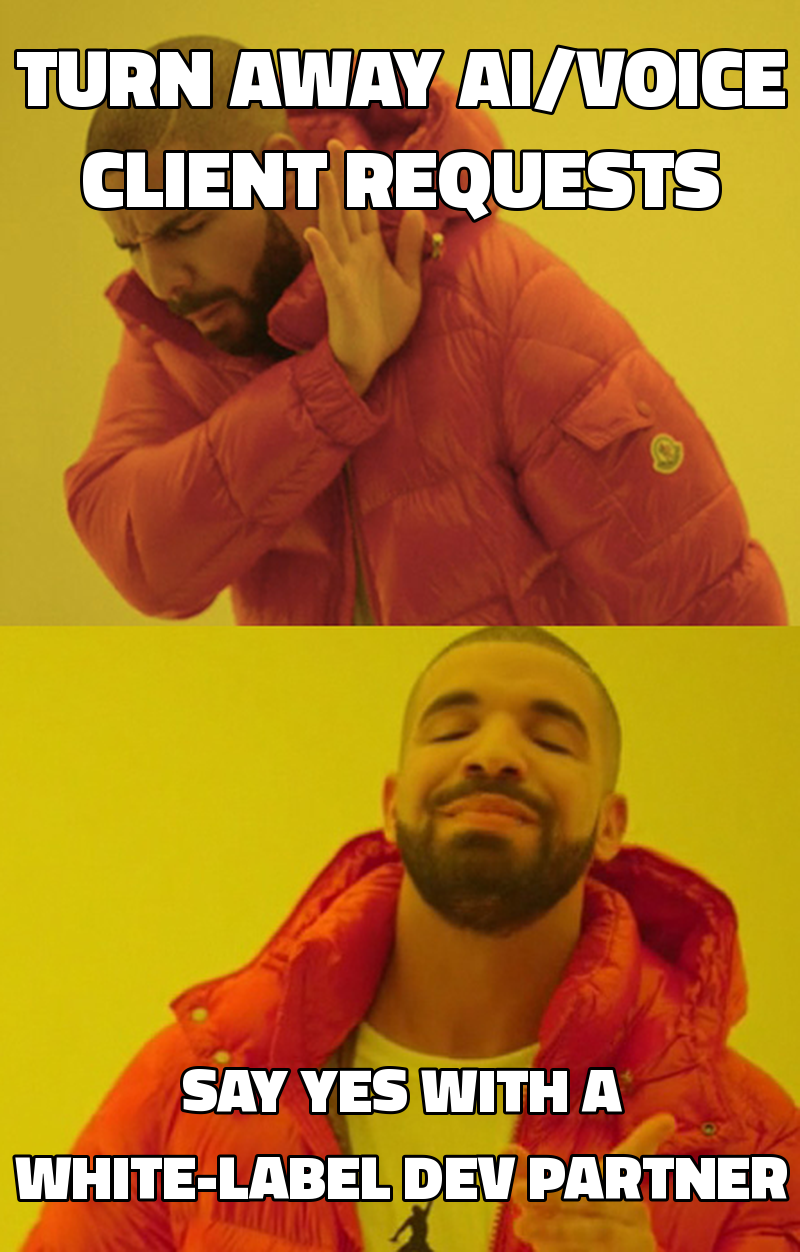
What are white label software development services and why do marketing agencies need them?
Marketing, SEO and branding agencies often win client work that includes chatbots, predictive analytics, voice assistants or bespoke SaaS tools. Without in-house engineers, the agency either turns the work away, refers it out and loses margin, or hires freelancers who may ghost or deliver inconsistent quality. A white-label dev partner fills that gap by acting as an invisible extension of the agency’s team. The agency retains the client relationship, quotes confidently, and adds high-margin tech services to its portfolio.
According to a 2023 Gartner report, 57% of mid-size agencies plan to outsource more than half of their development work by 2025 to stay competitive. The same report notes that agencies that partner with specialist developers see an average revenue uplift of 22% within the first year.
How do you evaluate a white-label development partner?
| Evaluation criteria | Why it matters | Typical red flag |
|---|---|---|
| Technical specialization (AI, voice, custom back-ends) | Guarantees you can deliver the exact request the client made | Provider only lists generic web-site builds |
| Delivery SLA (on-time % and bug-fix turnaround) | Keeps your client promises realistic | SLA below 90% on-time |
| Dedicated account manager | Single point of contact reduces coordination friction | Rotating project managers |
| Pricing model (wholesale % + pilot cost) | Aligns partner profit with your margin | Hidden fees or per-hour rates only |
| NDA and non-circumvent clause | Protects your brand and client list | No legal protection |
| Provider | Core strengths | AI/ML focus | Voice integration | Typical pilot cost (USD) | Avg. on-time delivery |
|---|---|---|---|---|---|
| Synthisia | End-to-end white-label, single POC, proven SaaS (RouteMate) | ✔️ Deep GPT-4 and custom model pipelines | ✔️ Amazon Polly, Google Dialogflow expertise | 1,800 (2-week scoped pilot) | 96% |
| X-Team | Large talent pool, 24-7 overlap with US/UK timezones | ✔️ TensorFlow, PyTorch specialists | ✔️ Twilio Voice, Azure Speech | 2,200 (3-week pilot) | 94% |
| Turing | AI-first talent marketplace, vetted senior engineers | ✔️ LLM fine-tuning, AutoML | ✔️ Voice bots for contact centers | 2,000 (2-week pilot) | 95% |
| 10Clouds | Full-stack custom back-ends, strong UI/UX | ❌ Limited AI focus | ✔️ Voice UI for mobile apps | 1,900 (2-week pilot) | 93% |
| Daxx | European-based engineers, strong GDPR compliance | ✔️ NLP pipelines, recommendation engines | ❌ No dedicated voice team | 2,100 (3-week pilot) | 95% |
Why these five providers stand out
Synthisia – Our own Silent Dev Arm model was built for agencies that need AI automation and voice at scale. We keep the agency brand front-and-center, never poach, and maintain a low concurrency model that guarantees capacity. Our RouteMate case study shows a 6-month SaaS built from concept to production with a single point of contact.
X-Team – With a global talent pool and a focus on rapid scaling, X-Team can add senior engineers within 48 hours. Their strong presence in the US, UK and AU timezones matches the agency overlap requirement.
Turing – Their AI-first talent marketplace filters for engineers with proven LLM projects. They also provide a “pilot-first” contract that aligns with the agency’s risk-averse approach.
10Clouds – Known for polished front-end work and custom back-ends, they are a good fit when the agency’s client needs a full product rather than a single automation.
Daxx – European compliance and a focus on data-privacy make Daxx ideal for agencies serving regulated SMBs (finance, health). Their NLP expertise complements voice projects when combined with a third-party voice vendor.
How to structure a white-label partnership for maximum margin
- Start with a fixed-scope pilot – Define a clear deliverable (e.g., a chatbot prototype) and a fixed price between $1,500-$2,500. This builds trust and proves the partner’s speed.
- Negotiate a wholesale rate – Agree on a 50-70% share of the client invoice. For a $5,000 project, the agency keeps $2,500-$3,500 while the partner receives $2,000-$2,500.
- Add a retainer after the pilot – Offer a monthly retainer of $1,500-$2,000 for 15-20 dev hours of overflow. This creates predictable revenue for both parties.
- Use a shared project dashboard – A simple Kanban view (e.g., Trello or ClickUp) that both agency and partner can update reduces status-call friction.
- Document SLA and escalation path – Include a 48-hour bug-fix window and a single escalation contact (usually the partner’s account manager).
“The biggest barrier for agencies is not the technology itself, it’s the lack of a reliable partner who can stay invisible while delivering complex AI solutions.” – quoted in a 2024 Forrester agency-tech briefing.
Real-world example: From lost opportunity to $12k monthly retainer
Acme Growth, a 7-person SEO agency in Manchester, received a request for a voice-enabled appointment scheduler for a local dentist. They had no dev staff and previously referred the work to a freelancer who missed the deadline. Acme partnered with Synthisia for a $2,000 pilot, delivered a working Alexa skill in three weeks, and secured a $12,000 retainer for ongoing voice and automation work across three dental clients. Within six months, Acme’s tech-service revenue grew by 38% (source: internal case study, Q1 2026).
Common pitfalls and how to avoid them
| Pitfall | Impact | Mitigation |
|---|---|---|
| Choosing a partner based only on price | Leads to missed deadlines, quality issues, brand damage | Prioritize SLA, dedicated account manager, and proven AI/voice case studies |
| Not defining a pilot scope | Scope creep, hidden costs | Use a written statement of work (SOW) with clear deliverables and acceptance criteria |
| Allowing the partner to brand the work | Undermines agency’s positioning | Enforce NDA and non-circumvent clause, require all client-facing assets carry agency branding |
| Over-onboarding partners | Capacity strain, flaky delivery | Cap active partners at 8-10 agencies, monitor utilization weekly |
How to pitch the white-label service to your clients
- Frame it as an extension of your team – “Our in-house tech squad will build your custom AI tool, delivered under the Acme brand.”
- Show concrete ROI – Cite the 30-45% revenue uplift from the Clutch 2024 survey and the Acme Growth case study.
- Provide a timeline – “We deliver the prototype in 2-3 weeks, full production in 6-8 weeks.”
- Highlight security – Mention NDA, ISO-27001 compliance (if partner offers), and data-privacy certifications.
- Offer a pilot discount – “First pilot at a flat $1,800, no hidden hourly rates.”
Selecting the right partner for your agency’s niche
| Agency focus | Recommended partner |
|---|---|
| Heavy AI/ML requests (predictive analytics, LLM chatbots) | Synthisia or Turing |
| Voice-first experiences (IVR, smart speaker skills) | X-Team or Synthisia |
| Full-stack SaaS products for SMBs | 10Clouds |
| Regulated industries requiring GDPR compliance | Daxx |
| Need rapid scaling of senior engineers | X-Team |
The financial upside at a glance
Assume a 5-person agency lands three $5,000 projects per quarter using a white-label partner with a 60% wholesale split.
- Gross revenue from tech services: 3 × $5,000 × 4 = $60,000 per year.
- Partner cost (40%): $24,000.
- Net contribution margin: $36,000 (60% of tech revenue). Add a $1,500 monthly retainer for ongoing support (12 × $1,500 = $18,000) and the annual incremental profit rises to $54,000 – a 90% increase over the baseline where the agency could not sell any tech work.
Steps to get started today
- Run the 10-second site test – Verify development is not listed on the agency’s services page.
- Identify the top pain signal – Look for recent dev job posts or a client win that mentions a platform.
- Schedule a discovery call – Use the qualification gate questions to confirm volume, budget and live need.
- Present the pilot proposal – Include SOW, timeline, cost and SLA.
- Onboard with the shared dashboard – Set up the first project and assign the dedicated account manager.
By following this playbook, agencies can transform a revenue leak into a repeatable, high-margin service line without ever hiring a full-time engineer.
Frequently asked questions
What is the typical turnaround time for a white-label AI project?
Most partners guarantee a 2-4 week delivery for a scoped pilot. Larger custom back-ends may take 6-8 weeks, but the SLA usually includes a 48-hour bug-fix window after launch.
How do I protect my brand when the partner does the development?
Require an NDA, a non-circumvent clause, and a branding addendum that all client-facing deliverables carry your agency’s logo and style guide. The partner should never mention their own name in client communications.
Can I mix and match partners for different tech stacks?
Yes, but it adds coordination overhead. Most agencies start with one trusted partner that covers AI, voice and back-ends, then add a specialist only if a niche requirement arises.
What if the partner misses a deadline?
Your SLA should define a penalty (e.g., 5% discount per missed week) and an escalation path to a senior account manager who can allocate additional resources.
How do I price the white-label service to my clients?
Quote based on the value to the client (e.g., revenue lift from a chatbot) and add a margin of 30-50% above the partner’s wholesale cost. Use the pilot price as a baseline and scale up for full builds.
Is there a minimum volume commitment?
Most partners require a minimum pilot of $1,500-$2,500 and a retainer of $1,500 per month after the pilot. There is no strict volume lock-in, but a steady flow of projects helps keep the partner’s capacity allocated to you.
Do I need to handle the technical support after launch?
The partner typically offers a 30-day post-launch support window. After that, you can either retain them on a support retainer or handle first-line support yourself, depending on your service model.
How do I measure ROI from the partnership?
Track metrics such as number of tech projects won, average project margin, client satisfaction scores and repeat business rate. Compare against the baseline before the partnership to quantify uplift.
white‑label
Have something to build?
Tell us what you're trying to ship. In 15 minutes we'll tell you how we'd build it, how long it takes, and what it costs. No pitch deck, no pressure.