
Step-by-Step Guide to White-Label Application Development for Agencies

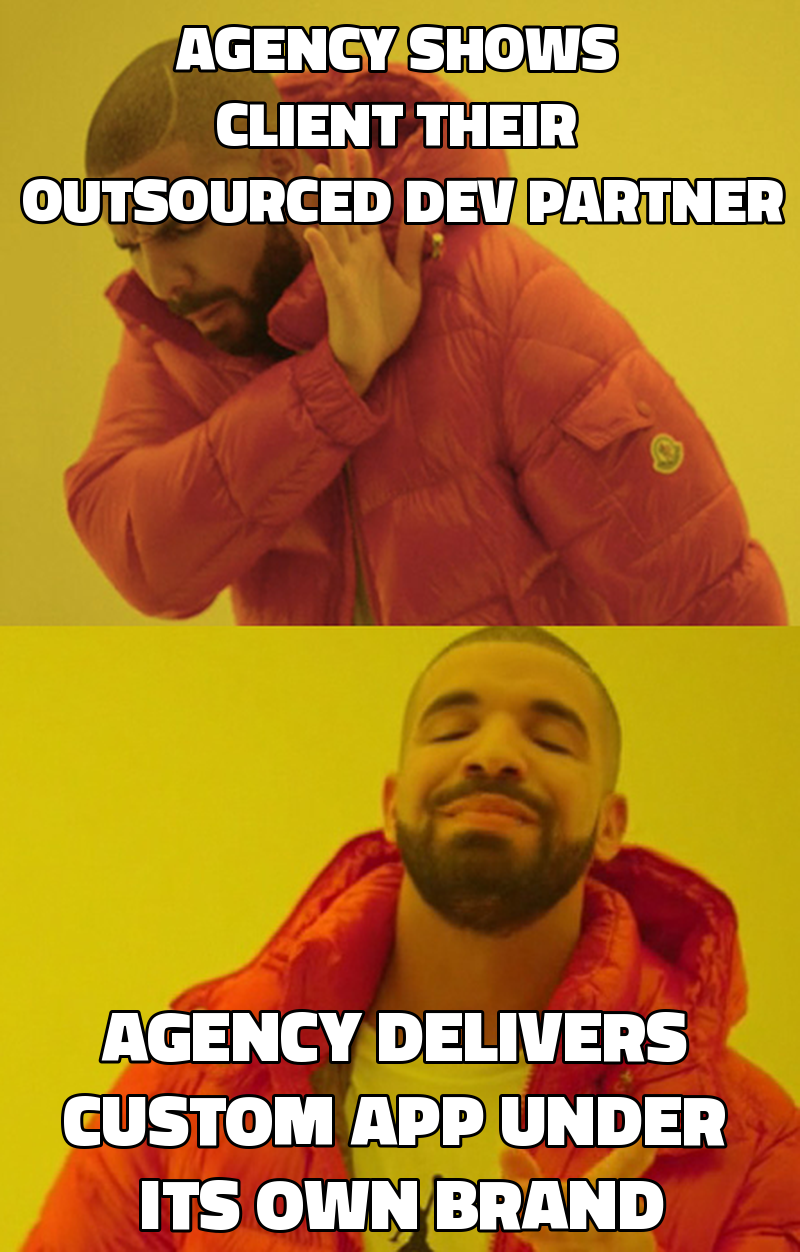
White-label application development is a structured partnership where the agency contracts a specialist dev studio to build the software, signs an NDA and a white-label master service agreement, and then delivers the finished product under the agency’s brand. The process is end-to-end, from legal paperwork to post-launch support, and it lets agencies say yes to client requests without hiring full-time engineers.
Key takeaways
- An NDA protects both parties; a White-Label MSA adds branding, IP, and payment terms.
- Start with a low-risk paid pilot (typically $2,000-$5,000) to prove capability and lock in trust.
- Fixed-scope pricing + a retainer for ongoing tweaks gives predictable cash flow and protects margins.
- Use a shared project dashboard (e.g., ClickUp, Notion, or a custom portal) to keep the agency in the loop and maintain the illusion of internal delivery.
- Brand the UI, documentation, and support channels with the agency’s logo, color palette, and tone of voice.
- After the first successful pilot, negotiate a wholesale rate of 50-70 % of the agency’s client bill to secure repeat work.
How does a white-label development partnership begin?
1. Identify the need and qualify the agency
Before you invest time, run the 10-second site test described in the ICP: open the agency’s website, check the Services page, and verify that “development” is not listed. If the agency showcases case studies that mention a web app, portal, or automation but has no engineers on the team, they are a prime candidate.
Qualification gates
| Gate | Proxy check | Typical qualifying answer |
|---|---|---|
| Volume | Number of active client projects | "We run 8-12 client projects simultaneously and get 2-3 dev requests per month." |
| Budget | Typical client spend on builds | "Our clients usually allocate $3k-$7k for a custom tool." |
| Live need now | Recent job post or new client win | "We just won a contract to build a chatbot for a local retailer." |
If the agency passes all three gates, move to the discovery call.
What legal documents are required?
2. NDA (Non-Disclosure Agreement)
An NDA is table-stakes. It should cover:
- Definition of confidential information (code, designs, client data).
- Duration (typically 2-3 years).
- Remedies for breach.
- Jurisdiction (US-NY for US agencies, England & Wales for UK agencies, NSW for AU agencies).
3. White-Label Master Service Agreement (MSA)
The MSA is the contract that lets you operate invisibly. Key clauses:
- Branding rights – you may replace all UI elements, documentation, and support emails with the agency’s brand.
- Intellectual property – the agency owns the final product; you retain a license to reuse generic components.
- Non-circumvention – the agency cannot approach your developers directly for a higher rate.
- Payment terms – wholesale rate (50-70 % of client bill), invoicing schedule, and retainer trigger.
- Liability limits – cap at the total project fee, exclude indirect damages.
| Document | Primary purpose | Typical length |
|---|---|---|
| NDA | Protect confidential info | 2-3 pages |
| White-Label MSA | Define branding, IP, payment, liability | 8-12 pages |
| SOW (Statement of Work) | Detail scope, milestones, deliverables | 2-4 pages |
All contracts should be signed electronically via DocuSign or HelloSign for speed.
How to structure the first pilot project?
4. Scope the pilot with a fixed-price SOW
A pilot should be small enough to deliver in 2-4 weeks but valuable enough to showcase ROI. Typical pilot scopes:
- One-page web app with a simple admin panel.
- Voice-enabled chatbot prototype (using Google Dialogflow or Amazon Lex).
- Automation workflow that connects a CRM to an email platform via Zapier-style custom code.
Pricing tip: Set a flat fee between $2,000 and $5,000 (the range most agencies can absorb). According to a 2023 Clutch survey, 68 % of small agencies prefer fixed-price pilots over time-and-materials contracts.
5. Define milestones and acceptance criteria
- Kick-off (Day 0) – shared project board created, agency provides brand assets.
- Design mock-up (Day 3-5) – agency reviews and signs off.
- Beta build (Day 10-12) – agency tests with internal stakeholders.
- Final delivery (Day 14-18) – agency receives white-labeled code, docs, and launch checklist.
- Post-launch support (Day 19-30) – 2 weeks of bug fixes included.
Use a simple status column: To Do → In Progress → Review → Done.
How to brand the delivered application?
6. UI and visual identity
Replace all visual elements with the agency’s logo, color palette, and typography. Tools like Figma or Sketch let you swap assets in bulk. Include a brand guide in the hand-off folder so the agency can maintain consistency.
7. Documentation and support channels
- Create a PDF user guide with the agency’s header and footer.
- Set up a support email address that forwards to your dev team but appears as
[email protected]using Gmail aliasing or a dedicated sub-domain. - Record a short onboarding video with the agency’s voice-over (use Descript to replace the narrator).
8. Legal branding clauses
The MSA should state that any public case study, portfolio entry, or press release will credit the agency as the “developer”. This protects your anonymity while giving the agency marketing material.
How to price ongoing work after the pilot?
9. Wholesale rate vs retainer vs revenue share
| Model | How it works | Typical % or fee |
|---|---|---|
| Wholesale rate | Agency bills client at full price, pays you a fixed wholesale percentage | 50-70 % of client bill |
| Fixed-scope retainer | Agency pays a monthly fee for up to 15-20 dev hours; excess is billed at a pre-agreed rate | $1,500-$2,500 per month |
| Revenue share | You receive a percentage of the client’s recurring revenue from the app (e.g., SaaS subscription) | 5-10 % of monthly recurring revenue |
According to a 2022 Deloitte report, agencies that lock in a retainer see 30 % higher lifetime value per partner than those that rely solely on per-project fees.
10. Setting the wholesale floor
Your deal shape specifies a minimum floor of $1,500. Below that the delivery overhead (project management, QA, legal) erodes profit. Communicate this floor early in the SOW to avoid scope creep.
How to manage delivery and keep the agency in the loop?
11. Shared project dashboard
Pick a tool the agency already uses (ClickUp, Asana, Monday.com) and create a partner workspace:
- Board view for milestones.
- Docs folder for brand assets, contracts, and hand-off files.
- Comments for real-time feedback; tag the agency’s Delivery Director.
Avoid building a full SaaS dashboard before you have paying clients – the ICP warns against the “build-instead-of-sell” trap.
12. Communication cadence
- Weekly status email (Monday) summarizing completed tasks and next steps.
- Bi-weekly video call (30 min) for demo walkthroughs.
- Ad-hoc Slack channel for quick questions; use a dedicated channel like
#agency-partner-dev.
13. Quality assurance and sign-off
Run automated tests (Jest for JavaScript, PyTest for Python) and a manual QA checklist. Provide a sign-off sheet where the agency’s Project Manager signs electronically.
How to protect the partnership from poaching?
14. Non-circumvention clause
The MSA should state that the agency cannot approach any individual who worked on the project for a period of 12 months. Include a penalty of 150 % of the last invoice if violated.
15. Limited concurrency model
Cap the number of active agency partners at 8-10. This ensures you can deliver on time, which is the core competitive edge. According to a 2021 Gartner survey, agencies value reliability over price 73 % of the time.
How to scale the white-label offering?
16. Build reusable component libraries
Create a core library of AI automation scripts, voice-assistant integrations, and SaaS boilerplates. Store them in a private GitHub repo with versioning. This reduces delivery time for each new pilot.
17. Hire a “Partner Success Manager”
One full-time person can own the partner dashboard, run quarterly business reviews, and upsell retainers. The role typically commands $80k-$100k USD per year in US markets, but the incremental revenue per partner (average $3k-$5k per project) justifies the cost after 6-8 partners.
Frequently asked questions
What if the client asks who actually built the app?
Most agencies position the white-label partner as an “internal engineering team”. The MSA allows you to provide a generic statement like “Developed by our in-house team” without revealing the partner’s name. If a client insists on a reference, you can offer a case study that credits the agency only.
How long does a typical pilot take from NDA to launch?
A well-scoped pilot runs 2-4 weeks: 1-2 days for NDA and MSA, 2-3 days for discovery and brand asset collection, 5-7 days for design and development, and 3-5 days for QA and client sign-off. Adding a 1-week buffer for revisions is common.
Can I charge the agency a markup on top of the wholesale rate?
Yes, but the markup should be justified by added value such as project management, QA, and branding. A 20-30 % markup on a 60 % wholesale rate is typical and still leaves the agency with a healthy margin.
What happens if the agency’s client wants a feature after launch?
Include a post-launch support clause in the SOW that covers up to 10 hours of change requests per month for $150 per hour. Anything beyond that can be scoped as a new mini-project.
How do I handle IP ownership when the agency wants to sell the app to another client?
The MSA should grant the agency a non-exclusive, transferable license for the specific client. If they wish to reuse the code for a new client, you can charge a reuse fee (usually 30 % of the original build cost) to cover your core component work.
Is it safe to work with agencies in different time zones?
Yes, as long as you set clear turnaround windows (e.g., “We deliver daily builds by 5 PM PST”). The ICP notes that IST-US overlap of 9.5-12.5 hours works well for async delivery, and AU overlap adds a useful extra window.
Do I need to be ISO-27001 certified to win agency contracts?
Certification is not mandatory for most SMB-focused agencies, but having a SOC 2 Type II report can be a differentiator. According to a 2023 PwC study, 42 % of agencies consider security compliance a make-or-break factor when selecting a dev partner.
Summary checklist for launching a white-label partnership
- Run the 10-second site test and qualification gates.
- Sign NDA and White-Label MSA with branding, IP, and non-circumvention clauses.
- Scope a $2k-$5k pilot with fixed milestones.
- Collect brand assets and set up a shared dashboard.
- Deliver white-labeled UI, docs, and support channels.
- Invoice at wholesale rate (50-70 % of client bill).
- Propose a $1,500-$2,500 monthly retainer for ongoing work.
- Conduct quarterly business reviews to upsell retainers or revenue-share deals.
By following this end-to-end process, agencies can confidently say yes to any custom-app request, keep the client relationship intact, and grow recurring revenue without the overhead of hiring a full-time dev team.
white‑label
Have something to build?
Tell us what you're trying to ship. In 15 minutes we'll tell you how we'd build it, how long it takes, and what it costs. No pitch deck, no pressure.